Eighty-Third in Ultrafast Nonlinear Optics: A High-Power Femtosecond Mid-Infrared Source Featuring Tunable Center Frequency and Chirp
 12/15 2025
 611
611
By combining two near-infrared pulses with adjustable chirp characteristics for difference frequency generation, mid-infrared pulses can be produced, with their frequency corresponding to the difference between the two input pulses. By modifying the chirp level of one near-infrared pulse, the instantaneous frequency of the mid-infrared pulse can be made to vary over time, achieving tunable chirp. Additionally, altering the time delay between the two near-infrared pulses allows for adjustments to the center frequency of the mid-infrared pulse. This paper introduces a mid-infrared source system with tunable chirp capabilities, as depicted in Figure 1[1]. 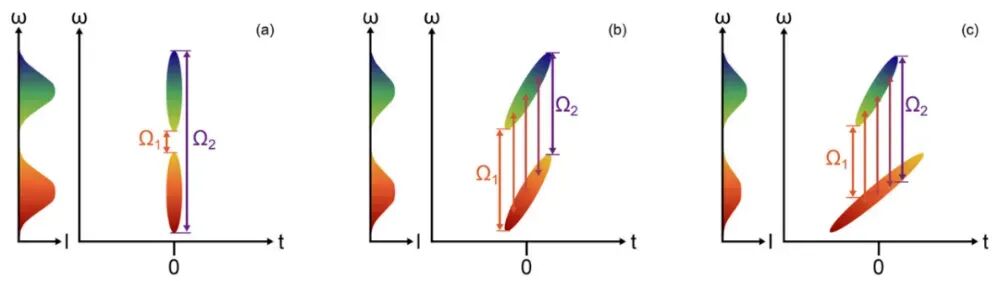
Figure 1. Time-frequency representation of difference-frequency pulses generated by infrared pulses with varying chirp values[1]
The experimental setup is illustrated in Figure 2. The front-end light source is a high-power titanium sapphire laser system, which emits 100 fs pulses with a central wavelength of 808 nm, a single-pulse energy of 20 mJ, and a repetition rate of 100 Hz. The output beam is divided into two paths: one path is used for generating mid-infrared pulses, while the other is employed for electro-optic sampling to detect their waveform. In the mid-infrared generation path, a pair of commercial optical parametric amplifiers generate pulses with tunable central wavelengths ranging from 1300 to 1550 nm. Here, the higher-frequency pulse serves as the pump light, and the lower-frequency pulse as the signal light. Both the pump and signal lights pass through transmissive grating stretchers, and their chirp levels are controlled by adjusting the positions of the two intermediate gratings. After beam expansion, the two beams are directed onto a 330 µm-thick DSTMS crystal. In the experiment, the signal light frequency is set to 210 THz (1426 nm, 80 µJ), and the pump light frequency to 214 THz (1400 nm, 480 µJ), resulting in the generation of a 4 THz mid-infrared idler wave with an energy of 1.8 µJ. In the mid-infrared pulse characterization path, a 30 µJ pulse split from the main path is compressed to 30 fs using a thin glass plate and prism pair. Part of the compressed pulse is focused onto a 200 µm-thick GaP crystal, overlapping spatially and temporally with the mid-infrared pulse for subsequent electro-optic sampling. 
Figure 2. Schematic diagram of the experimental setup[1]
Figure 3 displays the measured electric field waveforms of the idler wave under different signal light grating spacings. Within approximately ±2 ps, the experimental data closely match the fitted results; however, deviations occur after t > 2 ps. Discrepancies in the 4-5 ps interval may be attributed to reflections of terahertz pulses within the generation or detection crystal, while deviations in the 2-4 ps interval may arise from narrowband absorption by residual water vapor in the optical path. 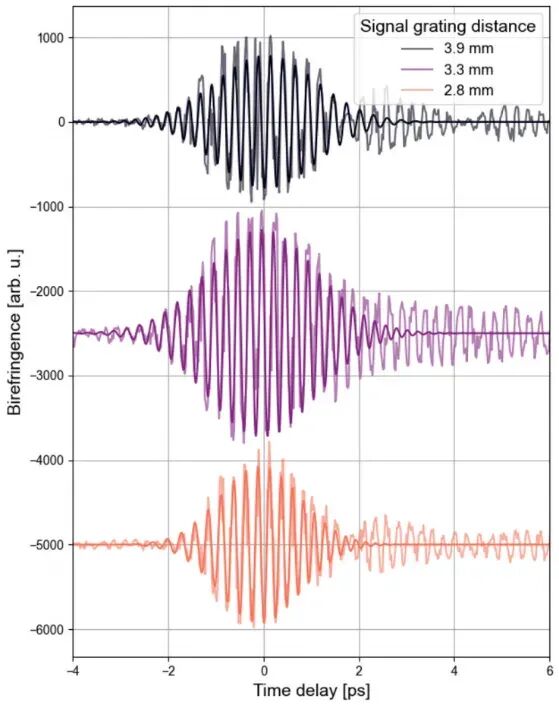
Figure 3. Electric field diagrams of the idler wave obtained under different signal light grating spacings[1]
Figure 4(a) illustrates the variation of the fitted idler wave chirp parameter b with signal light grating spacing, where solid circles represent experimental measurements and crosses denote simulation results. The inset displays the full width at half maximum (FWHM) of the electric field waveform, with the yellow solid line indicating the theoretically calculated chirp curve. Figure 4(b) shows the variation of group delay dispersion β with grating spacing, while Figure 4(c) presents two-dimensional time-frequency diagrams (contours as fitted results) for three selected spacings. 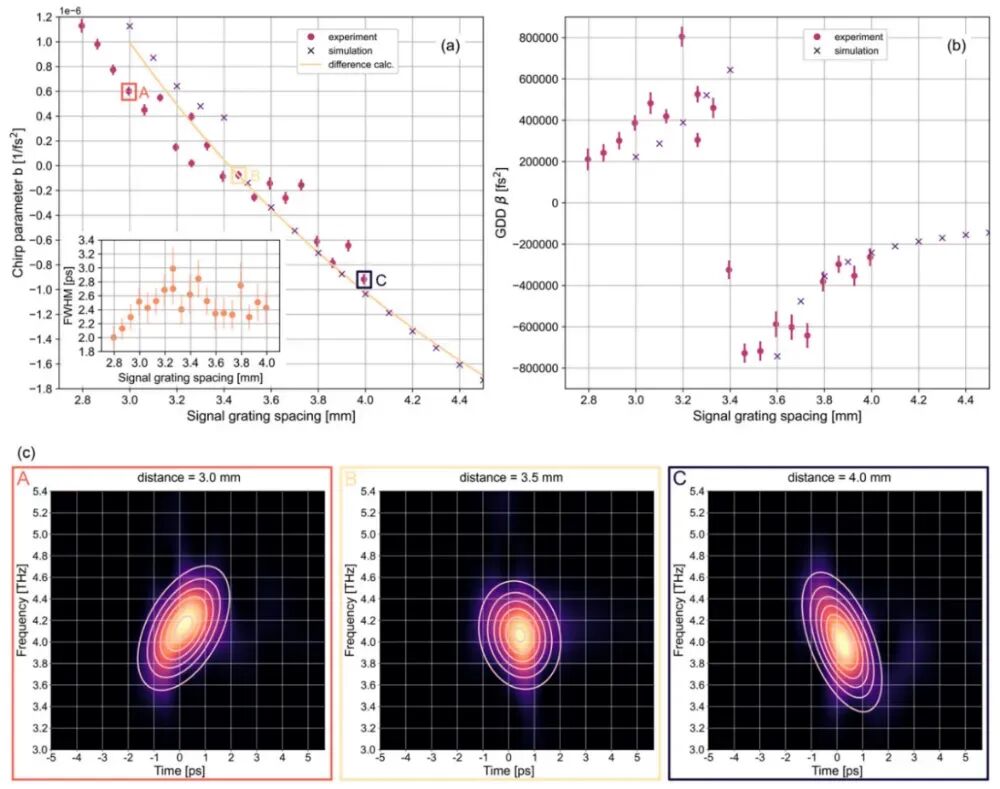
Figure 4. Characterization of the chirp properties of the idler wave[1]
In summary, this paper presents a flexibly tunable chirped mid-infrared source. By adjusting the positions of a pair of gratings in the signal light stretcher, the chirp level of mid-infrared pulses can be effectively controlled. During the characterization of the chirp tunability system, the experimental results align closely with simulations, confirming the system's capability to control chirp parameters and wavelength adjustments. This provides a more versatile light source for terahertz and mid-infrared spectral applications.
References: [1] L. Boie, B. H. Strudwick, R. T. Winkler, Y. Deng, and S. L. Johnson, "High-power femtosecond mid-IR source with tunable center frequency and chirp," Applied Physics Letters 126(6), 061105 (2025).
-
On the Eve of Its IPO, Avatr Finds Itself Embroiled in a 'Farce of Controversy and Belittlement'
-
![]()
Yutong Optics' Japanese Subsidiary Unveiled in Tokyo, Shifting Strategic Focus to Technology-Driven Growth
-
![]()
Half-Year Revenue Outstrips Last Year’s Total! Zhongrun Optics Forecasts 80.2% H1 Revenue Growth
-
![]()
Why Does AI Competition Start with Computing Power?
-
![]()
Apple AI Finally Makes Its Debut in China, Yet iPhone's 'AI Autonomy' Faces Uncertainty
-
![]()
Apple AI and QianWen Make Up Lessons: Alibaba Has Its Own 'Doubao Phone'
-
![]()
QianWen Joins Apple, Signal for Large Models to ‘Fade into the Background’
-
![]()
The ‘Anchor’ Strategy of Google Hidden Behind the Bleeding Financial Report