Yield Soars Above 90%! How SCHOTT Conquered the 'Most Formidable Optical Waveguide'
 03/10 2026
 611
611
Recently, the German optical glass behemoth SCHOTT Group proudly announced that its cumulative shipments of wafers in the augmented reality (AR) sector have catapulted past 600,000 units, with geometric waveguide shipments hitting the remarkable 100,000-unit milestone.
As a premier supplier of optical materials at the pinnacle of the supply chain, SCHOTT's adeptness at anticipating industry trends is vividly mirrored in its tangible shipment records. Whether dealing with diffractive or geometric waveguides, meticulous precision processing on high-refractive-index glass wafers is indispensable. The cumulative shipment of 600,000 AR wafers signifies that, over the past few years, the production lines and capacity expansions of most global optical waveguide manufacturers have been firmly anchored on SCHOTT's RealView™ high-refractive-index wafers. This landmark achievement is not merely a triumph for a single supplier; it also serves as a testament to the AR optics industry's evolution from fragmented trial-and-error endeavors to centralized mass production.
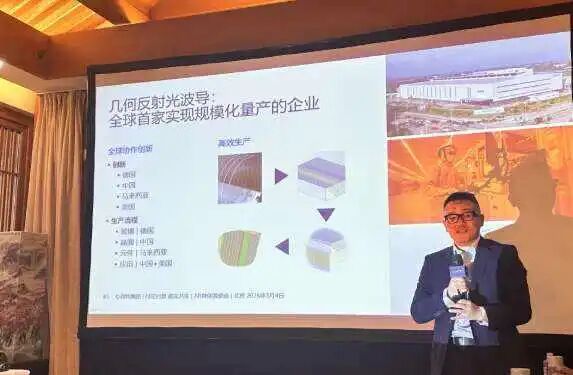
The '100,000-unit' shipment of geometric waveguides marks a significant leap forward in scaling up the production of this highly challenging technology. Geometric waveguides necessitate the embedding of nanoscale coating arrays within the glass, followed by ultra-high-precision bonding. Long acknowledged as the technology boasting the finest display performance yet posing the toughest yield breakthrough, its intricate process has dissuaded numerous manufacturers, with capacity constraints persistently hindering the market expansion of end products utilizing this solution.
In September 2025, SCHOTT achieved the world's first mass production of geometric reflective waveguides, becoming the trailblazer in the industry to scale this technology. Presently, across several pivotal processes in geometric waveguide manufacturing, SCHOTT has attained yields surpassing 90% at each stage, demonstrating that this once 'acclaimed yet unpopular' pathway now possesses the capacity to sustain the consumer market.
According to TrendForce's research and forecasts, global AR glasses shipments are projected to reach 950,000 units in 2026, representing a year-on-year increase of 53%. SCHOTT's cumulative reserve of 600,000 wafers is precisely laying the foundation for this million-unit market. Given that a single wafer can be sliced into multiple waveguides, this implies that the downstream production capacity enjoys far greater flexibility than the figures alone suggest.
Wu Min, the Sales Director for the Asia-Pacific region of SCHOTT's Advanced Optics Business Unit in China, stated that the industry has surpassed the early critical juncture of thousands or tens of thousands of units, with the next aspiration being to breach the one million mark. Once this milestone is attained, economies of scale will genuinely materialize, propelling the industry into a new era.
Public information unveils that SCHOTT's inaugural production line is operating at full capacity, the second is on the verge of launch, and the third is in the planning stages, with production capacity anticipated to expand to 4-5 million units in the next 2-3 years. This strategy of scaling for profit is propelling SCHOTT to deepen its commitment to the Chinese market.
SCHOTT announced that it will expand its Suzhou AR Technology Center this year, with a focus on joint innovation and customized development centered around diffractive and reflective (geometric) waveguide technologies. It will also establish an Automation and Industrial Engineering Center to comprehensively bolster its innovation and manufacturing capabilities in China.
This also underscores that the competition in optical materials has transitioned from comparing single refractive indices or transmittance rates to a contest of full-chain engineering prowess. For local AR device manufacturers, SCHOTT's services signify a substantial shortening of the time window from prototype design to mass production ramp-up. Technical concepts hindered by yield and capacity bottlenecks can also be swiftly brought to market through collaborative efforts with material suppliers.
The 600,000 wafers amassed represent not only SCHOTT's performance benchmark but also a fresh challenge for the entire AR industry after surpassing the early critical point: When upstream material suppliers have amassed sufficient resources and even the most challenging-to-manufacture geometric waveguides can be shipped in 100,000-unit batches, what kind of products will the end market require to trigger the true million-unit inflection point?
The answer may still be en route, but one thing is certain—the scale-up competition in AR optics has shifted from 'Can it be made?' to 'Can it be made in large quantities and with exceptional quality?' in the latter half of the race.
-
![]()
ByteDance, DJI, and Xiaohongshu Secure Top Three Positions Among China’s Fastest-Growing Unicorns
-
Tesla's in-car voice system in China is finally learning to 'understand human language'
-
![]()
Foreigners Are Amazed: Chinese Electric Vehicle Drive Systems Unveil Innovative 'Poses'
-
![]()
700,000 Brothers and the Future of Robots: Behind JD.com's 'Nirvana Plan'
-
![]()
Zhipu's Trillion-Dollar Valuation: A New Chapter for China's AI
-
![]()
Is Laifen, a 'Dyson Alternative' on the Rise, Now Ensnared by the 'Alternative Curse'?
-
![]()
Beyond Patents: Insta360 and DJI Compete in Retail
-
![]()
Piercing Through Industry Chaos: The Curtain Rises on Compliance for Autonomous Driving