First Batch Hits Guangzhou! 20 Jiushi Intelligent Unmanned Vehicles Secure Municipal Road Test Permits, Boosting Testing Efficiency by 40% Across Four 4.8-Kilometer Roads
 01/19 2026
 681
681
Introduction
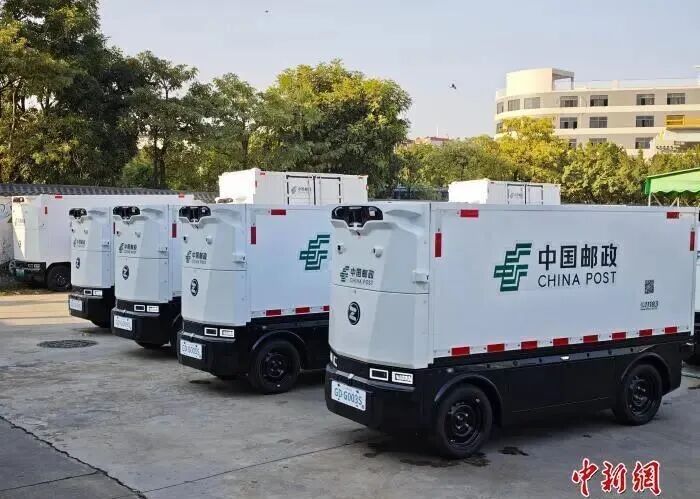
While debates rage on about when autonomous driving taxis, or Robotaxis, will be ready to carry passengers, a fleet of driverless, “cute”-looking unmanned vehicles have already taken the lead, securing “ID cards” for legal operation on Guangzhou’s roads.
Their cargo isn’t passengers, but something far more practical—express parcels.
This event marks the starting point for the commercialization race of autonomous driving technology in one of China’s most commercially dynamic cities, operating on a low-speed, essential, and predictable track.
(For more details, click: Xinhua News Agency Reporter Rides Unmanned Driving Vehicle in Guangzhou’s Nansha District: “Smooth Driving” Leaves the Strongest Impression)
I. The 'National Team' Steps In: Why Post and Jiushi?
On January 14, 2026, Guangzhou’s intelligent connected vehicle development reached a significant milestone:
Twenty Z-series unmanned logistics vehicles, a collaborative effort between China Post’s Guangzhou Branch and tech company Jiushi Intelligence, officially obtained municipal road test permits and commenced testing on four routes in Huadu District, spanning a total length of 2.8 to 4.8 kilometers.
This partnership is intriguing.
On one side is China Post, a “national team” logistics enterprise boasting the most extensive and deeply penetrated urban-rural network.
On the other side is Jiushi Intelligence, a tech company specializing in urban delivery unmanned vehicles.
Their collaboration goes beyond a simple technical test; it’s a precise pairing of a “scenario provider” and a “technology provider.”
China Post’s involvement offers unparalleled triple advantages: stable business volume (massive mail and parcel flows), absolute scenario legitimacy (public service attributes facilitate road access support), and fixed community routes (relatively consistent paths from collection and delivery points to communities).
This precisely sidesteps the greatest challenge faced by passenger autonomous driving—the infinitely complex open roads and unpredictable human drivers.
Jiushi Intelligence’s modular unmanned logistics vehicles, resembling “LEGO bricks,” can flexibly adjust cargo compartments to suit different mail categories.
This design, rooted in real business needs, ensures that technology is no longer an abstract concept.
It is estimated that after large-scale application, this system could enhance regional express delivery efficiency by over 40%.
This isn’t just about showcasing technology; it’s about tangible cost reduction and efficiency enhancement.
II. 'Low-Speed' Leads the Way: Why Logistics Vehicles Became Pioneers
Compared to the “high-speed, full-scenario” aspirations of Tesla and Waymo, unmanned delivery vehicles take a more pragmatic approach: low-speed, closed or semi-closed areas, and point-to-point fixed routes.
This is widely regarded as the “clearest breakthrough” for the commercialization of autonomous driving technology.
The reasons are straightforward: it perfectly bypasses many of the current technical, regulatory, and ethical challenges:
Relatively low technical thresholds: speeds are generally controlled at 20-40 km/h, providing ample reaction time; driving environments are relatively simple (community and park roads), with far fewer emergencies than urban arterial roads.
Different safety redundancy requirements: even if accidents occur, the severity of low-speed collisions is far lower than that of high-speed vehicles, making them more acceptable to the public and regulators.
Clear and calculable business models: they replace human delivery personnel, with clear benchmarks for cost (salaries, management, turnover) and efficiency (working hours, carrying capacity), making return on investment (ROI) easier to calculate.
Thus, we witness a “rural-to-urban” strategy: before technology can fully conquer complex urban traffic, these vehicles first occupy “capillary” scenarios such as parks, campuses, communities, and airports.
Guangzhou Post’s test is a prime example of applying this strategy to the “postal express” sector, a national-level livelihood scenario.
III. Regulatory Breakthroughs: The Urban Ambition Behind a Local Ordinance
The direct impetus for this “first batch” of tests comes from the “Guangzhou City Intelligent Connected Vehicle Innovation and Development Ordinance,” implemented at the end of 2025.
This local ordinance provides legal grounds for road testing, demonstration operations, and accident liability determination of autonomous vehicles, addressing the critical issue of “vehicles being able to operate.”
Guangzhou’s actions are highly representative. It forms a “differentiated competition” landscape with Beijing (Yizhuang) and Shanghai (Pudong):
Beijing Yizhuang focuses on a “full-stack ecosystem” and large-scale operations of passenger Robotaxis (e.g., Apollo Go and Pony.ai).
Shanghai adopts a high-profile approach, targeting ambitious goals for L4-level large-scale passenger and freight transportation through its “Model Speed Intelligent Travel” plan.
Guangzhou, on the other hand, appears more “pragmatic and flexible.” It supports leading Robotaxi companies like WeRide and Pony.ai while vigorously promoting local platforms like OnTime. Simultaneously, as seen in this case, it rapidly issues permits for low-speed commercial scenarios such as logistics and sanitation, encouraging a “diverse and thriving” ecosystem.
This landscape indicates that China’s autonomous driving development has shifted from a pure technological R&D competition to a “city-level application ecosystem” competition.
Whoever provides the richest scenarios, the most innovation-friendly regulations, and the most efficient approval processes will attract industrial clusters and win the future.
IV. The Future Is Here: How Will Unmanned Delivery Reshape Our Lives?
The testing of these 20 unmanned vehicles in Huadu District is a small starting point but points to a vast future. When unmanned delivery networks mature, they will transform far more than just “faster parcel delivery.”
They could potentially restructure urban logistics systems:
Large distribution centers connected by unmanned heavy trucks (similar to Shanghai’s Yangshan Port plan), with medium-sized unmanned vehicles handling transfers between regional hubs, and these small unmanned vehicles completing the “last mile” or even “last hundred meters.”
The entire process will be digitalized, trackable, and predictable.
The deeper impact lies in mitigating the impact of labor force structural changes on the logistics industry and freeing human labor from repetitive and tedious handling tasks, redirecting it to more complex customer service, exception handling, and technical maintenance roles.
Of course, challenges remain: reliability in adverse weather conditions, adaptability to complex mixed human-vehicle traffic scenarios, optimizing public interaction experiences (e.g., parcel collection), and balancing costs and scale—all require resolution through testing.
As China Post’s unmanned vehicles glide through Guangzhou’s streets, they cast a silhouette of a future city.
The key to winning this competition may not lie in whose sensors are more precise or algorithms more complex, but in who first finds the perfect balance between technology and social costs, regulatory safety and commercial efficiency.
In short, the “Unmanned Vehicles Are Coming” (WeChat official account: Unmanned Vehicles Are Coming) believes:
The story of autonomous driving may not begin with the glory of passenger transportation but is likely to succeed through the pragmatism of cargo transportation.
These “express couriers” shuttling through streets and alleys may very well be the first to knock on the door of the autonomous driving era, delivering a resounding knock.
Hey! What do you think?
#UnmannedVehiclesAreComing #AutonomousDriving #SelfDriving #UnmannedVehicles
-
![]()
How Can Embodied AI Overcome the Data Challenge of 'Being Able to Work'? Solutions from Five Leading Players
-
![]()
Half-Year Pre-Tax Loss Hits 4.5 Billion, Full-Year Net Cash Outflow Reaches 16.2 Billion! GAC Incurs 8,000 Yuan Loss per Vehicle Sold
-
![]()
In a Bid to Propel Towards a $10 Billion IPO, Jieyue Xingchen Weaves a Hardware Fairy Tale: A 'Chinese Version of Apple + OpenAI'?
-
![]()
REDMI Note 17 Pro First Impressions: Built to Last and Waterproof, Who Cares About Cost-Effectiveness?
-
![]()
MiHoYo’s AI Companion BSide is Here! I Tried It Out—Great Aesthetics, But Needs Work
-
![]()
A Token Cloud Drifting in the Winds of Change
-
![]()
A Token Cloud Looms on the Horizon
-
![]()
Qualcomm, NVIDIA, and Horizon Robotics: Pioneering Similar Paths in Automotive Tech