Shenzhen's April Report on Driverless Vehicles: 1,259 Vehicles on the Road, Shifting from 'Running' to 'Running All Night'—What Is This City Doing Right?
 05/18 2026
 619
619
Introduction
In April, Shenzhen's driverless vehicles quietly accomplished something significant. According to the April 2026 Monthly Operation and Development Report on Functional Driverless Vehicles released by the Shenzhen Intelligent Connected Transportation Association:
The Guangming District launched its first driverless vehicle routes, expanding citywide coverage from seven to eight districts. Nighttime operations have shifted from single-point trials to large-scale implementation—nearly 300 new nighttime routes were added in Pingshan and Longgang, with JD.com, Neolix, and Jiushi leading the way in achieving regional networking.
A total of 1,259 registered operational vehicles are in use citywide, including 811 driverless logistics vehicles, 443 driverless sanitation vehicles, and 5 driverless inspection vehicles. With 2.835 million monthly deliveries, the commercial value is estimated at approximately RMB 24.08 million, saving nearly RMB 2.75 million in costs.
Driverless Vehicle Era (WeChat Official Account: Driverless Vehicle Era) believes this is not just a pilot program but an emerging urban infrastructure.
(For further reading, click: '1,215 Vehicles! Shenzhen's March Report on Driverless Vehicles: 'Night Riders' Go Online, Delivery Volume Surges 57%, Reshaping Urban Capillaries!')
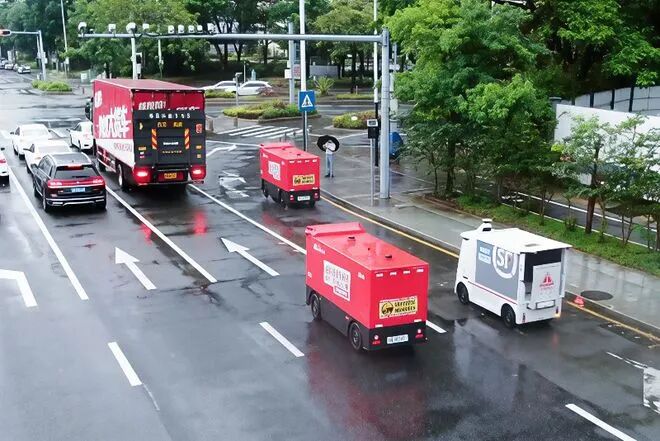
Image Source: NetEase
I. Scale and Growth: 1,259 Vehicles in Operation
Let's start with the foundational data.
As of the end of April, 1,259 functional driverless vehicles were registered for operation citywide. Logistics vehicles account for 64% (811 units), sanitation vehicles 35% (443 units), and inspection vehicles are in the initial stage with 5 units.
The online rate has risen to 86%, up 9 percentage points month-over-month. This means nearly 9 out of every 10 vehicles are operational. The 9% increase indicates rapidly improving operational stability.
Ranking of companies by vehicle count: Neolix leads with 394 vehicles, followed by Jiushi with 149, Meituan with 138, and White Rhino with 66. The top four companies account for nearly 70% of the total, showing a clear concentration effect.
There are 2,492 total routes, an 18% month-over-month increase, and a total mileage of 11,622 kilometers, also up 18% month-over-month.
Road network expansion is accelerating. In April alone, 193 new routes and 1,804 kilometers were added—equivalent to 6-7 new routes per day.
II. Operational Efficiency: Vehicles Average 9.2 Hours of Daily Operation, 'Night Owl' Fleets Arrive
Operational data for Shenzhen's driverless logistics vehicles shows steady improvement.
According to statistics, the average daily operational hours per vehicle increased from 7.7 in February 2026 to 9.1 in March, remaining stable above 9.2 hours in April. This indicates that driverless vehicles have transitioned from 'pilot operations' to 'regular work'.
Nighttime operations were the biggest highlight in April.
After Shenzhen opened nighttime road access at the end of 2025, JD.com launched its first cross-district nighttime route in March 2026. In April, nighttime routes in Pingshan and Longgang expanded rapidly, with JD.com, Neolix, and Jiushi leading in achieving regional networking. Progress from 'single-route trials' to 'regional networking' was swift.
In terms of corporate operational efficiency, JD.com was active in cross-district nighttime allocations. Its model of 'daytime last-mile delivery + nighttime cross-district allocation' increased the average daily usage per vehicle from about 12 hours to 24 hours, boosting capacity utilization by 66%.
III. Safety and Compliance: 99.7% Compliance Rate, Accident Rate Remains Stable
In April, there were 6 traffic accidents, with a monthly accident rate of 0.43 incidents per 10,000 kilometers, unchanged from the previous month.
What does 6 incidents represent? Based on 139,000 kilometers traveled, this averages one accident every 23,000 kilometers.
Compared to human driving? The average accident rate for ride-hailing vehicles is about 0.6-0.8 incidents per 10,000 kilometers. Driverless vehicles are already below the human average.
Liability breakdown: 4 accidents with primary responsibility or higher, 2 with less than primary responsibility.
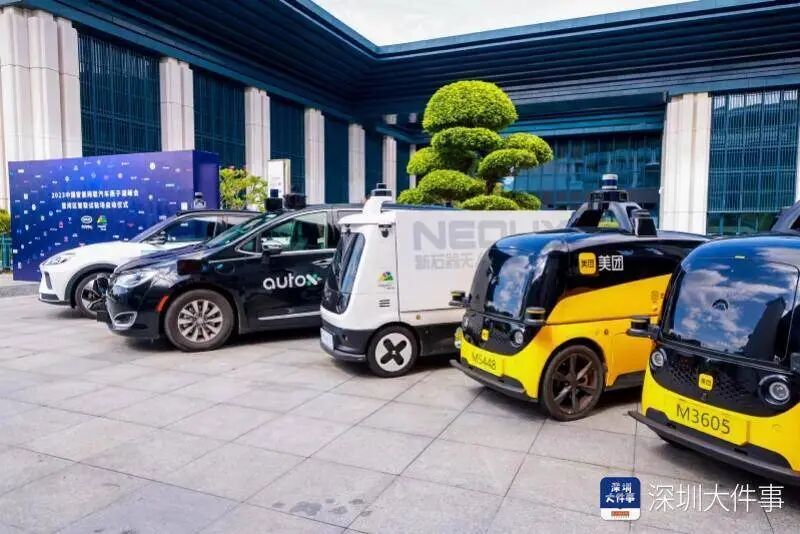
Image Source: Southern Metropolis Daily
Vehicle compliance rate: 99.7%, up 0.3% month-over-month.
Operational compliance rate: 92.7%, down 0.7% month-over-month.
There were 56 operational non-compliance incidents, mainly due to occupied parking spots, environmental changes blocking passage, and unreasonable routing. The core issue: driverless vehicles follow rules, but reality does not.
Among automakers, Neolix had the most non-compliance incidents (30), directly related to its large vehicle base and complex routes. Jiushi had about 18, and JD.com had 4.
IV. Complaint Analysis: 49 Complaints in April, Up 4.3% Year-Over-Year
In April, 49 complaints were filed by citizens, up 4.3% year-over-year.
Complaint breakdown: 10 technical issues, mainly involving vehicle recognition and signaling. Neolix, Jiushi, White Rhino, and JD.com were the top sources.
Complaints are not criticism but a feedback mechanism for 'problem identification and resolution.' Shenzhen has established a 'daily briefing, weekly reporting' system, putting pressure on companies but providing clear direction for improvements.
Regional complaint distribution: Longgang District had the most complaints (about 19), followed by Bao'an (13), Nanshan (8), and Pingshan (7). This directly correlates with operational density—more routes mean a larger complaint base.
Serious complaints: 3 in April, mainly involving regional signaling issues, roadblock barriers causing stops, and unreasonable parking locations.
Of the 3 serious complaints in March, 2 were resolved, and 1 remained unresolved in April.
V. Regional Progress: Guangming Launches First Routes, Futian is Densest, Pingshan Becomes a 'Showcase'
The biggest event in April: Guangming District launched its first functional driverless vehicle routes. This brings Shenzhen's intelligent connected unmanned delivery services to full coverage across 8 districts.
Guangming's launches include: campus scene routes by SF Express and Neolix, 10 express routes by White Rhino and SF Express, and 3 express routes by China Post and Jiushi, covering diverse scenarios such as supermarkets, fresh produce, retail, and postal services.
Route mileage: Longgang District leads with 5,728 kilometers, followed by Pingshan (1,879 km), Bao'an (1,419 km), cross-district routes (882 km), and Nanshan (701 km). Longgang is the absolute leader, accounting for nearly half of the city's total.

Image Source: Shenzhen Intelligent Connected Transportation Association
Route density (kilometers per square kilometer): Longgang District has the highest at 14.8, followed by Pingshan at 11.2.
On April 30, Pingshan District issued citywide open management regulations, becoming Shenzhen's first region to allow 'full-area access, on-road operation, unmanned operation, and commercial trials.' Led by the District Development and Reform Bureau, a joint working group with transportation, traffic police, and industry and information technology departments handles applications uniformly. This represents institutional innovation: shifting from 'case-by-case approval' to 'regularized management.'
VI. Industry Developments: Advancing Safety and Commercialization
In April, the Shenzhen Transportation Bureau visited companies like Meituan and Neolix, holding special meetings to discuss corporate self-inspections, rectifications, and follow-up work.
Three key developments:
First, the bureau commissioned third-party agencies to independently review corporate self-inspection results, linking safety assessments to testing and demonstration qualifications—no safety clearance means no road access.
Second, a monthly reporting and 'daily briefing, weekly reporting' system was established—high-frequency updates ensure problems are addressed promptly.
Third, the bureau partnered with research institutions to establish a key laboratory for autonomous driving safety, conducting in-depth reviews of typical accidents.
Shenzhen is simultaneously pursuing two goals: expanding operations (Guangming route launches, nighttime capacity increases) and strengthening oversight (safety assessments, review linkages). This embodies the concrete implementation of 'balancing development and safety.'
VII. Trend Analysis: From 'Operational Viability' to 'Operational Density'
April's data reveals three trends:
First, nighttime operational networking is a critical turning point.
From 2 nighttime pilot routes in March to nearly 300 new routes in Pingshan and Longgang in April.
Nighttime is the 'golden window' for logistics—empty roads and high delivery efficiency. Whoever first establishes a nighttime network will dominate 24/7 operational capacity.
Second, safety and compliance are strict requirements.
With a 99.7% compliance rate, 92.7% operational compliance rate, and an accident rate below the human average, driverless vehicles have 'passed the test.'
However, 56 operational non-compliance incidents and unresolved signaling issues in some routes indicate room for improvement to reach 'excellence.'
Third, regional networking is a prerequisite for scaling.
Multiple isolated points are less effective than interconnected networks. Pingshan's pioneering implementation of 'full-area access, on-road operation, unmanned operation, and commercial trials' provides a institutional framework. If replicated in other districts, Shenzhen's driverless vehicles will enter a true 'citywide operational' phase.
In summary, Driverless Vehicle Era (WeChat Official Account: Driverless Vehicle Era) believes:
Shenzhen's April data for driverless vehicles tells a simple truth: this technology has moved beyond 'can it operate?' to 'how can it operate more densely, stably, and safely?'
Shenzhen is paving this path one kilometer at a time, one vehicle at a time, and one complaint resolution at a time.
What do you think?
References: Media reports from the Shenzhen Intelligent Connected Transportation Association, Southern Metropolis Daily, NetEase, etc.
#DriverlessVehicleEra #Driverless #AutonomousDriving #DriverlessVehicles
-
![]()
Breaking the Mold: LG, Haier, and Hisense Redefine Online and Offline Home Appliance Sales Strategies in India
-
Lenovo's AI Goldmine: How Long Can Yang Yuanqing Keep 'Feasting'?
-
![]()
Samsung Galaxy Z Fold 8 Review: Ultra-Slim Dual Design Shines, but Telephoto Absence is a Bummer
-
![]()
Dongfeng VOYAH’s New Car Makes a Splash, Targeting More Than Just the 30s and 40s Crowd
-
![]()
Annual Salary of 700 Million Fails to Retain Him! AI Genius Jiahui Yu Departs Meta to Launch His Own Startup
-
Qianwen Seeks to Move Beyond Its 'Alibaba Identity'
-
![]()
How Can We Comprehensively Resolve Ctrip's Monopoly Issue?
-
![]()
From Computing Power Supply-Demand Dynamics to Capital Integration: Jin Jing New Energy Embarks on a New Business Phase