Has Chongqing Outstripped Guangzhou Once Again? The Top Ten City Rankings Take an Unexpected Turn!
 07/30 2026
 567
567
Source: Shenlan Finance
The 'mid-year economic snapshots' of the top ten cities have all been unveiled.
A fresh narrative has emerged: stock market K-line charts are no longer just about corporate valuations; they've started to redefine the industrial landscape of cities.
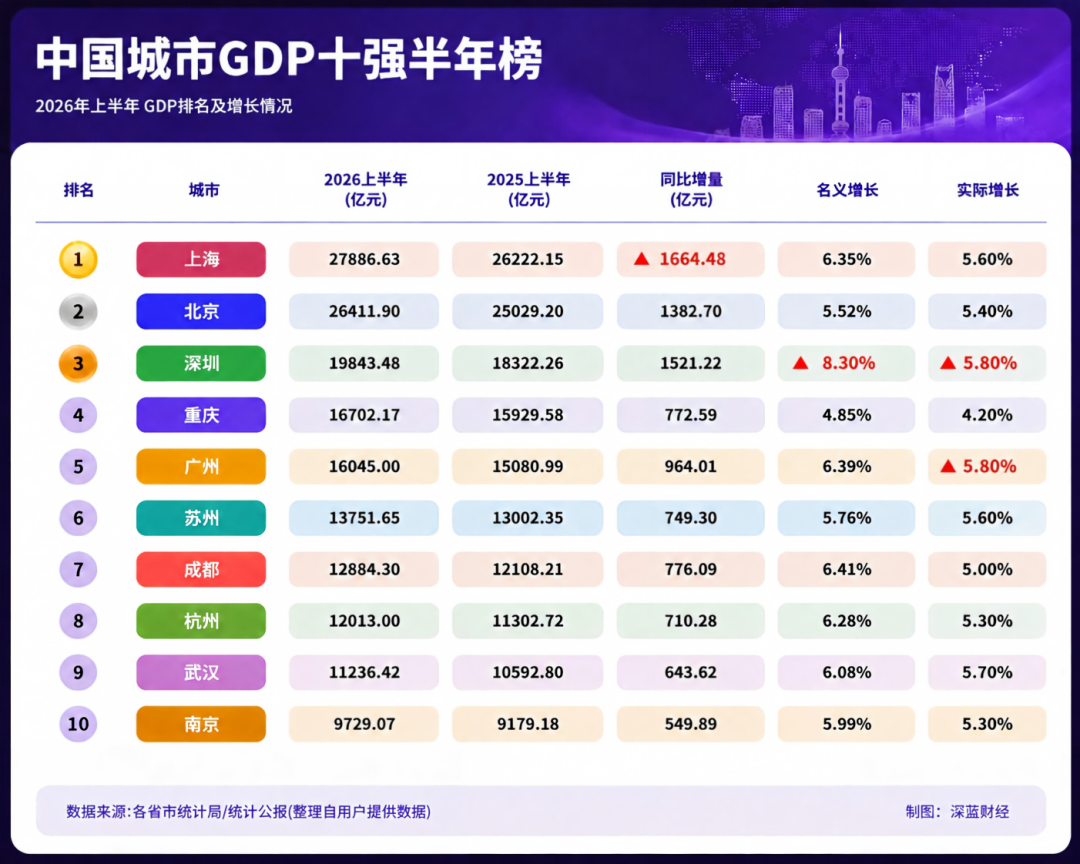
At first glance, the list of the top ten cities by GDP for the first half of the year seems unchanged from the same period last year. But beneath the surface, strong undercurrents are at play—
The standout moment is that Chongqing has once again leapfrogged Guangzhou to reclaim the title of the 'fourth city,' a position it last held in the first quarter comparison this year. Meanwhile, Suzhou and Wuhan, both shining brightly, have maintained their GDP rankings, but their internal growth momentum is soaring, with growth rates among the top three.
These shifts are being driven by a common, powerful force—cutting-edge technology. Semiconductors, optical modules, AI computing power, and intelligent driving are no longer just buzzwords for attracting capital; they've become the dividing line in the fortunes of cities.
In this new narrative, the old growth formulas of cities are losing their edge. The new trend is that among top cities, the focus is shifting from size to quality, from GDP to 'tech quotient.'
1. Standout Moment: Chongqing Overtakes Guangzhou Again
The latest figures reveal a surprising twist: the title of the 'fourth city' has returned to Chongqing.
In the first quarter of this year, Guangzhou, boasting a remarkable 6% growth rate, had snatched the long-lost 'fourth city' crown from Chongqing. However, when the six-month data was released, Guangzhou, despite running faster and achieving the highest growth rate among the top ten (5.8%), lost out in total GDP to Chongqing, which had the lowest growth rate (4.2%), with a staggering difference of 65.717 billion yuan.
Why is this happening? One key factor is the difference in reference points—since both cities' growth rates are year-on-year comparisons. In other words, the base figures from the same period last year heavily influence this year's 'apparent growth rate.'
In the first half of 2025, Guangzhou's base figure was notably lower. At that time, Guangzhou's GDP was 1.508099 trillion yuan, a year-on-year increase of 3.8%; in contrast, Chongqing's GDP was 1.592958 trillion yuan, with a year-on-year increase of 5.0%—leaving Guangzhou trailing by nearly 85 billion yuan (84.859 billion yuan) in total.
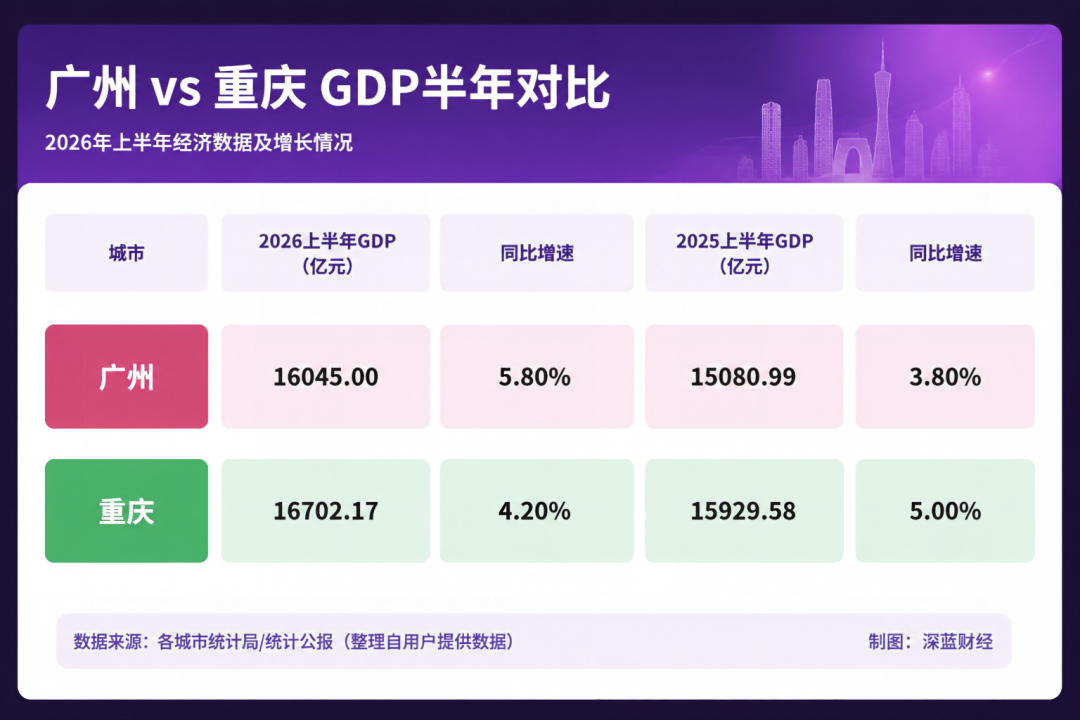
Thus, a simple GDP comparison is misleading; understanding the hidden economic signals is far more valuable.
Since the first half of 2020, the competition between Guangzhou and Chongqing for the 'fourth city' title has been like a gripping drama. Although the question of whether the two are truly comparable has always sparked interest. After all, Guangzhou, with a population of 19.101 million, is a provincial capital and an established 'first-tier city' in the east; Chongqing, with a population of 31.8726 million, is a municipality directly under the central government but a latecomer in the western inland region.
However, both are traditional automotive hubs and have weathered the pain of industrial transformation in recent years. On the industrial economy timeline, Guangzhou and Chongqing serve as mirrors to each other, and a healthy comparison is warranted.
So, how do the industrial qualities of these two 'fourth city' contenders stack up now?
2. Stock Upgrades: What Exactly Are the 'Fourth Cities' Vying For?
Let's start with Guangzhou. Why has its growth momentum been so robust? The answer is simple: everything is thriving. In the first half of the year, Guangzhou's GDP growth rate hit a five-year high for the same period, driven by the simultaneous progress of the 'three engines' of demand-side consumption, investment, and exports.
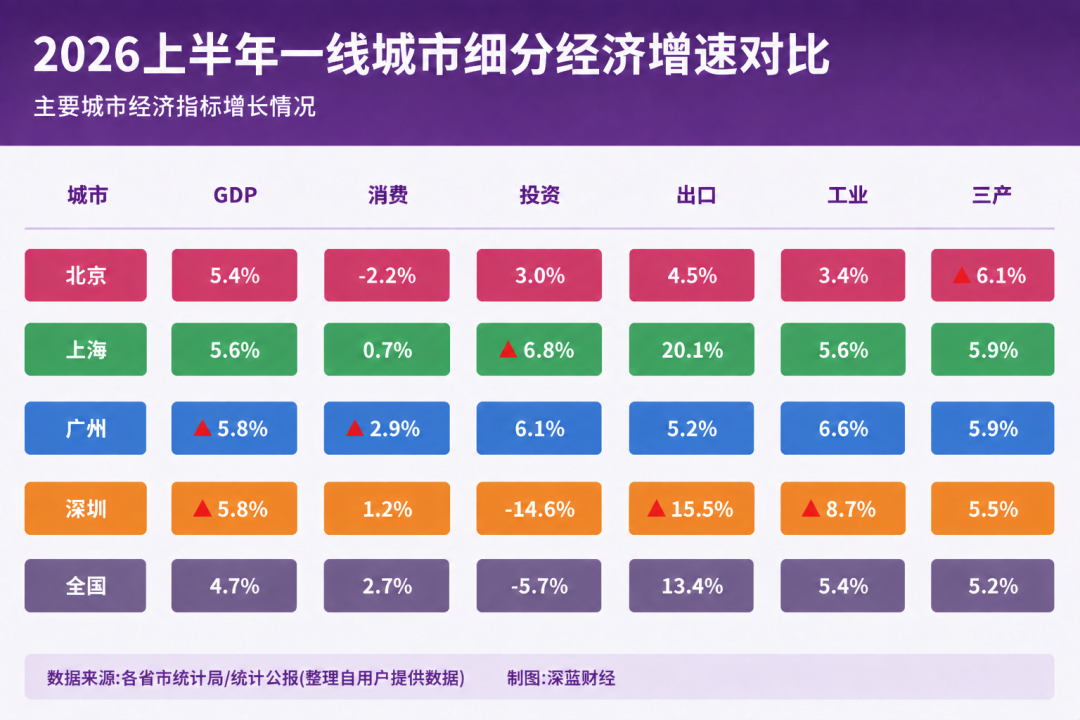
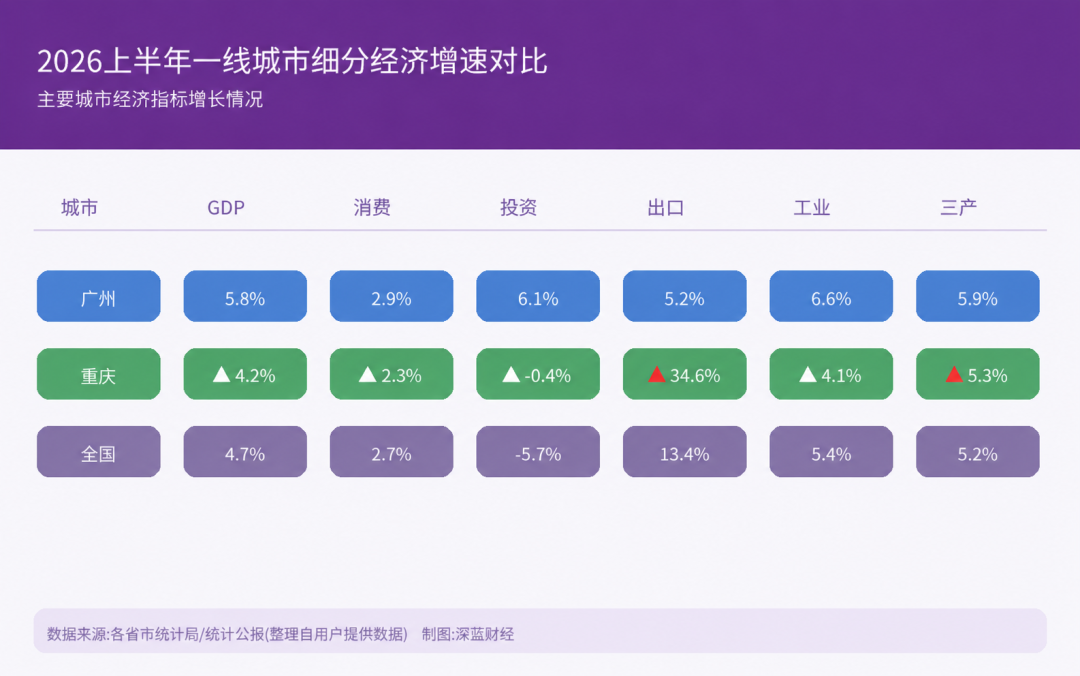
From an industrial perspective, Guangzhou traditionally relied on the three pillars of automobiles, electronics, and petrochemicals. Three years ago, after announcing its 'second entrepreneurship,' it began to actively cultivate three new pillars: next-generation information technology, intelligent and new energy vehicles, and biopharmaceuticals and health.
The latest data shows that Guangzhou's three traditional pillars have all picked up steam, with the automobile manufacturing industry growing by 9.1%, the electronics manufacturing industry by 11.2%, and the petrochemical manufacturing industry by 5.2%.
Among the emerging three pillars, retail sales of new energy vehicles increased by 29.2%, the added value of the biological pharmaceutical manufacturing industry by 21.9%, and next-generation information technology also saw a comprehensive release of production capacity, with the output of analog chips, displays, and service robots increasing by 20.9%, 18.5%, and 13.5%, respectively.
In this light, if the question 'Is Guangzhou still okay?' was lingering in many people's minds at the beginning of 2026, now, 'a remarkable comeback' can be said to have become the new economic epithet for the first provincial capital.
On the other side, almost simultaneously with Guangzhou's 'second entrepreneurship,' Chongqing proposed a series of ambitious numbers '33618.' In essence, it aims to build a modern manufacturing industry cluster consisting of 3 trillion-yuan industry clusters, 3 five-hundred-billion-yuan industry clusters, 6 hundred-billion-yuan industry clusters, and 18 emerging industry clusters. This is widely regarded as the 'blueprint' for Chongqing's industrial upgrading and transformation.
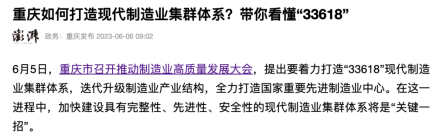
From the latest first-half data, among Chongqing's '33618' modern manufacturing industry clusters, the next-generation electronic information manufacturing industry cluster grew by 7.4%, the intelligent connected new energy vehicle cluster by 5.8%, and the intelligent equipment and smart manufacturing industry cluster by 10.5%. All performed admirably.
However, concerns linger for the automotive industry, which leads the '33618' clusters.
Last year, Chongqing regained the title of the 'automotive capital' thanks to Changan's rapid transformation through its 'third entrepreneurship,' with new energy vehicle sales exceeding one million, and Seres's meteoric rise with AITO.
However, not long ago, Seres's A-shares plummeted by the daily limit. On July 13, its market value fell below 94 billion yuan, shrinking by more than 100 billion yuan from its peak. Some analysts suggest that this is not just a blip on the K-line chart but perhaps a realistic correction of the logic that 'binding with Huawei equals a premium.'
This also serves as a wake-up call for the city. Over the past decade, having an automaker meant having a growth engine for a city, and whoever could snatch up a major automaker had the potential to cash in on manufacturing. But in the future, relying solely on automakers may not suffice, and a single star enterprise cannot sustain long-term stable prosperity.
Moreover, in the first half of this year, due to exceptionally strong consumer policies last year and a significant contraction in policies in 2026, with a decline in support for entry-level consumption, the national automotive market showed clear differentiation, with unexpected growth in exports but significant pressure on domestic demand.
From January to June, national automobile production and sales reached 14.993 million and 15.017 million units, respectively, down 4% and 4.1% year-on-year. Against this backdrop, Chongqing, the 'automotive capital,' also felt the chill. Amid the buzz around Zhang Xue's motorcycles going viral and a 49.7% increase in local motorcycle production, Chongqing's new energy vehicle production only grew by 3.8%.
Overall, the local above-scale industrial growth rate of 4.1% was also significantly lower than the national average of 5.4%. This indicates that Chongqing still has ample room for improvement in industrial upgrading.
3. Incremental Breakthroughs: Suzhou and Wuhan's Meteoric Rise
If, in this round, Guangzhou and Chongqing are competing on 'stock,' with the outcome hinging on the upgrading effects of traditional pillar industries, then Suzhou and Wuhan are competing on 'increment,' focusing on the technological content of emerging industries.
In the first half of the year, the top three growth rates among the top ten cities were 5.8%, 5.7%, and 5.6%, respectively. Shenzhen and Guangzhou tied for first, Wuhan ranked second, and Shanghai and Suzhou tied for third.
You'll notice that, apart from Suzhou and Wuhan, the rest are all first-tier cities. One of these cities is only an ordinary prefecture-level city in terms of administrative rank, while the other, although a sub-provincial city, is located inland. What has propelled them to the top?
The driving force behind all this is cutting-edge technology. In the first half of the year, almost everyone in the capital market was chasing 'light.' And both Suzhou and Wuhan are basking in this 'light.'
In the first half of the year, the two cities made remarkable strides in the capital market. Wuhan's total market value soared from 1.21 trillion yuan at the end of last year to 2.09 trillion yuan, surpassing Chongqing and Nanjing with a 72.3% increase, officially ranking eighth, making it the city with the most dramatic change in position among the top ten.
In terms of companies with a market value of over 100 billion yuan, Wuhan successfully broke through to zero in half a year. Four companies—YOFC, Accelink Technologies, Huagong Tech, and Dinglong Culture—saw their market values exceed 100 billion yuan, growing by 3.7 times, 2.8 times, 1.3 times, and 1.8 times, respectively.
Wuhan's story is essentially an explosion fueled by patience. From the birth of China's first optical fiber here in 1976 to the emergence of Optics Valley in 1988, the city has spent more than two decades deeply cultivating the 'optical chip display terminal network,' finally waiting for the explosion in demand for AI computing power.
Currently, Wuhan has built a unique domestic complete optoelectronic industry chain, securing technological positions in key AI computing power links such as optical fibers, optical modules, optical chips, and semiconductor materials.
Reflected in local economic data, in the first half of the year, Wuhan's high-tech manufacturing industry accounted for 38.4% of above-scale industry, surpassing the combined proportion of traditional industries such as automobiles, steel, petrochemicals, and tobacco for the first time. The 'protagonist' of Wuhan's manufacturing industry has changed. From 'automobiles, steel, oil, and tobacco' to 'chip-optical synergy,' the city's greatest driving force for development has shifted from traditional industries to technological innovation.
This is a historic moment.
For Suzhou, in the first half of the year, the total market value of its listed companies increased by 2.012797 trillion yuan, ranking first in terms of increment among the top ten cities. Unlike Wuhan's focus on the entire optoelectronic information chain, Suzhou possesses a complete AI computing power hardware chain covering optical modules, optical devices, high-speed PCBs, and testing equipment, aligning with the current global computing power infrastructure investment main storyline.
Reflected in the economic spectrum, in the first half of the year, the local above-scale industrial added value growth rate reached a high of 9.3%. Industry's contribution to economic growth reached 58.0%.
Behind this, the leading effect of the AI industry is prominent. Strong demand for electronic components and devices drove Suzhou's electronic information industry output value to grow by 10.0% year-on-year, maintaining double-digit growth for four consecutive months; led by industries such as energy storage and power batteries, robots, and electrical equipment, the local equipment manufacturing industry output value surged by 8.0%.
Throughout the first half of the year, the GDP rankings of the top cities remained relatively stable, but it couldn't mask the fact that capital was voting with its feet: wherever cutting-edge technology clustered, capital flowed. And the data seems to suggest: where cutting-edge technology companies take root, the economy of that city is likely to break through.
In this new upheaval, no one can remain a 'perennial winner.' Even seemingly unshakable leaders like Beijing and Shenzhen have their own 'new troubles.'
Beijing has 'won big' in the large model race, but the pain point of losing traditional manufacturing has not yet been resolved, and the 'blood replacement' process for high-end manufacturing is far longer than imagined. Shenzhen, although securing the top growth rate in the first half of the year, still needs to see whether the new model of 'industrial upward expansion' can support the mass production needs of cutting-edge technology in the second half of the year.
What is most feared in the future is that the story is told, the capital is in place, but the production lines haven't caught up.
Note: The cover image was generated by AI.
*Disclaimer: The views expressed in this article are solely those of the author. The market carries risks, and investment should be made with caution. Under no circumstances does the information or opinions expressed in this article constitute investment advice to anyone.
Shenlan Finance's new media cluster originated from the Shenlan Finance Journalist Community and has a 16-year history. It is a well-known domestic financial new media outlet, with accounts focusing on China's most valuable companies, cutting-edge industry developments, and emerging regional economies, providing valuable content for investors, corporate executives, and the middle class. Welcome to follow.
-
![]()
Initiation of Control over Access for Intelligent Driving's 'Little Blue Lights'
-
![]()
Is the Intelligent Driving Blue Light, a Source of Pride for Lixiang and AITO Owners, Facing a Ban?
-
![]()
Embarrassing Meta: Promises Made, Money Invested, but No 'Fruits' Yet
-
![]()
BMW Announces Thousands of Job Cuts via 'Voluntary Exit Scheme'
-
![]()
Official Announcement: Intelligent Driving Blue Light Banned Due to Safety Concerns; Automakers React Swiftly | Mirror Pro
-
Each Truck Can Cut Fuel Costs by 200,000 Yuan Annually! Why Are New Energy Vehicles Scarce in the Booming Electric Heavy Truck Market Led by CNHTC, Sany, and Dongfeng?
-
![]()
Kingsoft Office Triples Performance Amidst Trust Controversy
-
![]()
The Leading Self-owned Brand Changes Hands in the First Half of the Year, with the Top Five Automakers Showing Diverse Trends