Shenzhen's Autonomous Vehicle July Report: 200,000 km Traveled, 3.17 Million Orders Processed, 60% Increase in Nighttime Activity! Beyond 'Five-Party Collaboration,' Full Citywide Deployment
 08/17 2026
 413
413
Introduction
When Shenzhen released its July report on the operational performance of functional autonomous vehicles, it sent ripples across the entire industry. The highlights included a single-month operational mileage exceeding 200,000 kilometers, a cumulative total of 3.17 million deliveries, the simultaneous launch of new routes in the Yantian, Dapeng, and Shenshan districts, and the achievement of 100% unmanned delivery network coverage across all administrative regions of the city. Most notably, Shenzhen pioneered a unique nationwide 'five-party collaboration' model, elevating the competitive landscape of autonomous vehicles from mere comparisons of single-vehicle performance to a new era of ecosystem-wide collaborative operations. 'Autonomous Vehicles Are Here' (WeChat ID: wurenchelaiye) posits that Shenzhen's achievements offer a replicable blueprint for cities still in the exploratory phase of scalable unmanned delivery solutions. (For further reading, click: 'Shenzhen's Autonomous Vehicles Clock 190,000 km in June: 1,300 Vehicles, 2,713 Routes! Full Coverage Across Nine Districts') 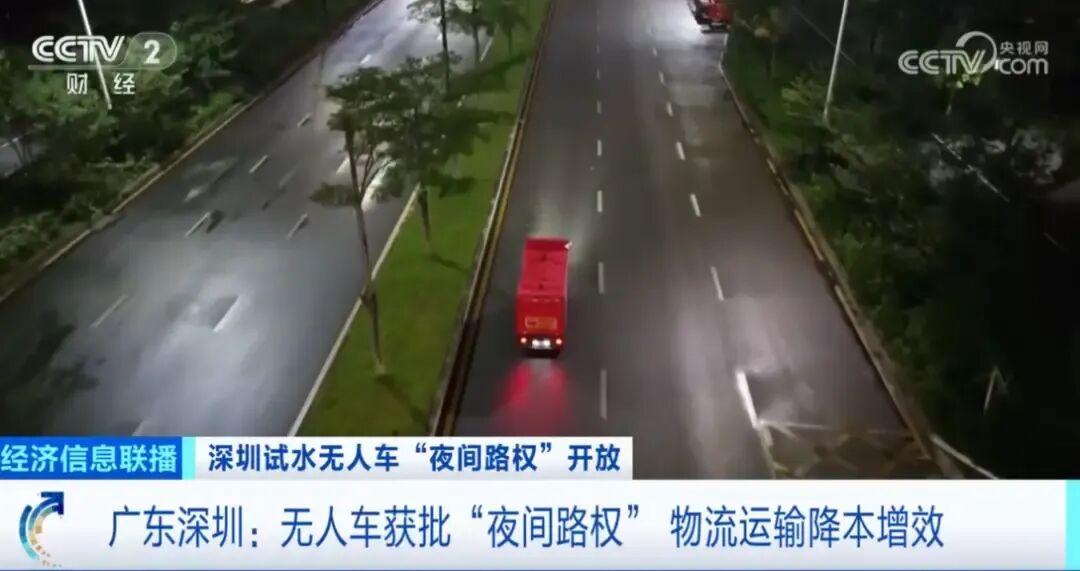
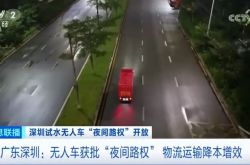
Image Source: CCTV
I. 1,337 Vehicles, 2,890 Routes: Shenzhen Emerges as China's 'Showcase' for Unmanned Delivery
Let's delve into the concrete figures.
By the end of July, Shenzhen boasted 1,337 registered functional autonomous vehicles in active operation, marking a 2.8% month-on-month increase. This fleet comprised 837 unmanned logistics vehicles, 495 unmanned sanitation vehicles, and 5 unmanned inspection vehicles.
A total of 2,890 routes were operational, spanning a cumulative distance of 13,637 kilometers—a figure growing at an 8% monthly rate. To put this in perspective, 13,637 kilometers is roughly equivalent to the straight-line distance from Shenzhen to New York.
In July alone, unmanned logistics vehicles traveled 200,000 kilometers, a 6.4% month-on-month increase—enough distance to circle the Earth five times. Impressively, 40,000 kilometers of this distance were covered during nighttime hours.
Order volumes also experienced a significant uptick.
A total of 3.17 million unmanned deliveries were completed in July, a 2.8% month-on-month increase. This included 3.165 million parcel deliveries and 4,000 fresh produce deliveries.
The commercial value generated reached approximately RMB 27 million, with estimated cost savings exceeding RMB 3.1 million.
In terms of corporate fleet size, Neolix led the pack with 395 vehicles, followed by Jiushi (154), Meituan (138), White Rhino (65), and JD (60). Leading players now view Shenzhen as their primary battleground.
II. 'Five-Party Collaboration': From Vehicle Count to Ecosystem Synergy
As the number of autonomous vehicles on the roads increased, new challenges emerged.
Operating an autonomous vehicle extends far beyond technical feasibility: questions arise regarding charging infrastructure, breakdown response, and liability resolution in the event of accidents.
The industry's traditional approach, where manufacturers operated and assumed full responsibility, forced each company to independently establish its own maintenance teams and secure facilities. This led to redundant efforts and difficulties in scaling operations.
Shenzhen's innovative solution is the 'five-party collaboration' model. This framework divides the unmanned delivery ecosystem into five distinct roles:
Technology providers supply vehicles and algorithms, bearing primary responsibility for system safety;
Asset holders own the vehicle fleet, ensuring stable operational capacity;
Commerce platforms match logistics orders with supply and demand;
Operations teams oversee safety management and full-chain maintenance, establishing a three-tier safety system (remote safety officers, on-site grid safety officers, ground crew);
Regulators monitor vehicle data in real-time, issue risk warnings, and support on-site emergency responses.
(For further reading, click: 'Unique Nationwide! Shenzhen's 'Five-Party Collaboration' Unmanned Delivery Pilot Launches, Steering Autonomous Driving Away from 'Money-Burning Competition' Toward 'Ecosystem Racing')
On July 30, the first pilot project launched in Longgang's nighttime logistics sector. Longgang boasts the highest concentration of functional autonomous vehicles in Shenzhen, with 949 open routes.
The model's core breakthrough lies in bundling safety management and service capabilities for decentralized deployment, enabling small and medium-sized express companies to match the service standards of industry leaders.
Competition has now shifted from comparisons of vehicle and order volumes to ecosystem value co-creation.
III. From 2 to 437 Routes: 'Cracking' Shenzhen's Nighttime Logistics in Three Months
In March, Shenzhen officially granted nighttime road access to functional autonomous vehicles.
Within three months, nighttime delivery routes exploded from 2 to 331. By late July, this figure had reached 437 routes, a 32% month-on-month increase.
A total of 172 vehicles operated at night, a 60% month-on-month rise, covering approximately 40,000 kilometers in July alone.
This growth rate would be considered 'overpowered' in any industry.
Nighttime logistics offers more than just additional orders. By repurposing idle road capacity during off-peak hours, it transforms unused infrastructure into scalable logistics resources.
Staggered operations improve efficiency while easing daytime traffic congestion, reducing logistics costs by about 20%.
Corporate data provides a clearer picture: Neolix operated 127 nighttime routes, Jiushi 187, and JD 121;
Neolix deployed 98 vehicles, Jiushi 49, and JD 26.
In July, Longgang District led nighttime mileage with 18,200 kilometers, followed by Pingshan (16,400 kilometers), Bao'an, Longhua, and Nanshan districts.
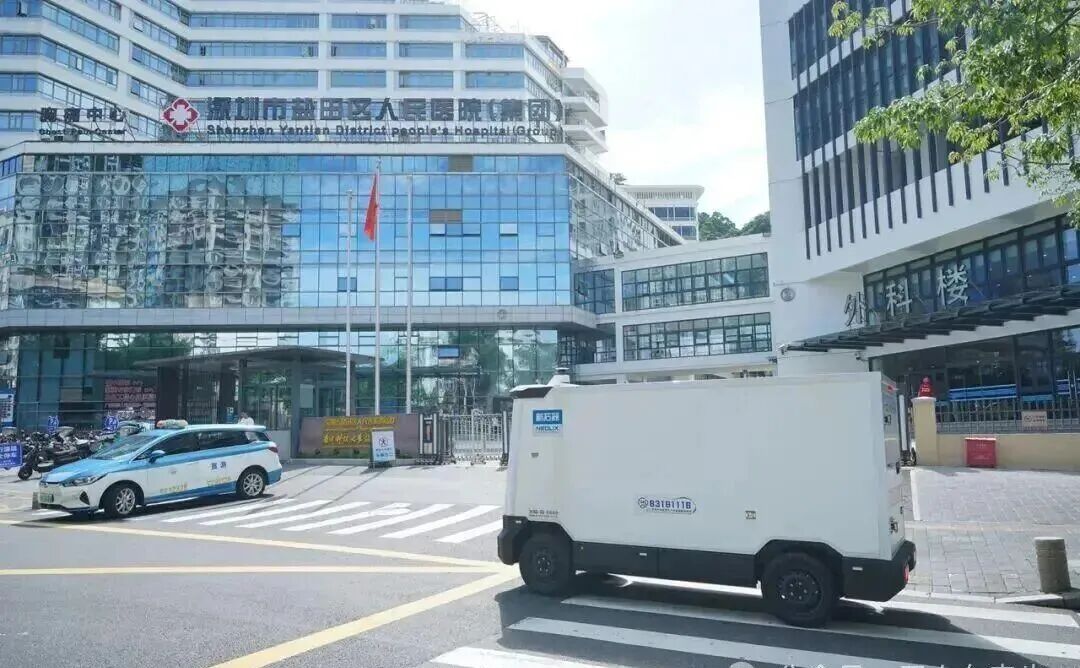 Image Source: Shenzhen Intelligent Connected Vehicle Association
Equally noteworthy are the supporting regulatory frameworks.
According to a July 13, 2026, report by Shenzhen Business Daily, three major bus companies—Shenzhen Bus Group, Shenzhen Eastern Bus, and Shenzhen Western Bus—jointly drafted the 'Shenzhen Functional Autonomous Vehicle Nighttime Operation Management Measures (Trial),' establishing a comprehensive standard framework covering vehicles and operations. For vehicles, the measures mandate strict nighttime noise controls, compliant reflective markings, and lighting systems that balance road visibility with anti-glare requirements. For operations, they introduce a closed-loop management system with a '5-minute online response, 15-minute on-site arrival' emergency protocol. From March's nighttime road access to June's nine-district coverage—Shenzhen achieved stable operations in just three months.
IV. Autonomous Vehicles on Subways, into Dapeng: Shenzhen Redefines Delivery
On July 28, JD Logistics achieved an industry first.
In Pingshan District, unmanned vehicles transported parcels from grid warehouses to subway stations, where standardized containers were loaded onto trains;
During off-peak hours, the subway crossed districts to Bao'an, where unmanned vehicles completed the final delivery to sorting centers. This three-stage process—unmanned collection, subway transit, unmanned delivery—operated entirely without human intervention.
Transportation costs dropped by about 60%, capacity utilization improved by 10%, and consumer delivery times shortened by half a day.
JD Logistics now operates nearly 100 unmanned vehicles across 22 Shenzhen express outlets, with 121 nighttime delivery routes.
Within a month, Shenzhen completed its unmanned delivery network.
On June 27, Yantian District launched its first functional route, closing the 'nine-district coverage' gap.
In July, Dapeng New Area activated seven initial routes, with Jiushi Intelligent and Neolix partnering with SF Express, YTO Express, JD Logistics, and China Post for last-mile deliveries across Kuiyong, Dapeng, and Nan'ao subdistricts.
The Shenshan Special Cooperation Zone simultaneously launched two routes.
(For further reading, click: 'Three Districts in One Month! Shenzhen Completes Unmanned Delivery Network, Begins 'Intercity Replication' to Shenshan Special Cooperation Zone')
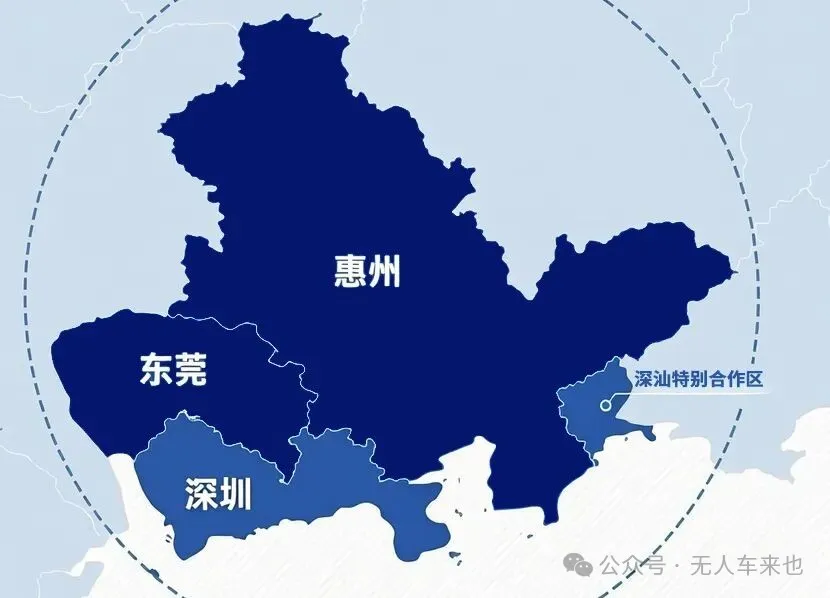 Image Source: Shenzhen Intelligent Connected Vehicle Association
Shenzhen's unmanned delivery network now covers all nine administrative districts, plus Dapeng New Area and the Shenshan Special Cooperation Zone.
Long-term plans include route connections with neighboring Dongguan and Huizhou.
V. Safety Remains Paramount: 0.35 Accidents per 10,000 km
Speed must not compromise stability.
In July, Shenzhen's unmanned delivery accident rate was 0.35 incidents per 10,000 kilometers, a 13% month-on-month increase. Seven accidents occurred, up 16% month-on-month.
The rise primarily stemmed from non-primary liability incidents: one involving Neolix, three involving JD, and one involving White Rhino.
Primary liability accidents remained stable, with just one each for JD and White Rhino.
Vehicle compliance stood at 98.9%, a 0.1% month-on-month decline. While all vehicles passed insurance checks, eight failed identifier (marking) inspections.
Operational compliance reached 91.8%, a 0.2% month-on-month drop. July saw 71 complaints and inspections (60 complaints, 11 inspections). From January to July, vehicle compliance fluctuated between 100% and 98.92%, while operational compliance ranged from 95.0% to 90.2%. Despite rapid scaling, safety standards held firm.
Citizen complaints totaled 60 in July, a 3% month-on-month increase, including three safety-related, six technical, and 51 management-related issues. Complaints by company: Jiushi (33), Neolix (17), JD (7), White Rhino (2), Cainiao (1).

In conclusion, 'Autonomous Vehicles Are Here' (WeChat ID: wurenchelaiye) believes:
As China's pioneering unmanned delivery demonstration zone, Shenzhen has eschewed flashy concept launches in favor of methodically addressing challenges in road network access, safety regulation, and ecosystem innovation.
This July report showcases results that serve as a model for cities nationwide.
As the 'Shenzhen Experience' replicates across China, the nationwide adoption of unmanned delivery will undoubtedly accelerate far beyond expectations.
What do you think?
References: Media reports from Shenzhen Intelligent Connected Vehicle Association, Sina, CCTV, Shenzhen Special Zone Daily, and Southern Metropolis Daily
#AutonomousVehiclesAreHere #Driverless #AutonomousDriving #AutonomousVehicles
-
![]()
Shenzhen's Autonomous Vehicle July Report: 200,000 km Traveled, 3.17 Million Orders Processed, 60% Increase in Nighttime Activity! Beyond 'Five-Party Collaboration,' Full Citywide Deployment
-
![]()
The "Happiness" of Xpeng
-
![]()
China Mobile: Coping with Tax Hikes and Fee Reductions, Are High Dividends the Sole Pillar?
-
![]()
Wei Brand V8X Unveiled: Can Great Wall Overcome the High-End Market Challenge?
-
![]()
Why Did Musk Set His Sights on Space Computing After Starlink?
-
Major Adjustment! Nokia Plans to Close R&D Center in China, Lay Off 1,600 Employees
-
![]()
Co-Lead Optoelectronics Pours 1.7 Billion Yuan into Investment, Triggering a 20% Surge to Limit-Up!
-
![]()
AI Smartphone Competition: Some 'Add Icing on the Cake,' Others 'Determine Survival'