:"
 01/12 2026
 615
615
Key Terms: RoboChallenge, WALL-OSS, Embodied Intelligence, Open-Source Model, End-to-End Architecture
The leaderboard for RoboChallenge—the world's premier large-scale, multi-task, real-world benchmark testing platform—has just been updated. China's Independent Variable Robotics' WALL-OSS has secured the second position overall, topping the charts in several tasks. This open-source model demonstrates robust capabilities, achieving outstanding results through its innovative architecture and training methods, thereby fostering the growth of the embodied intelligence industry ecosystem.

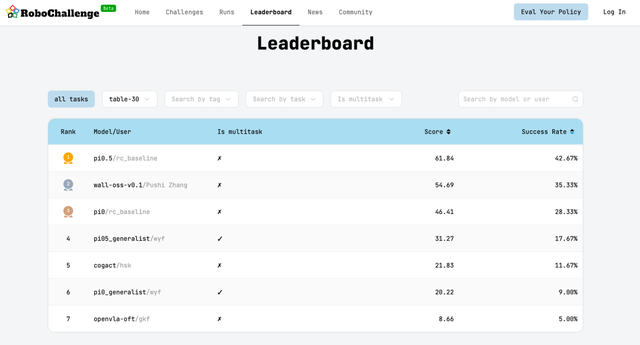
Recently, the RoboChallenge leaderboard—a benchmark testing platform for large-scale, multi-task real-world performance—has been updated, with pi0.5, WALL-OSS, and pi0 taking the top three spots.
Let's delve into the science. Pi0.5 and pi0 are large operational models developed by the U.S. company Physical Intelligence. Meanwhile, WALL-OSS is a fully self-developed, open-source operational model from China's Independent Variable Robotics, capable of not only performing tasks but also generating complex reasoning processes simultaneously.
This achievement sends a powerful message. For a considerable time, China's embodied intelligence industry has faced criticism for "lacking a brain." While we excel in ontology (robot physical design) and motion control algorithms, enabling robots to truly "think" and autonomously interact with the physical world—thereby unlocking creative productivity—has been a challenge. However, China's embodied intelligence models are now on par with leading international models.
More intriguingly, both Independent Variable and Physical Intelligence have opted to open-source their models, displaying remarkable tacit agreement. This strategic alignment, though seemingly coincidental, is an inevitable choice at this pivotal stage in the development of the embodied intelligence industry.

In the latest RoboChallenge tests, Independent Variable's WALL-OSS delivered exceptional performance, ranking second overall and outperforming the star model pi0. It clinched first place in multiple tasks, including folding dish towels, pressing buttons, and watering plants.
Key Highlights:
RoboChallenge's tests could be likened to an "open-book exam," as dozens of desktop tasks and scenarios are predefined, similar to setting the exam questions in advance.
As an open-source model, WALL-OSS operates with transparency, akin to playing with its "cards face up." Every operation is genuinely driven by the model, emphasizing its significance in providing problem-solving approaches and showcasing the model's true performance.
Unlike "black-box" evaluations with closed-source models, where the method of task completion remains unclear, WALL-OSS, as an open-source model, offers complete transparency. Its core capabilities can be fully explained and replicated through publicly available code and parameters. Its rankings are a direct reflection of the model's true capabilities, free from any dilution or manipulation—a testament to its robust strength.
From a technical perspective, WALL-OSS's outstanding performance stems from its deep reconstruction of the "end-to-end" architecture:
It utilizes an innovative Mixture of Experts (MoE) architecture and a "shared attention + expert routing" design, effectively addressing the challenges of "catastrophic forgetting" and "modal decoupling" when transitioning visual-language models to embodied models.
Through a three-stage training paradigm—"discrete first, continuous next, and then joint"—it overcomes the pain point of "cognitive-action disconnection," enabling precise control over actions, such as the force applied when watering plants.
Additionally, its internalized cross-level chain-of-thought reasoning capability allows for seamless switching between high-level decision-making and low-level execution, enabling precise joint control to complete complex tasks, even in unexpected situations.
Fun Fact: WALL-OSS was open-sourced in September last year, just one day apart from Physical Intelligence's open-sourcing of pi0.5. This indicates that Independent Variable's technical pace has consistently aligned with leading international embodied intelligence companies. Today, their models are once again at the forefront of the leaderboard, demonstrating that Independent Variable has firmly established itself in the global first tier.

The significance of open-sourcing lies in ecosystem building, with its value ultimately reflected in the ecosystem's prosperity.
Independent Variable believes that in the cutting-edge field of embodied intelligence, where hardware and software are deeply intertwined, constructing a high-quality open-source foundational model is the solid "foundation" for accelerating the prosperity of the entire industry ecosystem and enabling large-scale, stable interactions between robots and the physical world.
Currently, the verification process for robot models is lengthy, with industry-specific small models and general-purpose large models varying widely in quality. Foundational, specialized, and fine-tuned models are intermixed, lacking unified evaluation standards. Open-sourcing is the necessary path to cut through the confusion and drive industry standardization and maturation.
In the "Silicon Valley 101 Podcast," Wang Hao, co-founder and CTO of Independent Variable, stated, "I've always believed that open-sourcing is incredibly important. Open-sourcing means we can stand on the shoulders of giants and move forward. We can make more improvements based on existing achievements, and feedback from community developers will also benefit open-source companies. Open-source companies can learn from this experience and think more deeply about their technological roadmaps."

Independent Variable's open-source WALL-OSS adheres to this "providing shoulders" philosophy, opting for a more comprehensive openness: not only releasing pre-trained model weights, complete training code, and dataset interfaces but also providing detailed deployment documentation.
Beyond fostering industry prosperity, "standing on the shoulders of giants" also prevents the industry from falling into the inefficient trap of repetitive research and development. Instead of every enterprise and researcher starting from scratch to "build skyscrapers from the ground up," they can rapidly iterate and innovate based on open-source foundational models, dedicating more energy to differentiated technological research and scenario-specific application deployment, significantly boosting innovation efficiency across the industry.
Jensen Huang has also bluntly stated, "The reason open-sourcing is so important is that without it, startups cannot thrive, university researchers cannot conduct research, and scientists cannot use artificial intelligence. Basically, your economy cannot fundamentally improve itself." This applies not only to AI but also to embodied intelligence and any technology.

In reality, behind every technological revolution lies a process of large-scale technological application transforming production methods. Without application, technology remains confined to the ivory tower, unable to create ripples.
As Independent Variable puts it, "Embrace open-sourcing, combat falsity with transparency, and replace isolation with collaboration." On the long, snowy slope of the embodied intelligence industry, what is needed are beacons of light rather than fog, and collective effort rather than self-admiration. Open-sourcing is precisely that beacon, illuminating the path ahead and gathering strength from all.

-
![]()
Registered Capital Slashed to 372 Million Yuan! Yutong Optical Finalizes Industrial and Commercial Change Registration
-
![]()
Zhuque-3 Successfully Lands, and 'Time Traveler' Secures Another ¥100 Million in Funding: China's Commercial Space Industry Experiences a 'Dynamic August'
-
![]()
Autohome Faces a Shrinking Window of Opportunity
-
![]()
Even a Titan Like Musk Has Faced Setbacks in Fulfilling Promises
-
![]()
AI Office: The End of the Racing Era, Context Becomes the Key to Success
-
![]()
Domestic Vehicle Chassis Revolution ②: The Steering Wheel Remains, But Mechanical Connections in the Steering System Are Decreasing
-
![]()
Exploring MiniMax Design: Can Video Editing Be as Simple as Speaking?
-
![]()
Why Can SenseTime Achieve Profitability While CloudWalk Still Faces Challenges, Despite Both Adopting Large Models?