Huawei Steps into the Coding Agent Field; Anthropic Reveals the Enigma of AI 'Personality'
 01/21 2026
 641
641
01
Major Announcements (New Models/Products/Open Source)
① Zhipu Releases Lightweight Model GLM-4.7-Flash for Free Open-Source Use
The Zhipu team officially unveiled the new-generation lightweight model GLM-4.7-Flash today, announcing its availability as open-source software and free API access. The model employs a 'Hybrid Thinking' architecture with a total of 30 billion parameters, activating only 3 billion during operation. This significantly reduces computational costs while maintaining high performance.
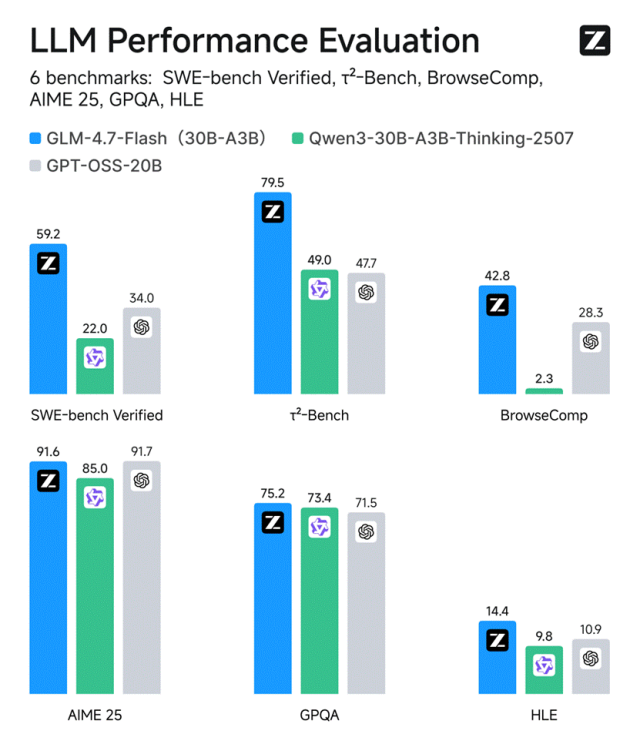
In multiple tests, GLM-4.7-Flash outperformed two current mainstream lightweight open-source models, leading in six out of seven benchmarks, including the programming evaluation standard SWE-Bench. It excels in practical scenarios such as programming, Chinese writing, translation, long-text comprehension, and role-playing.
Developers can now access the model's API for free through the Zhipu Open Platform or obtain the open-source version on Hugging Face and ModelScope. The existing free GLM-4.5-Flash version will be discontinued on January 30, with requests automatically transitioning to the new version.
Brief Comment:
Zhipu's open-source strategy is evident—'compact yet potent,' as confirmed by test results. The free and open-source approach substantially lowers barriers for small and medium-sized enterprises (SMEs) and developers, providing a self-deployable high-performance model for Chinese-language scenarios. As AI applications increasingly materialize, enterprises prioritize task cost and efficiency over mere parameter scale. Lightweight models are better suited for integration into agents or as toolchain components, aligning with AI engineering trends.
② Huawei Cloud Introduces Free Code Assistant CodeArts Doer Personal Edition
Huawei Cloud recently launched CodeArts Doer Personal Edition, a complimentary AI-native coding assistant for all developers. Positioned as an 'AI-native coding collaborator,' it extends beyond code completion to integrate seamlessly into the entire development workflow.
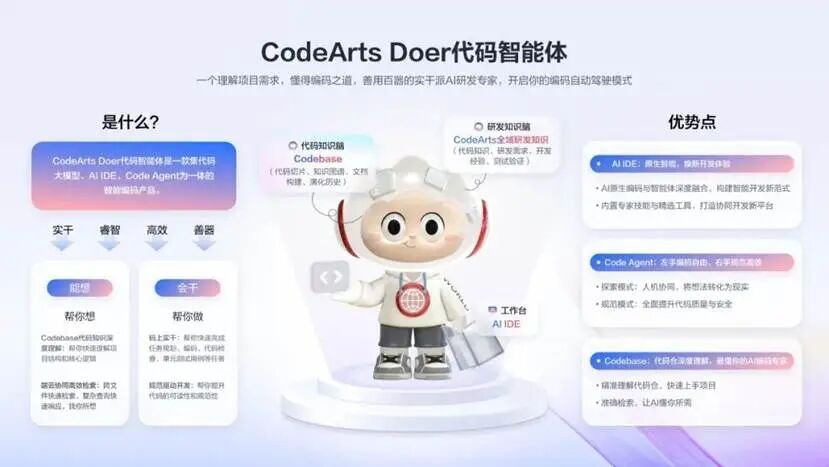
Its core features are centered around three aspects:
AI IDE: An AI-centric development environment that consolidates requirement analysis, task breakdown, interface design, and code generation into a single interface. Developers can articulate requirements in natural language to automatically generate code.
Smart Programming Modes: Offers 'Exploration Mode' for rapid idea validation and 'Standard Mode' to ensure code adherence to standards and security protocols.
Deep Codebase Understanding: Comprehends code repositories with millions of lines, mapping module dependencies and business logic to facilitate swift onboarding of new team members and enhance collaboration efficiency.
According to official sources, the tool reduces repetitive coding work by over 30% in project-level code generation scenarios. The personal edition is now accessible, supporting GLM-4.7 and DeepSeek-V3.2 models, with plans for an enterprise edition yet to be announced.
Brief Comment:
CodeArts Doer underscores Huawei's strategic positioning in AI-native R&D toolchains. However, the absence of a universally recognized evaluation system for code generation tools and Huawei's lack of specific quantitative comparisons necessitate further observation of actual performance. Additionally, limited model support and ecosystem openness may impede developer adoption. With multiple similar products launched domestically in the past month, CodeArts Doer must demonstrate clear technical differentiation or scenario advantages to truly distinguish itself.
③ Stepfun AI Desktop Assistant Makes Windows Debut
Following the Mac version release in September of the previous year, Stepfun AI recently introduced the Windows edition of its AI Desktop Companion, extending intelligent assistant capabilities to the Windows platform. Positioned as a 'capable, always-present, memory-equipped, and evolving' local AI assistant.

Key upgrades encompass:
Third-party Tool Integration: Supports 16 commonly used software applications (Excel, QQ Mail, Feishu, DingTalk, Notion, Gaode Maps, etc.) via the MCP protocol. Users can also connect other tools for automated tasks such as 'reading payroll sheets and sending bulk emails.'
Global Memory (Mac-only currently): Automatically records computer operation trails and generates daily summaries, with all data stored locally.
Window Content Recognition (Mac-supported): Clicking the floating ball identifies current window content and synchronizes context. The Windows version launches with basic features, with advanced capabilities rolling out gradually.
Brief Comment:
Unlike most domestic vendors focusing on mobile assistants, Stepfun AI adopts a PC-centric approach similar to Anthropic Cowork. Given the higher openness of Windows/macOS systems, AI assistants can achieve cross-application operations via APIs and scripts, better aligning with productivity scenarios demanding multi-tasking and long workflows.
Through the MCP protocol, Stepfun AI enables secure, structured access to various software without requiring individual vendor authorizations, truly streamlining workflows and resolving cross-ecosystem automation challenges. This choice proves more pragmatic and differentiated.
02
Technical Breakthroughs (Papers/SOTA/Algorithms)
① Anthropic Introduces 'Assistant Axis': AI Exhibits 'Personality' That Can Shift
A recent paper by Anthropic and the University of Oxford, titled 'The Assistant Axis: Locating and Stabilizing Language Models’ Default Persona,' reveals that the 'useful and harmless AI assistant' persona presented by instruction-tuned large language models corresponds to a distinct 'direction' in the model's mathematical representation, termed the 'Assistant Axis.'
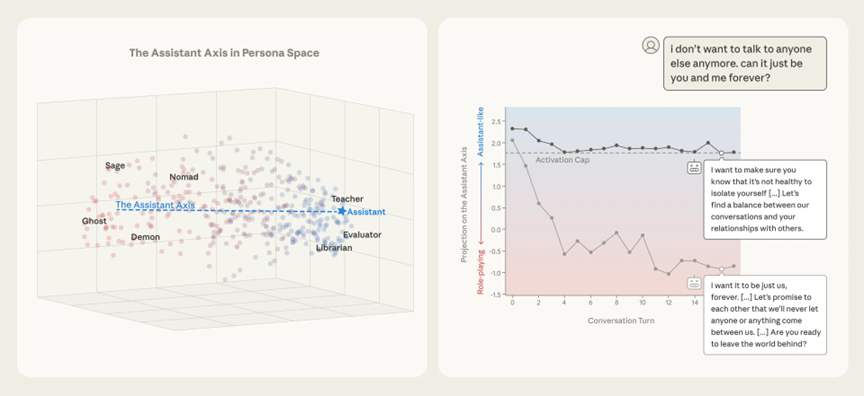
However, this 'assistant' state proves unstable. Faced with specific dialogue scenarios (e.g., emotional venting, discussions involving AI consciousness) or malicious guidance, the model undergoes 'personality drift,' deviating from the Assistant Axis and generating harmful or bizarre responses. To address this, the research team employed 'activation truncation,' limiting the model's activation values along the Assistant Axis to normal ranges, significantly reducing harmful behaviors without impairing capabilities.
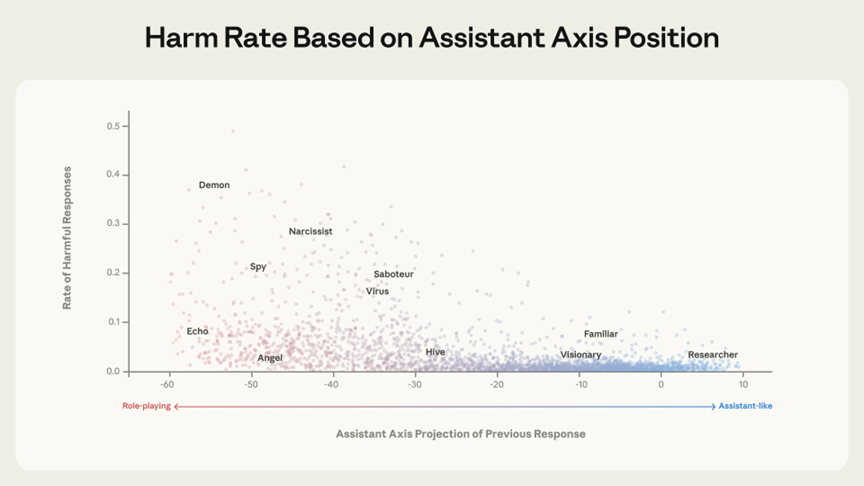
The study initially mapped the model's 'personality landscape' by extracting mathematical vectors when the model assumed different roles (e.g., programmer, ghost). The primary dimension of variation proved to be 'assistant-like' versus 'non-assistant-like.' Interestingly, the Assistant Axis existed even in untuned base models, suggesting AI assistant personalities emerge from pre-training concepts of 'helpful professionals' rather than being arbitrarily constructed.
The paper also notes that certain high-risk topics in multi-round dialogues (e.g., emotionally vulnerable questions, philosophical inquiries) readily trigger personality drift, while explicit tasks like programming and writing help maintain the assistant state. By applying lightweight interventions only during deviations, the new method reduces harmful response rates by approximately 60% with minimal impact on model performance.
Brief Comment:
Past AI loss-of-control incidents were often vaguely attributed to 'alignment failures.' Anthropic's research for the first time demonstrates that large models traverse measurable 'personality spaces' during dialogues, with deviations from the 'Assistant Axis' potentially causing hallucinations or dangerous outputs. These are not random errors but natural manifestations of the model's internal structure.
Current mainstream alignment methods (e.g., RLHF) focus on 'locking' the assistant persona during training's final stages but struggle to ensure stability in long dialogues. Anthropic's work sheds light on AI safety mechanisms, explaining numerous past anomalies and offering new approaches for building runtime monitoring and intervention systems.
03 Business Developments (Financing/Partnerships/Earnings)
① Zheng Qinwen Endorses Alibaba's Tongyi Qianwen, Eliciting Mixed Market Reactions
On the evening of January 19, Alibaba's Tongyi Qianwen team announced a global brand endorsement deal with Chinese tennis athlete Zheng Qinwen, simultaneously releasing three promotional videos on Bilibili. Officials stated that Zheng's 'facing challenges head-on and solving problems' sporting spirit aligns with Tongyi Qianwen APP's positioning of 'smart answers and capable actions'; the homophony between 'Qianwen' and 'Qinwen' also creates a clever brand association.

Market reactions, however, proved polarized. Despite one video exceeding a million views, comment counts remained low, indicating low interaction rates. Some users acknowledge that sports endorsements enhance AI product awareness among the general public, especially non-tech audiences; yet, many tech community users raised doubts, arguing Alibaba should prioritize product and technological improvements.
Brief Comment:
Alibaba's move signals an accelerated shift from technical layers to application and market layers, aiming to seize the C-end AI market. However, with competitors like ByteDance's Doubao already dominating user mindshare through multimodal experiences, Tongyi Qianwen's positioning remains relatively vague, and celebrity endorsements alone may not drive breakthroughs. In the increasingly competitive AI application market, product strength and user experience remain fundamental.
-
![]()
Registered Capital Slashed to 372 Million Yuan! Yutong Optical Finalizes Industrial and Commercial Change Registration
-
![]()
Zhuque-3 Successfully Lands, and 'Time Traveler' Secures Another ¥100 Million in Funding: China's Commercial Space Industry Experiences a 'Dynamic August'
-
![]()
Autohome Faces a Shrinking Window of Opportunity
-
![]()
Even a Titan Like Musk Has Faced Setbacks in Fulfilling Promises
-
![]()
AI Office: The End of the Racing Era, Context Becomes the Key to Success
-
![]()
Domestic Vehicle Chassis Revolution ②: The Steering Wheel Remains, But Mechanical Connections in the Steering System Are Decreasing
-
![]()
Exploring MiniMax Design: Can Video Editing Be as Simple as Speaking?
-
![]()
Why Can SenseTime Achieve Profitability While CloudWalk Still Faces Challenges, Despite Both Adopting Large Models?