In-Depth: When AI Converges with 'Nuclear Energy,' Zuckerberg Fully Backs Meta Compute
 01/21 2026
 692
692
Preface:
As the computing power demands of AI soar, clashing with the physical limits of energy supply, the rules of engagement in Silicon Valley are undergoing a complete overhaul.
Recently, Mark Zuckerberg officially unveiled the premier strategic initiative, [Meta Compute], with the ambitious goal of deploying tens of gigawatts of computing clusters within the next decade and surging towards hundreds of gigawatts in the long run. This move implies that the future power consumption of Meta's data centers will rival that of a medium-sized nation.
Accompanying this grand plan is Meta's most decisive strategic pivot in its history, marked by drastic actions against the metaverse division—once the cornerstone of the company's rebranding vision—through a 10% workforce reduction. The metaverse dream, which has consumed $60 billion, ultimately transforms into a [lifeline] for AI infrastructure.
Image Source | Network
Behind the Strategic Shift: Urgency to Accelerate in AI
Meta's strategic pivot masks a five-year odyssey of trial, error, and unwavering resolve.
In 2021, Zuckerberg rebranded the company from Facebook to Meta, proclaiming an [All-in Metaverse] ambition, with RealityLabs emerging as the core division for this vision.
At its zenith, the division boasted 15,000 employees, developing core products like Quest headsets, Ray-Ban smart glasses, and the Horizon social platform.
However, after four years, this seemingly grand narrative has devolved into a [financial sinkhole], with cumulative investments exceeding $60 billion. It has failed to establish a stable business model or attract a sufficiently large user base.
In 2024, RealityLabs' losses escalated to $17.7 billion, a new peak compared to $16.1 billion in 2023.
In stark contrast to the metaverse's dismal performance is the fierce competition in the AI sector.
While OpenAI's GPT series and Google's Gemini models continue to dominate the market's attention, Meta's Llama4 has suffered a reputation collapse.
The reality gap has compelled Zuckerberg to make a tough decision: slash the metaverse and fully support AI.
In early 2026, Meta officially announced a 10% workforce reduction at RealityLabs, eliminating 1,500 positions. Businesses like VR headsets and virtual social networks—[expensive and niche]—were the hardest hit.
Meanwhile, resources are rapidly shifting towards AI hardware. The Ray-Ban smart glasses, launched in collaboration with EssilorLuxottica, unexpectedly became a [game-changer], achieving significant success through AI interaction scenarios close to daily life.
During an investor call, Zuckerberg candidly stated: [We are cutting expenses outside our core business to fund personal superintelligence.]
Simultaneously, Meta introduced a new performance review system, [Checkpoint], employing extreme incentive and elimination mechanisms to safeguard its AI strategy.
This is complemented by a stricter elimination mechanism, where 5% of low-performing employees will be laid off, and large team managers must rate 15%-20% of their staff as low performers.
The company is willing to pay exorbitant costs for top performance but has increasingly less patience for mediocrity and inefficiency. This institutional design starkly reveals Meta's urgency to accelerate in AI.
Meta Compute: The [Physical Backbone] for Superintelligence
The launch of the Meta Compute initiative fundamentally reflects Zuckerberg's desire to control the underlying rules of AI.
In terms of specific implementation, the Prometheus cluster in Ohio (1GW) will go online in 2026, while the Hyperion cluster in Louisiana will reach 1.5GW in its initial phase and expand to 5GW by the end of 2027. Together, they can support 1.5 to 2 million high-end GPUs, sufficient to train general-purpose large models with over 10 trillion parameters.
To achieve this, Meta's capital expenditures are continuously rising.
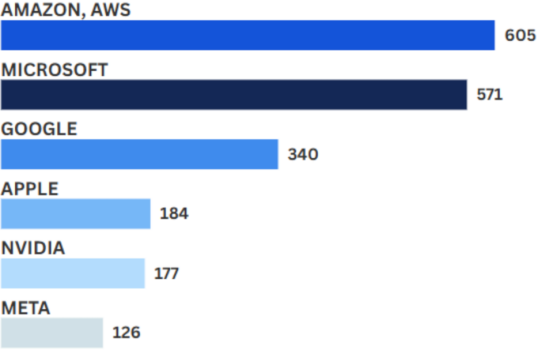
Capital expenditures reached $70-72 billion in 2025, with growth accelerating further in 2026. Management even anticipates that capital expenditures could exceed $100 billion in a single year by 2027, with 70% allocated to GPU and computing cluster construction.
More critically, the plan's core objective is [superintelligence], a form of general artificial intelligence surpassing human cognitive capabilities.
Zuckerberg has publicly stated that the ultimate competition in AI will be over infrastructure. Without sufficient computing power, even the most advanced algorithms are merely [castles built on sand].
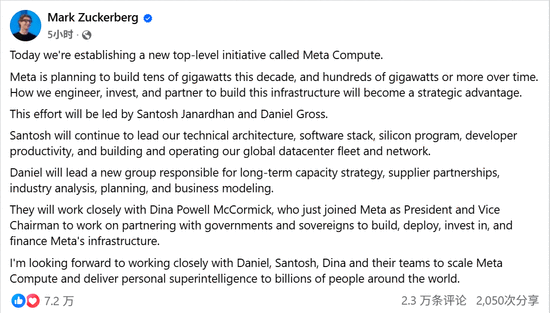
Currently, Meta lags in the large model race, with the Llama 4 model underperforming in market response. Computing shortages have directly slowed recommendation efficiency in its advertising business, forcing Meta to [invest in infrastructure to buy time] by laying down a computing foundation in advance to bridge the gap in model iteration.
With OpenAI, Google, and Microsoft holding early advantages in large models, Meta must create differentiated barriers to break through.
The strategy of compensating for model shortcomings with infrastructure barriers to achieve a competitive edge in AI mirrors Meta's early logic of monopolizing user traffic through social infrastructure.
The combination of AI and nuclear energy represents a [long-term] investment spanning a decade. Commercializing SMR technology, constructing nuclear power facilities, and deploying computing clusters all require lengthy cycles.
By betting on [AI + nuclear energy] now, Meta aims to secure growth certainty in the superintelligence era of the 2030s and beyond.
Assembling an Avengers League for the $600 Billion AI Infrastructure
Behind Zuckerberg's $600 billion gamble lies a clear formula for computing supremacy: Computing Supremacy = Energy × Chips / Time × Risk.
To support this $600 billion AI infrastructure blueprint, Zuckerberg has meticulously assembled a core team—a [three-pronged approach] for strategic execution and a [Superintelligence Avengers League] for technological breakthroughs.
This talent war is unprecedented in scale. Meta lured Apple's AI department head, Ruoming Pang, with a $200 million compensation package, followed by the recruitment of two core Apple AI researchers, Mark Li and Tom Gunter.
It successfully poached seven core researchers from OpenAI, machine learning experts from Google DeepMind, and core developers from Anthropic, with some talent offers reaching $100-200 million, comparable to the salaries of top Wall Street CEOs.
Meta acquired a 49% stake in data annotation leader ScaleAI for $14.8 billion, bringing the under-30 founder, Alexander Wang, on board.
It swiftly acquired voice AI startup PlayAI, integrating its team to strengthen voice interaction technologies.
Within 20 days, Meta completed the acquisition of Manus, executing a classic [acqui-hire] maneuver.
This [dream team] was integrated into the newly established Meta Superintelligence Lab (MSL), forming an AI super-engine combining research, development, and application.
The 6.6GW Power Race Where AI Meets Nuclear Energy
The goal of [hundreds of gigawatts of computing power] is essentially an energy competition.
The International Energy Agency predicts that by 2035, U.S. data center electricity demand will surge from 200 terawatt-hours annually to 640 terawatt-hours, equivalent to Germany's national annual consumption.
The U.S. grid is already overburdened. Texas receives dozens of gigawatts of data center power requests monthly but can only approve slightly over 1GW.
Most transmission lines are over 40 years old, with global shortages of critical equipment like transformers. Building a new high-voltage transmission line takes at least seven years, while constructing a new power plant requires around five years.
For AI giants, time is money. A medium-sized data center going online half a year earlier is worth billions of dollars. No one is willing to wait for grid upgrades.
In this power grab, Zuckerberg has chosen the most aggressive and visionary path: betting on nuclear energy. Meta's energy strategy (strategy) is clear and decisive.
① Secure long-term nuclear power supply: Signed agreements with three nuclear energy companies—Vistra, TerraPower, and Oklo—to secure 6.6GW of nuclear power by 2035.
② Deploy next-generation nuclear technology: Collaborated with Oklo, supported by OpenAI CEO Sam Altman, to build a 1.2GW nuclear energy park in Ohio, consisting of 16 small modular reactors, expected to supply power by 2030.
Partnered with TerraPower, founded by Bill Gates, to construct two 345MW reactors with options to purchase six more, with the first projects completing in 2032.
③ Fill short-term gaps: Signed 20-year contracts to directly purchase power from three operational traditional nuclear plants owned by VistraCorp, addressing the [immediate but insufficient] challenge.
According to BloombergNEF, investments in new nuclear reactors to support Meta's data centers alone will exceed $14 billion.
Epilogue:
Today, as algorithmic optimization approaches physical limits, energy is becoming the primary bottleneck for AI development.
If the limit of computing power is electricity, then what lies beyond electricity?
AI's progress has never been solely a victory of algorithms. Fundamentally, it is a competition over humanity's efficiency in utilizing energy.
Whoever can obtain more computational energy at lower costs holds the key to stronger AI.
Unlike Zuckerberg's nuclear energy route, Elon Musk's xAI purchased entire power plant equipment overseas and shipped it to the U.S. to build a micro-grid.
Google spent $4.8 billion acquiring power generation company IntersectPower to achieve [energy independence].
Microsoft committed to covering all grid upgrade costs, isolating industrial and residential electricity expenses.
But regardless of the path, an energy reconfiguration triggered by AI has arrived. Tech giants are transforming from mere energy consumers into participants in energy infrastructure.
Partial References: NetEase Technology: [Zuckerberg Presses the 'Nuclear Button'! $600 Billion Gambling on AI Infrastructure, Metaverse Layoffs of 10% to Fund AI], Yang Guojie: [Zuckerberg's Trillion-Dollar Gamble: Meta's AGI Last Stand], Blue Energy: [Meta's Multi-Billion-Dollar Gamble: Zuckerberg Launches Computing Supremacy Dark War with 'National-Level' Energy Projects], Tencent Technology: [Power Shortage, Power Shortage, Power Shortage! Building a Grid Takes 7 Years, Musk and Zuckerberg Can't Wait a Day]
-
![]()
Registered Capital Slashed to 372 Million Yuan! Yutong Optical Finalizes Industrial and Commercial Change Registration
-
![]()
Zhuque-3 Successfully Lands, and 'Time Traveler' Secures Another ¥100 Million in Funding: China's Commercial Space Industry Experiences a 'Dynamic August'
-
![]()
Autohome Faces a Shrinking Window of Opportunity
-
![]()
Even a Titan Like Musk Has Faced Setbacks in Fulfilling Promises
-
![]()
AI Office: The End of the Racing Era, Context Becomes the Key to Success
-
![]()
Domestic Vehicle Chassis Revolution ②: The Steering Wheel Remains, But Mechanical Connections in the Steering System Are Decreasing
-
![]()
Exploring MiniMax Design: Can Video Editing Be as Simple as Speaking?
-
![]()
Why Can SenseTime Achieve Profitability While CloudWalk Still Faces Challenges, Despite Both Adopting Large Models?