Global AI Titans Flock to "The Three-Body Problem": How a Chinese Intellectual Property Became the Benchmark for Tech Innovation
 01/23 2026
 573
573
The arena of large-scale AI models is entering a transformative new phase.
As technical metrics such as parameter scale, benchmark scores, and reasoning speed reach maturity, the industry's focus is pivoting to a new competitive frontier: differentiation has emerged as the new battleground.
A critical question arises: How can tech giants demonstrate that their AI is "genuinely unique"?
The answer may lie in envisioning the "future."
While AI capable of coding is now commonplace, convincing consumers, investors, and partners of its superior grasp of the "future" demands a cultural passport—a validated, authoritative, and consensus-driven framework for the future to substantiate its capabilities.
Thus, they have all converged on a singular direction: leveraging hardcore sci-fi intellectual property (IP).
When Large Models Encounter the "Three-Body Barrier"
Why has hardcore sci-fi IP become indispensable for tech giants? The rationale is straightforward: standardized tests can no longer distinguish between competitors, necessitating real-world narrative scenarios to validate capabilities.
When technical performance fails to create insurmountable gaps, "narrative ability" becomes the new core competitiveness. Today, all large models can answer questions correctly; the true test lies in whether they can craft a compelling future narrative. Hard sci-fi IP provides a pre-existing, logically coherent framework for future imagination.
Notably, over the past two years, a trend has emerged: global tech giants, when showcasing their AI's core capabilities, consistently reference the same Chinese sci-fi IP.

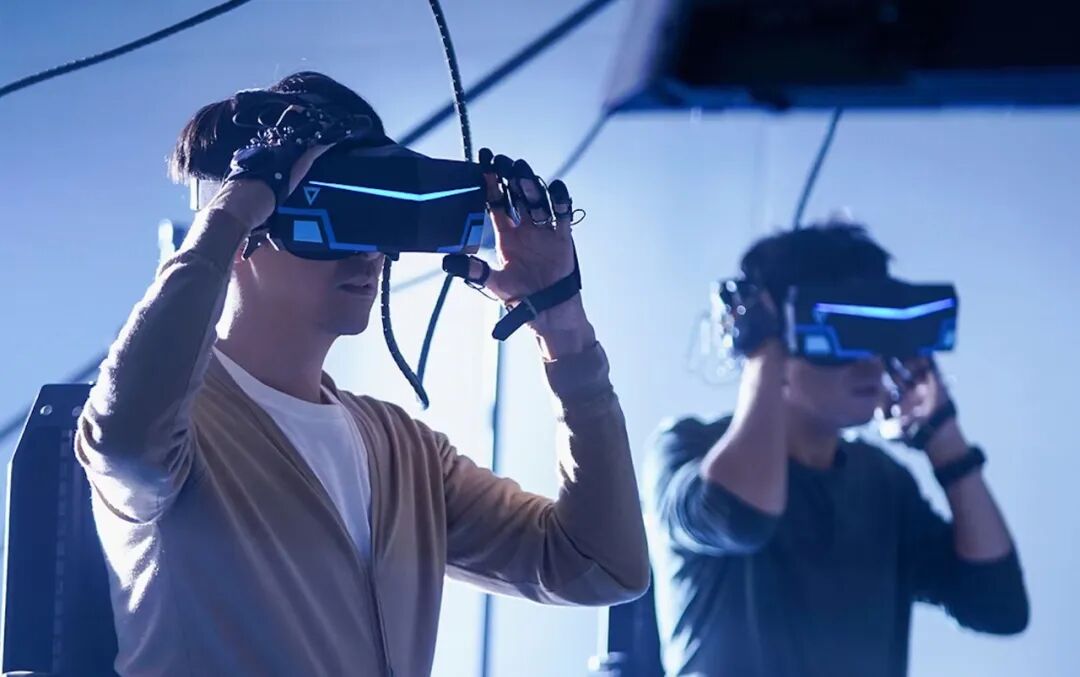
In 2024, when Apple unveiled its Vision Pro, it specifically selected scenes from "The Three-Body Problem" TV series for its demonstration. The Red Coast Base radar and Operation Guzheng, combined with immersive visual and auditory effects, transported users into the suffocation moment—a civilization's struggle on the brink of destruction. Meanwhile, in its Gemini global promotional video, Google also chose "The Three-Body Problem" to showcase its technological prowess, posing physical questions about the Three-Body universe to Gemini.

The question then arises: Why has a Chinese sci-fi IP become the preferred choice for global tech giants?
Readers of "The Three-Body Problem" will appreciate its uniqueness: it constructs a "cultural Turing wall" that is both hardcore and complex, distinctly Chinese yet universally resonant.
For this reason, when tech giants seek to validate multiple AI capabilities, "The Three-Body Problem" serves as an exemplary repository of material.

From a textual perspective, the 880,000-word trilogy of "The Three-Body Problem" presents a unique challenge: with a timeline spanning millions of years and intricate character relationships across two civilizations, from Operation Guzheng to the Wallfacer Project, from the Dark Forest to the Universe Reset, every detail embodies complex civilizational logic. If AI cannot comprehend such an ultra-long narrative structure, it cannot truly "understand" "The Three-Body Problem."
Of course, when tech giants choose "The Three-Body Problem" to test AI, they value more than just its nearly million-word volume. The underlying logical chains—whether they can derive variant models under different civilizational parameters while maintaining core assumptions unchanged—are the crux of this test.
For instance, concepts like the Dark Forest theory, technological explosion, and dimensional reduction strikes are not mere fantasies but thought experiments grounded in game theory, physics, and sociology. Particularly, the derivation process of the Dark Forest theory involves axiomatic assumptions, interest analysis, and strategic choices, forming a complete game theory model.
This tests AI's ability to "reason" rather than "recite answers"—a potentially stricter evaluation than standardized tests.
Meanwhile, the visualized imagination presented in "The Three-Body Problem" offers another layer of validation for AI testing: the ghostly countdown on the retina, fragments of four-dimensional space, the Waterdrop probe, and the binary foil... These highly visualized scenes provide a possible "proving ground" for AI video generation technology. These imaginations are both scientifically grounded and artistically tense, allowing AI's generation quality to undergo dual scrutiny: it must not be too sci-fi to defy physical intuition, nor too realistic to lose imagination.
Based on these observations, it is foreseeable that more tech companies will adopt "The Three-Body Problem" for AI testing in the future. Such "untouched" territories, logically consistent, imaginatively explosive, and not yet overly polluted by AI training data, may become crucial resources for tech giants.
The underlying logic is simple: "The Three-Body Problem" still retains a certain degree of "freshness" to some extent. When publicly available internet texts are exhausted and classical literary works become commonplace, the narrative rhythm, cultural metaphors, and thinking patterns of "The Three-Body Problem," especially in its original Chinese version, have become unique training resources for Chinese AI.
Why "The Three-Body Problem" Became the "Utility" for AI Giants
From R&D to testing and validation, "The Three-Body Problem" may be becoming the default option for large companies to prove their capabilities—as indispensable and taken for granted as utilities like water, electricity, and coal.
But with so many hardcore sci-fi IPs available, why has only "The Three-Body Problem" become the "infrastructure"?
The reason lies in its "first and only" ecological niche.
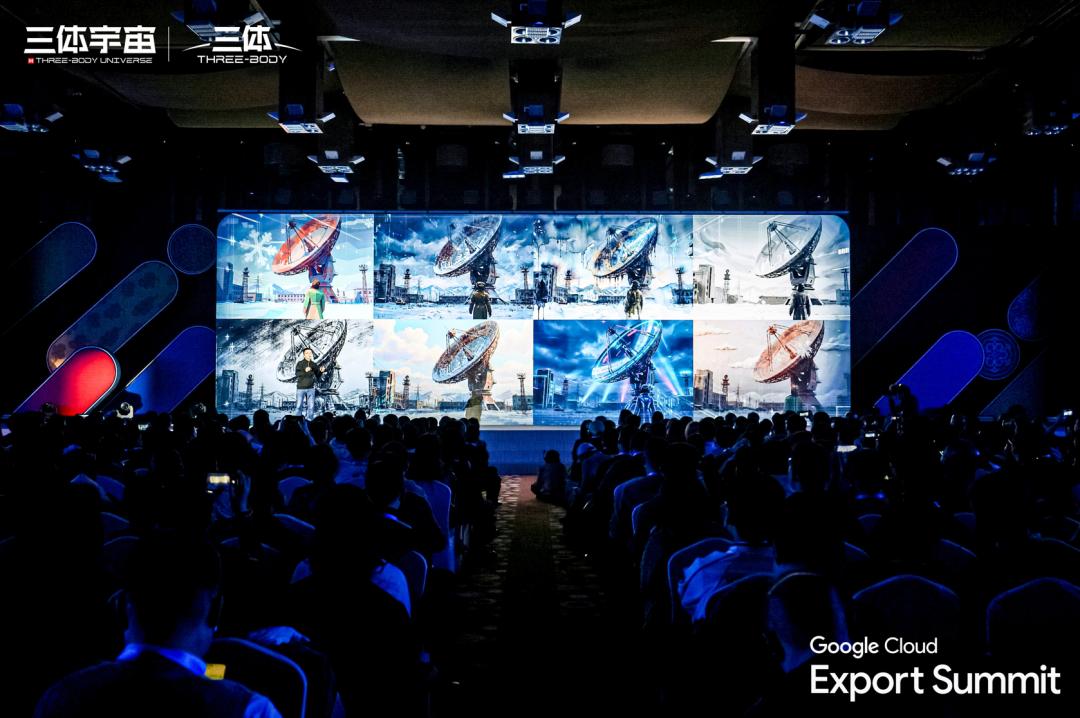
The formation of an ecological niche is never planned but results from market consensus. At the 2026 Google Cloud Global Summit held on January 15, The Three-Body Universe, the global exclusive copyright holder and operator of the Three-Body IP, collaborated with Google Cloud. Beyond using Gemini's ultra-long text processing capabilities to organize the civilizational timeline of "The Three-Body Problem" trilogy into a logical map, they also employed the Veo video generation model to transform the book's sci-fi settings into visual scenes.
Leading companies like Google and Apple, by pioneering the use of "The Three-Body Problem" to validate AI capabilities, have set an example for the industry. Later entrants aiming to prove "we can do it too" find the most efficient way is to join the same track. This resembles collision testing in the automotive industry: once Volvo establishes safety standards, the entire industry must adopt the same system for market recognition.
The demonstration effect of these leading companies is immense; their choices serve as a quality certification, signaling to the market that "this is the gold standard for evaluating AI capabilities."

Admittedly, "The Three-Body Problem" lacks the rigid plot structure of "The Lord of the Rings" nor the overly open-endedness of the Cthulhu Mythos, which risks losing evaluative standards. It strikes a golden balance between "certainty" and "possibility"—sufficiently hardcore to create technological gaps yet open enough to allow interpretations at various levels.
This "just right" characteristic empowers both individual creators and tech giants. While the latter need no further elaboration, for individual creators, The Three-Body Universe recently partnered with Bilibili to launch the "AI Creation Contest: Three-Body Problem Track," with a prize pool reaching the million-yuan level, attracting a surge of creators. Participants can use AI tools to create secondary works based on "The Three-Body Problem's" worldview. On the surface, it appears fan-oriented, but the deeper logic may be to transform the Three-Body IP into a creative "canvas" that can be continuously interpreted and enriched, providing a release point for creators' inspiration and AI's potential.
How vast is this "release point's" potential? According to Bilibili, over 80 million users view AI-related content monthly on the platform. When a top-tier IP like "The Three-Body Problem" enters this pool, the resulting chemical reaction means each creation could mobilize enormous traffic, reaching millions or even tens of millions of viewers, translating AI productivity into cultural influence.

Additionally, in terms of national popularity, "The Three-Body Problem" remains the "origin point" of Chinese sci-fi. This doesn't diminish other sci-fi works but highlights that, in terms of public recognition, commercial value, and narrative completeness, "The Three-Body Problem" has completed its market education, resonating emotionally with investors, media, and users around the core of "giving civilization to the years, rather than years to civilization." A less popular IP would incur high explanation costs and fail to gain market traction.
While the U.S. has cyberpunk narratives like "The Matrix" and "Terminator," which are indeed used for AI testing, they represent caution and confrontation with technology. In contrast, "The Three-Body Problem" offers a grander, more neutral cosmic framework, discussing universal laws of civilizational evolution rather than simple human-machine opposition.
In this bidirectional embrace between sci-fi IP and AI, no one enforces the use of the Three-Body IP for AI testing, yet everyone defaults to it as if it were infrastructure. Simultaneously, it's evident that The Three-Body Universe is breaking boundaries between content, technology, and consumption scenarios through sustained commercialization, making the Three-Body IP a "high-value scenario" connecting cutting-edge technologies.
Will the Ultimate Fate of Large Models Be to Become Better "Storytellers"?
Returning to the original question: What do large models ultimately compete on?
Technology will converge, computing power will become commoditized, and APIs will engage in price wars. However, humanity's demand for good stories remains eternally unchanged. When technical performance fails to create absolute gaps, "narrative ability" becomes the core competitiveness. This narrative ability refers not only to the model's text generation level but also to the entire storytelling system through which tech companies persuade the market.
In fact, the more powerful AI technology becomes, the more it needs humanistic narratives to anchor its value. When models can instantly generate million-word texts, mere "writing ability" ceases to be a selling point.
The key lies in whether it can grasp the humanistic weight of phrases like "giving civilization to the years, rather than years to civilization" from "The Three-Body Problem." Can it convey the metaphor of the "Waterdrop probe"—absolutely smooth on the surface yet harboring lethal intent—while describing it?
Looking at the current tech industry, this "narrative ability" is reshaping the competitive landscape. Steve Jobs once said, "The most powerful person in the world is the storyteller." Different stories lead to different valuation models and financing capabilities.
Thus, the value of the Three-Body IP lies not only in its past success but also in its ability to integrate into tech companies' "narratives" as a necessary component of future innovation.
When "The Three-Body Problem" transforms from a book into an "engine" and from a story into a "tool," the era of Chinese sci-fi truly begins.
This also heralds a grander shift: we are moving from a "technology-driven content" era to a "content-driven technology" era. In the past, Hollywood used CGI to bring sci-fi novels to the screen; now, AI companies use sci-fi IP to validate technological capabilities. This reversal signifies that content itself has become the roadmap for technological evolution. Whoever possesses a better future imagination framework holds the narrative power over technological development.
On the eve of AI reshaping everything, the ceiling of technology has never been computing power but our way of imagining the future. When sci-fi becomes technological infrastructure, those who can tell stories will win the war.
-
![]()
Registered Capital Slashed to 372 Million Yuan! Yutong Optical Finalizes Industrial and Commercial Change Registration
-
![]()
Zhuque-3 Successfully Lands, and 'Time Traveler' Secures Another ¥100 Million in Funding: China's Commercial Space Industry Experiences a 'Dynamic August'
-
![]()
Autohome Faces a Shrinking Window of Opportunity
-
![]()
Even a Titan Like Musk Has Faced Setbacks in Fulfilling Promises
-
![]()
AI Office: The End of the Racing Era, Context Becomes the Key to Success
-
![]()
Domestic Vehicle Chassis Revolution ②: The Steering Wheel Remains, But Mechanical Connections in the Steering System Are Decreasing
-
![]()
Exploring MiniMax Design: Can Video Editing Be as Simple as Speaking?
-
![]()
Why Can SenseTime Achieve Profitability While CloudWalk Still Faces Challenges, Despite Both Adopting Large Models?