China's AI Efficiency Philosophy Shines at Davos
 01/27 2026
 715
715
By Liang Tian
Source: Node Finance
There's no denying that AI has emerged as the linchpin of global economic growth.
At the World Economic Forum in Davos this year, influential voices made bold predictions. Elon Musk speculated that we might witness AI surpassing human intelligence by the end of the year, while Microsoft CEO Satya Nadella cautioned that large corporations are more susceptible to disruption in the AI era.
The influx of fresh perspectives was staggering. From Node Finance's vantage point, the panel discussion titled "Native AI Application-Driven Enterprises" truly resonated with the challenges businesses face. The clash of viewpoints among the panelists made this year's Davos more engaging than ever.
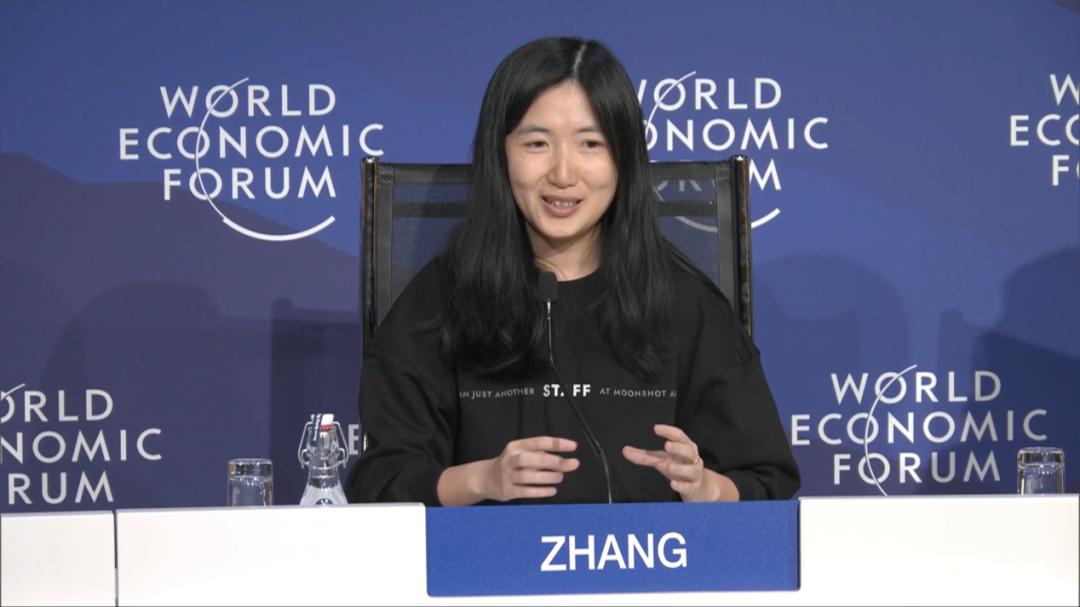
The panel featured industry insiders, including Ravi Mhatre, an investor in Anthropic and founder of Lightspeed; Bipul Sinha, a venture capital partner at Lightspeed and CEO of Rubrik; and Zhang Yutong, president of Kimi.
A year after DeepSeek R1 revolutionized AI in January of the previous year, Kimi, as a representative of Chinese models, showcases how Chinese AI leverages "extreme efficiency" to make its mark globally, despite constrained computing power.
What distinguishes companies that merely use AI from those truly driven by it?
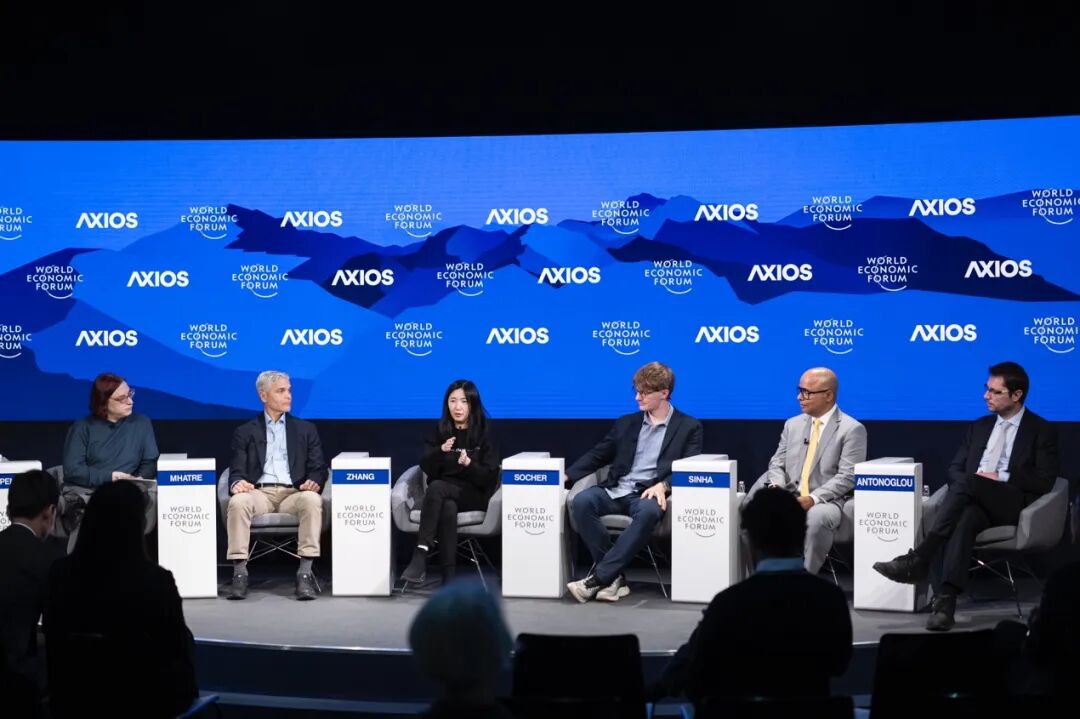 World Economic Forum Annual Meeting 2026 - Dialogue on "Native AI-Driven Enterprises"
The consensus is clear: AI is reshaping businesses.
According to Accenture, by 2025, 87% of Chinese companies have ramped up their AI investments, with over half reporting that their AI projects are progressing faster than anticipated.
However, the implementation has been disjointed. McKinsey research reveals that only 1% of business leaders believe their organizations have reached a mature stage of AI application.
Despite significant investments, the results have been lackluster. This discrepancy between high investment and low maturity sets the stage for AI discussions at this year's Davos Forum.
Where exactly are companies falling short?
Rubrik CEO Bipul Sinha pinpointed the issue: "You can't equate using chatbots and AI search with true AI transformation."
Traditional companies grapple with organizational bloat and operational inertia. When attempting AI transformation, they often shy away from overhauling existing workflows, opting for minor adjustments instead. This leads to superficial AI implementations that fail to penetrate the core of the business.
During the forum, panelists provided clear, quantifiable definitions for AI-driven enterprises in terms of organizational structure and collaboration methods.
"An enterprise qualifies as AI-driven if at least three to five workflows across all business lines have achieved end-to-end AI implementation. For a company to be deemed a leader in AI transformation, over half of its employees' tasks must have seen a 20% performance improvement," Bipul Sinha proposed.
Zhang Yutong defined AI-driven enterprises from the perspective of organizational structure, introducing the "human-agent ratio."
Currently, AI is providing unprecedented operational leverage to companies. By focusing solely on application-layer development, a team can have fewer than 10 members but hundreds of intelligent agents working alongside them, assisting in completing a vast amount of work at the operational level. "Therefore, I believe that AI is currently granting all companies extremely high operational leverage," she said.
Speaking of AI-driven transformation, Claude Code serves as a prime example. Ravi Mhatre noted that it was launched just eight months ago and has already achieved an annualized revenue of $1.5 billion, with nearly 15 million developers on board. Companies capable of producing disruptive results with AI often break free from traditional organizational structures, processes, and work methods.
Once organizational structures become flexible, deeper changes occur in interaction methods.
A popular saying goes, "Software is eating the world." However, during the panel, a core consensus emerged: intelligence is replacing code and graphical user interfaces (GUIs) as the new universal language.
Ravi Mhatre predicted that AI would first eliminate numerous manual processes that have yet to be digitized. However, in applications with large user bases and high experience requirements, engineering and design will still need to be human-led for a considerable time. In the long run, the ultimate form will be hybrid collaboration between "humans + AI," rather than complete automation.
This aligns with Zhang Yutong's viewpoint. She described that future software will become "intangible," with humans no longer needing to click hundreds of buttons or memorize complex formulas to operate GUIs. Instead, they will use natural language to invoke all functions through intelligent agents.
With software becoming "intangible," user interface (UI) and user experience (UX) transformations follow suit.
"People can master AI usage by clearly describing their intentions and then invoking all functions of existing software through AI," Zhang Yutong said. If existing software cannot meet demands, AI can even write personalized tools on the spot and deliver final results directly.
Ravi Mhatre added that we are on an exponential curve of "intelligence intensity explosion," where "intelligence" will become a new language for expressing automation intentions. As demonstrated by Cursor, code can be "vibe-coded" with robustness and nearly reach production-level quality.
If AI can directly replace well-trained programmers in engineering scenarios, then, regarding the longer-term future, a radical prediction arises—the best AI will be built by AI, not humans.
This viewpoint sparked discussions on the degree of autonomy. Zhang Yutong proposed a prerequisite: before having a truly useful and scalable AI system, AI must first possess long-term autonomous execution capabilities like humans.
The other guests seemed to concur more with the viewpoint of prioritizing long-term autonomous execution capabilities.
While AI technology has indeed advanced rapidly, from the perspective of reshaping corporate organizational structures and workflows, there is still much for humans to explore gradually.
Overall, most viewpoints from the panelists shared common ground. Behind this consensus, we noticed two forces representing the open-source and closed-source approaches of Chinese and U.S. AI, respectively. This is not just a difference in development routes but also a clash of two development philosophies between China and the U.S. in exploring artificial general intelligence (AGI).
Computing Power Is Not the Only Variable: Where Does China's AI Competitiveness Come From?
Since the release of DeepSeek R1 in January of the previous year, Chinese open-source large models have rapidly expanded their global market presence with their high performance and low-cost characteristics.
On GitHub, the global open-source community, the popularity of Chinese open-source projects such as DeepSeek, Qwen, and Kimi continues to soar. Silicon Valley companies like Meta, Airbnb, and Thinking Machines Lab have adopted Chinese AI technology architectures as research and development samples.
Chinese large models are initiating a reverse technology export to Silicon Valley. According to joint statistics by Goldman Sachs and OpenRouter, by the end of 2025, nearly 80% of U.S. startups had adopted Chinese large models.
Nowadays, it has become a consensus in the industry that "Chinese open-source models can significantly reduce development costs," with some startups able to lower related costs to 10%-20% of the original closed-source solutions.
However, this achievement was made under the backdrop of chip resource blockades. Given that computing power is comparable to the driving force of large models, how has China's AI achieved such results when computing power is constrained?
This is attributed to three major driving forces in China's current AI competition, as expressed by Zhang Yutong, a guest in another dialogue titled "China's AI + Economy."
First is the empowerment of a large-scale market.
China's vast manufacturing and retail sectors provide AI with unique usage scenarios. The combination of massive data and complex business logic enables Chinese companies to build truly scalable systems in production processes, allowing for efficient iteration of technologies in practical applications.
Second is society's inclusive and open attitude toward new technologies.
Recalling the development of new energy vehicles, solar energy, smartphones, and autonomous driving, Zhang Yutong believes that Chinese users and enterprises show a high willingness to embrace new productivity-enhancing tools. "The openness to technology and the attitude of embracing new technologies are unique advantages of China," she added.
Finally is the "infrastructure-first" mindset.
China's continuous investment in power supply, cross-regional highways, and multi-city mega data centers has effectively reduced energy acquisition costs. This leading position in digital infrastructure ensures that frontier innovations are not hindered by energy bottlenecks, providing a solid foundation for technological breakthroughs.
China's Alternative Path to Breakthrough in AI
Besides the macro environment, enterprises have also forged differentiated routes under limited resources.
In contrast, in 2025, OpenAI, NVIDIA, and Oracle jointly invested over $2 trillion in infrastructure construction.
If Silicon Valley is exploring the upper limits of AI computing power, China is exploring the ultimate efficiency of AI—abandoning the arms race of blindly competing for computing power scale, focusing on capability density, and building open weights technology solutions that ordinary people can use based on an open-source ecosystem.
Take Kimi as an example. With only 1% of the resources of top U.S. labs, "from the first day of entrepreneurship, we were soberly aware that Chinese startups do not have the conditions to indiscriminately pile up computing power," Zhang Yutong revealed.
"This forces us to achieve extreme efficiency through extensive basic research innovations." She disclosed that Kimi has invested significant effort in introducing engineering thinking into the research process, ensuring that all algorithmic innovations can operate stably on a large scale in production systems.
For instance, Kimi is the world's first company to successfully implement the Muon optimizer in large language model training. Meanwhile, its self-developed linear attention mechanism (Kimi Linear) has significantly surpassed traditional full-attention systems in processing speed, achieving a leap in efficiency.
Behind these complex technical terms lies a simple logic: by reconstructing underlying algorithms, the same computing power can produce higher intelligence. This efficient utilization of resources has accumulated experience and intuition that cannot be obtained solely by piling up computing power.
As Zhang Yutong mentioned in the panel, AI will reconstruct organizational efficiency and collaboration forms, which in turn benefits Kimi itself.
Kimi, which has topped global open-source rankings multiple times, has only 300 employees. This efficiency advantage is rapidly transforming into democratized productivity.
"Nowadays, a large number of resumes we receive are no longer PDFs but personal website links. Even people who know nothing about coding can showcase their talents through AI-generated web page code. AI has democratized professional skills, unleashing the individual creativity of everyone," Zhang Yutong said.
When asked at Davos whether a new "Chinese AI Moment" would emerge this year, Zhang Yutong smiled and responded, "We will soon release a new model."
Conclusion
Many describe the current situation as a technological competition between Chinese and U.S. AI, but this is not a 100-meter sprint; it is a marathon. Therefore, AGI requires the long-term faith of idealists.
China's AI has gone from early lag to nearly catching up, writing a new chapter in the global narrative of AI.
Nowadays, the essence of the gap between China and the U.S. lies in "path selection." If we only look at the capabilities of a single top model, a gap does exist. However, when considering cost-effectiveness and ecological capabilities, Chinese enterprises and Silicon Valley are both competitive and complementary. Currently, Chinese AI is becoming an outstanding representative of efficiency, innovation, and engineering capabilities, providing new possibilities for global AI development and corporate innovation.
-
![]()
Registered Capital Slashed to 372 Million Yuan! Yutong Optical Finalizes Industrial and Commercial Change Registration
-
![]()
Zhuque-3 Successfully Lands, and 'Time Traveler' Secures Another ¥100 Million in Funding: China's Commercial Space Industry Experiences a 'Dynamic August'
-
![]()
Autohome Faces a Shrinking Window of Opportunity
-
![]()
Even a Titan Like Musk Has Faced Setbacks in Fulfilling Promises
-
![]()
AI Office: The End of the Racing Era, Context Becomes the Key to Success
-
![]()
Domestic Vehicle Chassis Revolution ②: The Steering Wheel Remains, But Mechanical Connections in the Steering System Are Decreasing
-
![]()
Exploring MiniMax Design: Can Video Editing Be as Simple as Speaking?
-
![]()
Why Can SenseTime Achieve Profitability While CloudWalk Still Faces Challenges, Despite Both Adopting Large Models?