AI Applications in 2026: Super Gateways, Digital Employees, and Embodied Intelligence
 02/03 2026
 663
663
By 2026, artificial intelligence (AI) is set to transition from being a mere convenience to the driving force that reshapes both our digital and physical landscapes. On the consumer front, AI could evolve into a super gateway, adept at comprehending and coordinating a multitude of services. In the business sector, it will metamorphose into a deeply integrated “digital employee,” capable of autonomously reconfiguring business processes. More significantly, as intelligent agents emerge from screens in the form of humanoid robots, they will start to make their presence felt in real-world factories and on streets.
Hence, when we talk about AI, we're not just discussing technology; we're exploring the dawn of a new era.
01. Consumer Side: The Rise of AI Super Gateways and the Transformation of the Internet Value Chain
Specifically, for consumers, AI applications are transitioning from being novel tools to becoming central hubs that can deeply integrate and orchestrate real-world services. From an industry standpoint, the primary drivers of traffic to consumer-facing AI applications remain the traditional Mobile Internet giants. These companies can leverage the mature commercialization strategies from the mobile internet era and apply them directly to monetize AI applications.
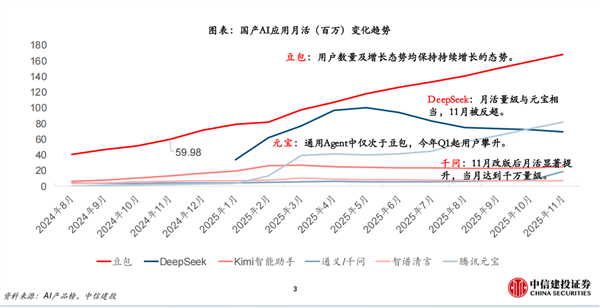
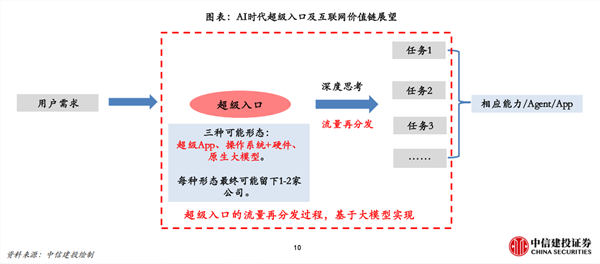
A more profound transformation is underway in the reshaping of value flow. During the mobile internet era, super apps generated value by aggregating traffic and distributing it to third-party services. In the AI era, the value of super gateways lies in “service orchestration.”
Users no longer need to manually search, compare prices, and navigate through multiple apps. Instead, they can simply voice a complex request, such as “plan a family vacation,” to an AI assistant. The assistant will then automatically understand the intent, access various service interfaces like maps, travel platforms, and ticketing systems, and provide a comprehensive solution or even complete the bookings directly. This signifies a shift in the internet's value chain from “traffic distribution” to “task resolution,” with the core link migrating to AI gateways that best understand user intent and efficiently orchestrate service ecosystems.
The driving force behind this transformation is the evolution of intelligent agent technology from “chat and dialogue” to the “era of accomplishing tasks.” Major internet companies are reshaping their core ecosystems—whether it's Tencent's social networks, Baidu's search capabilities, ByteDance's content platforms, or Alibaba's e-commerce transactions—through AI. They are vying to build the most robust ecological moats by integrating a broader range of third-party services via open protocols. Thus, the competition in 2026 essentially revolves around “who becomes the primary orchestration hub for users' digital lives,” with the winner setting the rules for value distribution in the next internet era.
02. Business Side: Deep Integration in Vertical Applications
As AI evolves into a super gateway for understanding intent and orchestrating services on the consumer side, this task-resolution-centric transformation is also reshaping the enterprise landscape. After years of development, AI is crossing the threshold from conceptual demonstrations to large-scale commercialization. Its role is shifting from an efficiency-enhancing auxiliary tool to a “digital employee” capable of autonomously closing loops to solve problems and even reshaping business processes.
This transformation is primarily driven by the growing maturity of intelligent agent technology. Today's AI is no longer just proficient in chatting or content generation; it has evolved into a complete capability loop encompassing “perception-planning-action-reflection.” This means it can autonomously break down tasks, invoke tools, and execute them based on a vague goal. More importantly, multi-agent collaboration technology is becoming widespread, enabling enterprises to assemble virtual teams of intelligent agents with diverse expertise to collaborate on complex tasks, such as simultaneously handling market analysis, production scheduling, and customer service. This expands automation from single-point tasks to entire business processes.
Secondly, enterprise demand is shifting from exploratory “technology experimentation” to pragmatic “efficiency imperatives.” As the cost of using large models decreases, the return on investment for AI applications becomes clearer. The focus for enterprises is no longer “whether to use AI” but “how to use AI to solve specific business problems.” This drives AI deeper into vertical domains with complex business logic and high professional barriers, such as finance, manufacturing, healthcare, and government services. In these scenarios, the value logic of AI fundamentally changes: it is no longer just about reducing labor costs but directly creating revenue and new value by optimizing decisions and expanding service boundaries.
03. Convergence: Accelerated Integration of Embodied Intelligence with the Physical World
Moreover, as AI deeply penetrates vertical industries and plays a pivotal role in business processes, its impact is no longer confined to the digital realm.
The shift from virtual to physical worlds is propelled by the rise of “physical AI.” This refers to artificial intelligence that not only thinks and generates content but also understands and applies physical laws like gravity and friction to command entities in the real world. Humanoid robots and autonomous vehicles are the leading representatives of this transformation.
Dual technological breakthroughs are fueling this convergence. On one hand, robots' “cognitive intelligence” has significantly improved through large models, enabling them to understand and plan complex tasks. On the other hand, “physical intelligence” is rapidly advancing, with humanoid robots now capable of performing dynamic tasks like walking and grasping. More critically, companies like NVIDIA are developing “world models” that construct highly realistic physical environments in virtual space, allowing robots to undergo extensive training and accelerate their reliable deployment in the real world.
At the application level, signs of large-scale adoption are becoming evident. Autonomous driving is moving from regional testing to broader urban services, with companies like Tesla expected to receive approval for fully autonomous driving in more regions. Humanoid robots are transitioning from labs to factory floors and commercial showrooms, handling tasks like material handling and assembly. Industry forecasts suggest that 2026 may witness a wave of large-scale deployments in logistics, manufacturing, and other scenarios.
04. Conclusion
If we take a broader view, the history of human-machine collaboration is one of continuously diminishing “interfaces.” From command lines to graphical interfaces, from touchscreens to voice, each simplification in interaction brings technology one step closer to humanity. Today, AI takes an even more significant leap: it seeks to understand not just clear commands but also fleeting intents, unspoken meanings, and complex needs. Thus, at the forefront of the consumer wave, the competition for super gateways is essentially a race to become the “first translator” of human intent. Deep within the industrial landscape, the penetration of “digital employees” represents the distillation of human wisdom and experience into replicable, collaborative, and evolvable streams.
The most poetic leap is occurring in the physical world. When intelligent agents are endowed with “bodies,” they transform from informational ghosts into entities capable of leaving footprints and bearing weight. Under the factory lights, beside assembly lines, robots emerging from countless virtual trials perform precise grasps—each a silent declaration that the ultimate testing ground for intelligence is always this world of friction, gravity, and the unexpected.
Thus, the accelerated evolution of AI applications in 2026 may mark a profound turning point—one where we seriously confront how to rewrite the narrative of human-technology symbiosis when machines can not only “know” but also “act” and even “think.”
- End -
-
![]()
Tough Times Are Here: The Auto Industry Is Mired in Immense Pain
-
![]()
Honda Finds Itself 'With No Alternative' but to Battle On for Another Ten Years
-
![]()
Is the 'Chili Fish Head' Car, Once a Hit Among Noble Ladies, on Its Way Out?
-
![]()
DJI Osmo 360 II Review: Impeccable Hardware, Yet Software Still Lags Behind
-
![]()
The 'Dichotomy' in Alibaba's AI Ledger
-
Reinventing the 'Old Guard' with AI: A $12 Billion Venture in Just a Year
-
![]()
Alibaba's Q2 Profit Plummets by 32.6 Billion Yuan, with 67.7 Billion Yuan Earmarked for Capital Expenditures
-
![]()
DJI Osmo 360 II In-Depth Review: How Does It Achieve Significant Image Quality Enhancements Without Sensor Changes or Excessive Spec Stacking?