Has Moonshot AI, Holding Billions in Cash, Secretly Earned 200 Million from Consumer End?
 02/28 2026
 683
683
Over the past three months, Moonshot AI has frequently appeared in the industry spotlight with an almost aggressive stance.
First, in terms of financing, this company, established just two years ago, completed two rounds of financing in less than a month, totaling over $1.2 billion—with Tencent, 5Y Capital, Alibaba, and other institutions participating. With this, Moonshot AI has joined the ranks of "decacorns," surpassing a $10 billion valuation and setting a record as the fastest domestic large model startup to reach this milestone.
Next came commercialization revenue. Moonshot AI not only exceeded its total revenue for 2025 in just 20 days but also signaled that overseas revenue had surpassed domestic revenue for the first time. On the product side, in response to the popular (explosive popularity) of OpenClaw, Moonshot AI quickly launched Kimi Claw, available exclusively to paid users at the 199 yuan tier or above, becoming the first among China's "Five Little Tigers" to develop a cloud-based Agent product.
Everything points to the same fact: This company, once seen by outsiders as "technologically idealistic," is accelerating out of its validation phase and entering the deep waters of commercialization.
But behind the prosperity, challenges are equally real. Compared to MiniMax and Zhipu, which are already listed on the Hong Kong Stock Exchange, Moonshot AI's commercialization is still in its early stages. Achieving the $100 million annual revenue target requires continuous product validation. According to Guangzhui Intelligence's estimates, Moonshot AI, which currently earns 200 million yuan annually from C-end subscriptions, coupled with growth in API revenue, is moving closer to this goal.
In 2026, as AI Agent adoption accelerates, Moonshot AI's real test has just begun.
How Did the Long-Awaited Commercialization Spring Finally Turn a Profit?
Among the "Six Little Dragons," Moonshot AI, which was once the slowest to start on the commercialization path, has finally seen good news.
It is reported that since its release on January 27 this year, its self-developed large model Kimi K2.5 has generated revenue in just 20 days that surpasses the total for all of 2025. It should be noted that Moonshot AI's paid subscription plan only officially launched in September last year, so the base is small.
Currently, the company's core revenue comes from two sources: API call revenue and paid subscription revenue.
Starting with APIs, in February this year, the Kimi K2.5 model saw extremely significant growth in overseas market calls. OpenRouter data shows that the model ranks second in Tokens consumed, with a month-over-month increase of 23,357%.
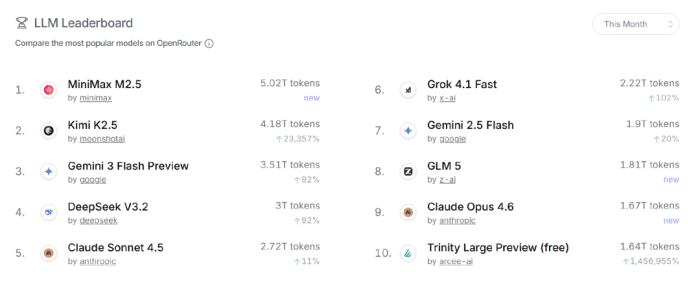
Kimi's ability to seize this growth opportunity is mainly due to identifying the core scenarios for API calls.
According to OpenRouter data, the top two call scenarios for Kimi K2.5 come from the February viral Agent product "Xiaolongxia" (Little Lobster) OpenClaw and the AI programming software Kilo Code. These two products also rank first and second in Tokens consumed on OpenRouter.
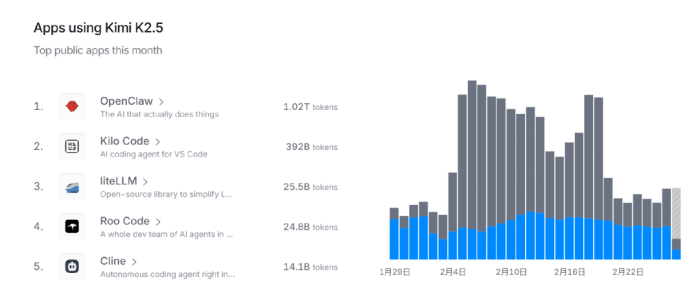
Among them, OpenClaw accounts for nearly a quarter of Kimi K2.5's overseas consumption. Currently, the model continues to rank first in OpenClaw call volume, with call volume nearly double that of MiniMax2.5 and Gemini 3 Flash.
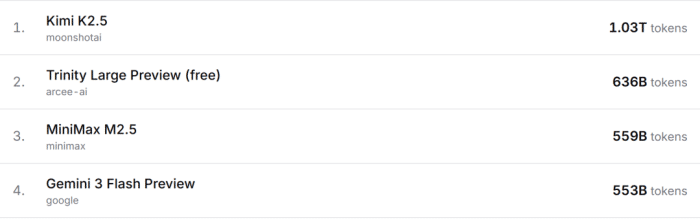
Among so many models, Moonshot AI was the first to benefit from this scenario dividend, primarily due to its limited-time free strategy, with quick decision-making and timely execution.
Kimi K2.5 first launched a free week for Kilo Code, and when OpenClaw went viral, it announced free access to call the Kimi K2.5 model and Kimi Coding capabilities. Thus, it became the first model officially announced by OpenClaw to offer free usage.
Even after reverting to paid access, some users may continue to stay for the model's capabilities, becoming the main users calling the API. For Kilo Code, yesterday's (February 26) data shows that Kimi remains the fifth most called model on the platform.
If the API boom is driven by new models and new Agent products, the revenue growth in overseas markets also represents a phased success of Kimi's subscription-based monetization. Comparing SimilarWeb data, with 33 million visits last month as an example, China currently accounts for over 60% of visits, but compared to 77% in September last year, it is clear that Moonshot AI has indeed made efforts in overseas expansion.
Even before K2.5, Kimi had already achieved short-term commercialization success by shifting to overseas markets and launching subscription-based monetization. In an internal letter at the end of 2025, Moonshot AI founder Yang Zhilin stated that since November 2025, Kimi's overseas API revenue has grown fourfold, with monthly growth rates of overseas and domestic paid users exceeding 170%.
It can be said that 2025 was a critical year for large model startups to focus on overseas expansion, and Moonshot AI was no exception.
However, after OpenClaw, Kimi still needs to retain more users through model iterations. Given the 60% drop in API consumption this week, API monetization is a highly competitive business, with price wars and continuous competitor iterations posing threats to Moonshot AI's API revenue.
In addition to API revenue, Moonshot AI's value-added revenue in 2026 will likely rely on Coding and Agent products. In the Coding field, domestically, Kimi has attempted to attract users through price cuts, such as the "Dialogue Price Cut" event launched three months ago, but its appeal was relatively limited, as Zhipu GLM offered steeper discounts.
Around the Spring Festival, competitors also accelerated their layout (strategic layout ). MiniMax M2.5 topped OpenRouter's popularity chart within 12 hours of release and the call volume chart within a week. Alibaba Cloud recently launched a Coding Plan subscription service, with new users paying as low as 7.9 yuan for the first month. Meanwhile, Zhipu's GLM Coding Plan announced a 30% price hike starting February 12, eliminating first-purchase discounts.
Facing cloud vendors that can afford to play, large model startups aiming to monetize Coding must rely on model capability competition to turn the tide.
Agent: Moonshot AI's Key Bet
Identifying the right API scenarios is just the beginning. Kimi's plan for this year places a greater bet on Agent products.
Before OpenClaw went viral, Yang Zhilin had already expressed Moonshot AI's determination to develop first-party products (products developed by the model company itself). Agent is the chosen direction.
After OpenClaw's explosion in popularity, Kimi was also the quickest among the "Six Little Dragons" to respond.
On New Year's Eve, the Kimi version of Kimi Claw was already launched, offering users the benefit of avoiding the pitfalls of deploying OpenClaw, such as environment configuration. It can deploy a cloud-based version of OpenClaw in just a few minutes. Users who already have OpenClaw can also choose to bind their version to Kimi for free access.
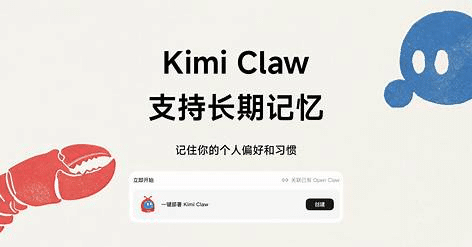
As a purely cloud-deployed product, although its capabilities are somewhat reduced compared to local deployment, Kimi Claw is a more user-friendly option for novices, whether due to the significant simplification of installation and deployment or the enhanced security of the cloud compared to local systems.
Compared to direct model dialogues, Kimi Claw's advantages lie in scenarios like scheduled tasks and continuous memory. For example, it can generate AI daily reports at set times each day or handle high-frequency daily tasks by automatically encapsulating complex steps into Skills, eliminating the need for multi-round dialogues each time. Examples include having AI extract email information, write outlines, or draft articles.
In actual testing, Guangzhui Intelligence had it learn a Skill called "Web-learner" for AI autonomous web searching. Through simple dialogue, it could download the Skill independently, eliminating the need to manually download it from ClawHub as required by OpenClaw. When asked to provide daily hot news summaries, it successfully delivered them on time as requested.
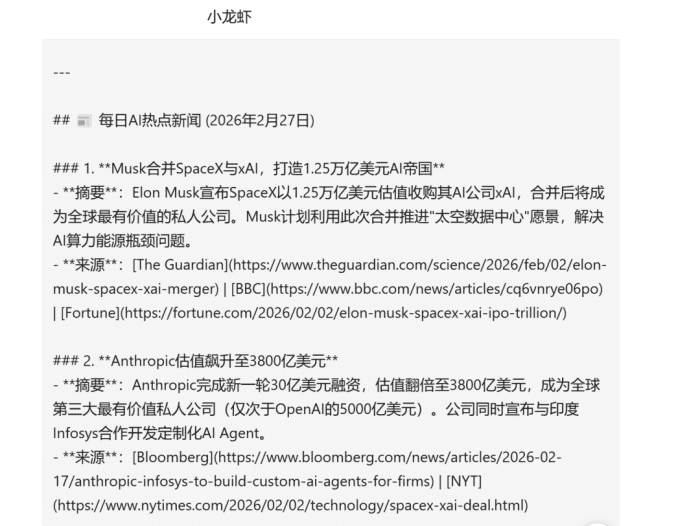
However, currently in the early testing phase, Moonshot AI has restricted Kimi Claw's access to subscribers paying 199 yuan/month or more.
Regarding "Who will become China's version of OpenClaw," Moonshot AI is not the only contender.
Alibaba and MiniMax have also launched their own cloud-based versions of OpenClaw. For example, MiniMax's MaxClaw takes a different approach, offering various expert modes tailored to functions like writing and scheduling.
However, these "alternative" products share a common pain point: for novice users, the actual experience often falls short of expectations. For instance, users need to know to prompt the AI to install Skills, and there is no significant improvement in handling simple tasks like daily research or search requests. On social media, many users mention that cloud-deployed products like OpenClaw may not be as user-friendly as directly using corresponding paid Agent products.
Nevertheless, for Moonshot AI, Kimi Claw is just the beginning of its experiment.
After committing to Agent development, Moonshot AI has been working from the model layer to the product layer to pave the way for future Agent products by refining the underlying model's Agent capabilities.
Whether it's KimiK2's native support for automatic tool calling, laying the foundation for Agent tool usage, or K2.5's multi-Agent clusters, which automatically break down complex tasks into multiple subtasks and assign them to different Agents for parallel processing, these are all optimization attempts Moonshot AI has made at the model layer for Agents.
In Moonshot AI's plans, the next-generation model K3, currently under development, will still serve Agents.
"Vertically integrating model training and Agent product experience (taste) to make K3 a more 'distinctive' model, allowing users to experience entirely new capabilities not defined by other models," Yang Zhilin stated in an internal open letter.
Can Moonshot AI's 'Naive Idealism' Sustain with Billions in Cash Flow?
Essentially, whether expanding commercialization or betting on Agents, Moonshot AI emphasizes one key point: the continuous improvement of technological capabilities.
Through technical improvements and further scaling, increasing equivalent FLOPs by at least an order of magnitude to catch up with world-leading models in pre-training. This is the first major strategic goal Yang Zhilin clearly proposed in an internal letter for 2026. Achieving this goal requires purchasing computing power and continuing Infra adaptation, and now Moonshot AI's focus is on investing its funds into model development.
Compared to 2024, when the entire company promoted K2 on social media, Moonshot AI's past anxieties are now behind it, and its abundant cash flow gives the company the confidence to remain "idealistic."
In an internal letter released at the end of last year, Yang Zhilin disclosed that the company had completed a new $500 million funding round, with cash reserves reaching 10 billion yuan. Combined with the latest $700 million funding round, Moonshot AI no longer faces concerns about running out of funds.
Yang Zhilin explicitly stated in the internal letter: "Compared to the secondary market, we believe we can raise even larger amounts from the primary market. In fact, our Series B/C funding rounds have exceeded the IPO proceeds and private placements of most listed companies. Therefore, we are not in a hurry to go public in the short term. Of course, we plan to use listing as a means to accelerate AGI in the future, timing it appropriately with the initiative in our hands."
Moonshot AI's ability to remain "unhurried" is largely due to the impressive performances of two competitors vying to be the "first large model IPO" in the secondary market.
Earlier this year, Zhipu and MiniMax successively listed on the Hong Kong Stock Exchange. Even with incomplete commercialization models and significant losses, their market capitalizations both surpassed 300 billion HKD. The secondary market, trusting AI's future potential, has adopted a valuation system far exceeding that of traditional internet giants. During the Spring Festival, Zhipu and MiniMax's valuations even surpassed Kuaishou and rivaled JD.com.
Backed by the successful IPOs of its peers, Moonshot AI can expect to continue raising more funds in the primary market. The strong FOMO (fear of missing out) sentiment among VCs has driven unlisted leading AI companies to secure more financing and push their valuations above 10 billion yuan.
However, returning to reality, compared to Zhipu and MiniMax, which have already been tested in the public market, Kimi's commercialization progress is still in its "early stages."
Based on Moonshot AI's disclosed information and using QuestMobile's benchmark of 9.67 million monthly active users in September, calculating with MiniMax's product payment rate (paid users ÷ total users, i.e., 10.3 thousand ÷ 19,057 thousand ≈ 0.05%), the number of paid users in September would be approximately 9.67 million × 0.5% = 48,400 users. With a 170% month-over-month growth rate, the number of paid users in November would be 48,400 × 2.7 × 2.7 = 352,900. At Moonshot AI's lowest membership tier of 49 yuan, the revenue from subscription payments alone in November could reach 17.29 million yuan.
If the dark side of the moon can maintain this revenue range, it could rake in 200 million yuan a year.
However, compared to the dark side of the moon's goal of achieving $100 million in consumer-end revenue as planned last year, it still requires a longer period of product revenue to validate this.
The tens of billions in cash reserves have given the dark side of the moon the confidence to continue being 'idealistic,' but the capital market will not wait forever. As MiniMax and Zhipu are already being tested in the secondary market, and as the price war for GLM has come to an end, the dark side of the moon needs not only continuous technological breakthroughs but also substantial breakthroughs in commercialization.
For the dark side of the moon, 2026 will be a critical year to validate its commercialization path and a turning point from being a 'potential player' to achieving 'certainty.'
-
![]()
Doubao Work Unveiled! Domestic AI Leaders Fully Commit to the 'Work' Sector
-
![]()
Who’s Sounding the Alarm on ‘Rushed Vehicles’?
-
![]()
Over 5.3 Billion Yuan in Losses Over Three and a Half Years! Can Yonyou Reverse Its Fortunes Through Streamlining and AI Transformation?
-
![]()
Baidu AI Adopts Free Model: A Strategic Maneuver in Traffic and Monetization
-
![]()
Silicon-Based OLED Pioneer Unveils Financial Results: H1 Shipments Outpace Entire 2025 Volume
-
![]()
AI's First "Lost Summer"
-
![]()
Zeiss Makes Another €2.2 Million Bet: Will Eye Tracking Be the Next Big Thing in the Smart Glasses Industry?
-
![]()
RUNTO Ranking | Global Top TV ODM Factories' Shipment Figures for July 2026