The Most Valuable Pass in the Era of Autonomous Driving: 'Road Rights' Are Becoming the New Hard Currency in Urban Competition! The 'permits' obtained by companies like Apollo Go, Neolix, Ineco, BaiRh
 02/28 2026
 769
769
Introduction
When an autonomous test vehicle moves from a closed campus onto open roads, it is not just entering the physical world but also engaging in a strategic game about the future of cities.
In the past, we believed that the core of autonomous driving lay in algorithms, computing power, and data.
Today, a more fundamental logic is emerging: 'road rights'—an administrative concept once overshadowed by technical discussions—are becoming a tougher competitive barrier than funding amounts or valuations.
Shunde's story provides an excellent case study. This city, renowned for its manufacturing industry, is now attracting batches of autonomous vehicle companies with its 'road rights permits.'
As of now, Apollo Go has secured 90 vehicle permits in Shunde, accounting for 82% of the city's total deployment, with 60 vehicles already in operation. Six functional autonomous vehicle companies—Neolix, Ineco, BaiRhi, Meituan, and WeRide—have deployed 68 vehicles for real urban road testing.
Here, road rights have undergone a transformation in value—from mere test permits to 'hard currency' for attracting high-value-added industries.
The WeRide Is Coming (WeChat Official Account: The WeRide Is Coming) believes that this logic of 'trading road rights for industrial growth' is unfolding in more cities.
(For further reading, click: 'The Battle for Autonomous Vehicle Road Rights: Strategic Layouts and Commercial Competition Behind the Opening of 103 Cities Nationwide')
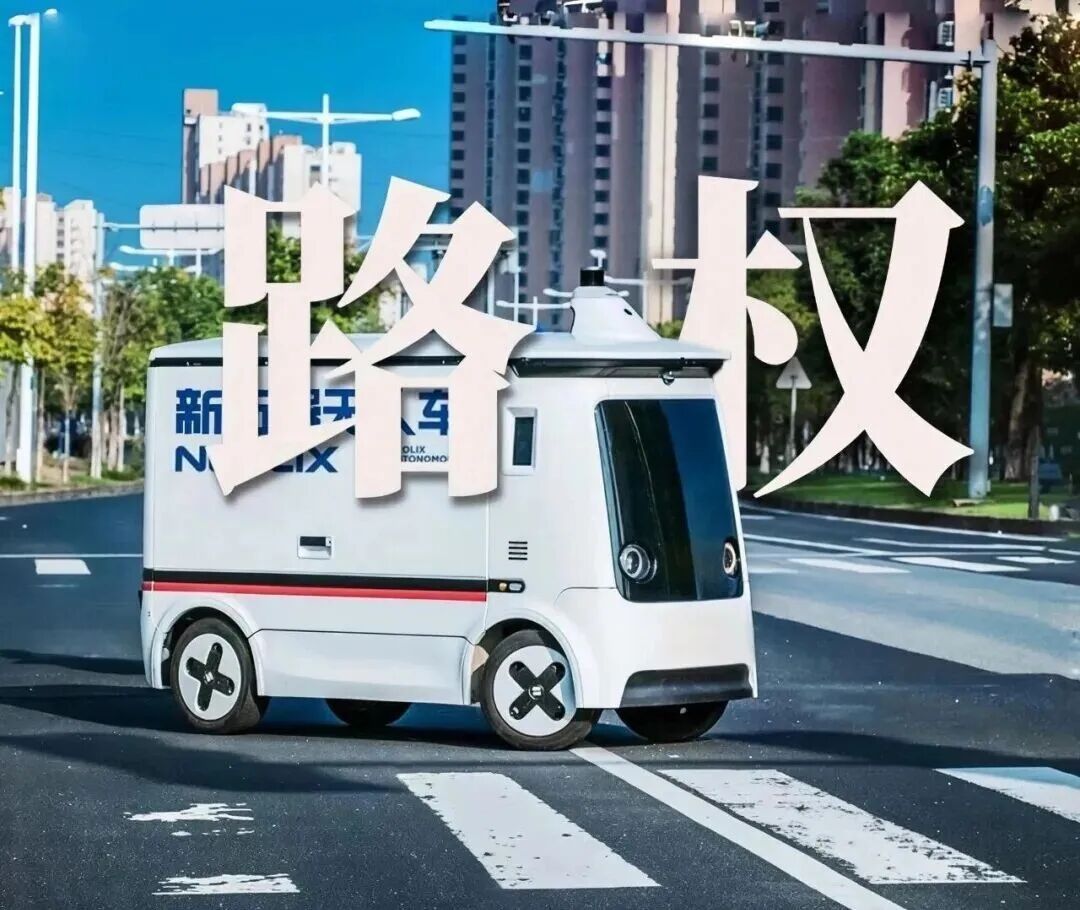
I. Longgang's 'Institutional Breakthrough': 153 Autonomous Vehicles Drive Industrial Clustering
The practice in Longgang District, Shenzhen, demonstrates another possibility—using refined road rights policies to systematically cultivate an industrial ecosystem.
Faced with the dilemma of 'no regulations to follow,' Longgang District took the initiative to break through by simultaneously 'opening roads and establishing rules.'
It collaborated with transportation and traffic police departments to swiftly assess road resources within the district, opening eligible road sections in advance.
Simultaneously, it led the formulation of guidelines for autonomous functional vehicles, clarifying evaluation criteria before road openings, covering traffic volume, road smoothness, and whether the routes pass through busy areas such as schools and markets.
(For further reading, click: 'Shenzhen Longgang District: Autonomous Garbage Transfer Vehicles Boost Efficiency by 100%, Over 60 Autonomous Logistics Vehicles Operate on the Nation's First Cross-District Autonomous Vehicle Artery')
The impact of this combined approach was immediate.
As of now, Longgang District has facilitated the operation of 153 autonomous vehicles from 20 companies, opening 504 routes, ranking among the top in the city in terms of scale.
Even more striking are the economic benefits: despite the incomplete establishment of an autonomous delivery system, it has helped express logistics companies reduce operating costs by 30% to 40%.
The head of Longgang District's New Energy Vehicle Industry Office revealed, 'We work with enterprises to explore technological applications and market expansion, identifying suitable scenarios for autonomous vehicles. Simultaneously, we accompany them in dock (connecting with) hospitals, businesses, and other entities to promote autonomous logistics technologies.'
This 'accompanying service' has deeply integrated autonomous vehicles into urban operations—delivering medications and test samples between main hospitals and community health centers in medical scenarios, and undertaking sanitation sweeping and garbage transfer in municipal areas.
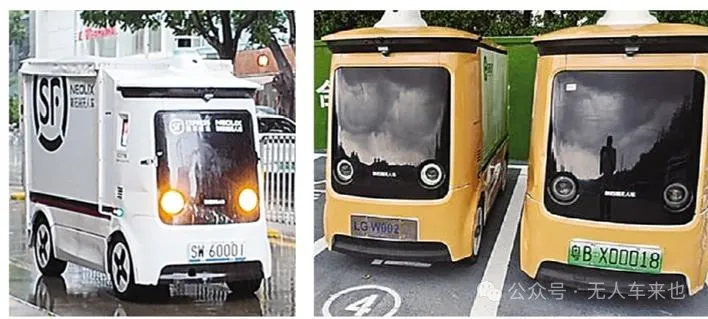
Starting from a pilot project involving 'one enterprise, one road, one vehicle' between SF Express and Neolix, Longgang has now developed a complete industrial chain covering 'vehicle R&D—scenario application—operational services,' using road rights openness to foster industrial ecosystem prosperity.
II. Shenzhen's 'Spring Festival Challenge': How 1,168 Autonomous Vehicles 'Weave a Network'
If Longgang represents a breakthrough in localized road rights openness, Shenzhen's citywide practice showcases top-level design capabilities in urban-scale road rights planning.
As of late January 2026, Shenzhen had 1,168 functional autonomous vehicles under regulatory supervision, including 767 autonomous logistics vehicles, with monthly order volumes exceeding 2.42 million, generating commercial value of approximately RMB 19.92 million. Behind these numbers lies a precisely functioning urban intelligent delivery system.
(For further reading, click: 'Shenzhen's Functional Autonomous Vehicle Report for January 2026: 1,168 Vehicles, 2.42 Million Monthly Deliveries, Over 30 Enterprises and Universities Co-establish the 'Shenzhen Autonomous Driving Safety Laboratory')
Some districts have innovated a 'dynamic road rights + negative list' mechanism, reducing enterprise route approval times from 7-10 working days to 2-3 working days.
This means that when express companies anticipate a Spring Festival capacity gap, they can open new routes within 48 hours—unimaginable under traditional governance frameworks.
Even more ingenious is the 'bus depot + autonomous logistics' model. One district has revitalized 177 public spaces across the district, transforming originally night-idle bus terminals into 'urban logistics nodes' for centralized charging, sorting, and dispatching of autonomous vehicles, reducing enterprises' offline operation and maintenance costs by an average of 37.5%.
During the 2026 Spring Festival, over 500 autonomous logistics vehicles shuttled among more than 800 communities and 300 commercial districts citywide. SF Express's 'subway + autonomous vehicle' intermodal dedicated line (dedicated line) handled over 30,000 orders daily, reducing road transportation time between Futian and Bihaiwan by 50%.
(For further reading, click: 'Shenzhen's Spring Festival New Landscape: Over 500 Autonomous Logistics Vehicles, 'Subway + Autonomous Vehicle' Dedicated Line Handles Over 30,000 Orders Daily! Neolix, Ineco, BaiRhi, Meituan, and Innovusion Showcase Their Capabilities')
The brilliance of this 'air-rail-road intermodal' model lies in:
It activates idle subway capacity during off-peak hours without adding a single inch of road;
It completes high-frequency short-distance transfers traditionally requiring 3-5 porters without adding a single driver, using autonomous vehicles instead.
III. Hong Kong's 'Ultimate Test': A 43.2-Kilometer Cross-District Leap
Turning to Hong Kong, its road rights openness represents the highest level of trust in autonomous driving technology.
On February 23, Apollo Go secured approval for cross-district testing in Hong Kong, becoming the first enterprise authorized to conduct autonomous driving tests in three core areas of the city.
The test route spans 43.2 kilometers, covering transportation hubs such as Airport Island, Tung Chung Town Center, and Sunny Bay. This marks a substantive leap for autonomous driving technology from closed campuses to complex urban roads.
(For further reading, click: '43.2 Kilometers! Apollo Go's Autonomous Vehicles Expand Testing in Hong Kong for the Fifth Time, No Longer 'Envious of the Mainland'! But Hong Kong's Autonomous Driving Still Faces Five Major Hurdles')
Hong Kong's unique geographical features and high-density traffic environment provide an extremely challenging validation scenario for autonomous driving technology.
Latest disclosed test data shows:
Over a cumulative test mileage exceeding 500,000 kilometers, autonomous vehicles achieved a 99.3% decision-making accuracy rate in mixed traffic flows, a 12-percentage-point improvement from the initial stage;
No liability accidents occurred throughout the testing, with emergency response times consistently below 0.8 seconds.
The Hong Kong Transport Department revealed that if test data continues to meet standards, commercial operation pilots could commence in specific regions by 2027.
This means residents may be able to book autonomous vehicles via mobile apps for 'last-mile' connections within the next five years.
IV. The Road Rights Game: A New Dimension of Urban Competition
Examining the practices in Shunde, Longgang, Shenzhen, and Hong Kong, a clear trend emerges: road rights are evolving from mere 'access permits' into 'strategic weapons' in urban competition.
First-tier cities like Shanghai, Beijing, Guangzhou, and Shenzhen use limited road rights in core areas to attract leading enterprises to establish R&D headquarters;
Second- and third-tier cities, on the other hand, exchange more open and larger-scale citywide road rights for tangible manufacturing bases, data centers, and operational positions.
Qingdao, with over 1,200 autonomous vehicles deployed at scale, has been dubbed 'the city with the most autonomous driving vehicles globally' by multiple media outlets.
Yangquan, a traditional coal city in Shanxi Province, has provided large-scale open test roads for autonomous driving enterprises. In exchange, these companies have not only established data centers and R&D teams locally but also committed to setting up operational centers and some manufacturing operations there in the future.
(For further reading, click: 'Yangquan City, Shanxi Province: The Nation's First Prefecture-Level City with Full-Domain Autonomous Driving Open, Hometown of Liu Cixin and Robin Li')
This model of 'tiered road rights + industrial bets' transforms local governments from passive regulators into active builders of industrial ecosystems.
Of course, road rights openness is not unconditional. Reports from Legal Daily point out that at the national level, no unified qualification requirements have been set for autonomous vehicles, and local definitions of autonomous vehicles lack uniform standards.
Professor Tao Yang from the School of Law at Beijing Jiaotong University argues that currently, it is unclear whether autonomous delivery vehicles are classified as motor vehicles or non-motor vehicles. If the Road Traffic Safety Law is directly applied for liability determination, difficulties arise due to unclear vehicle attributes and the absence of a driving subject.
This means road rights policies must strike a precise balance between industrial promotion and public safety, technological innovation and risk management.
The wheels of autonomous vehicles are rolling onto a new chessboard of urban development, and road rights have become one of the most significant pieces in this game.
For enterprises, securing more and higher-quality road rights means obtaining the 'admission ticket' for commercialization.
For cities, designing more scientific and attractive road rights policies—like Shunde's full-domain openness, Longgang's negative list, Shenzhen's bus depot sharing, and Hong Kong's cross-district coordination—means seizing the 'commanding heights' of the future intelligent transportation industrial chain.
In conclusion, The WeRide Is Coming (WeChat Official Account: The WeRide Is Coming) believes:
There are no bystanders in this game for road rights.
Every city aspiring to remain competitive in the next decade must seriously consider: What road rights can I offer to secure what industries?
Hey! What do you think?
#TheWeRideIsComing #AutonomousDriving #SelfDriving #AutonomousVehicles
-
![]()
Net Profit Surges 13.65% Year-on-Year! Yutong Optics Reports RMB 1.782 Billion in H1 Revenue
-
![]()
Q2 Net Profit Slashes Losses by 80%! Has Costar Emerged from Its Darkest Hour?
-
AI Agents: The Paradigm Shift from 'Conversation' to 'Execution'
-
NVIDIA Takes Bold Strides to Lead in Both Hardware and Software Realms
-
![]()
It's Hard to Build Cars, Even Harder to Build Humans, and XPENG is Doing Both
-
![]()
Valuation Soars by $57 Billion: Three Entrepreneurs Born in the 1980s Forge an AI Unicorn Now Suddenly on the Market
-
![]()
How Can We Achieve the Goal of 100,000 Hydrogen Vehicles by 2030?
-
![]()
July Online Market for Consumer-Grade Sports Cameras: Robust Double-Digit Growth in Sales Volume and Value, Mid-Range Products Fuel Market Expansion