Baidu's Financial Report Reveals a Critical '43%': AI Revenue Generation is Now a Reality
 02/28 2026
 639
639

Baidu is starting to earn money from AI, but there are still several hurdles to overcome.
On February 26, Baidu released its financial report for the fourth quarter and full year of 2025. Several key points from this report caught my attention:
The financial report shows that Baidu's total revenue in 2025 reached 129.1 billion yuan, with AI business revenue hitting 40 billion yuan. In the fourth quarter (Q4 2025), Baidu's total revenue was 32.7 billion yuan, with AI business revenue accounting for 43% of Baidu's general business revenue, exceeding market expectations.
Starting from the fourth quarter of 2025, Baidu redefined its original Baidu Core as Baidu General Business. This includes Baidu Core's new AI businesses, traditional businesses, and others. Traditional businesses primarily consist of traditional advertising services provided across search, information feeds, and other product lines.
Baidu's revenue is increasingly driven by AI. After adjusting the financial reporting framework, the 43% share of AI business revenue in Q4 becomes even more prominent, driving sequential revenue growth in Q4. For the full year of 2025, Baidu Core's AI business revenue reached 40 billion yuan, up 48% year-on-year, becoming its new growth engine.
This is the first time Baidu has disclosed AI revenue figures. It first included AI revenue in its financial report in 2024 and has now taken a step further by disclosing the proportion of AI business revenue. 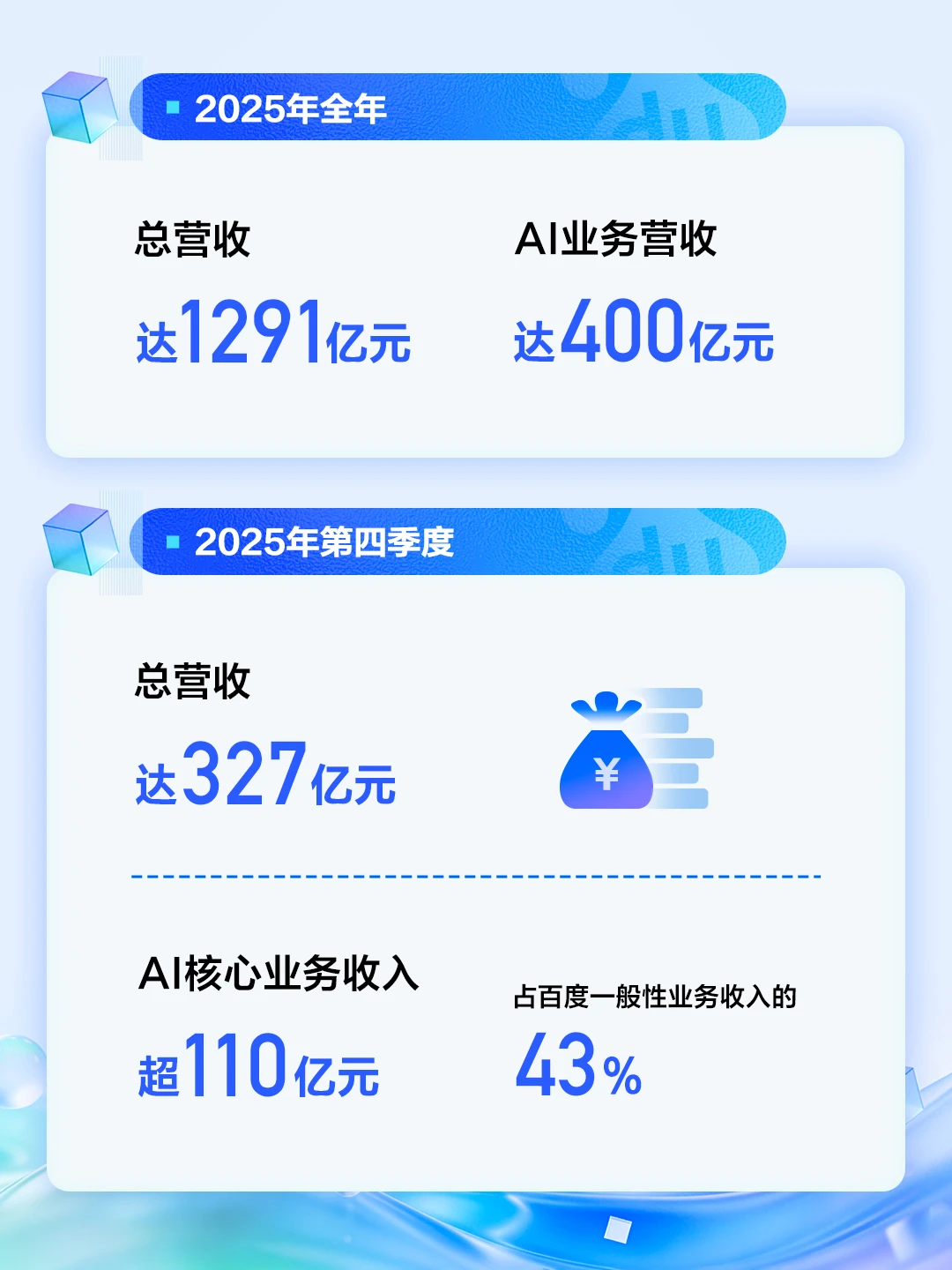
Image | Baidu Official
While the outside world is still accustomed to measuring the technological depth and valuation of large model companies by parameter scale and computational power reserves, the operational data in Baidu's financial report also holds significant industry significance.
On one hand, the financial data represents not only its business but also the fruition of its AI strategy transitioning from staged investments to commercial realization. It also marks a substantial restructuring of Baidu's revenue mix. During this process, AI has transformed from a cost center to a "profit center" for Baidu.
On the other hand, the financial report's revelation of the critical 43% ratio demonstrates to the industry that AI is not just about throwing money in but can also generate self-sustaining revenue. This proportion signifies a qualitative change for Baidu, indicating that AI can evolve from a foundational enabling tool to a core engine capable of sustainably generating cash flow.
In simpler terms: The era of AI generating revenue has truly arrived.
For a long time, Baidu's revenue has been primarily driven by traditional search and online marketing, with AI businesses seen more as strategic investments for immediate defense and future survival. Like other AI vendors, it has been challenging to quickly form a scalable, verifiable, and mature revenue model that could become a pillar of the company's performance.
This has led to an industry question: When will AI become an independent, sustainably growing, and even high-quality revenue generator?
Baidu's 40 billion yuan in annual AI business revenue and 43% quarterly share have not only made AI a new growth engine for Baidu but also positioned it as one of the few domestic companies capable of scaling and converting its full-stack AI capabilities into revenue.
This also provides an answer for the entire industry: A full-stack technological layout + vertical scenario implementation + pay-for-performance can be a viable direction for AI commercialization.
From Baidu's AI commercialization practices, it has clearly divided its new AI businesses into three major parts: intelligent cloud infrastructure, AI applications, and AI-native marketing services.
Among them, intelligent cloud infrastructure is the main revenue driver for the AI business, showing strong growth momentum. In 2025, AI cloud revenue increased by 34% year-on-year, with subscription revenue for AI high-performance computing facilities in Q4 alone surging by 143% year-on-year.
The AI applications segment has achieved a breakthrough of over 10 billion yuan, becoming a significant incremental contributor to revenue growth. Its product matrix includes categories such as ERNIE Bot/ERNIE Assistant, Baidu Netdisk AI Edition, Baidu Wenku AI, digital humans, and enterprise agents.
The AI-native marketing services segment has experienced the most rapid growth, with full-year revenue increasing by 301% year-on-year, becoming a key factor in reshaping Baidu's advertising landscape. In December, Baidu App's monthly active users reached 679 million, while ERNIE Assistant's monthly active users reached 202 million. Since the launch of the Chinese New Year red envelope campaign, ERNIE Assistant's monthly active users have quadrupled year-on-year.
Notably, AI-native marketing services leverage AI capabilities to transform traditional search advertising and intelligent marketing. Their growth and effectiveness indicate that AI's "upgrading" of traditional core businesses can also yield greater efficiency and benefits, such as expanding C-side market coverage, improving advertising conversion rates and user experience, and generating higher average revenue per user.
In Li Yanhong's view, "2025 is a critical year for AI to become Baidu's new core." AI cloud, AI applications, AI-native marketing services, and related businesses have become Baidu's core operations, supporting its new market valuation.
Baidu's AI has also formed a business model of "full-stack AI technology (primarily AI cloud) laying the foundation, AI applications driving incremental growth, and marketing services enhancing efficiency." This has helped it complete the transition from long-term technological investment to AI commercialization, driving continuous optimization of the company's profit structure.
The core value of this transformation lies in the health of the business model. Baidu's AI revenue primarily comes from performance-oriented businesses such as enterprise services, model calls, and industry solutions, exhibiting stronger repurchase potential and growth. This has allowed Baidu to move away from a single revenue structure heavily reliant on advertising, establishing a new safety net for long-term development.
At the same time, when we shift our perspective from Baidu itself to the entire Chinese AI industry, this financial report can be seen as a watershed moment for AI commercialization in China.
Prior to this, competition in the domestic AI industry was mostly concentrated on superficial aspects such as parameter scale, technology launches, and scenario pilots, with commercialization progress largely remaining at sporadic pilot stages. After this point, the industry's competitive logic will shift from "who has the larger model" to "who can commercialize faster, more stably, and more healthily."
However, Baidu still needs to run harder, as the AI race is a marathon. Behind the financial data, Baidu's AI commercialization still faces several major challenges.
The revenue structure of the AI business still needs optimization. The current 40 billion yuan in AI revenue mainly comes from B-side AI cloud and enterprise services. In the AI-to-Consumer (AI2C) market, although ERNIE AI Assistant has achieved 202 million monthly active users, becoming a leading AI-native application in terms of user scale in China, its commercialization potential still has significant room for improvement. Once corporate and user willingness to pay weakens, Baidu's AI business revenue will also be affected.
The AI commercialization pathway still needs refinement. Baidu's free strategy for its ERNIE large model has undoubtedly expanded the ecological influence of Baidu's models, attracting a large number of developers and enterprises to participate. However, it has also directly compressed revenue from model calls. Baidu needs larger AI entry points to continue validating its business model and alleviate short-term profitability pressures.
Long-term businesses such as autonomous driving have not yet achieved scaling (scalable) monetization. As a heavily invested AI-related field by Baidu, although Apollo Go's order volume has maintained strong growth, it has not yet achieved scalable profitability and remains in a continuous investment phase. The long-term high investment in this business may continue to affect the company's short-term profit margins. How to balance the pace of technological implementation and commercial returns has become a key issue for Baidu to address.
Industry competition is intensifying, and Baidu needs to find differentiated survival space. Competition among AI vendors has entered a fierce stage, with homogenization and price wars emerging. For example, ByteDance has lowered token prices and launched industry hits like Seedance 2.0 in video generation; Qianwen has become a new player, integrating its capabilities with Alibaba's commercial ecosystem. Baidu needs to more rapidly convert its technological strengths into differentiated development drivers and establish ecological advantage barriers.
In my view, to consolidate its leading position in the AI field, Baidu still needs to make efforts in three areas:
First, accelerate the commercialization process of C-side AI products, refine existing products such as ERNIE Assistant, Netdisk AI, and Wenku AI into scalable paid blockbusters, and gradually balance the revenue structure between B-side and C-side.
Second, deepen vertical industry barriers, cultivate industry know-how in advantageous fields such as finance, manufacturing, and government affairs, and create differentiated solutions to avoid becoming a mere computational power supplier.
Third, expedite the commercialization of cutting-edge technologies such as autonomous driving and clarify the timeline for scalable profitability, turning long-term investments into new growth curves.
For Baidu, how to safeguard its existing commercialization achievements and effectively address growth risks will directly determine whether it can continue to stay in the AI race and what position it will achieve.
Before that, Baidu still needs to continuously strengthen external communication to make it clear to the outside world that its narrative logic is changing, in response to those constantly singing the blues.
Baidu's 2025 financial report serves as an excellent value judgment node: The 43% AI revenue share represents not only a turning point for AI industry commercialization but also redefines new value standards for AI companies.
-
![]()
Doubao Work Unveiled! Domestic AI Leaders Fully Commit to the 'Work' Sector
-
![]()
Who’s Sounding the Alarm on ‘Rushed Vehicles’?
-
![]()
Over 5.3 Billion Yuan in Losses Over Three and a Half Years! Can Yonyou Reverse Its Fortunes Through Streamlining and AI Transformation?
-
![]()
Baidu AI Adopts Free Model: A Strategic Maneuver in Traffic and Monetization
-
![]()
Silicon-Based OLED Pioneer Unveils Financial Results: H1 Shipments Outpace Entire 2025 Volume
-
![]()
AI's First "Lost Summer"
-
![]()
Zeiss Makes Another €2.2 Million Bet: Will Eye Tracking Be the Next Big Thing in the Smart Glasses Industry?
-
![]()
RUNTO Ranking | Global Top TV ODM Factories' Shipment Figures for July 2026