Anthropic’s Move: A Backhanded Boost for Chinese AI
 02/28 2026
 558
558
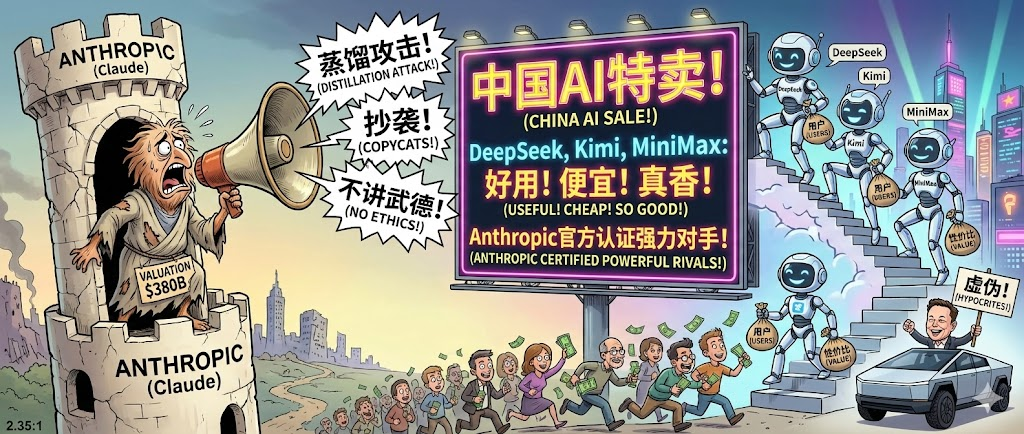
With Anthropic announcing the completion of a $30 billion funding round and its valuation skyrocketing to $380 billion, the Silicon Valley darling released a highly combative manifesto. It accused DeepSeek, Moonshot AI (Kimi), and MiniMax of engaging in "industrial-scale" data distillation on its Claude model.
However, from a market standpoint, AI Capital Bureau sees this manifesto more as a 'certification advertisement' aimed at global investors. Anthropic, employing its most forceful language, is signaling to the world that the capabilities of these three Chinese AI firms have grown so potent that they 'sting,' even posing a threat to the formidable technological moat it has painstakingly constructed.
Elon Musk's pointed remarks on social media further exposed the hollow nature of this stance. He bluntly called out Anthropic for its blatant hypocrisy, accusing it of "stealing code written by humans while protesting that Chinese companies are 'stealing' from them."
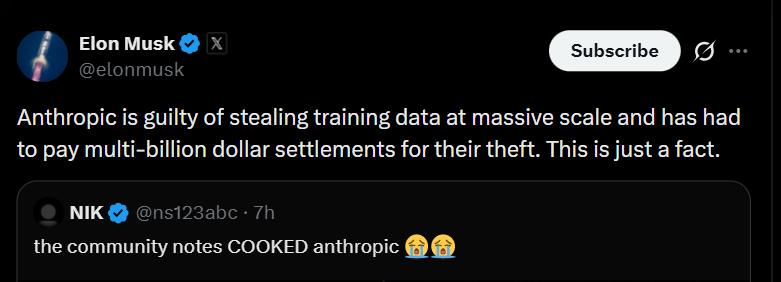
In Musk's opinion, these Silicon Valley behemoths are themselves built on the widespread 'plundering' of copyrighted data across the internet. Now, they seek to monopolize the technological high ground by defining so-called 'distillation attacks.' This double standard cannot obscure a fundamental truth: when nearly all publicly available data from human civilization has been fed into models, using more advanced models to generate high-quality data (i.e., distilled or synthetic data) has become an industry-wide necessity.
The ultimate rule of commercial competition is always straightforward: who is more usable, cost-effective, or superior. Regardless of how convoluted the process or how controversial the methods, the memory of technological history is fleeting.
Users don’t care whether a model’s intelligence comes from pure organic accumulation or is honed through clever distillation as a 'lever'—they only care about who can swiftly resolve a bug or deliver a report at the lowest token cost.
Just as Musk once questioned DeepSeek's hardware scale but had to concede its efficiency, this 'pragmatism' is the driving force behind AI's Age of Exploration.
Currently, the legal boundaries surrounding 'data distillation' remain ambiguous. Is it copyright infringement, or is it akin to the 'knowledge internalization' that occurs when humans read books? Before legal rulings can keep pace with technological advancements, the fierce survival competition demonstrated by Chinese companies—despite their limitations in computing power and data—is actually shattering Silicon Valley's illusion of monopoly.
Anthropic's outrage seems more like a defensive anxiety, signaling to the world that these three companies have entered the core battlefield of global AI.
In essence, Anthropic’s outcry has not only flaunted its $30 billion funding to the world but also inadvertently highlighted the caliber of its Chinese rivals—DeepSeek, Kimi, and MiniMax.
This invaluable 'certification ad fee,' reluctantly paid by Anthropic on behalf of Chinese AI, has made a loud splash. Ultimately, the industry will remember who emerges victorious, while debates over 'distillation' will be swept away by the tide of algorithmic innovation.
AI Capital Bureau is a professional observation and analysis platform focused on capital market dynamics in the artificial intelligence field. We closely monitor capital operations such as financing, listings, and mergers and acquisitions of AI and embodied intelligence-related companies. We deeply analyze industry trends and investment opportunities, providing valuable insights for industry participants. We are committed to bridging the gap between AI innovation and capital markets, helping Chinese hard-tech companies achieve value discovery and growth.
Risk Warning and Disclaimer: The market carries inherent risks; invest cautiously. This article does not constitute investment advice and should not be used as practical operational guidance. Trading risks are borne by the individual.
-
![]()
Doubao Work Unveiled! Domestic AI Leaders Fully Commit to the 'Work' Sector
-
![]()
Who’s Sounding the Alarm on ‘Rushed Vehicles’?
-
![]()
Over 5.3 Billion Yuan in Losses Over Three and a Half Years! Can Yonyou Reverse Its Fortunes Through Streamlining and AI Transformation?
-
![]()
Baidu AI Adopts Free Model: A Strategic Maneuver in Traffic and Monetization
-
![]()
Silicon-Based OLED Pioneer Unveils Financial Results: H1 Shipments Outpace Entire 2025 Volume
-
![]()
AI's First "Lost Summer"
-
![]()
Zeiss Makes Another €2.2 Million Bet: Will Eye Tracking Be the Next Big Thing in the Smart Glasses Industry?
-
![]()
RUNTO Ranking | Global Top TV ODM Factories' Shipment Figures for July 2026