Anthropic Accuses Chinese AI of 'Plagiarism': What Capitalist Schemes Lie Behind?
 03/06 2026
 498
498

Musk Mocks, Capital Shifts: Sino-US AI War Escalates—How Can China Break Through?
On the first day back to work, the AI circle staged a 'drama'! The US AI unicorn Anthropic suddenly accused three Chinese AI companies—DeepSeek, Moonshot AI (Kimi), and others—of copying technology through 'distillation attacks.'
What is a 'distillation attack'? We'll set that aside for now. Just one day later, Anthropic, which has consistently touted data security, announced a 'softening' of its core safety policies. Previously, the company often halted the development of related large models on the grounds that they were 'dangerous.' However, Anthropic now states that once competitors release 'similar or more advanced' models, it will no longer enforce this suspension mechanism. This AI circle feud quickly drew scathing mockery from Elon Musk: 'How dare they steal what Anthropic stole from human programmers?'
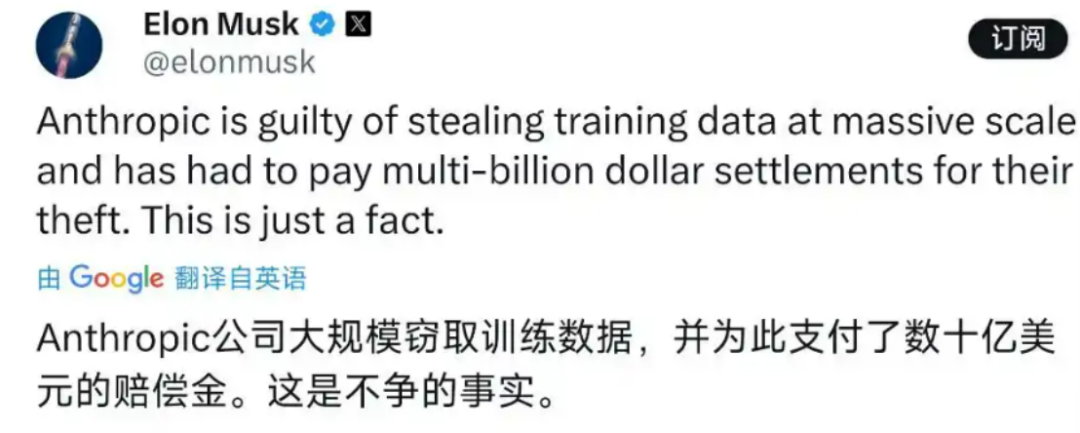
Image Source: X
This seemingly technological dispute is, in fact, a self-rescue ploy by US AI companies under valuation pressure. What exactly is Anthropic accusing Chinese large models of? What trends will the future global AI industry exhibit across the four dimensions of technology, capital, market, and commercialization paths?
Why Is the 'Anti-Distillation' Accusation a Capitalist Performance?
First, let's clarify what 'distillation' means. Model distillation is a standard training technique in AI, where a large model guides a smaller model to learn, achieving knowledge transfer and model compression. This time, Anthropic accused several Chinese companies of registering 24,000 fake accounts, engaging in 16 million dialogues with Anthropic's large model Claude, and then packaging this 'high-quality dialogue' data to train their own models.
Image Source: Internet
It should be noted that 'distillation' is a common method used by some global AI companies to train their large models. Anthropic itself is a user of 'distillation' technology and even engages in more aggressive data scraping. Notably, Anthropic has now become one of the most unfriendly AI companies to China in the field. In September 2025, Anthropic explicitly banned services to Chinese companies in official documents. In fact, accusing Chinese companies of data distillation has become a common tactic among US companies. On February 12, 2026, OpenAI submitted an internal memo to the US Congress, explicitly accusing DeepSeek of bypassing its security measures through complex obfuscation to conduct distillation on GPT series models.
A significant backdrop to Anthropic's high-profile accusations against Chinese companies is that, entering February 2026, US AI concept stocks have experienced multiple rounds of significant declines, with capital markets expressing concerns about 'disrupting traditional business models' in the future of AI. CNN commentary also pointed out that many so-called large models are essentially elaborately packaged search engines.

Anthropic CEO Dario Amodei Image Source: Internet
Some argue that Anthropic, facing valuation pressure, is essentially signaling to capital markets that 'its technology is leading' by accusing Chinese companies. Anthropic clearly wants to tell capital markets: 'I'm the best because someone is copying me.' This somewhat deliberate move aims to maintain its high valuation but also exposes the growing distrust in closed-source AI systems in the market.
At the same time, large models like Anthropic's are also finding reasons to 'relax' their safety policies, creating a more lenient policy environment for themselves.
So, how do domestic open-source large models compare?
China's AI Breakthrough: Not Through Plagiarism, But Through Open-Source and Ecosystem
Neither DeepSeek nor Moonshot AI, MiniMax, or others have responded to Anthropic's one-sided accusations. Industry insiders believe that Chinese companies' silence stems from confidence in their technological strength, a refusal to engage with baseless accusations, and a desire not to fuel US media hype.
Image Source: Internet
Behind Anthropic's 'accusation drama,' Chinese AI companies have already forged their own path to breakthroughs. As global AI investment shifts toward certain tracks, the Chinese market, leveraging its advantages, is nurturing unique investment opportunities. Currently, Moonshot AI's latest valuation exceeds $4 billion, led by Alibaba, Tencent, Wuyuan Capital, and Joann Capital. The rapid progress of Chinese AI companies benefits from a vast pool of engineers, rich data resources, a relatively complete industrial chain, and a commitment to open-source and open routes. Breakthroughs by large models like DeepSeek and Kimi are inevitable outcomes of technological innovation and scenario deepening.
Image Source: Internet
With NVIDIA's massive investment in OpenAI, capital will form new-level 'industrial barriers' around computing power and platform ecosystems in the foreseeable future. This is not simply driven by funds but by deepening industry ties through capital.
In contrast, Chinese AI applications (such as Doubao, Qianwen, Yuanbao, etc.) have attracted new users through large-scale subsidies, completing a transition from 'explosive growth' to 'scale investment for user growth.' The red envelope wars during the Spring Festival seem to confirm this trend. This subsidy model contrasts sharply with foreign approaches that focus more on enterprise-level paid paths or large-platform monetization strategies. In the future, the Chinese market will emphasize cultivating scenarios and user habits through subsidies and rapid growth, while European and American markets will transition more quickly toward monetization paths and ecosystem payments. Correspondingly, US companies strengthen their global advantages through capital concentration, computing power layout (layout), and product leadership, while Chinese companies form a strong ecological driving force through local scale and application scenario expansion, rapidly advancing from consumer-end apps to industry-level deployments.

Image Source: Internet
The AI industry is moving from a pure technological revolution phase into a new stage of 'capital empowerment + commercial ecosystem reconstruction + global competition differentiation.' The future winners will not just be the technologically strongest but platform-based companies capable of building sustainable monetization ecosystems and global network effects.
No More High-Stakes Bets on Technology: Obtaining Real Interaction Data Is More Important
The plunge in Wall Street's AI concept stocks reflects capital's doubts about the short-term prospects of new technologies. However, one undeniable fact is that AI will ultimately become infrastructure in commercial environments. Capital may no longer be optimistic about massive short-term growth but no longer doubts stable growth. Globally, AI investment has shifted from 'betting on technological uncertainty' to 'betting on certain expansion paths.'

Image Source: Internet
As computing power resources become increasingly scarce, the core bottleneck of AI is no longer in models but in who can obtain computing power long-term, stably, and at low cost. From this perspective, sectors like GPU/AI-specific chips, computing power leasing, and computing power clouds have greater investment potential.
The AI field is also evolving from models to agents and then to platforms. In the future, industry core competitiveness will no longer depend on single model parameters but on control over agent scheduling, definition of tool interfaces, and accumulation of user behavior data.

Image Source: Internet
The Chinese market presents unique opportunities for AI investment. Products like ByteDance's Doubao, Alibaba's Tongyi Qianwen, and Tencent's Yuanbao attract new users through large-scale subsidies. This is not a traditional internet 'burn money' war but essentially about occupying user interaction entry points to obtain real-world AI behavior data.
In the AI era, the purpose of opening more AI entry points is to enable more people to use AI, iterate AI, and form behavioral records through AI collaboration. Such data cannot be obtained through crawlers but only through real user scale accumulation. Future super AI applications, the integration of AI with social, content, office, and search functions, and platform-based companies with distribution capabilities will have certain development potential. Such investments may suppress corporate profits in the short term but are expected to cultivate China's AI platform giants in the medium to long term.
AI Competition Returns to Application Scenarios
The realization of AI investment also lies in industry-specific AI applications. China's internet development history has proven that while platform-based companies reap the highest rewards, industry applications often achieve stable profitability earliest—just like the SaaS sector during the cloud computing era and local life, e-commerce, and finance sectors during the mobile internet era.
In February 2026, AI applications from major Chinese companies entered explosive development. ByteDance's Seedance 2.0: An AI video generation model with multimodal input (text, image, audio), synchronous video and audio generation, 60-second output, and costs reduced to 1/10 of manual filming. Overseas creator usage exceeded 10 million. Additionally, Qianwen can link to Taobao/Alipay in dialogues, with AI triggering nearly 200 million orders with a single sentence.
 Image Source: Internet
Today, Chinese AI has shifted from 'technological showcases' to industrial deepening, with manufacturing, healthcare, and consumption seeing large-scale implementations. Open-source + ecosystems have become key. US AI is moving from 'general models' to specialized agents, with breakthroughs in autonomous driving, enterprise services, and military AI, building barriers through customized computing power and vertical models.
In January 2026, Clawdbot, an open-source AI project that ignited the global tech circle, achieved a core breakthrough by transforming AI from a 'passive dialogue tool' into an 'active executing digital agent,' truly realizing a paradigm shift where 'AI can get things done.'
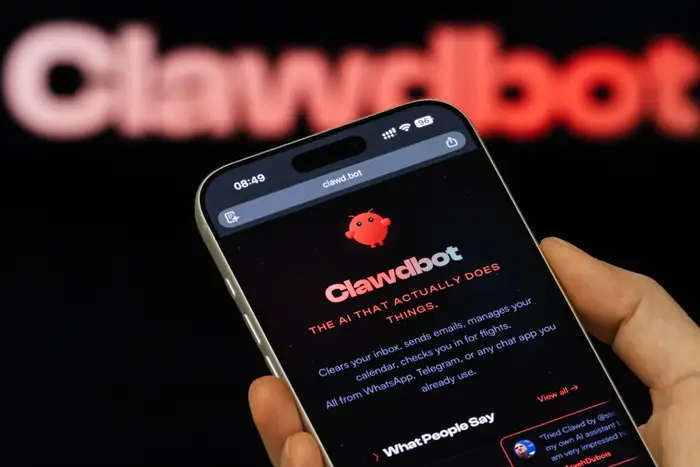
Image Source: Internet
The differing development paths of Sino-US AI seem to have provided answers. This war of words (verbal war) over AI models essentially transcends mere technology and copyright issues, becoming a microcosm of global tech competition, capital layout (layout), and industrial discourse power. Ultimately, Anthropic's accusations are nothing more than a 'self-rescue drama' by US AI companies under valuation pressure.
China's AI rise, while not the first in originality, can catch up through its industrial chain, vast market demand, and continuous technological innovation. The future of the global AI industry will ultimately return to a dual-core competition of technological strength and ecosystem construction.
References
1. Anthropic Accuses Three Chinese Models of 'Illegal Distillation': Musk Calls It 'Thief Crying Thief,' Beijing News
2. Anthropic Claims It Was Distilled by DeepSeek! Why Does Musk Criticize? Fourth Wave
3. Anthropic's Accusation of Distillation Attacks Against Chinese AI Companies Exposes Closed-Source AI Privacy Risks, Guancha.cn
-
![]()
Doubao Work Unveiled! Domestic AI Leaders Fully Commit to the 'Work' Sector
-
![]()
Who’s Sounding the Alarm on ‘Rushed Vehicles’?
-
![]()
Over 5.3 Billion Yuan in Losses Over Three and a Half Years! Can Yonyou Reverse Its Fortunes Through Streamlining and AI Transformation?
-
![]()
Baidu AI Adopts Free Model: A Strategic Maneuver in Traffic and Monetization
-
![]()
Silicon-Based OLED Pioneer Unveils Financial Results: H1 Shipments Outpace Entire 2025 Volume
-
![]()
AI's First "Lost Summer"
-
![]()
Zeiss Makes Another €2.2 Million Bet: Will Eye Tracking Be the Next Big Thing in the Smart Glasses Industry?
-
![]()
RUNTO Ranking | Global Top TV ODM Factories' Shipment Figures for July 2026