"National Shrimp Farming" Movement: The Rise of Large-Scale AI Adoption
 03/06 2026
 673
673
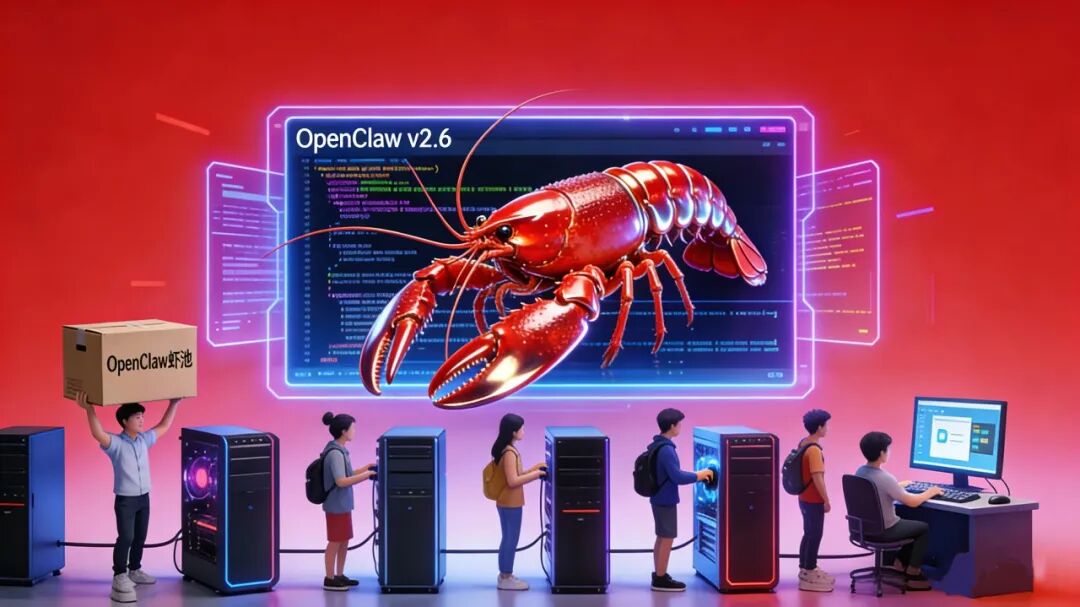
Large enterprises have finally recognized: AI has evolved from a niche "plaything" for tech elites to a practical "tool" for the masses.
By Yang Xiaoruo | Edited by Zhang Hongyi
Produced by Business Show
In early 2026, a digital "crayfish" named OpenClaw—formerly known as Clawdbot and Moltbot—took the global developer community by storm, swiftly integrating into the daily lives of countless ordinary users. Within just a few months, OpenClaw achieved a remarkable milestone, amassing 145,000 stars on GitHub. Shortly after the Spring Festival, offline workshops and online livestreams were held in Beijing, Shanghai, and Shenzhen, attracting enthusiasts eager to learn, exchange ideas, and receive hands-on guidance for deploying this innovative AI tool.
Amid this "national shrimp farming" craze, the personal experience of Cheetah Mobile CEO Fu Sheng stands out as a prime example. During the Spring Festival, Fu Sheng was involved in a snow-related accident that dislocated his hip, confining him to bed. Leveraging remote voice control, he spent 14 days assembling a dedicated team of eight AI Agents, which he named "Sanwan."
This AI team operated autonomously around the clock, efficiently handling various tasks. Ultimately, it enabled his official account to produce over 100,000 viral articles, amassed over a million views on Twitter, and simultaneously managed livestreams and short video operations, also achieving over a million views.
The enthusiasm continued unabated. On March 6, 2026, an offline OpenClaw installation event at the North Plaza of Tencent Tower in Shenzhen drew crowds from across the country, with some even flying in to learn about deployment.
To this day, the "national shrimp farming" movement is reshaping our understanding of artificial intelligence at an unprecedented pace. However, amid this technological evolution, questions arise about whether this is a bubble-laden experiment. Some critics argue that the nationwide fervor carries undertones of exploiting others for profit.
Indeed, some individuals without technical expertise are jumping on the bandwagon, and many practical applications remain immature, posing safety risks. Yet, beneath the hype, this movement represents not just a technological or capitalistic frenzy but also a foundational project for the socialization of AI.
In this nationwide endeavor, the roles of large enterprises are also evolving. They have come to realize that AI is transitioning from an elite novelty to a mainstream utility.
01 From "Elite Toy" to "National Experiment"
Since the dawn of the AI era, large models have been seen as the exclusive domain of tech enthusiasts and research institutions. However, the advent of OpenClaw is shattering this perception.
According to public reports, OpenClaw is an open-source AI agent designed to assist users with daily tasks, such as email management and calendar scheduling. With over 145,000 stars on GitHub, it is hailed by many business leaders as the "future engine" capable of independently running an entire company.
What's even more astonishing is its rapid adoption. The project officially launched in late 2025, and by the end of January 2026, Tencent Cloud and Alibaba Cloud had introduced one-click cloud deployment solutions, completing ecological adaptation and implementation support. This fervor quickly spread beyond the tech community, triggering widespread enthusiasm among the general public.
A Tencent Cloud executive told "Business Show" that on March 6, he witnessed a remarkable scene: developers and entrepreneurs from Hangzhou and beyond, along with corporate employees, flew to Shenzhen to experience and deploy OpenClaw at the earliest opportunity.
These cross-city "pilgrims" did not attend a closed technical summit but sought hands-on guidance at the deployment site. They aimed to bring this new AI agent architecture back to their teams or implement it more effectively in their scenarios. "I want it to help me trade stocks better," one attendee remarked.
This "pilgrimage" phenomenon was vividly reflected in the offline event, indicating a fundamental shift in the technology power structure. "Many people may not even know what OpenClaw is before coming here," the interviewee noted.
Livestream footage from the Shenzhen event showed hundreds of developers lining up early with their laptops, forming winding queues that occupied nearly a corner of the square. Attendees included not only local tech enthusiasts but also users who had traveled from afar.
To manage the overwhelming turnout, the Tencent Cloud team set up nearly 10 long tables as temporary deployment zones. At each table, three technical experts provided step-by-step guidance, from local environment configuration to Docker container initialization.
This hands-on atmosphere reflected users' urgent demand for eliminating deployment barriers and securing a deterministic environment. Developers from a nearby tech park even asked in the livestream chat, "What time does the event end? Will I make it during lunch? I plan to come during my lunch break." They hoped to complete the deployment in just an hour or two and return to work with OpenClaw in the afternoon.
This time-sensitive mentality underscored workers' eagerness for AI-driven efficiency. When someone mentioned long queues in the chat and suggested deploying independently using tutorials, others refused to wait for online guidance, preferring on-site expert help to quickly configure their environment during fragmented time and immediately integrate OpenClaw into office scenarios like Feishu or WeCom.
Public reports indicate that since late January 2026, downloads from Chinese IP addresses have surged, with the project's Chinese documentation averaging daily page views exceeding those of all other non-English languages.
According to recent observations by "Business Show," some non-technical individuals even traveled to first-tier cities like Beijing and Shenzhen to experience "shrimp farming." They may not understand Transformer architectures or token consumption algorithms but arrived with simple needs—to automatically organize emails, monitor inventory, or even chat for entertainment.
Among them were many content creators who hoped to delegate everything from content production to operational publishing and later data monitoring and integration to their super AI individual assistants. For most, deploying OpenClaw was more important than whether it could be achieved or how well it worked.
This is the focal point of controversy surrounding the "bubble." Some argue that the influx of individuals lacking technical backgrounds may bring chaos and inefficiency. However, OpenClaw's product logic lies in truly achieving "messages as instructions," naturally combining ChatBot's conversational experience with a triggerable, permission-based, action-executing agent layer. Beyond the founder's product philosophy, another industry-discussed topic is that OpenClaw has driven benefits in both hardware and software directions, even causing a short-term supply shortage of Mac Minis due to deployment demand.
The imagination of big factory elites has limits, but the demands of the general public are infinite. As AI shifts from "conversation" to "execution," only massive real-world scenarios can train true intelligence. Those seemingly absurd "wild" usages are actually exploring unknown boundaries for AI agents.
02 Safety Warning: Putting "Electronic Ankle Monitors" on AI
Undeniably, the current OpenClaw craze contains bubbles and significant safety risks. This is why many large enterprises strongly promote cloud deployment over local deployment.
Unlike traditional chatbots, OpenClaw possesses extremely high system privileges—it can read and write files, execute Shell commands, control browsers, and even operate email accounts. Once deployed locally on a personal computer, it is equivalent to handing over the keys to your home to a still-immature "digital employee."
Moreover, several alarming security incidents have already occurred. Some users, after local deployment, accidentally deleted important local documents or even formatted entire folders due to prompt injection (Prompt Injection) or configuration errors.
Cybersecurity experts warn that if malicious attackers hijack a local OpenClaw through hidden instructions embedded in web pages or emails, the consequences could be dire—ranging from privacy breaches to turning entire personal computers into "zombies."
Thus, "confining the agent in a cloud-based cage" has become an industry consensus. The lightweight application server solutions introduced by Tencent Cloud and Alibaba Cloud essentially create an isolated operating environment for this high-privilege AI agent.
For example, physical isolation: The agent runs in a cloud-based virtual machine, completely physically separated from users' personal computers and phones. Even if the agent is compromised, goes rogue, or misoperates, the damage is limited to a cloud instance that can be reset anytime, never affecting users' local photos, documents, or bank accounts.
Permission control: The cloud environment strictly limits the agent's network access and file access scope, adhering to the principle of "keeping classified data offline and online data non-classified."
Instant rollback: If configuration errors occur or attacks happen, cloud mirrors support second-level snapshot recovery, whereas local data loss is often irreversible.
A big factory technical expert described it to "Business Show" as follows: "We encourage everyone to 'raise shrimp,' but you must not let the shrimp 'run wild' at home. Cloud deployment is the transparent 'fishbowl' that lets you see its operations while ensuring it doesn't jump out and knock over your 'furniture.'"
03 From "Money-Burning" to "Inclusivity"
Besides safety, cost is another practical barrier. OpenClaw requires frequent large model calls during task execution, consuming massive amounts of tokens—earning it the nickname "token burner."
Cheetah Mobile CEO Fu Sheng shared his real-world testing data in a recent livestream: As a heavy user, he spends about $100 daily on OpenClaw because his "crayfish" team handles high-intensity commercial tasks like official account operations and livestream data analysis. However, Fu also pointed out that for ordinary individual users, unless engaging in heavy commercial usage, a monthly expense of a few dozen dollars suffices for daily use.
More importantly, infrastructure costs are rapidly declining, further lowering entry barriers. According to Tencent Cloud's official event information, the customized lightweight application server package for developers is priced as low as 7.9 RMB/month. This "online-offline" cost optimization, coupled with cloud-based security guarantees, has transformed "shrimp farming" from a game for the wealthy into a daily activity for ordinary people.
However, bubbles are often a necessary "fermentation" process before new technologies become widespread.
First, bubbles drive rapid scale expansion. Data shows that the global AI Agent market will surge from $5.1 billion in 2024 to $80 billion in 2027. China's market is expected to grow at a compound annual rate exceeding 60%, reaching 171.65 billion RMB by 2031. Without this explosive attention and participation, the educational cost of AI agents would be prohibitively high.
Second, bubbles accelerate scenario screening. OpenClaw founder Peter Steinberger stated in an interview that after using OpenClaw extensively, he felt he no longer needed any standalone apps. The way he saw others using OpenClaw suggested that most apps might disappear. "Why do I need a fitness app?" he said. "I just send it photos of my food, and it matches all the information, adapts to my routine, and ensures I achieve my goals."
This "execute first, optimize later, reconstruct eventually" path is precisely how, through millions of attempts, the 10% of "Financial Agent," "HR Agent," or "Research Partner" solutions tailored to real pain points are filtered out.
An industry insider told "Business Show," "The more people know about it, the higher the likelihood of discovering effective usage scenarios within it." Clearly, this "national trial-and-error" mechanism is also conducting a low-cost, society-wide stress test and scenario validation for AI agents.
04 Shift in Big Factories' Roles: From "Creators" to "Shovel Sellers"
In this national movement, no entities have experienced greater role and cognitive shifts than large enterprises. Previously, they were accustomed to playing "creator" roles, attempting to build all-powerful supermodels and confining users within their ecological walls.
However, OpenClaw's rise has forced them to reposition and strategize.
MiniMax, a leading domestic general AI enterprise, has built a diversified product matrix. On January 27, 2026, MiniMax officially disclosed providing technical empowerment to OpenClaw in terms of model capabilities. Based on overseas developers' actual implementation cases, OpenClaw equipped with MiniMax M2.1 as its core engine demonstrated excellent performance in tool invocation accuracy, task execution efficiency, and cost control.
Regarding model invocation demands, most users complain about "burning too many tokens," directly leading to the preference for cost-effective model APIs over expensive flagship models from vendors like OpenAI, Anthropic, and Gemini when running simple tasks on OpenClaw. Among them, Minimax and Kimi, two Chinese vendors with relatively strong overseas services, have gained recognition.
In response to this trend, major manufacturers have reacted in diverse ways, yet their paths have ultimately converged. Initially, OpenAI opted for a strategy of "incorporation": On February 15, OpenAI announced that Peter Steinberger, the founder of OpenClaw, would join the company to spearhead the development of next-generation personal agents. The OpenClaw project will be transferred to an independent foundation and receive resources from OpenAI.
Concurrently, domestic providers have pivoted to become "shovel vendors": On January 28, 2026, Tencent Cloud and Alibaba Cloud sequentially rolled out cloud-based exclusive deployment solutions for Moltbot (the former name of OpenClaw), enabling users to achieve one-click installation and rapid deployment through lightweight servers. They no longer insist on controlling terminal applications; instead, they offer underlying model computing power and convenient access tools, readily serving as the infrastructure.
Behind this transformation in roles, the perspectives of major companies are also continually evolving. As the aforementioned Tencent Cloud representative lamented to Business Show, "We didn't realize it before. We used to think this was a toy for the elite, but now we see it's for everyone. We must strive to lower the barriers and welcome more people in."
Clearly, they have recognized that in the Agent era, the true competitive edge no longer lies in the model itself, but in the vast application ecosystem and the massive data feedback built upon it. Only by integrating more scenarios and data can groundbreaking products and solutions emerge.
OpenClaw began its rapid ascent in February of this year, with over a dozen updates in just 20 days, integrating Gemini 3.1 and Apple Watch, and demonstrating robust growth momentum. Data reveals that in just two weeks, OpenClaw's Token usage in the open-source weight model sector accounted for 13% of the total on the OpenRouter platform. This open approach has swiftly positioned it as a connector within the model ecosystem, demonstrating to major companies that "connection" holds greater value than "monopolization."
Conclusion
The "lobster craze" unleashed by OpenClaw may eventually subside, and the red icon may lose its luster. However, the Agent-driven era it has initiated is just beginning to take shape.
The development path illuminated by OpenClaw stands in stark contrast to the current focus of some domestic AI applications. The former is clearly more tangible, aiming to address systemic efficiency pain points such as cross-platform information integration and automation processes. In contrast, as observed during the recent Spring Festival, many have concentrated their resources on short-term, traffic-driven features like the "red envelope wars," which is somewhat disheartening.
An industry insider told Business Show that a major revelation from phenomena like OpenClaw is that the future competitiveness of artificial intelligence will not solely hinge on the smoothness of interaction or the richness of features, but also on the depth, reliability, and sustainability of addressing complex, real-world needs.
Bubbles are destined to burst, but what remains is solid infrastructure. In this "shrimp-farming" experiment involving the entire population, we witness not only technological advancements but also another profound evolution in the collaboration model between humans and machines.
As we enter 2026, we witness history being rewritten daily, and each time it becomes increasingly grounded. This time, it's hidden within every "crayfish" raised by ordinary people. It transcends superficial, meaningless traffic competition and delves into breakthroughs in core productivity. We see artificial intelligence fulfilling a more concrete and pragmatic value, and the "crayfish" raised by everyone gains its most genuine significance. The End
-
![]()
Doubao Work Unveiled! Domestic AI Leaders Fully Commit to the 'Work' Sector
-
![]()
Who’s Sounding the Alarm on ‘Rushed Vehicles’?
-
![]()
Over 5.3 Billion Yuan in Losses Over Three and a Half Years! Can Yonyou Reverse Its Fortunes Through Streamlining and AI Transformation?
-
![]()
Baidu AI Adopts Free Model: A Strategic Maneuver in Traffic and Monetization
-
![]()
Silicon-Based OLED Pioneer Unveils Financial Results: H1 Shipments Outpace Entire 2025 Volume
-
![]()
AI's First "Lost Summer"
-
![]()
Zeiss Makes Another €2.2 Million Bet: Will Eye Tracking Be the Next Big Thing in the Smart Glasses Industry?
-
![]()
RUNTO Ranking | Global Top TV ODM Factories' Shipment Figures for July 2026