Junyang Lin Should Turn Down Alibaba’s Investment
 03/06 2026
 499
499
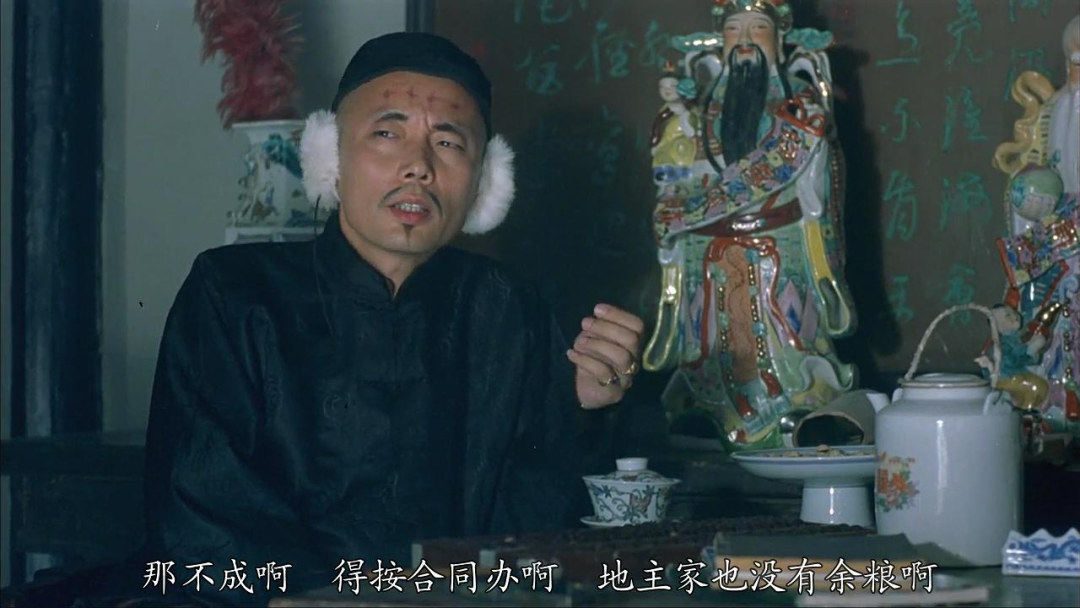
Junyang, you must stay strong against temptation.
Author: Xue Xingxing
Editor: Jiang Jiao
Cover Design: Party A and Party B
Alibaba has been around for 26 years, marking a significant milestone in its 102-year vision. Over the past two decades, Alibabarians have continuously made strides in China's internet sector, staying true to the founder's vision and consistently contributing Alibaba's talent to society.
However, when it comes to the types of talent Alibaba has contributed, historically, it has produced more managerial talent than technical expertise. As a result, when Alibaba talent is mentioned today, it often sparks a wave of jokes about the "Alibaba style." This is understandable, as Alibaba did not heavily rely on technology-driven growth in its early years, resulting in fewer technical talents being nurtured compared to other internet companies of the same era.
With the dawn of the AI era, more Alibaba technical talents have started to gain prominence, many of whom have grown within the Alibaba ecosystem. Over the past two years, as major domestic companies have begun to compete fiercely for AI talent, Alibaba has also stepped up its contribution of technical talent to society. Notable examples include Yan Zhijie, an early core member of the Academy, Zhou Chang, the former technical leader of the Tongyi Qianwen large model, and Bo Liefeng, the former head of the applied vision team at the Tongyi Lab.
Possibly buoyed by Alibaba CEO Wu Yongming's strong emphasis on AI strategy, the media has started to refer to Alibaba as the "Whampoa Military Academy" in the AI field. Baidu, which once nurtured an entire generation of Chinese internet professionals, might find this amusing—what goes around comes around.
Nevertheless, Junyang Lin's recent departure seems to have generated more buzz and impact than those of other AI talents who left Alibaba in the past two years. Lin is the technical leader of Alibaba's Tongyi Qianwen and the driving force and "spokesperson" behind the open-sourcing of the Qwen model. He has been lauded by the media as a core technical talent at Alibaba Tongyi and one of Alibaba's youngest P10-level technical experts in history.
Lin's departure also seemed more sudden. There were hardly any external signs before he posted the farewell message, "me stepping down. bye my beloved qwen." Just a day earlier, he was still sharing Alibaba's newly released Qwen-3.5 small model series on social media and thanking Elon Musk for his likes and comments.

Junyang Lin's Tweet
From March 4th to the present, Junyang Lin's departure has become one of the hottest topics in China's AI sector. Countless media outlets are trying to uncover the reasons behind his departure, ranging from organizational adjustments within Alibaba's Qwen team to clashes between large companies' strategic directions and technical talent, and even internal company conflicts.
According to sources, Zhou Hao from Google's DeepMind team may replace Lin and lead the post-training work for Qwen. Zhou previously participated in the development of Google's Gemini 3.0 model. Interestingly, after Lin's departure, Omar Sanseviero, the head of developer experience at DeepMind, publicly extended an invitation for the Qwen team to join.
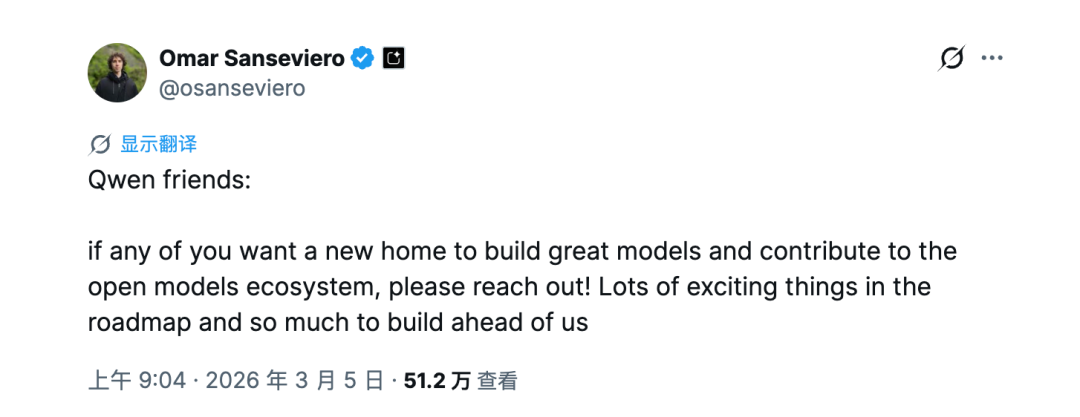
Omar Sanseviero Extends an Olive Branch to the Qianwen Team
Internally at Alibaba, the stir caused by Lin's departure has far exceeded external expectations. After Lin announced his departure, many Qwen employees publicly showed their support on social media, stating, "Qwen is nothing without its people."
When Sam Altman was dismissed by the OpenAI board, hundreds of employees supported him, threatening to resign en masse if his position was not restored. Their slogan on social media was, "OpenAI is nothing without its people."
Around the time of Lin's departure, several technical leaders from Alibaba's Qwen team also left in quick succession, including Yu Bowen, the post-training leader of Qwen; Hui Binyuan, the leader of Qwen Code; and Li Kaixin (Kaixin Li), a core contributor to Qwen3.5/VL/Coder. Similar to Lin, most of them are technical talents cultivated by Alibaba in recent years, having joined the company as campus recruits.
Technical talents are indeed more straightforward. A few years ago, under Alibaba's "Cloud and DingTalk Integration" strategy, Wu Zhao, who had led DingTalk for several years, was forced to resign. Apart from some key DingTalk personnel he took with him, there was hardly any more uproar in the public opinion arena.
Now, the entire AI circle has been affected by Lin's departure, with various parties speculating on the impact it will have on the development of the Qianwen model. Even Alibaba, known for its strong organizational culture, has stumbled somewhat in the face of losing control over technical talent.
On the afternoon of March 4th, Alibaba's Tongyi Lab urgently convened an all-hands meeting to communicate internally about the turmoil caused by Lin's departure. The meeting was of high importance, with Alibaba CEO Wu Yongming, Alibaba Chief Talent Officer Jiang Fang, and Alibaba Cloud CTO Zhou Jingren all attending to answer questions.
According to 36kr, Alibaba's senior management defined the core nature of this adjustment as follows: Qwen is not contracting; this is a team expansion unrelated to any political struggles. Instead, more resources will be invested. How could Junyang Lin's departure possibly be related to political struggles? Everyone knows that we Alibabarians have never been involved in politics. Otherwise, why would Feng Qingyang go to the Cliff of Repentance?
Whether this all-hands meeting succeeded in stabilizing morale remains unknown, but at least it failed to alleviate external speculation about the Qwen team's instability. Its sole purpose seemed to be maintaining the group's dignity. On that afternoon, Lin posted on his WeChat Moments, "Brothers of Qwen, keep working according to the original plan. It'll be fine."
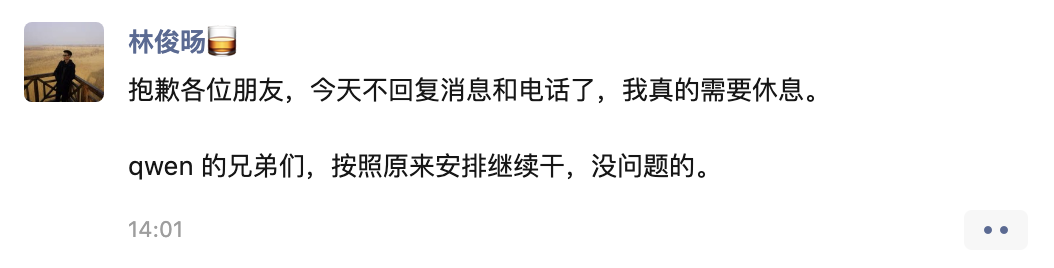
Screenshot of Junyang Lin's WeChat Moments
On March 5th, Wu Yongming sent an internal email officially announcing Lin's departure at the company level. He stated that "the company has decided to approve classmate Junyang Lin's resignation." Perhaps to quell doubts about uneven resource allocation within the company triggered by Lin's departure, Wu also announced the establishment of a foundational model support team, with Wu, Zhou Jingren, and Fan Yu jointly coordinating group resources to support foundational model construction.
Some observers who may not fully understand the dispute might wonder: How could Alibaba, which announced last year that it would invest over 380 billion yuan in AI over three years, still face insufficient resource investment in foundational models?
You simply don't understand large companies well enough. The group's total investment is one thing, but how it is implemented is another. Foundational model construction is important, but is the Waimai free order (free delivery for food orders) feature of the Qianwen App not important? No matter how well the open-source ecosystem performs, has it directly translated into revenue for Alibaba Cloud?
It's just youthful recklessness—acting without considering the consequences and causing such a commotion. After Wu Yongming announced Lin's departure, Alibaba had to specifically refute rumors externally, stating that the current Qianwen model team is stable, there has been no "mass resignation," and all products and services are operating normally.
You see, a few years ago, Wu Zhao felt so wronged and reluctant when facing the group's decision to take back DingTalk, yet he accepted the arrangement gracefully. Even if he intended to leave, he first served as Zhang Yong's assistant for a few days. It wasn't until he finally started his own venture that he vaguely told the media, "DingTalk will always belong to the group."
Last year, the group's strategy changed, and Wu Zhao was brought back into the fold. Upon returning to Alibaba, he remained the CEO of DingTalk. When the media wrote reports, they emphasized that this was a "strategic correction" by Alibaba's new management, reflecting Wu Yongming's strategic direction of "user first, AI-driven."
Well, that's the dignity of adults.
After Lin's departure was settled, there were also reports in the market advising against overestimating Lin's value. Although he was the technical leader of the Qwen team, he was never the team's core.
For instance, Jiemian News quoted a source close to Alibaba as saying, "Internally, Junyang Lin is not the core presence of the entire Qwen or even the Tongyi Lab... The soul figure of Qwen remains Zhou Jingren, Alibaba's partner and Alibaba Cloud CTO."
I'd say we can take this even further. A couple of days ago, Jack Ma led a group of core management from Alibaba and Ant Group to Hangzhou Yungu School to offer guidance on the future development of AI. Ma stated at the meeting that AI presents an opportunity to return education to its essence, "The future is not about making children compete with AI in calculation and memory but about keeping them curious and learning empathy and responsibility..."
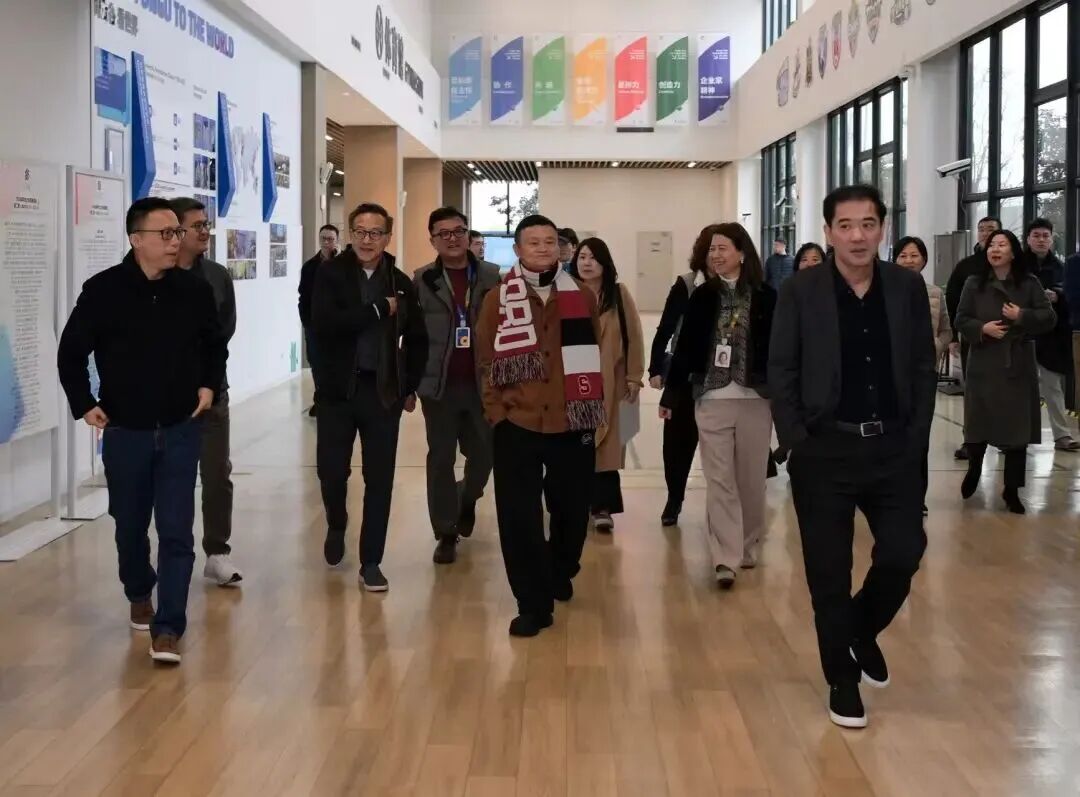
Jack Ma Leads Alibaba and Ant Group Executives to Hangzhou Yungu School
Alibaba Group Chairman Joseph Tsai, CEO Wu Yongming, Risk Committee Chairman Shao Xiaofeng, E-commerce Business Group CEO Jiang Fan, Ant Group Chairman Eric Jing, and CEO Han Xinyi, among others, participated in the exchange.
In terms of core figures, these are the true cores of Qwen. In terms of soul figures, these are the true soul figures of Qwen. With so many talented youngsters in the AI field, Qwen's future remains bright even without Junyang Lin.
However, since he's already being hailed as a talented youngster, I privately suggest that Junyang Lin follow in the footsteps of other talented youngsters, strike out on his own, and embark on an entrepreneurial journey. In the AI era, there's no shortage of youngsters achieving instant fame. Born in 1993, Lin is only a year younger than Yang Zhilin—he still has a chance if he gives it another shot.
It's said that investors have been rushing to offer Lin money these past two days. According to 36kr, Junyang Lin alone is worth 100 million USD. Investor News reported that many investors and leading large companies are trying to contact Lin—it's unknown whether Alibaba is among these leading large companies. After all, among Chinese internet companies, Alibaba has invested in the most AI large model companies.
But Junyang, you must stay strong against temptation. Even if you still love Qwen, don't take Alibaba's investment. Wu Zhao, who took Alibaba's investment last time, is now back at the group's beck and call, implementing its strategy.
Learn from Elon Musk, learn from Anthropic. If you don't get along with OpenAI, strike out on your own and create better models and products than OpenAI.
After all, the resources you've received at Alibaba don't seem to have been that substantial.
© All rights reserved by Shangshan. Unauthorized reproduction is prohibited.
-
![]()
Doubao Work Unveiled! Domestic AI Leaders Fully Commit to the 'Work' Sector
-
![]()
Who’s Sounding the Alarm on ‘Rushed Vehicles’?
-
![]()
Over 5.3 Billion Yuan in Losses Over Three and a Half Years! Can Yonyou Reverse Its Fortunes Through Streamlining and AI Transformation?
-
![]()
Baidu AI Adopts Free Model: A Strategic Maneuver in Traffic and Monetization
-
![]()
Silicon-Based OLED Pioneer Unveils Financial Results: H1 Shipments Outpace Entire 2025 Volume
-
![]()
AI's First "Lost Summer"
-
![]()
Zeiss Makes Another €2.2 Million Bet: Will Eye Tracking Be the Next Big Thing in the Smart Glasses Industry?
-
![]()
RUNTO Ranking | Global Top TV ODM Factories' Shipment Figures for July 2026