Wang Xing Must Channel the 'Thousand-Group War' Spirit to Alleviate AI Anxiety
 03/06 2026
 502
502
How Can Meituan Alleviate Its AI Anxiety?
The Spring Festival of the Year of the Horse serves as a prime testing ground for the AI capabilities of various companies. Industry giants such as Alibaba, ByteDance, Tencent, and Baidu, alongside emerging players like Zhipu, DeepSeek, and MiniMax, are leveraging their strengths through product iterations, red packet incentives, gala marketing, and initiatives such as "order a free milk tea with one sentence" to fiercely compete for the AI-to-Consumer (AI2C) super entrance.
Meituan, not wanting to be left behind, upgraded its AI assistant "Wen Xiaotuan" ahead of the Spring Festival to join the AI fray. The person in charge stated that the upgrade aims to address real pain points in local life services during the Spring Festival, helping users find suitable, genuinely available, and better-priced services while minimizing the likelihood of encountering issues.
'Heavy on B, Light on C': Meituan's AI Struggles to Keep Up
Testing revealed that the new version of "Wen Xiaotuan" still operates primarily in a Chatbot (Q&A) mode. Although it incorporates deep thinking capabilities and can tap into Meituan's vast local life service data, the experience feels more akin to using DeepSeek's chat function. According to its service instructions, the large models supporting Wen Xiaotuan include Meituan's self-developed "LongCat" and DeepSeek Chat.
This exposes an awkward reality: Meituan has yet to establish a clear path for AI to transition from "assisted Q&A" to "autonomous execution."
For instance, when I issued the command, "Help me book a restaurant for 6 PM, serving Sichuan cuisine, for two people, using a coupon," Wen Xiaotuan merely acted as an "information porter," providing text-based information such as restaurant recommendations, dish suggestions, and itinerary planning. However, it failed to fulfill the critical "action" demand of "booking."
In contrast, Qianwen has already advanced into the Agent era. Using "order a free milk tea with one sentence" as a starting point, it integrates Alibaba's business ecosystem. Users are no longer just passive recipients of advice but can truly experience a new AI-driven lifestyle where "a single sentence gets things done."
Doubao, in collaboration with hardware manufacturers, launched AI-powered devices such as AI phones and AI recording beans, externalizing Doubao's AI capabilities. For instance, the viral Doubao AI phone, under limited system authorization, achieves a closed loop of "perception-decision-execution" with high completeness, bringing AI Agent's capabilities into the daily lives of ordinary users.
This technological and experiential gap caused Meituan's AI efforts in the Spring Festival battle to be overshadowed by competitors' firepower.
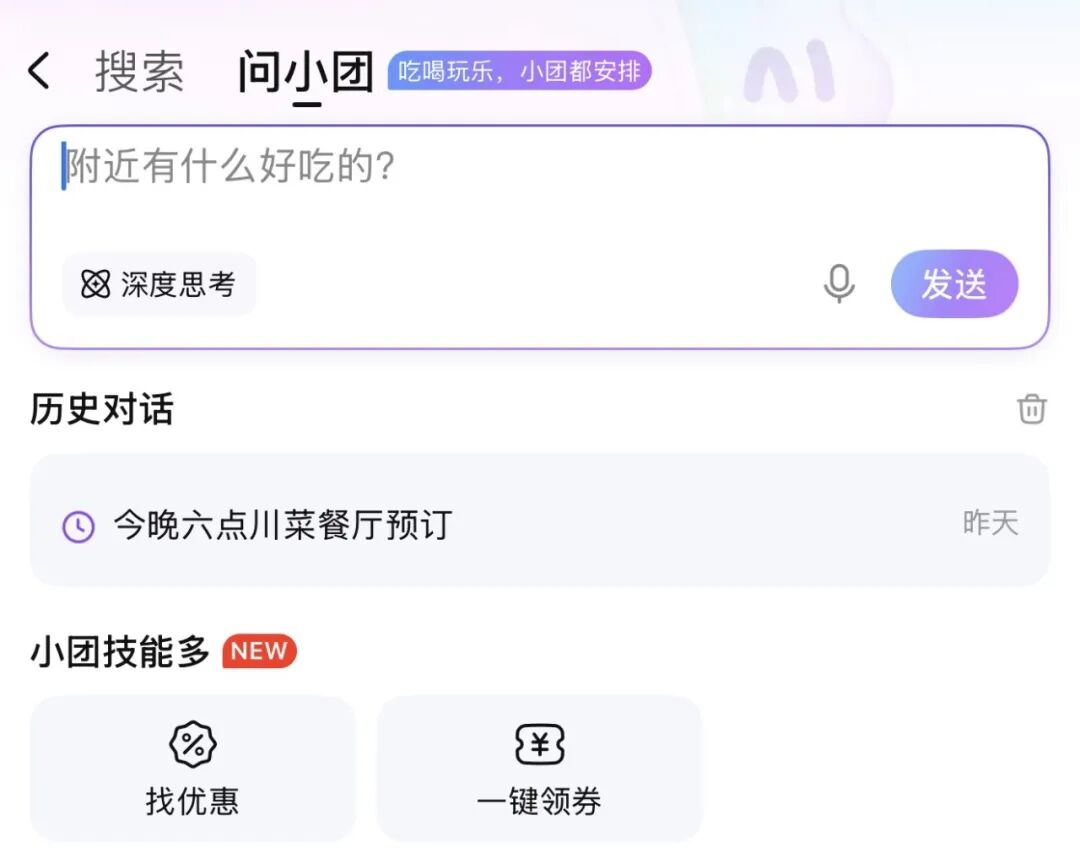 Figure: Wen Xiaotuan Interface, Screenshot by Tang Chen
As the Spring Festival AI battle wound down and companies focused on post-mortem analysis, Meituan made another move: its subsidiary, Guangnian Beyond, launched the AI browser Tabbit. This marked the team's debut after Meituan's costly ¥2 billion acquisition and was seen as another significant step in Meituan's AI applications following its "deep research" agent.
However, before the outside world could grasp Wang Xing's true intentions in entering the browser sector, Tabbit became embroiled in a plagiarism controversy within 24 hours of its launch.
Media reports claimed that independent developer "Mengxi Shuile Ma" (Has Mengxi Gone to Sleep?) publicly pointed out that Tabbit's translation function's code and interface layout were highly similar to his open-source project "Peidu Wa" (Study Companion Frog), with "read-frog" related terms retrievable in the source code.
Although the controversy quickly subsided through mutual reconciliation, it exposed loopholes in Meituan's compliance review mechanism. Combined with Wen Xiaotuan's hasty entry into the battle, it's evident that Meituan is anxious in the AI2C entrance competition.
Behind this impatient haste lies Meituan's multiple considerations: capturing AI2C traffic entrances to avoid being intercepted by competitors, addressing product shortcomings in AI2C to narrow the gap with leading players, and activating team combat effectiveness (fighting capacity) to build a complete ecosystem synergizing AI and local life services.
Admittedly, Meituan's AI is noticeably lagging compared to its main rivals. Alibaba has built a full-stack self-developed system encompassing "models-cloud-self-developed chips" and integrated AI capabilities across its business ecosystem, achieving end-to-end AI transformation in consumer decision-making, fulfillment scheduling, and merchant ecosystems.
ByteDance, centered around the Doubao large model, deeply integrates AI into core scenarios like Douyin search, e-commerce, local life services, and content recommendations, rapidly expanding its user base, function call frequency, and coverage. In particular, Douyin's local life services, empowered by AI-driven precise recommendations and convenient transactions, directly challenge Meituan's core businesses of in-store dining and instant retail, squeezing Meituan's survival space.
In fact, Wang Xing has always shown strong interest in AI and elevated it to a core strategic level within the group. In late February 2025, Wang Xing clearly stated at an internal communication meeting that Meituan's second decade would focus on three key areas: grocery retail, internationalization, and technology. The core technology goal is to seize AI opportunities and build a large-scale, full-category, in-depth, and ecologically healthy local commerce system.
From a strategic perspective, Meituan's AI moves are neither late nor few, having established a multi-dimensional, full-chain matrix system. For example, at the technical level, Meituan has open-sourced and released multiple versions, including LongCat-Flash (language model), LongCat-Flash-Omni (multimodal model), and LongCat-Video (video generation model).
Meanwhile, Meituan's annual AI investment exceeds ¥10 billion, primarily directed toward GPU computing power, self-developed large model R&D, and full-chain implementation, providing technical support for AI product innovation.
Its highlights lie in B-end services, where Meituan has launched a series of AI business assistants for catering merchants, including AI customer service, AI scheduling specialists, AI operations, and AI business managers, helping merchants reduce costs and increase efficiency. Official data shows that AI-driven site selection success rates have improved by 30%, customer service efficiency by 80%, and products like "Daishu staff officer" (Daishu Advisor) and "Daishu butler" (Daishu Housekeeper) have covered thousands of catering brands, generated over 100,000 reports, and achieved an 87% site selection accuracy rate.
However, Meituan's AI2C progress has been unsatisfactory. Its flagship independent local life service AI assistant Xiaomei, general-purpose AI assistant LongCat, and AI assistant Wen Xiaotuan have struggled to form synergy, let alone gain widespread popularity.
Overall, Meituan's AI2C strategy appears disjointed, lacking a clear main thread. Products operate in silos without coordination. For instance, the newly launched Tabbit AI browser feels like a KPI-driven project detached from Meituan's core business, failing to deeply integrate with core local life services like food delivery and in-store dining to drive traffic and close service loops.
Wang Xing Must Channel the 'Thousand-Group War' Spirit
The importance of AI2C to Meituan cannot be overstated. Once AI applications like Qianwen, Doubao, Yuanbao, and Wenxin enhance Agent capabilities and become consumer decision-making entrances, Meituan risks becoming a bottom-tier "service pipeline," like early telecom operators, losing its competitive initiative.
The ban on Doubao AI phones largely stemmed from AI bypassing app interceptions at the system level to complete closed loops directly. Original platforms or apps would be reduced to downstream "service providers," passively isolated from users. Further, they would rely on new AI application entrances for traffic allocation, facing "strangulation."
Wang Xing clearly doesn't want Meituan to end up in this situation. He has swiftly adjusted Meituan's AI business to a combat stance. At the Q1 2025 earnings call, he elaborated on Meituan's AI strategy and industry competition for the first time, emphasizing that Meituan's AI approach is offensive, not defensive.
To this end, he outlined a clear three-tier roadmap for Meituan's AI strategy:
First, "AI at work," meaning fully integrating AI into all employees' daily work and the company's overall operations, significantly boosting the work efficiency and office experience of 100,000 employees through technological empowerment;
Second, "AI in products," transforming all existing B2B and B2C products and services with AI technology while creating native AI products to better serve consumers, partner merchants, and riders, further consolidating core competitive advantages;
Third, "Building LLM (Large Language Models)," continuously increasing capital expenditures to enhance the core capabilities of self-developed foundation models and solidify the technological foundation.
However, paradoxically, Wang Xing appears cautious in his specific AI layout and development judgments. In early 2025, he stated that for fulfillment-based service industries, AI's current impact remains limited.
A few months later, at Meituan's shareholder meeting, he reiterated that people tend to overestimate industry changes in the next one or two years while underestimating long-term transformations over the next decade. He reminded shareholders that, in the early stages of a tech wave, financial investments require patience.
This "eager yet cautious" mindset has created Meituan's current contradictory AI state: relatively complete B-end AI layouts primarily reinforce fulfillment efficiency moats, while AI2C progress remains slow, with a persistent lack of core AI decision-making entrances.
Delving deeper, one reason is Meituan's long-standing focus on offline local businesses, where the technology team holds limited influence within the company. AI implementation heavily relies on business-side cooperation, and cross-departmental progress remains inefficient.
Another reason is Meituan's preference for allocating resources to quick-win, implementable business expansion projects. For example, acquiring Dingdong ahead of the Year of the Horse Spring Festival aimed to solidify its instant retail position, representing a "space-for-time" strategy to buy development time for Meituan AI.
Moreover, real operational pressures are squeezing Meituan. Besides expecting a ¥23.3-24.3 billion net loss in 2025, Meituan's core local life services face intense competition from Taotian, JD.com, Douyin, and others. Its stock price has also been declining since 2026, and its critical AI transformation and second growth engine remain unrealized.
 Figure: Online Sources
Perhaps Wang Xing still lacks the decisiveness and ruthlessness he displayed during the "Thousand-Group War" when it comes to AI.
According to incomplete statistics, over 3,000 group-buying websites emerged domestically between 2010-2011, with at least ten scaling up significantly.
Meituan's ability to stand out from the group-buying chaos relied not on first-mover advantage but on a replicable, highly implementable methodology: clear strategy, aggressive execution, and pragmatic efficiency.
For example, Meituan built the internet industry's iconic ground promotion iron army, implementing a closed-loop management model of "early start, late sharing, strong review" to translate "frequent visits, frequent orders" targets into daily actions.
Another example: during the fiercest phase of the "Thousand-Group War," while competitors frantically expanded into new cities, Wang Xing decided to halt expansion and concentrate resources on serving consumers. This decision not only strengthened his control over Meituan but also preserved cash flow, allowing Meituan to expand market share when rivals faced capital chain ruptures.
From today's perspective, this "Thousand-Group War" playbook remains applicable to Meituan. To ease Meituan's AI anxiety, Wang Xing must prioritize AI more seriously, step to the forefront to lead personally, and truly elevate it to a "CEO project."
Merely showing strong interest or designating it as a core group strategy is insufficient. Meituan needs a clear AI strategic direction and more efficient, implementable execution. Only by fully committing to AI can it safeguard its core competitiveness. Incidents like Tabbit's setback will only cause Meituan AI to miss more opportunities.
For Meituan, it's still in the game but lacks the "all-in" resolve of its competitors. That determination can only come from Wang Xing. It's time for him to step to the forefront again.
References:
Kechuangban Daily, "2 Billion Acquisition Debut! Guangnian Beyond Launches AI Browser Tabbit"
TMTPost, "Wang Xing's First AI Comments: Meituan's Strategy is Offensive, Not Defensive"
-
![]()
Doubao Work Unveiled! Domestic AI Leaders Fully Commit to the 'Work' Sector
-
![]()
Who’s Sounding the Alarm on ‘Rushed Vehicles’?
-
![]()
Over 5.3 Billion Yuan in Losses Over Three and a Half Years! Can Yonyou Reverse Its Fortunes Through Streamlining and AI Transformation?
-
![]()
Baidu AI Adopts Free Model: A Strategic Maneuver in Traffic and Monetization
-
![]()
Silicon-Based OLED Pioneer Unveils Financial Results: H1 Shipments Outpace Entire 2025 Volume
-
![]()
AI's First "Lost Summer"
-
![]()
Zeiss Makes Another €2.2 Million Bet: Will Eye Tracking Be the Next Big Thing in the Smart Glasses Industry?
-
![]()
RUNTO Ranking | Global Top TV ODM Factories' Shipment Figures for July 2026