The Launch of National Standards for Humanoid Robots and Embodied AI: A Pivotal Moment for the Industry
 03/06 2026
 677
677
Authored by Zhineng Technology
China has recently unveiled its inaugural 'Humanoid Robots and Embodied Intelligence Standard System (2026 Edition)'.
While some may view this as merely another addition to the extensive list of national standards, this particular release is genuinely groundbreaking.
The robotics sector is on the cusp of becoming a trillion-dollar industry, and China, in its nascent stages of development, has already laid down a standard framework to foster sustained growth. This approach echoes the successful trajectories seen in the new energy vehicle and battery sectors.
01
Why are standards pivotal?
Let's consider the early days of new energy vehicles, where a plethora of charging pile standards existed:
◎ Japan's CHAdeMO
◎ Europe's CCS
◎ China's GB/T
These standards were mutually incompatible, posing challenges for automakers to devise a unified charging solution. However, as China's market share surged, its GB/T charging standard gained prominence and is now being adopted internationally. After all, our products offer both affordability and quality.
Humanoid robots are currently grappling with identical challenges:
◎ Diverse dexterous hand interfaces across manufacturers
◎ Proprietary joint motor control protocols
◎ Incompatible communication methods for perception modules
◎ Vastly different software architectures
The consequence: The entire industrial chain struggles to collaborate effectively. Despite having over 140 companies and 330 products in China, core technologies are being redundantly developed.
What are emerging robotics firms doing? They're focusing on interface adaptation, system reconstruction, and hardware compatibility. This underscores the urgency for a standardized system. Without standards, there can be no industry. Given the substantial investment in resources and capital in China, a unified standard, even if imperfect initially, will pave the way for continuous product iteration through practice.
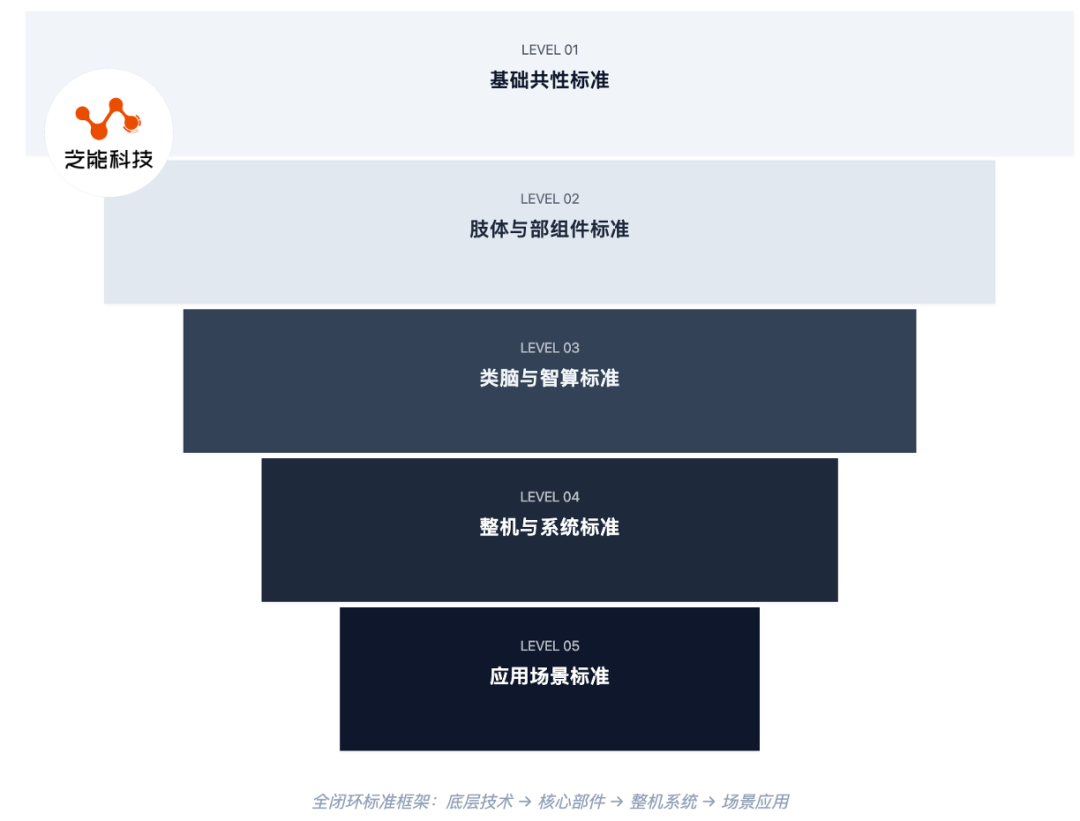
What does this standard system entail?
Three key aspects:
● Firstly, establishing a 'basic operating system' to unify industry terminology. This encompasses definitions for terms, classifications, architectures, and modules. Just as the internet and automotive electronics couldn't have evolved without TCP/IP, USB, and CAN, a unified language is essential for industrial scaling.
● Secondly, addressing core engineering challenges by developing component and system standards (such as joint modules, dexterous hands, sensor modules, and control units) to foster a modular industrial chain. The future robotics industry will mirror the automotive sector:
◎ OEMs (e.g., Unitree, Zhiyuan, Tesla)
◎ Tier 1 and Tier 2 supply chains (e.g., dexterous hands, joint motors, control systems)
This specialized division of labor, with each entity focusing on its strengths, will double efficiency.
● Thirdly, proactively tackling safety concerns, including human-robot safety, data privacy, and behavioral boundaries. As robots penetrate factories, hospitals, and homes, safety issues will become increasingly complex. Without unified norms, the industry will face significant regulatory risks.
02
In the realm of robotics,
China is 'competing for standards'
More critically, global standards for humanoid robots are yet to be established. How significant is this? Historically, China has missed out on standard-setting opportunities in numerous industries:
◎ Mobile operating systems: Dominated by American iOS and Android
◎ Fuel vehicle standards: China has minimal influence
However, the tide is turning. China now boasts three absolute advantages:
◎ Unparalleled manufacturing capabilities: China commands a substantial share of the global robotics supply chain (motors, reducers, sensors).
◎ Abundant application scenarios: Training data is vital for robots. China possesses the world's largest array of factories, warehouses, logistics, and service industry settings.
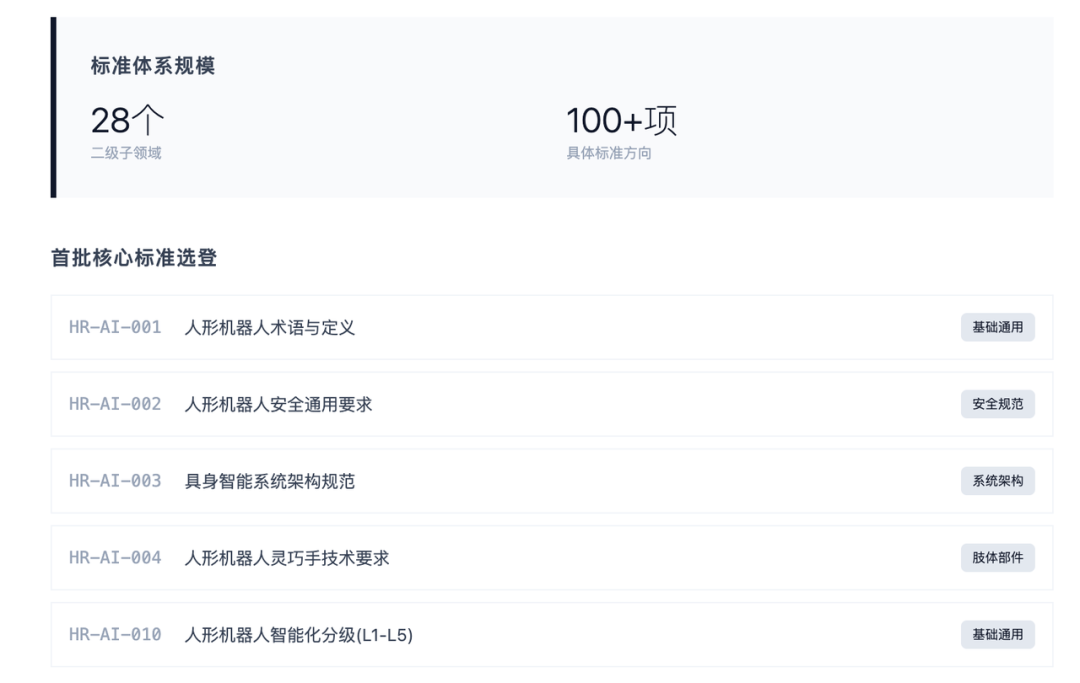
◎ A thriving ecosystem of industrial companies: Global humanoid robot shipment data for 2025 reveals Unitree with over 5,500 units and Zhiyuan with over 5,100 units, totaling 13,000 units worldwide. China holds a dominant position. This standard system spans 28 sub-fields and over 100 standard directions, aiming to translate these advantages into rule-making authority.
Despite the significance of standard releases, the industry's true growth still faces three hurdles:
◎ Cost: Current robot prices range from 100,000 to 300,000 RMB. Only by reducing prices to below 50,000 RMB can they truly penetrate the mass market.
◎ Task capabilities: Currently, robots can manage material handling, simple assembly, and display performances. Truly complex multi-task operations and autonomous planning are still under development.
◎ Data scale: Autonomous driving has demonstrated that AI capability is directly proportional to data scale. The same principle applies to robots. The future's fiercest competition will revolve around robot training data.
Summary
The launch of this standard system is pivotal for China's robotics industry at a macro level. Over the next five years, three transformative changes may unfold: a significant decline in robot prices, widespread adoption of robots in manufacturing, and the formation of a complete supply chain. If this process unfolds smoothly, the industry scale could soar to the trillion-dollar mark. Indeed, standards are of paramount importance.
-
![]()
Doubao Work Unveiled! Domestic AI Leaders Fully Commit to the 'Work' Sector
-
![]()
Who’s Sounding the Alarm on ‘Rushed Vehicles’?
-
![]()
Over 5.3 Billion Yuan in Losses Over Three and a Half Years! Can Yonyou Reverse Its Fortunes Through Streamlining and AI Transformation?
-
![]()
Baidu AI Adopts Free Model: A Strategic Maneuver in Traffic and Monetization
-
![]()
Silicon-Based OLED Pioneer Unveils Financial Results: H1 Shipments Outpace Entire 2025 Volume
-
![]()
AI's First "Lost Summer"
-
![]()
Zeiss Makes Another €2.2 Million Bet: Will Eye Tracking Be the Next Big Thing in the Smart Glasses Industry?
-
![]()
RUNTO Ranking | Global Top TV ODM Factories' Shipment Figures for July 2026