Personnel Shake-Up at Alibaba’s Qwen: Unraveling the Reasons Behind Lin Junyang’s Departure
 03/06 2026
 577
577

Early this morning (March 4), Lin Junyang, the technical lead of Alibaba’s Tongyi Qianwen (Qwen) project, took to social media to bid farewell to the Qianwen team, writing, “I’m stepping down, my dear Qwen.”
According to reports from LatePost and Phoenix Technology, Lin Junyang formally submitted his resignation to Alibaba on the afternoon of March 3, following an internal meeting.
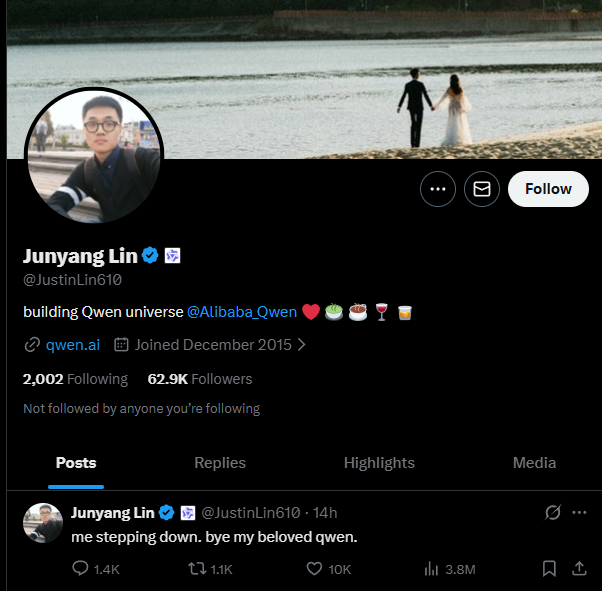
When questioned about Lin Junyang’s resignation, Alibaba Cloud informed Qianbidao that they had “no immediate response.”
There is speculation that Lin Junyang’s departure may stem from organizational restructuring. A source close to Alibaba Cloud revealed to Qianbidao: “The technical foundation is now well-established, and there is a need for new talent capable of driving commercialization.”
Lin Junyang was not the only one departing. On the same day, Yu Bowen, the post-training lead for Qianwen, also officially resigned.
Two other technical experts from the Qianwen large model team also left, including Hui Binyuan, the lead for code-related work, and Li Kaixin, a core contributor to the Qwen3.5 series, Qwen VL, and Coder series.
Notably, shortly before Lin Junyang’s departure, Alibaba’s Qwen had just released the Qwen3.5 small-scale model series and completed a brand integration.
On the evening of March 2, Alibaba officially open-sourced four Qwen3.5 small models: Qwen3.5-0.8B, 2B, 4B, and 9B. The release attracted attention on overseas social media, with Elon Musk commenting that these small models possess “impressive intelligence density.” Subsequently, Lin Junyang posted on social media to thank Musk for his praise.
- 01 -
Prior to his resignation, Lin Junyang served as a Senior Algorithm Expert at Alibaba’s DAMO Academy and was the technical lead for the Tongyi Qianwen series of large models. He participated in and led the development of multiple open-source large models.
Public records indicate that Lin Junyang was born in 1993. He completed his undergraduate studies in the English Department at the University of International Relations and pursued a master’s degree in Linguistics and Applied Linguistics at Peking University’s School of Foreign Languages.
His research focused on natural language processing and multimodal representation learning, with multiple papers published in top international conferences such as NeurIPS, ICML, and ACL.
In 2019, Lin Junyang joined Alibaba’s DAMO Academy Intelligent Computing Lab as a fresh graduate, participating in the development of the multimodal model M6.
In 2023, he spearheaded the official release of the Tongyi Qianwen large model, which integrated multimodal technologies into its architecture.
In 2024, he led the open-sourcing of the Qwen series models, introducing multiple versions such as 7B, 14B, and 72B.
In 2025, the team released the Qwen3-Max model with trillion-scale parameters, trained on approximately 36T of data. It outperformed several international mainstream models in evaluations like GPQA (equivalent to graduate-level exams). That same year, he also established a robotics and embodied AI research team to explore applying multimodal agent capabilities to real-world scenarios.
From public information, Lin Junyang played a pivotal role in the technical development of Tongyi Qianwen. For instance, he led the development of Qwen3.0, which outperformed Llama2-70B in performance. He also proposed a multimodal agent framework, enhancing the model’s understanding of visual and audio inputs, and helped foster a large-scale Chinese open-source large model ecosystem.
The industry expressed significant regret over Lin Junyang’s departure.
Wang Tiezhen, the China head of the globally renowned open-source community Hugging Face, posted on social media: “There truly is no one—literally no one—like Lin Junyang in this world... Your departure is a tremendous loss for Alibaba’s Qwen.”
- 02 -
In addition to the aforementioned sources, LatePost’s report also mentioned that Lin Junyang’s departure is likely related to the ongoing organizational restructuring within the Qwen team. Recently, the Tongyi Lab planned to split the Qwen team from a “vertically integrated” system covering different training processes and modalities into horizontally divided teams focused on pre-training, post-training, text, multimodal, etc.
Tech blogger Lanxi also believes that Alibaba aims to adjust the separation of product and model development. He stated on his social media account: “Models focus on models, and products focus on products. This is the comfort zone for the model team—only engaging in research without market responsibilities. Qwen’s exceptional reputation in the open-source community was built this way. However, the product team suffers, as everything requires coordination with peer model teams without overall control... Now, with the Qianwen App directly engaging in a war of attrition with Doubao and Yuanbao, allowing the model team to remain an exception is no longer feasible.”
If organizational restructuring is the cause, an unavoidable backdrop is the escalating intensity of the AI arms race.
During the Spring Festival, Alibaba (Tongyi Qianwen), ByteDance (Doubao), Tencent (Yuanbao), and Baidu (Wenxin) collectively promoted their products. Morgan Stanley estimated that total promotional spending across platforms likely exceeded 8 billion yuan. With such massive resource investments, half-hearted efforts are not an option, and one of the foundations of large companies’ combat effectiveness is organizational capability.
Jia Yangqing, a former Alibaba technical executive and now founder of Lepton AI, offered a new perspective, discussing the conflict between open-source and commercialization.
He cited the fates of several companies. Databricks and Redis Labs are successful examples of open-source commercialization, while RethinkDB, a beloved open-source database, shut down in 2016 despite its technical excellence. “Is there friction between open-source vision and commercial priorities? This is purely speculative, but if not, it would be the exception, not the norm.”
He further noted: “For companies, balancing open-source and commercial interests is indeed extremely difficult.”
Southern Metropolis Daily quoted industry insiders speculating that Lin Junyang’s departure might be due to his performance targets shifting to daily active users (DAUs). However, a source stated that all major companies evaluate DAUs.
Nevertheless, data from around the Spring Festival shows that Qianwen’s DAUs were strong. Through the “Spring Festival Hospitality Plan,” DAUs peaked at 73.52 million the day after the event and stabilized around 40 million, higher than pre-marketing levels, with better traffic retention than competitors.
Vito, a secondary market investor who has observed Alibaba for at least 10 years and runs the WeChat public account “Riri Tan,” told Qianbidao that Lin Junyang’s resignation resulted from multiple conflicts, including organizational and talent mindset issues.
He argued that Alibaba has always been a company with a strong organizational culture, and its early success stemmed from this culture. However, such a culture makes it difficult to attract and retain top talent.
“Top talent seeks freedom. Alibaba’s culture cannot accommodate the idea of supporting team members in a management style that fosters self-motivation and cohesion, believing that ideal managers are logical and reasonable. For every small team leader, the most important task is to recruit people better than themselves; otherwise, it's 'a failure.' This requires leaders to have a small ego and not think they are invincible or capable of doing everything alone.”
He judged that although Lin Junyang joined Alibaba as a campus recruit and was a top AI talent cultivated by the company, “his underlying values conflicted with Alibaba’s culture, which is the most important reason for his departure.”
As for claims that “commercial and technical goals were not fully aligned,” Vito did not believe this was the core reason for the departure of Qianwen’s technical backbone.
He said: “Technical belief and commercialization are not contradictory, especially in cutting-edge fields like AI, where leading companies should excel in both research and technical implementation. Alibaba’s DAMO Academy’s forward-looking organizational setup provided advantages, and such conflicts are always compromisable. It’s unlikely they would lead to a breakup.”
This article does not constitute any investment advice.
-
![]()
Doubao Work Unveiled! Domestic AI Leaders Fully Commit to the 'Work' Sector
-
![]()
Who’s Sounding the Alarm on ‘Rushed Vehicles’?
-
![]()
Over 5.3 Billion Yuan in Losses Over Three and a Half Years! Can Yonyou Reverse Its Fortunes Through Streamlining and AI Transformation?
-
![]()
Baidu AI Adopts Free Model: A Strategic Maneuver in Traffic and Monetization
-
![]()
Silicon-Based OLED Pioneer Unveils Financial Results: H1 Shipments Outpace Entire 2025 Volume
-
![]()
AI's First "Lost Summer"
-
![]()
Zeiss Makes Another €2.2 Million Bet: Will Eye Tracking Be the Next Big Thing in the Smart Glasses Industry?
-
![]()
RUNTO Ranking | Global Top TV ODM Factories' Shipment Figures for July 2026