ATH Unveils 'Wukong': Is Alibaba Redefining Its AI Strategy?
 03/19 2026
 590
590
Alibaba's 'AI Anxiety' Amidst Industry Shifts
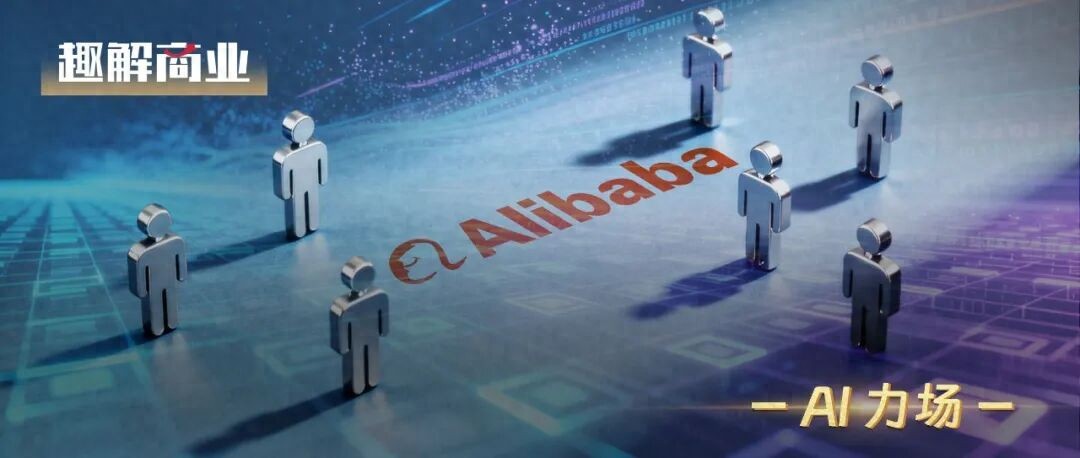
On March 16, Alibaba Group circulated an internal memo to all staff, formally announcing the launch of the Alibaba Token Hub (ATH) business unit, directly overseen by Group CEO Eddie Wu Yongming. Positioned alongside its e-commerce and cloud intelligence divisions, ATH emerges as Alibaba's third pillar, signaling a strategic pivot in its AI endeavors.
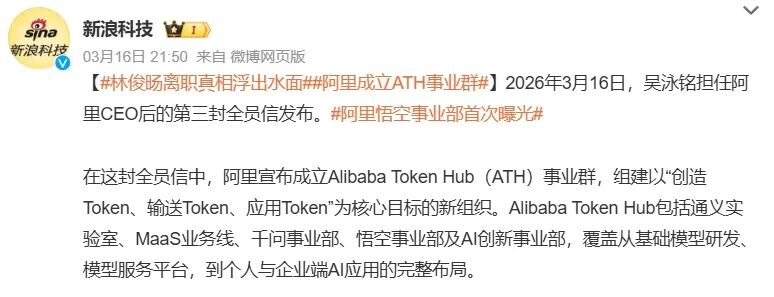
Image source: Weibo capture
Less than a month after Junyang Lin's exit, Alibaba has once again overhauled its AI business structure. With key technical leaders departing, the question arises: Is Alibaba's 'Token'-centric reorganization a reactive measure to talent loss, or a proactive stance in anticipation of the AGI (Artificial General Intelligence) era?
01. Is Qwen Set for a Major Leap?
Prior to ATH's inception, Alibaba had streamlined its operations under the 'One Alibaba' banner, restructuring from '1+6+N' to 'Four Key Sectors': Alibaba China E-commerce, Alibaba International Digital Commerce, Cloud Intelligence, and 'All Others' (encompassing Hema, Damai Entertainment, etc.).
AI initiatives were predominantly housed within the Cloud Intelligence Group, integrating Tongyi Lab (large models), T-Head (chips), and Alibaba Cloud (computing power). Technical teams collaborated with e-commerce, local services, and payment units, forming a cohesive ecosystem.
However, ATH's formation marked a consolidation of AI efforts across the group, centered around Tongyi Lab. Before ATH, T-Head was just one facet of Alibaba's AI strategy. The recently established Qwen C Business Group (a merger of the Intelligent Information and Intelligent Connectivity Business Groups) also played a pivotal role, housing consumer-facing products like the Qwen App, Quark, AI hardware, and the UC Browser. Additionally, business units like Taobao and DingTalk were independently developing AI capabilities.
ATH's establishment effectively centralizes and integrates these dispersed AI operations.
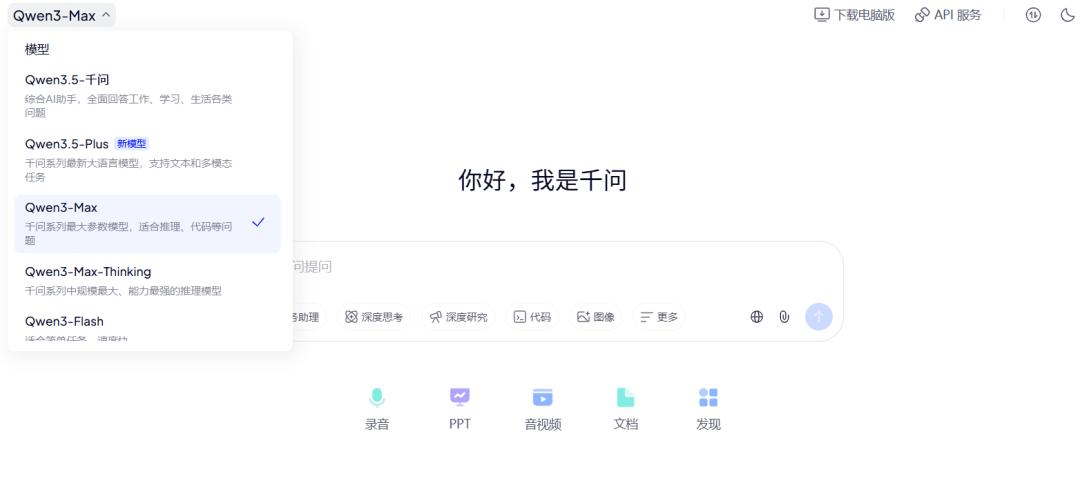
Image source: Qwen capture
According to Eddie Wu's memo, ATH comprises five main divisions: Tongyi Lab handles foundational model R&D; the Qwen and AI Innovation Business Divisions focus on consumer applications, developing the Qwen AI assistant and exploring innovative apps; the MaaS (Model as a Service) line, transferred from Alibaba Cloud, manages the model service platform for enterprises and developers; and the new Wukong Business Division creates AI-native work platforms for businesses, deeply integrating model capabilities into workflows. All divisions report directly to Eddie Wu.
Departments under direct CEO oversight typically indicate top strategic priority and concentrated resource allocation. Previously, the QWEN team navigated a multi-tiered reporting structure. Before Junyang Lin's departure, his QWEN team reported to Alibaba Cloud CTO Zhou Jingren, who in turn reported to Eddie Wu. At the group level, there was no independent AI unit to coordinate efforts. Internally, the QWEN team expressed dissatisfaction over 'insufficient computing power and limited card access hindering training.' Now, with streamlined decision-making, the organizational foundation is set to resolve computing power conflicts and cross-departmental issues.
To some extent, ATH's creation can be seen as a fallout from Junyang Lin's departure. Industry insiders suggest that ATH's formation, modeled after Google Brain and DeepMind's merger, was initiated early to resolve internal conflicts stemming from the separation of production and modeling teams; Lin's exit accelerated this process.
The separation of production and modeling was common in AI's early stages, with R&D teams focusing on model iteration and product teams on market penetration. The model team remained independent to avoid being influenced by product KPIs and business cycles. However, with intensifying competition in consumer applications and refined B-end demands, model teams can no longer operate in isolation. Model capabilities must be deeply embedded in business processes, necessitating closer collaboration between model and product teams.
Media reports previously highlighted divergent goals between the Qwen team (led by Junyang Lin) within Tongyi Lab and the Qwen product team. After the Qwen App project launched in September 2025, the Qwen technical team prioritized 'open-source influence,' developing models of various sizes and tools while engaging the open-source community. The product team sought earlier upgrades to the Qwen foundational model's multimodal capabilities, such as image editing and photography, but the Qwen team prioritized open-source community downloads.
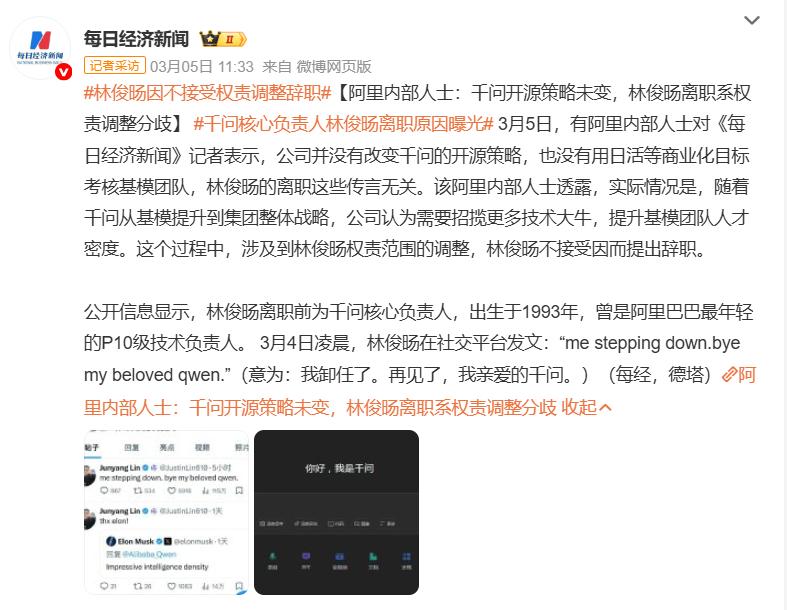
Image source: Weibo capture
Post-ATH, the Qwen product and model teams are now part of the same business group. According to 'Huxiu,' Alibaba has mandated that Qwen achieve a user base breakthrough this year, swiftly surpassing Yuanbao to lead the market; the Qwen App is also expected to serve as the AI gateway for Alibaba's ecosystem, linking e-commerce and local services.
The Qwen App's iterations require deeper integration of the Qwen team's post-training phase with the product team's work. Currently, Qwen's post-training lead is Zhou Hao, a former DeepMind senior researcher, while the Qwen Business Division is headed by Wu Jia (Alibaba Vice President). Both are likely to collaborate under a unified OKR system, with Qwen's user experience undergoing significant changes.
02. Why 'Token' as the Organizational Core?
Beyond Qwen coordination, a key reason for ATH's establishment is to meet surging Token demand.
Tokens are the fundamental units consumed by large language models during learning and inference, making them indispensable in the AI era, akin to 'mobile data.' ATH's formation prepares Alibaba for the impending 'Token arms race.'
In his memo, Eddie Wu stated that we stand on the brink of an AGI explosion. Billions of AI Agents will perform digital tasks, relying on model-generated Tokens as the primary medium for human-digital interaction. The 'ATH Business Group' aims to 'create, deliver, and apply Tokens' (Tongyi Lab for creation, MaaS for delivery, and the Qwen, Wukong, and AI Innovation Business Divisions for application).
At the recent NVIDIA GTC conference, founder Jensen Huang echoed this sentiment: More Silicon Valley engineers now use AI daily for coding, research, and document processing, all consuming Tokens. Enterprises must cover these AI-related expenses for employees, with Huang predicting significant enough costs to warrant separate budgeting, similar to providing computers and software. In the future, every engineer may receive an annual Token budget.
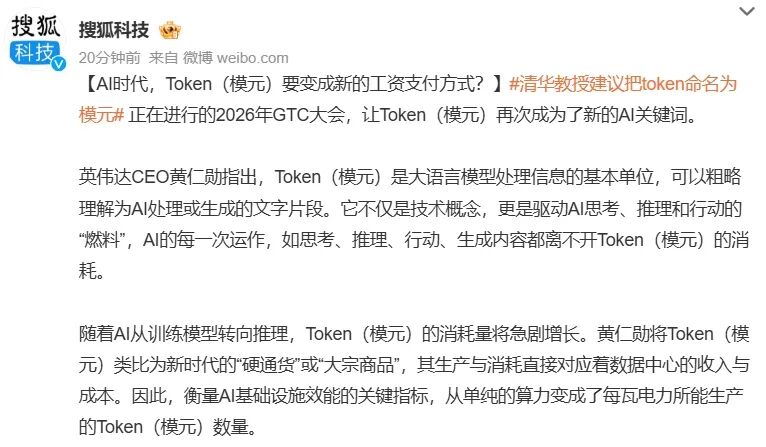
Image source: Weibo capture
Office-level Agents like Openclaw (Longxia, or 'Lobster') are key drivers of Token consumption. The day after ATH's announcement, DingTalk held a press conference to introduce the Wukong Business Group, making its debut within ATH, and highlighted its 'Lobster' Agent. As a B-end AI-native work platform, Wukong is deeply integrated into DingTalk AI 2.0, allowing employees to organize tasks, initiate approvals, and perform other functions via voice commands without manual interface operation.
Unlike Lobster, Wukong adopts a CLI-native approach, reconstructing the DingTalk system into atomic instructions that AI can directly invoke, ensuring stable execution. Wukong operates within the user's permission scope, reducing security risks.
The enterprise-level work scenarios targeted by Wukong will lead to sustained, massive Token consumption. This represents Alibaba's bet on B-end AI productivity and a crucial step in commercializing its Token ecosystem.
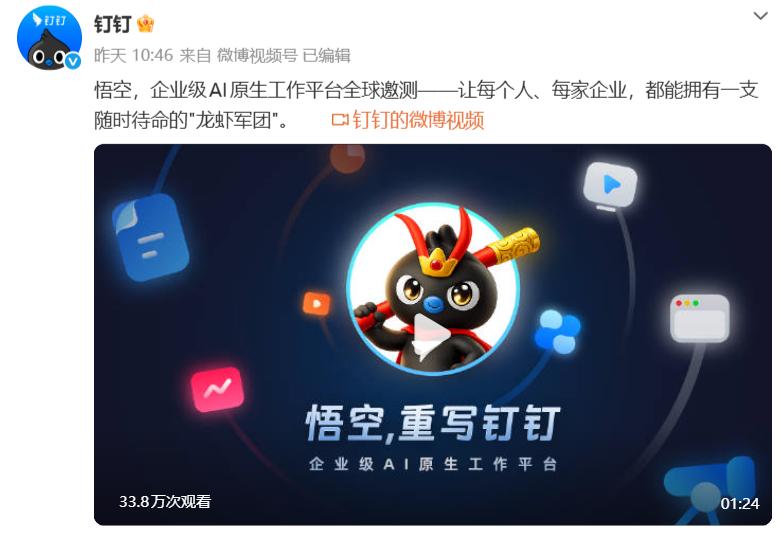
Image source: Weibo capture
Notably, besides Alibaba, ByteDance, Baidu, and Tencent are also entering the enterprise-level office Agent sector: ByteDance launched the cloud-based ArkClaw, emphasizing low-code integration with Feishu and Douyin ecosystems; on March 9, Tencent introduced WorkBuddy, a full-scenario AI Agent compatible with OpenClaw's skills, requiring no cloud deployment and enabling remote operation via corporate WeChat.
Office-level Agents are becoming a new battleground in AI competition among major corporations. Whoever can seamlessly integrate AI into office workflows while balancing efficiency and security will gain core influence in enterprise services in the AGI era.
From resolving internal conflicts to anchoring the Token ecosystem, Alibaba's transformation is not just a response to talent changes but an inevitable choice as AI competition deepens. As model competition shifts towards scenario implementation and ecosystem strategy, ATH's establishment represents not only a reconstruction of Alibaba's AI landscape but also a crucial pivot for domestic major corporations from 'model building' to 'AI utilization.' The contest surrounding Tokens and Agents has only just begun.
-
![]()
Doubao Work Unveiled! Domestic AI Leaders Fully Commit to the 'Work' Sector
-
![]()
Who’s Sounding the Alarm on ‘Rushed Vehicles’?
-
![]()
Over 5.3 Billion Yuan in Losses Over Three and a Half Years! Can Yonyou Reverse Its Fortunes Through Streamlining and AI Transformation?
-
![]()
Baidu AI Adopts Free Model: A Strategic Maneuver in Traffic and Monetization
-
![]()
Silicon-Based OLED Pioneer Unveils Financial Results: H1 Shipments Outpace Entire 2025 Volume
-
![]()
AI's First "Lost Summer"
-
![]()
Zeiss Makes Another €2.2 Million Bet: Will Eye Tracking Be the Next Big Thing in the Smart Glasses Industry?
-
![]()
RUNTO Ranking | Global Top TV ODM Factories' Shipment Figures for July 2026