The Future of E-commerce Hinges on Agent-Based Recommendations | Australia Post E-Commerce Report 2026
 03/19 2026
 616
616

The Australia Post E-Commerce Report 2026 offers an in-depth analysis of the latest online shopping trends in Australia, providing retailers and practitioners with comprehensive insights into shifting consumer behaviors, market trends, and future opportunities. The report highlights that with the rapid growth of e-commerce, household participation in online shopping continued to rise in 2025, making e-commerce a dominant force in the retail sector.
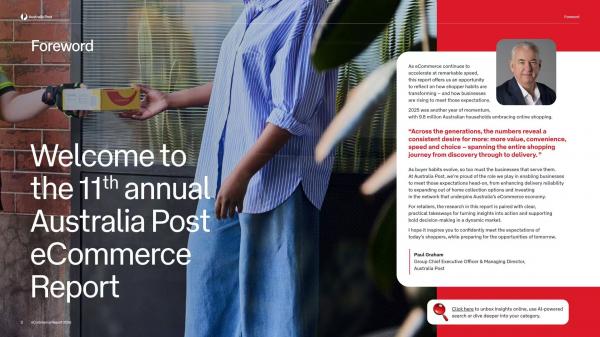
Paul Graham, CEO and Managing Director of Australia Post, noted that e-commerce continued to accelerate in 2025, with 9.8 million households across Australia shopping online. He emphasized that from Baby Boomers to Generation Z, consumers of all generations are highly aligned in their pursuit of "more value, more convenience, faster speeds, and greater choice." With profound changes in user habits, businesses must also iterate and evolve their services rapidly.
I. Online Shopping Has Become Deeply Embedded in the Daily Lives of Australian Consumers
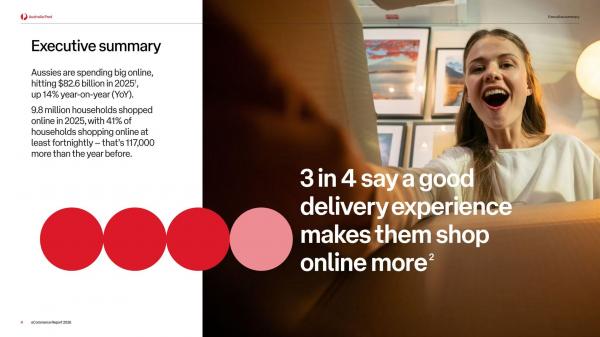
In 2025, Australian consumers reached a record high in online spending, totaling AUD 82.6 billion, a 14% year-on-year increase. Nationwide, 9.8 million households engaged in online shopping, with 41% shopping at least every two weeks, an increase of 117,000 households from the previous year.
The report distills three key findings: declining consumer brand loyalty, increased shopping frequency, and continuous improvement in delivery experiences. Based on these, the report further proposes five business insights for 2026: clearly communicate value, prepare for the agent-based future, shift from transactional to relational thinking, capitalize on promotional events, and offer diverse delivery options.
II. Five Actionable Guidelines for E-Commerce Businesses in 2026
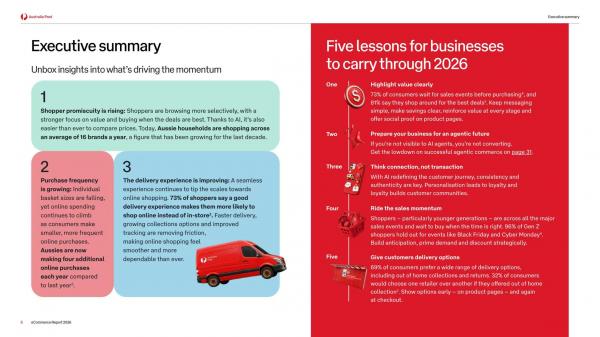
Value Communication: 73% of consumers wait for promotions before purchasing, and 81% compare prices across platforms. Therefore, businesses should clearly communicate discounts and promotional information at critical touchpoints in the shopping journey to facilitate sales conversions.
Embrace the Agent-Based Future: In the future, failure to be discoverable by AI agents will mean missed conversions.
Connection Over Transaction: AI is reshaping the consumer journey, with consistency and authenticity becoming key to winning consumer trust. Only personalized experiences can foster true user loyalty.
Capitalize on Promotional Events: 96% of Gen Z consumers wait for major sales events like Black Friday and Singles' Day. Therefore, businesses need to preheat (pre-heat) in advance and develop pricing strategies to quickly and precisely capture consumer attention.
Delivery as a Competitive Edge: 69% of consumers prefer diverse delivery options, and 32% choose a retailer based on the availability of self-collection points. Delivery options are becoming a key battleground for differentiation among merchants.
III. Rediscovering Your Consumer Generational Profiles

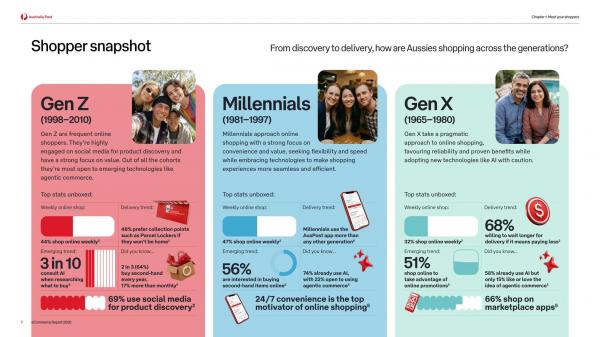
Generation Z: Discovers products via social media, value-driven consumption, and most open to emerging technologies like agent-based e-commerce.
Millennials: Prioritize convenience and value, seek flexibility and speed, and embrace technology to make shopping more efficient.
Generation X: Pragmatic and rational, prefer reliable and proven benefits, and weigh new technologies cautiously.
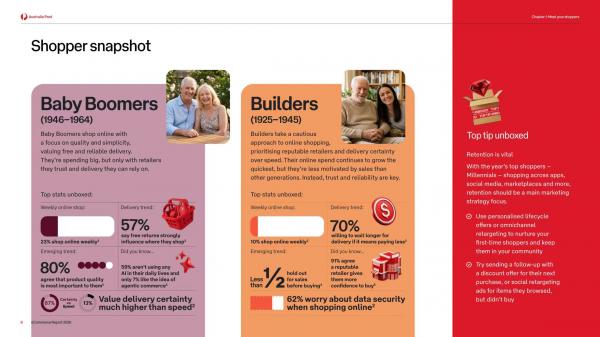
Baby Boomers: Quality-first, value free and reliable delivery, and only shop with retailers they trust.
Builders Generation (1925-1945): Cautious about online shopping, prioritize reputation and delivery certainty, and exhibit the fastest growth in online spending.
IV. The New Normal in Consumer Behavior
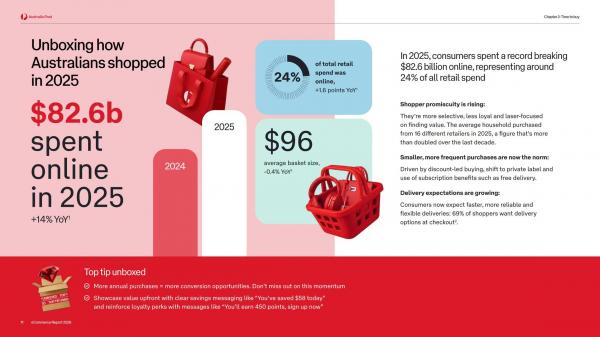
In 2025, consumer behavior exhibited three key characteristics:
Declining Brand Loyalty: Consumers are more discerning, less loyal to brands, and focused on finding value. On average, each household shops from 16 different retailers, more than double the number from a decade ago.
Smaller, More Frequent Purchases Become the Norm: Driven by discounts and subscription benefits (e.g., free shipping), average order values have decreased, but purchase frequency has increased.
Rising Delivery Expectations: 69% of shoppers expect to see delivery options at checkout.
V. The Geographic Landscape of Australian E-Commerce
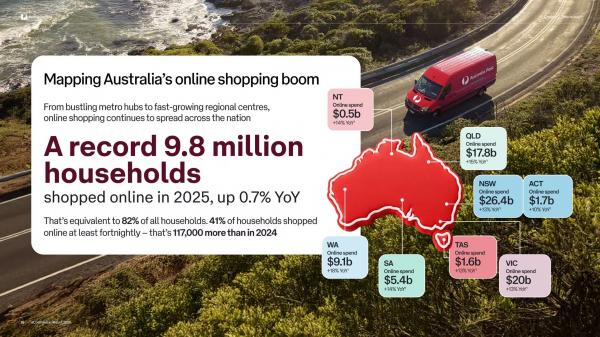
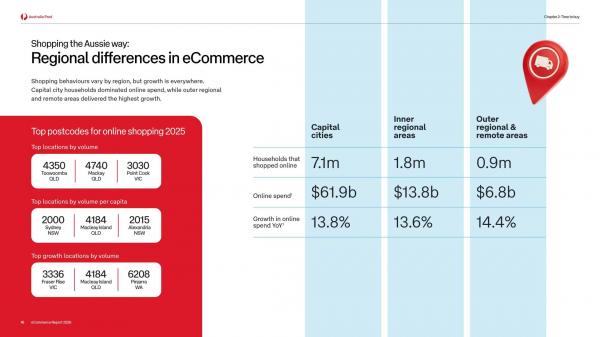
In terms of regional distribution, households in capital cities dominate online spending, while outer suburbs and remote areas show the highest growth rates.
Capital Cities: 7.1 million households shopped online, spending AUD 61.9 billion, a 13.8% year-on-year increase.
Inner Suburbs: 1.8 million households shopped online, spending AUD 13.8 billion, a 13.6% year-on-year increase.
Outer Suburbs and Remote Areas: 900,000 households shopped online, spending AUD 6.8 billion, a 14.4% year-on-year increase.
These figures indicate that e-commerce is penetrating all regions of Australia, with significant growth potential in remote areas that cannot be overlooked.
VI. The Rise of Online Marketplaces
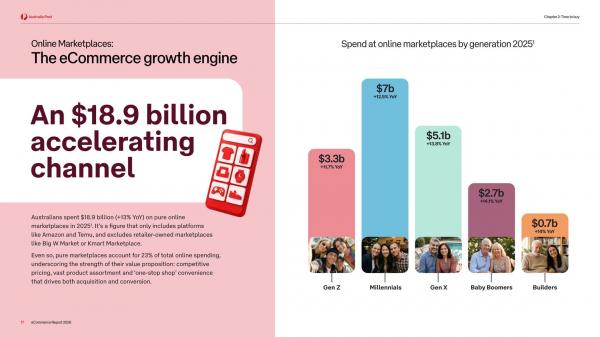
In 2025, Australian consumers spent AUD 18.9 billion on third-party online platforms (e.g., Amazon, Temu), a 13% year-on-year increase, accounting for 23% of total online consumer spending. This figure excludes platforms like Big W Market and Kmart Marketplace.
Third-party online platforms have become growth engines due to their strong value propositions: competitive pricing, a wide range of product choices, and the convenience of "one-stop shopping," which attracts new customers and drives conversions. For small and medium-sized retailers, e-commerce platforms can serve as instant secondary sales channels, offering access to a massive audience, built-in trust, and pathways to scale. However, they must also weigh risks such as intense competition, profit margin pressures, and diminished brand control.
VII. Optimizing the Checkout Experience
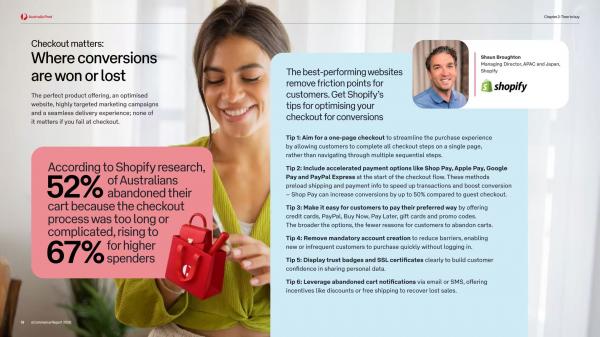
Shaun Broughton, Managing Director of Shopify Asia-Pacific and Japan, emphasized that no matter how good the product, website, or marketing is, if the checkout process fails, everything else is for naught. The best-performing websites eliminate customer friction points.
For payment service providers, the following six checkout optimization techniques are recommended:
Single-Page Checkout: Streamline the process to reduce drop-offs.
Integrate Express Payments: Options like Shop Pay, Apple Pay, and Google Pay can boost conversion rates, with Shop Pay outperforming guest checkout by 50%.
Diverse Payment Methods: Include credit cards, PayPal, buy-now-pay-later, gift cards, etc.
Eliminate Mandatory Registration: Lower the barrier for first-time customers to make a purchase.
Display Trust Badges: Enhance customer confidence and trust in sharing personal data.
Leverage Abandoned Cart Reminders: Send offers via email or SMS to recover lost sales.
VIII. Self-Collection Lockers Become the New Standard
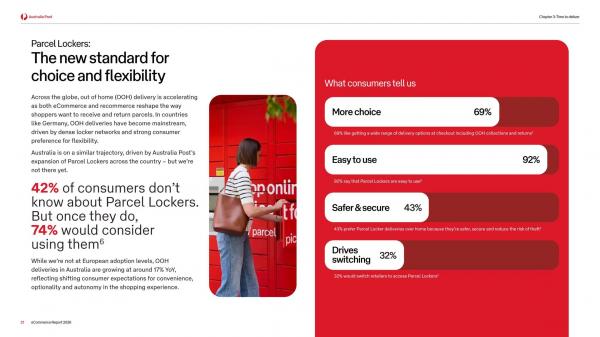
Globally, as e-commerce and secondhand e-commerce reshape how consumers receive and return goods, "out-of-home" self-collection delivery is accelerating. In places like Germany, dense networks of self-collection lockers and consumer preference for flexibility have made self-collection the mainstream option.
Australia is following Europe's developmental trajectory but still has gaps. Surveys show that 42% of consumers are unaware of self-collection lockers, yet 74% are willing to try them once informed. Although adoption lags behind Europe, self-collection delivery in Australia is growing at approximately 17% annually—consumer expectations for convenience, choice, and autonomy are reshaping the delivery landscape.
IX. Delivery Speeds Continue to Accelerate
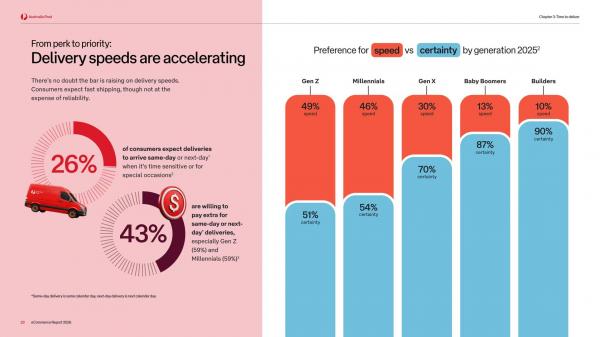
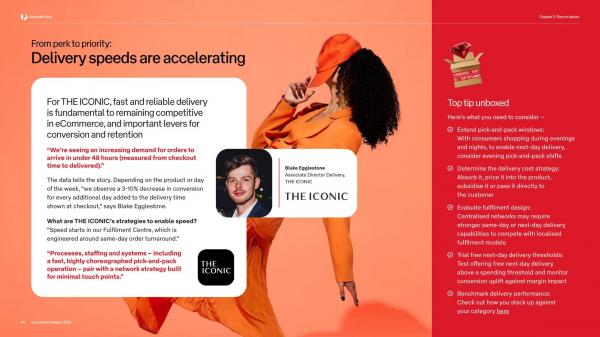
Consumer expectations for delivery speed are rising, but reliability remains equally important. Surveys show that when products are time-sensitive or for special occasions, 73% of consumers expect same-day or next-day delivery; 50% are willing to pay extra for such speeds, with Gen Z and Millennials showing the highest willingness (both at 59%).
Experience from fashion e-commerce platform THE ICONIC demonstrates that delivery speed directly impacts conversion rates. Blake Egglestone noted growing demand for orders to arrive within 48 hours, with conversion rates dropping by 3-10% for each additional day shown at checkout.
X. Four Key Trends Shaping the Future of E-Commerce
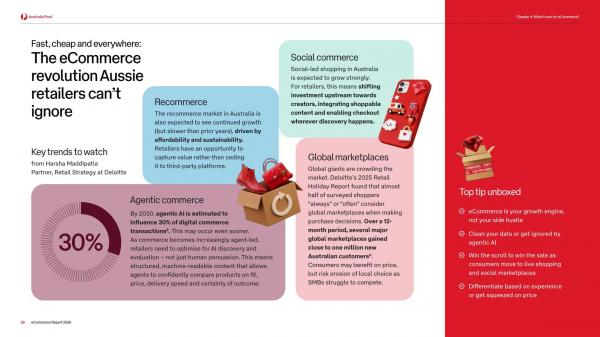
Experts from Deloitte identify four key trends for e-commerce in 2026 and beyond:
Secondhand E-Commerce: Driven by affordability and sustainability, Australia's secondhand e-commerce market will continue to grow. Retailers have opportunities to capture value rather than ceding the market entirely to third-party platforms.
Agent-Based E-Commerce: By 2030, AI agents are expected to influence 30% of digital transactions. Merchants need to ensure discoverability by AI and optimize content, which requires structured, machine-readable product information.
Social Commerce: Social-driven shopping in Australia is expected to grow strongly. Merchants should shift resources toward creators, integrate shoppable content, and enable transactions at every possible touchpoint.
Global E-Commerce Platforms: Nearly half of shoppers "always" or "often" consider global e-commerce platforms when making decisions. While consumers may benefit from lower prices, SMEs' difficulty in competing could lead to reduced local choices.
XI. The Dawn of the Agent-Based E-Commerce Era
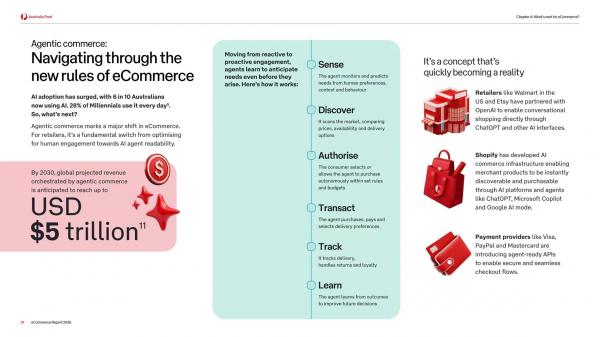
With AI adoption surging, 60% of Australians are now using AI, and 28% of Millennials use it daily. Agent-based e-commerce marks a significant shift in retail—for merchants, it represents a fundamental transition from optimizing for human engagement to optimizing for AI agents.
The agent workflow consists of six stages: perception (monitoring and predicting demand), discovery (scanning the market for prices), authorization (consumers set rules to authorize purchases), transaction (autonomous ordering and payment), tracking (monitoring delivery and returns), and learning (optimizing from outcomes).
This concept is rapidly becoming reality: Walmart, Etsy, and OpenAI have collaborated to enable conversational shopping; Shopify is developing AI commerce infrastructure; and payment providers like Visa and PayPal have launched agent-ready APIs. Agent-based e-commerce is moving from concept to reality.
XII. Adoption of Agent-Based E-Commerce
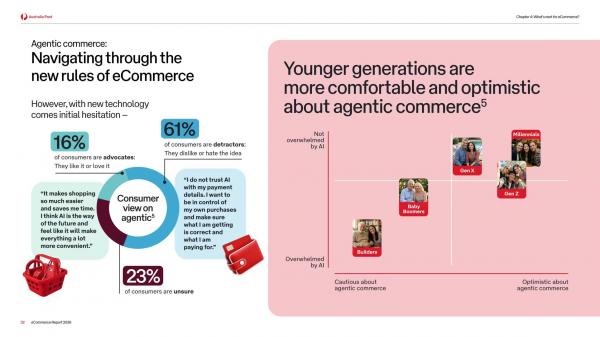
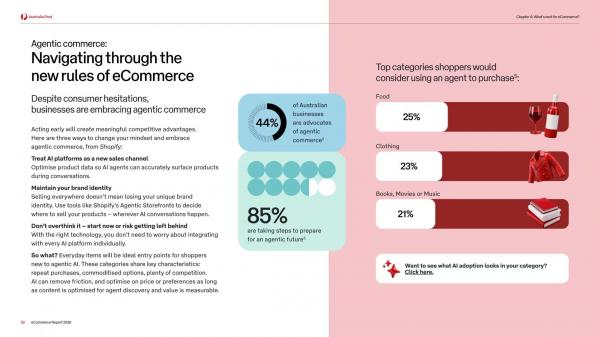
New technologies often face initial hesitation. Surveys show that younger generations are more comfortable and optimistic about agent-based e-commerce:
Ages 18-34: ~40% cautious, ~60% optimistic
Ages 35-54: ~60% cautious, ~40% optimistic
Ages 55+: Nearly 80% cautious, only 20% optimistic
Despite consumer hesitation, businesses are embracing agent-based e-commerce. Shopify recommends that businesses take three key steps:
Treat AI Platforms as New Sales Channels: Optimize product data so AI agents can accurately represent products in conversations.
Maintain Brand Identity: Use professional tools to decide in which AI conversational contexts to sell products.
Act Now: Don't overthink—start taking action now, or risk falling behind.
AI agent-based e-commerce is initiating a paradigm revolution in the retail industry. The core transformation lies in the gradual transfer of shopping decision-making authority from 'humans' to 'AI agents'—consumers authorize agents to perform full-chain operations such as price comparison, order placement, payment, and tracking. The transaction logic shifts from 'people seeking products' to 'agents seeking and purchasing on behalf of users'.
This trend will reshape the competitive rules for retailers. The future battleground will no longer be brand official websites or e-commerce platforms but rather the 'recommendation lists' of AI agents. Products that cannot be accurately understood, evaluated, and accessed by agents may automatically disappear from consumers' candidate lists. This implies that structured, machine-readable product information will become a fundamental requirement rather than a value-added option.
Meanwhile, AI agents will drive highly rationalized consumer decision-making—optimal solutions based on data will replace emotional brand loyalty, with quantifiable metrics such as price, delivery speed, and return convenience becoming core competitive factors. Therefore, retailers must shift from 'winning hearts' to 'persuading algorithms,' transitioning from user operations to data asset management.
Looking ahead to 2030, AI agents may dominate over 30% of digital transactions. This represents not just a technological upgrade but a reconstruction of the underlying business logic: whoever controls the cognitive entry points of AI agents will hold the key to the future of the retail industry.
-
![]()
Doubao Work Unveiled! Domestic AI Leaders Fully Commit to the 'Work' Sector
-
![]()
Who’s Sounding the Alarm on ‘Rushed Vehicles’?
-
![]()
Over 5.3 Billion Yuan in Losses Over Three and a Half Years! Can Yonyou Reverse Its Fortunes Through Streamlining and AI Transformation?
-
![]()
Baidu AI Adopts Free Model: A Strategic Maneuver in Traffic and Monetization
-
![]()
Silicon-Based OLED Pioneer Unveils Financial Results: H1 Shipments Outpace Entire 2025 Volume
-
![]()
AI's First "Lost Summer"
-
![]()
Zeiss Makes Another €2.2 Million Bet: Will Eye Tracking Be the Next Big Thing in the Smart Glasses Industry?
-
![]()
RUNTO Ranking | Global Top TV ODM Factories' Shipment Figures for July 2026