Kuaishou's 'AWS Moment': A Stark Valuation Disconnect
 03/27 2026
 594
594

Author | Chang Yuan
Editor | Key Points Editor
Prior to 2015, Wall Street institutional investors held a firm consensus on Amazon: it was perceived as a traditional retailer struggling to break even, eking out meager profits from goods transactions. For a considerable period, capital markets priced this behemoth using the most conservative and traditional e-commerce valuation logic, with AWS (Amazon Web Services) consigned to the unremarkable 'other businesses' category, receiving scant attention.
When Amazon first isolated AWS's revenue figures from its intricate financial statements, analysts were taken aback: AWS emerged as a highly profitable, rapidly expanding cash cow. Subsequently, Amazon's market capitalization soared over the years, metamorphosing from a low-margin retailer into a high-margin tech powerhouse.
Value re-evaluations are commonplace in business history. The inertial labels left by dominant businesses often act as a potent gravitational force, concealing the roaring new engine for extended periods. If we redirect our commercial gaze to today's Hong Kong stock market, a similar cognitive bias seems to be at play in Kuaishou's valuation.
On March 25, Kuaishou released its Q4 and full-year 2025 results. From a fundamental standpoint, there were no critical flaws; amidst a general slowdown in retail e-commerce, its e-commerce GMV maintained double-digit growth, serving as a beacon of hope. However, the stock price witnessed a significant correction the following trading day.
The crux of the issue lay in management's signal during the earnings call that 'capital expenditures will noticeably increase,' directly triggering capital market sensitivity to AI return cycles and short-term profit pressures.
This dilemma is not unique to Kuaishou. Recently, Tencent and Alibaba have both emphasized expanding AI investments, with both stocks experiencing noticeable corrections under pressure. Unlike the 2025 fixation on capex increases, the market in 2026 exhibits a collective risk aversion toward major firms' AI investments.
On the flip side, native AI players like MiniMax and Zhipu, with clear labels, attract capital more readily, enjoying ample imagination premiums and high valuations.
This sharply differentiated pricing logic bears a striking resemblance to Amazon's AWS moment. Before the inertia of old logic dissipates, the value of the new cycle often lurks within these 'complex' elements that are overlooked.
Is Purity a Prerequisite for Attention?
Within Kuaishou's earnings report, the most noteworthy data no longer originates from traditional businesses but rather from the AI performance buried deep in the financials.
In Q4 2025, Kling AI's operating revenue reached RMB 340 million. In December 2025 alone, its revenue surpassed $20 million, with an annualized revenue run rate (ARR) hitting $240 million.
Not only that, but the viral success of Seedance2.0 did not impede Kling's growth; instead, it helped educate a broader user base in the Chinese and global markets, expanding the overall market pie. During the Q4 earnings call, Kuaishou CEO Cheng Yixiao revealed that as of January 2026, Kling AI's ARR had exceeded $300 million. By this calculation, Kuaishou's monthly revenue in January reached $25 million, marking a significant 25% month-over-month increase.
Based on current growth momentum and commercialization progress, Kuaishou's management maintains strong confidence that Kling AI's revenue will more than double year-over-year in 2026. As model capabilities continue to improve, product forms become more refined, and professional scenario adaptability strengthens, Kling AI's commercialization is expected to accelerate further.
From steady quarterly revenue growth to robust monthly ARR performance, Kling AI charts an exceptionally clear commercialization trajectory. Behind these figures lies not only its leadership in foundational large models but also validation of its sustained market payment capacity and scalable monetization potential in real market competition. Across the entire AI industry, numerous AI products are still groping for commercialization paths in the dark.
However, this newly ignited engine has not been adequately reflected in the capital market's pricing models.
In Goldman Sachs' latest February 2026 report, the implied valuation of Kling AI within Kuaishou's stock price is merely approximately $5 billion (around RMB 36 billion). In a research report released by JP Morgan earlier this year, the bank unabashedly described Kuaishou as 'one of the cheapest AI stocks globally.'
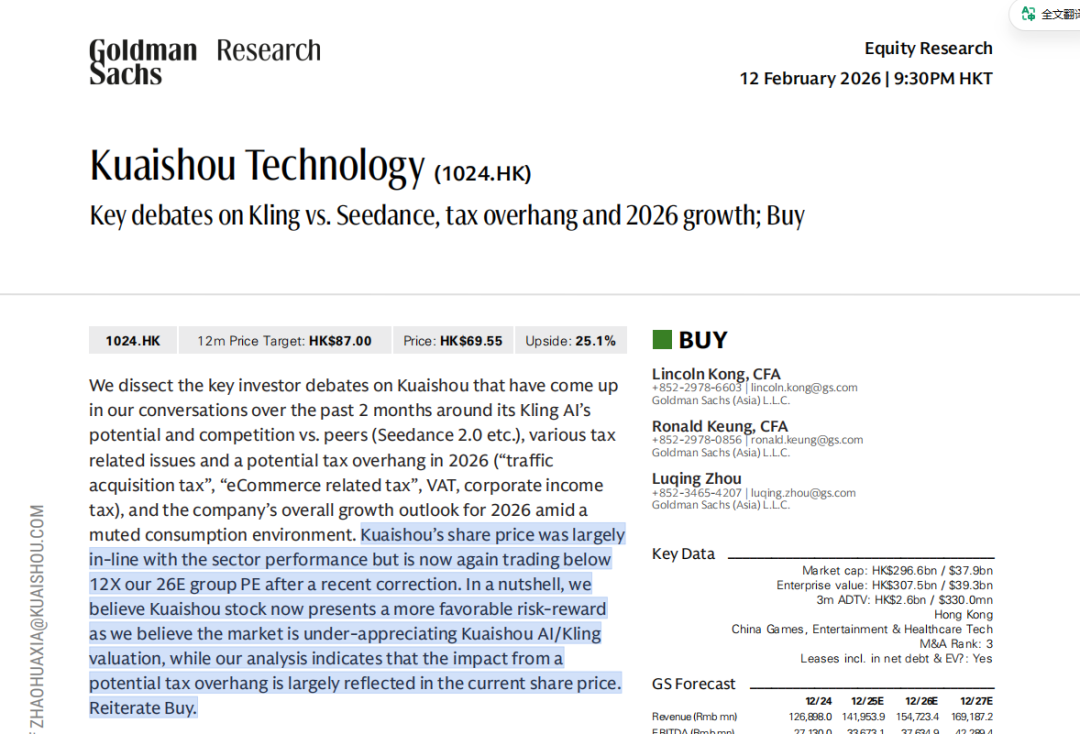
Kuaishou's revenue primarily derives from three segments: advertising, live streaming, and e-commerce. Under current market logic, advertising typically commands higher P/E ratios than live streaming and e-commerce. Currently, e-commerce stocks generally trade at around 10x P/E, such as Alibaba at 17x, Pinduoduo at 10x, and JD.com at 14x.
Even if we crudely view Kuaishou as a pure e-commerce stock for conservative estimation, its RMB 20 billion net profit would correspond to a valuation of at least RMB 200 billion. Yet on March 26, during Hong Kong trading, Kuaishou's market capitalization fell below RMB 180 billion. This implies that Kling AI carries virtually no valuation, even being treated as a negative asset. Meanwhile, in the same Hong Kong market, AI darlings MiniMax and Zhipu, neither with ARR surpassing $200 million, have seen their market caps soar to $40 billion.
A star AI business with an ARR exceeding $300 million and exceptional growth certainty is nearly treated as a 'free bonus' when purchasing the stock. This represents not only Kuaishou's current valuation misalignment but also suggests that the capital markets are brewing a re-evaluation opportunity.
Pragmatists Will Ultimately Prevail
The emergence of video generation models has infinitely reduced the marginal production costs of video content, representing not just a technological revolution but also a comprehensive reshaping of existing digital content production and distribution chains. Commercial returns have already been validated in fields like film, gaming, and live-streamed e-commerce. Both domestic think tanks and global consulting firms have provided highly positive and quantified forecasts for the commercialization prospects of video generation models.
Just one day before Kuaishou's earnings release, a black swan event occurred in the industry. On March 24, OpenAI suddenly announced the complete shutdown of Sora's application and API services. Correspondingly, across the ocean, China's AI video sector, represented by Kling AI and Seedance, is rising strongly.
Sora's journey has been filled with Silicon Valley-style individual heroism and drama. One core reason for this behemoth's abrupt exit was the prohibitive computational costs. Video generation is an extremely resource-intensive task, and when faced with fierce competition from large model companies like Anthropic and Gemini, Sora became a massive burden on OpenAI's computational resource allocation.
Sora's departure precisely validates the correctness of Kling's approach. If Sora aimed to create a universal world simulator, Kling has from the outset pursued a highly pragmatic content production engine route.
Compared to Sora's obsession with having AI emerge an understanding of the 3D world and physical laws through massive video data, Kling places greater emphasis on controllability. In practical commercial applications, creators do not need AI to understand profound cosmic laws; rather, they need AI to precisely follow instructions, such as accurately controlling a character's specific movement or ensuring a particular product's logo remains undistorted. To this end, the development team has invested tremendous effort in engineering experiences like camera control, keyframe specification, and subject locking.
Unlike Sora and most video generation models on the market, which function as standalone tools, Kling's major advantage lies in its integration with Kuaishou's massive content platform, providing natural implementation scenarios. For example, Kling can be deeply integrated into content creation workflows, directly empowering short video creators, advertisers, and live-streamed e-commerce merchants on the platform. This 'generation-distribution-monetization' internal circulation mechanism grants Kling stronger self-sustaining capabilities.
Operationally, since its launch, Kling has targeted professional B-end markets, deeply expanding into top-tier content production groups including the film and television industry, delivering superior results. During the micro-short drama boom, Kling introduced highly targeted role consistency control and storyboard generation functions, significantly reducing short drama production costs. Its adaptability in high-threshold professional scenarios like film and television continues to be validated. In the recently aired hit drama 'Peaceful Years' produced by Huace Film & TV, Kling AI was deeply involved in virtual scene and special effects production, significantly reducing costs while maintaining content quality. In live-streamed e-commerce and product display fields, video generation technology is rapidly being used to create high-quality product marketing videos, virtual anchors, or dynamic live-stream backgrounds. These represent practical areas that standalone tools have never touched.

In terms of product iteration pace, Kling continues China's internet strategy of rapid, incremental updates. Leveraging massive real user calls, Kling quickly identified pain points like human expression and body movement continuity for targeted optimization.
Since Q4 2025, Kling AI has sequentially launched the Kling O1, Kling 2.6, and Kling 3.0 model series. Kling O1, as the first unified multimodal creation tool, integrates text, video, image, and subject inputs, consolidating all generation and editing tasks into a single versatile engine, achieving integrated generation and editing creation. The Kling 2.6 model introduced the milestone 'synchronized audio-visual output' capability, completely transforming the traditional AI video generation workflow of 'silent footage first, manual dubbing later,' and added motion control functions. The latest Kling 3.0 series models, further upgraded based on the All-in-One concept, achieved a systemic leap from basic generation to professional-grade creative orchestration.
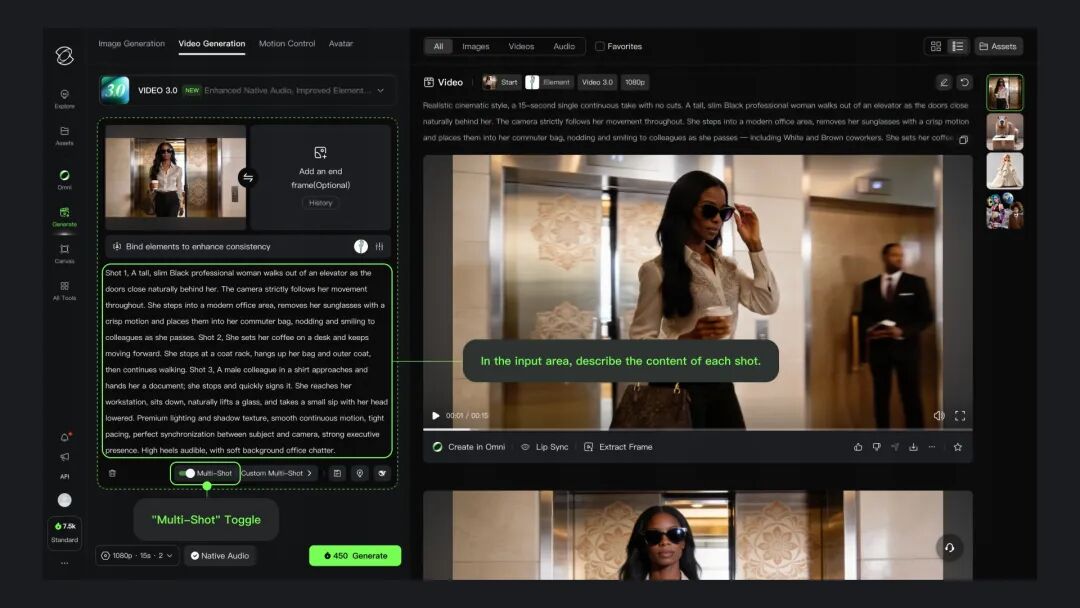
The future leadership of the video generation industry will belong to pragmatists like Kling, who can deeply embed into creator ecosystems, precisely resolve commercial pain points, and successfully transition from standalone generation tools to integrated productivity platforms.
By the end of 2025, Kling AI's global user base had surpassed 60 million, generating over 600 million videos and providing API services to over 30,000 enterprise clients and developers.
A Profound Transformation from the Recommendation Era to the Reasoning Era
In his book 'The Second Curve: Thoughts on Reinventing Growth,' management guru Charles Handy once proposed a harsh business dictum: any enterprise must proactively identify and initiate its second curve (i.e., new growth engine) before its first curve (main business) peaks. The toughest challenge in this transition lies not merely in finding that new track but in cleverly leveraging the massive resources accumulated from the first curve to nourish it, while ensuring the new business is not dragged down by the first curve's immense inertia.
Reviewing Kuaishou's performance in recent years, its management has found an excellent balance in pursuing the second curve leap: while Kling AI has continuously created surprises over the past two years, the main business has maintained steady growth.
In Q4 2025, Kuaishou's total revenue increased by 12% YoY to RMB 39.6 billion, with adjusted net profit reaching RMB 5.5 billion. Average daily active users reached 408 million, while average monthly active users hit 741 million. For the full year 2025, total revenue grew by 12.5% YoY to RMB 142.8 billion, with net profit reaching RMB 20.6 billion, up 16.5% YoY, and a net profit margin of 14.5%.
With the main business continuing to generate robust cash flow and constructing a solid foundation, Kuaishou has successfully overcome the most challenging hurdle in finding its 'second curve.'
On one hand, Kling AI's commercialization process has crossed the validation stage and entered the fast lane of accelerated realization; on the other, the highly mature short video sector and exceptionally stable foundation remain intact. Faced with this clear business structure and future, the market still has not granted it due valuation. This disconnect may stem from superficial external perceptions of Kuaishou's AI strategy or the belief that its AI efforts lack purity.
The market's entrenched impression is that Kuaishou's AI ace in the hole is merely Kling. However, AI's reach has long surpassed single video generation, empowering Kuaishou's entire platform ecosystem with unprecedented depth and breadth.

Over the past year, Kuaishou has continuously driven AI capabilities from the most foundational technical layers to the most frontend business scenarios, constructing a complete AI capability system spanning technical infrastructure, general models, application models, and specific business scenarios. Entering Q4 2025, AI's role as a core engine within Kuaishou's platform ecosystem has deepened further, accelerating implementation along three main arteries—commercialization, e-commerce, and content ecosystem—comprehensively driving efficiency innovations across content distribution, transaction conversion, and operational decision-making.
In the realm of online marketing, the continual enhancements of generative recommendation large models and intelligent bidding models have spurred an approximate 5% increase in revenue from domestic online marketing services. In the e-commerce sector, iterative improvements to the end-to-end generative retrieval framework, OneSearch, have contributed to a roughly 3% uptick in the volume of mall search orders.
Within the content ecosystem, the advent of the new tagging system, TagNex, powered by the multimodal large language model Keye-671B, has enabled a more nuanced understanding of content. This has, in turn, bolstered user engagement and retention. Furthermore, the end-to-end generative recommendation large model has evolved to the OneRec-V2 iteration, consistently refining the precision of recommendations.
This technological revolution, spearheaded by large models, is propelling Kuaishou's content ecosystem capabilities forward. It's transitioning from a mere mechanical comprehension of content in the past to accurately recommending and facilitating richer interactions in today's intelligent age. A more robust positive feedback loop has been established between the platform's vast content offerings and the ultimate user experience.
From the standalone success of Kuaishou's Kling to its thriving presence across diverse business lines, AI is emerging as an ubiquitous nervous system within Kuaishou. It's aiding the company in making a historic leap from an era of collaborative filtering-based recommendations to an era of deep understanding-based reasoning.
Epilogue
A decade ago, capital markets were slow to recognize the true worth of Amazon Web Services (AWS), ultimately leading to a complete reassessment of its value. Today, the Hong Kong stock market finds itself in a similar phase of cognitive dissonance when it comes to Kuaishou.
The silent departure of Sora has already heralded the failure of the cash-burning approach for general-purpose video large models. Kuaishou's Kling, with its pragmatic approach that closely aligns with user needs and is deeply integrated into the commercial ecosystem, not only substantiates the genuine commercial value of AI-generated video but also secures Kuaishou's definitive entry into the next era.
As the share of AI business revenue in the overall financial statements steadily rises, and the incremental boost provided by AI to core businesses such as e-commerce, advertising, and live streaming becomes increasingly evident, the moment for Kuaishou's revaluation is fast approaching.
-
![]()
The Allure of 'Acquisition Spree': Li Shufu's Left Turn, Xu Jiayin's Right
-
![]()
Strategic Transformation Yields Results: Phoenix Optics Reports 10.9% YoY Rise in Core Net Profit for H1 2026
-
![]()
Three Key Growth Trajectories Synergize! Crystal-Optech Reports 3.478 Billion Yuan in Revenue for H1 2026
-
![]()
Semi-Annual Report Sparks XPENG Motors Buzz
-
![]()
1.6 Billion Big Order Secured! SeeYA Technology's Revenue Soars by 287.87% in the First Half of the Year
-
![]()
Baidu's Profits Plunge by 68%: Unraveling the Mystery Behind the Numbers
-
![]()
Baidu’s Profits Tumble by 68%! Where Has All the Money Gone?
-
![]()
Hynix’s Taobao Store Shuts Down Abruptly: What Should Customers Do About Warranty Services for Memory Modules?