Big Tech Companies Start Building Walls for Employees
 04/13 2026
 442
442

Employees from Alibaba have reported that 'using Pinduoduo for price comparisons during work hours has resulted in being blacklisted by the billion-dollar subsidy program.' Meituan staff complain that 'connecting to Meituan's Wi-Fi prevents access to Taobao, with requests consistently being denied.' Pinduoduo employees also claim to be restricted by JD.com, stating that 'using a mobile phone to open the JD app prevents viewing all products.'
Cover image source: Unsplash
There was a time when, in the eyes of consumers, the business wars among big companies meant that if one offered subsidies, the other would offer even more; if one gave out red envelopes, the other would give bigger ones. However, by 2026, the relentless price wars had been halted, and the 'conflicts' between big companies had returned to basics.
Recently, a JD.com intern complained on a social platform that after connecting to the company's network, the billion-dollar subsidy feature on Pinduoduo mysteriously disappeared, ending the post with a question: 'When will it be restored?'
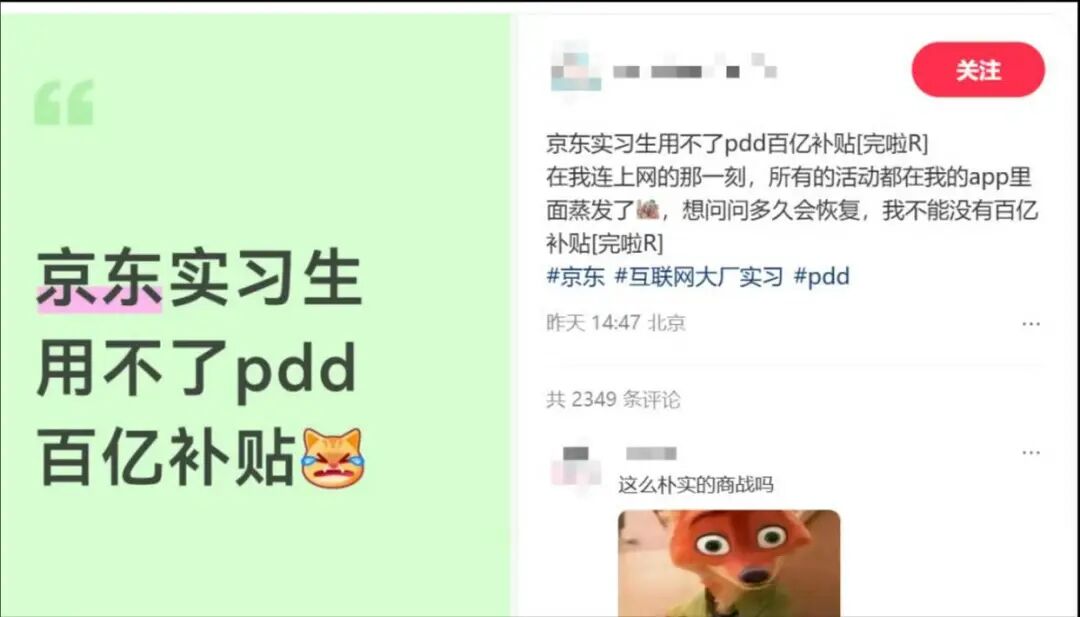
Once the post was published, the comment section immediately came alive, with many netizens claiming to be employees of internet companies sharing similar experiences. One netizen said, 'I interned at Qunar Travel before, and now I can't access the hotel booking page on Meituan anymore.'
Onlookers joked, 'Is this what honest business warfare looks like?' However, the real internet business wars might be even more straightforward. Around the same time, both JD.com and Meituan were reported to have imposed strict restrictions on employees' use of external AI large models.
The internet industry spent nearly a decade dismantling the 'walls' between different platforms, brick by brick, under the push of regulatory authorities. Yet now, big companies are erecting even higher barriers at their doorsteps.
From 'tearing down walls' to 'building walls'—has the internet industry we are familiar with changed?
1
Big Companies Quietly Block Competitors
It's not exactly new for major internet companies to impose restrictions on each other.
For example, employees of big companies are subject to non-compete clauses, preventing them from showcasing products from other platforms or accessing links to other platforms on their own... After all, in market competition, it's understandable that big companies want to protect their own traffic pools.
It wasn't until the continuous push for antitrust regulation that interconnection gradually became an industry consensus, and big companies began to 'tear down walls,' such as Taobao and Tmall supporting WeChat Pay, JD.com enabling Alipay, and Tmall integrating with JD Logistics.
However, while the visible walls were torn down, the invisible walls were quietly being rebuilt. Now, even employees have been classified as 'preventions' by big companies, with many netizens claiming to be employees of big companies sharing their experiences on social platforms:
Employees from Alibaba have reported that 'using Pinduoduo for price comparisons during work hours has resulted in being blacklisted by the billion-dollar subsidy program.' Meituan staff complain that 'connecting to Meituan's Wi-Fi prevents access to Taobao, with requests consistently being denied.' Pinduoduo employees also claim to be restricted by JD.com, stating that 'using a mobile phone to open the JD app prevents viewing all products.'

However, in the eyes of most employees at big companies, targeted blocking via IP addresses among big companies has long been an open secret. The intention is to prevent the platform's business strategies and pricing systems from being replicated by competitors, especially during major promotional periods when even a 1% price difference for the same product can influence consumer decisions.
After entering the AI era, big companies have become even more overt about imposing restrictions.
According to multiple media reports, JD.com officially began restricting external AI at the end of March, with employees encountering page blocks when trying to access external websites. If they want to use external AI tools, special applications are required. Similarly, Meituan recently spread the news that it would 'no longer recommend business teams to use Alibaba Cloud's Qwen model,' requiring employees to prioritize using its self-developed large model, LongCat.
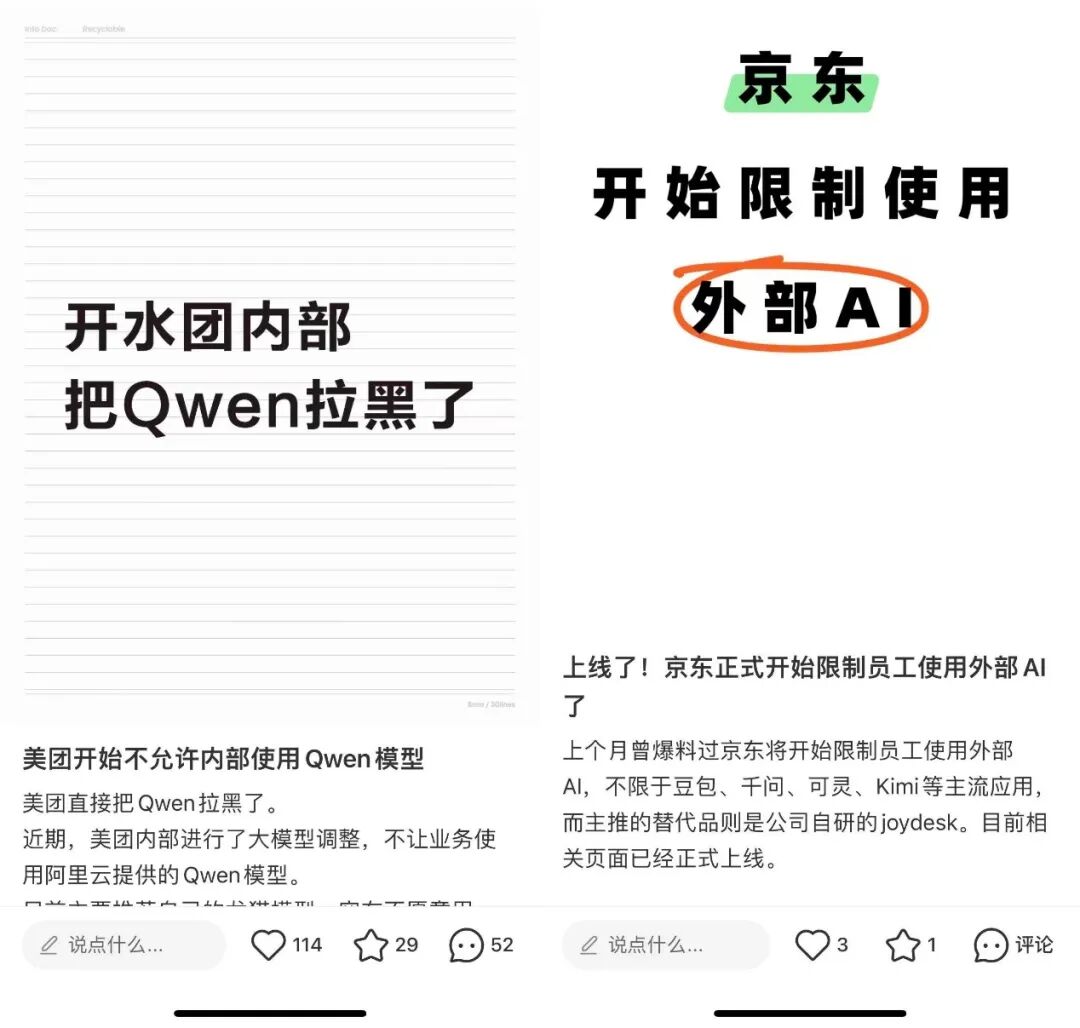
As early as last May, ByteDance issued an internal memo stating that it would ban third-party AI programming software, including Cursor and Windsurf, in batches. In September, Microsoft also announced a complete ban on employees using DeepSeek-related applications.
Microsoft stated, 'We do not allow any unvetted AI services to access the company's codebase,' believing this to be one of the main reasons why big companies are banning external large models, essentially driven by data security concerns.
In the digital age, a company's core data contains vast amounts of user data, trade secrets, and core code. Employees using external AI tools indeed pose a risk of data leakage.
Furthermore, big companies also need to continuously 'feed' their own AI large models. The continuous iteration of large models requires massive amounts of usage data and user feedback as support, which are crucial for training large models.
Simply put, the longer a large model runs in real business scenarios, the more key industry insights it can grasp, thereby driving continuous evolution of the large model. Since big companies already possess real business scenarios, they are naturally unwilling to easily pass up this training opportunity.
More importantly, JD.com and Meituan are currently slightly behind in the large model competition, and cutting off external channels for mandatory internal training is naturally a quicker shortcut.
2
Big Companies Quietly Block Competitors
It is evident that whether domestic or overseas tech giants, facing the pace of the AI era that 'iterates monthly,' all inevitably feel the pressure. The shift from 'tearing down walls' to 'building walls' is merely an instinctive defense mechanism for big companies in the business world.
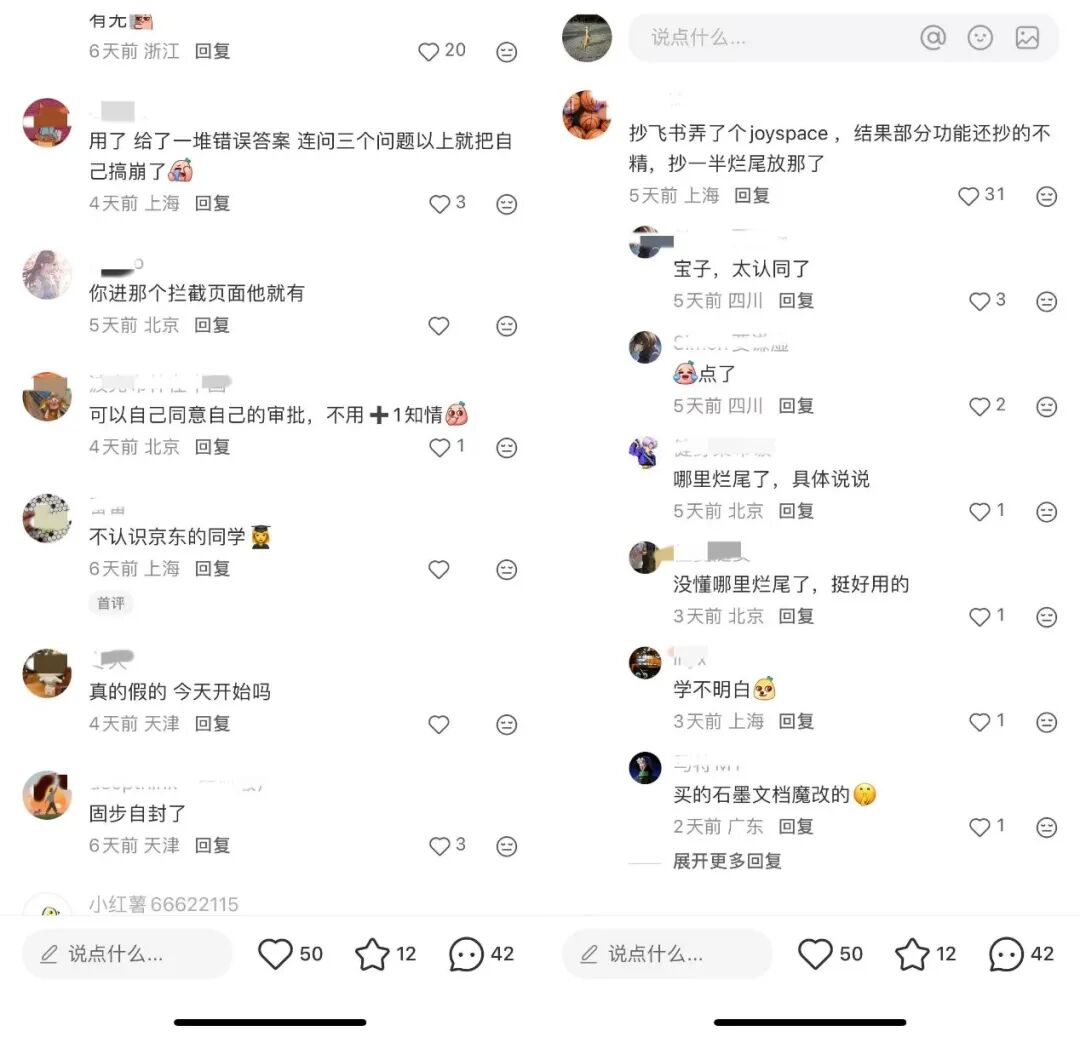
However, the first to 'break down' are the workers. After big companies restricted the use of external AI models, some employees began to complain that using their company's self-developed model required asking the same question three times to get a reliable answer.
As a result, workers began to try using magic against magic, such as using mobile hotspots to access external models, secretly bringing their own computers to work, or handling all questions at home before going to work.
It is certain that whether external or self-developed models, AI has become an indispensable part of workers' lives.
Big companies like Alibaba and Tencent have started providing employees with Tokens as part of their benefits; ByteDance offers AI learning subsidies for employees, with expenses like purchasing Tokens eligible for reimbursement.
Several domestic big companies have issued memos encouraging the use of AI. Although they have not explicitly linked Token consumption to employee performance, what AI tools you use, how well you use them, and how much value you produce will become new criteria for the company to evaluate you.
However, for most workers, embracing AI is not an easy task. Most people are still learning how to master yesterday's AI tools, while the rules on the battlefield have already changed. The scarcity of AI talent is self-evident.
According to the report 'Four Major Wind Vane Industries for Spring Recruitment 2026' released by Maimai, the talent supply-demand ratio for AI positions is 0.97, meaning 'jobs are waiting for people,' not 'people are looking for jobs.' From January to February this year, the proportion of AI positions among new economy jobs surged approximately 12 times year-on-year.
Some headhunters revealed that AI companies in Beijing, Shanghai, and other places offer annual salaries of around 600,000 to 1 million yuan to fresh Ph.D. graduates, with top talents even able to earn 2 million yuan.
Transitioning from the traditional internet era to the AI era, the underlying logic of competitive dimensions, technological requirements, and industry trends will be reshaped once again. While everyone is talking about 'computing power' in the market, 'brainpower' is actually the scarcer resource.
Therefore, big companies are not stingy when it comes to paying for talent. ByteDance offers an annual salary of 1.28 million yuan for 'large model application architecture experts'; Alibaba Cloud maintains a conversion rate of 70%-80% for summer interns, aiming to lock in AI talent in advance.
In addition to luring talent with high salaries, big companies also stabilize their internal base by formulating comprehensive incentive policies and employee benefits.
This makes it easy to understand why ByteDance and Tencent would go to great lengths to snatch a gym—it's the same logic as big companies providing free canteens and shuttle buses in the past. Providing a comfortable working environment for employees is also a way to retain talent.
Besides tangible salaries and benefits, big companies also deeply bind employees' interests with the company's future, such as ByteDance's targeted issuance of additional stock options for its Seed department (research team) last year.
The arrival of the AI era brings the biggest change of 'uncertainty'—uncertainty about the direction in which AI technology will converge, uncertainty about whether the internet industry will undergo a complete reshuffle, and uncertainty about whether past competitive logics still apply.
Therefore, whether for big companies or workers, the only rule for adapting to innovation is continuous learning and embracing change.
3
The Logic of Internet Competition Has Changed
Over the past two decades, the underlying logic of the internet can be summarized in one word: 'light.'
The internet industry is a typical example of a light asset model. Looking at platforms like Alibaba, Tencent, and Meituan, their core competitive moats are not offline factories, warehouses, or logistics teams, but products.
Products have brought big companies the competitive moats they rely on—Alibaba connects buyers and sellers through Taobao; Tencent has built an ecosystem connecting everything through WeChat; Meituan dispatches millions of riders and merchants through algorithms.
Traffic, algorithms, and content, although intangible, are very solid competitive moats because user habits, content ecosystems, and user scales cannot be replicated overnight.
From the recently concluded food delivery wars, Taobao Snack, JD.com, and Meituan collectively burned over 100 billion yuan, but even Taobao Snack, which gained market share in the food delivery sector, cannot be considered the absolute winner.
However, these seemingly solid competitive moats are now being gradually eroded by AI.
Platforms' user mindset and traffic entry points are being quietly preempt (occupied) by AI assistants, allowing users to complete actions like ordering food or hailing a taxi with a single sentence without even opening an app.

Content is no longer scarce, as large models can generate text and videos in bulk within seconds. The content ecosystems built on massive user-generated content (UGC) in the past can easily be toppled by AI.
Steinberg, the founder of the open-source AI agent OpenClaw, pointed out that about 80% of existing applications will exit mainstream usage scenarios in the future because agents possess stronger data integration and management capabilities, capable of replacing many single-function apps.
As a result, big companies are clinging more tightly to their resources. High-frequency apps like Taobao, Alipay, and WeChat Pay have all rejected attempts by Doubao Mobile to bypass permissions for underlying calls; Amazon has blocked ChatGPT crawlers, etc.
At the same time, big companies are shifting their focus to resources that are harder to seize, such as computing clusters, model training costs, chip reserves, and AI talent. These 'heavy assets' have become the new competitive moats in the AI era.
Alibaba is considering increasing its planned investment of 380 billion yuan over the next three years in AI infrastructure and cloud computing to 480 billion yuan; ByteDance's capital expenditures in 2026 are expected to exceed 160 billion yuan.
These heavy asset investments, amounting to hundreds of billions, burn far more and last longer than a subsidy war. Moreover, once established, they are difficult to catch up with quickly and will even accelerate like a 'flywheel.'
Therefore, it is an inevitable result of the industry's shift from 'virtual' to 'real' that outside observers joke about the increasing simplicity of big companies' business wars.
In the past, everyone vied for users' attention; now, everyone is vying for tangible heavy assets, which take time to accumulate and cannot be achieved quickly by simply throwing money around.
From this perspective, it becomes easier to understand why big companies are erecting higher barriers at their doorsteps. After all, compared to burning money, accumulating AI capabilities by imposing restrictions and retaining talent is clearly a more cost-effective strategy.
When burning money no longer drives growth and traffic dividends dry up, the internet must also bid farewell to its 'adolescence' of wild growth fueled by imagination. Only by holding more hard resources can it have the say in defining new rules in the AI era.
So what if business warfare tactics become simpler? Whether in the past, present, or future, 'resources' have always been the ultimate truth.
-
![]()
Wang Huiwen, Former Meituan Executive, Achieves 20-Fold ROI, Supports 24 AI Startups
-
![]()
Another AI Computing Power Unicorn Launches IPO! Founded by a Changjiang Scholar
-
![]()
OFILM Holdings Secures Zhongke Daojing, Marking a Significant Leap in the Optical Communication Industry!
-
What Will Be the Next Key Battleground for Large Models After AI Coding?
-
![]()
Leapmotor's Sales Soar, Yet Hidden Concerns Loom
-
![]()
China’s Action Camera Market Soars: 3.12 Million Units Sold in Six Months, DJI Secures 74% Dominance
-
![]()
Zhang Yiming: Strategic Retreat as a Path Forward
-
![]()
Exploring Charging for Some Features of QianWen App: Can It Follow the Path of Doubao?