Dialogue with Gao Haichuan from Qianjue Technology: Aiming to Equip Half of the Industry's Robots with Qianjue Brains
 04/13 2026
 605
605
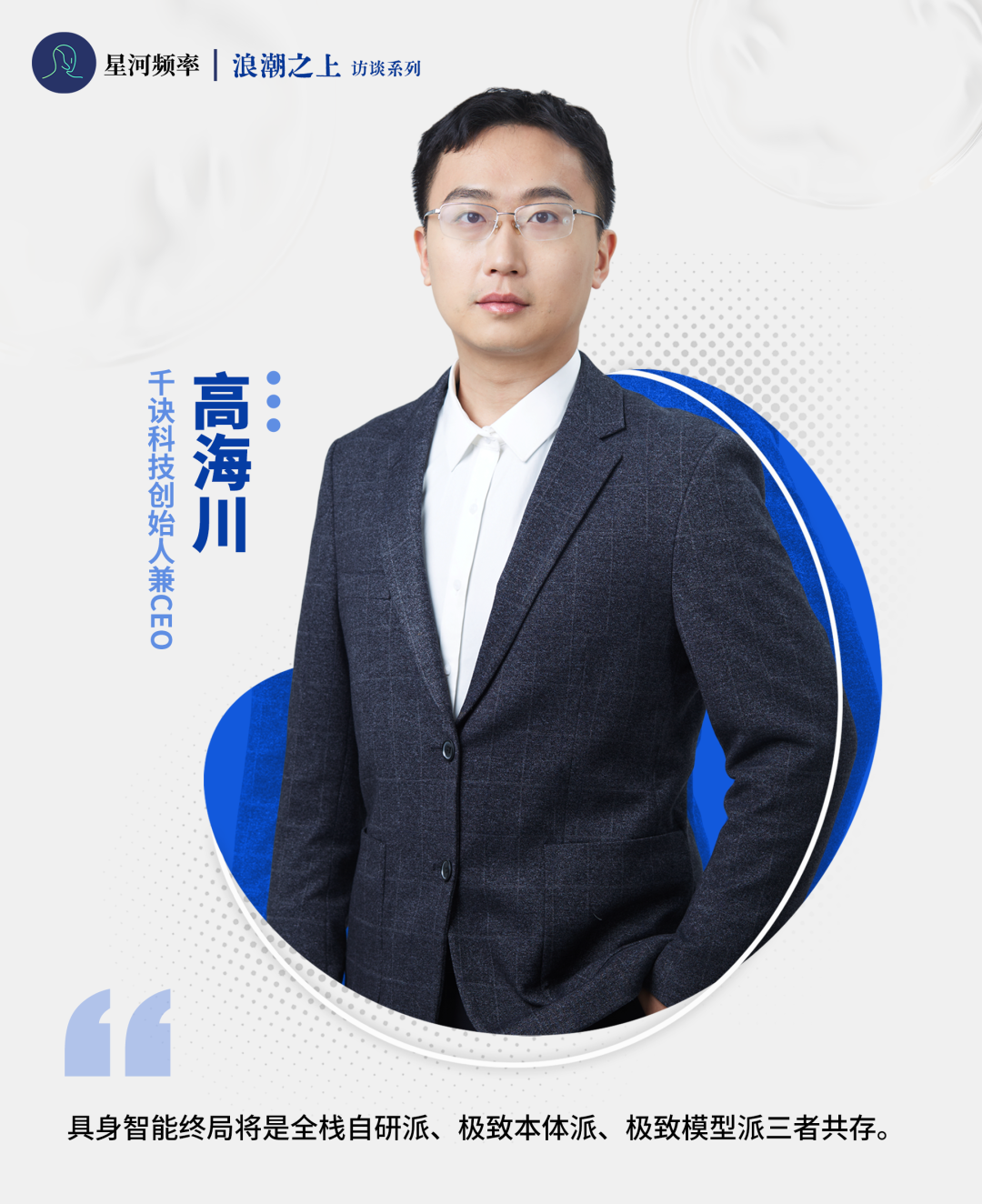
Amidst the wave of embodied AI, there are always those at the forefront, defining the direction of the flow. Xinghe Frequency launches a new interview series, "Above the Wave." Focusing on key figures in the embodied AI industry, we share insights from technological turning points to business decisions, from product launches to industry outlooks. We don't discuss vague trends; we only record the thoughts, judgments, and actions that truly drive the wave. We don't chase hot topics; we only catch the crest, allowing more people to hear the next frequency of embodied AI first.
Amidst the wave of embodied AI, while most players are still fully focused on burning money to develop humanoid robots and telling investors grand stories for the next 5-10 years, Qianjue Technology has chosen a completely different path: resolutely not entering the hardware market, but only serving as a robot brain supplier.
They are like Android in the smartphone era, providing underlying API brain access for various third-party hardware terminals.
Commercialization officially began in October 2025, with over 100,000 devices expected to be connected in the first half of 2026, covering seven major categories and focusing primarily on the home scenario.
Qianjue Technology has become one of the few embodied AI companies to achieve large-scale deployment, and it is the industry leader in terms of the number of brains connected.
The supply chain for embodied AI is longer than that for smartphones, and the brain, as the most critical component, requires enormous investment in funds, data, and time for independent research and development from scratch. It will exist as a third-party component for a long time.
Qianjue Technology's goal is to become the brain used by the most robots, rather than the brand owner of a single popular hardware product.
In terms of technical approach, Qianjue has also not followed the currently most popular VLA route but has adhered to a brain-like partitioned predictive world model.
Like Turing Award winner and former Meta Chief AI Scientist Yann LeCun, they are challenging the generative AI paradigm head-on.
Currently, evaluating a model should not only focus on its theoretical upper limit with massive data but also on its sample efficiency and computational efficiency under limited data and computational power.
A model with a future upper limit of 100 points but only 40 points now is unusable; a model with a future upper limit of 90 points but already at 70 points now is sufficient for use. This is what customers need today, and Qianjue falls into the latter category.
This pragmatic and sharp approach runs through Qianjue's commercialization, technical route, and future outlook.
In discussions about the future of embodied AI, Qianjue's answer is: the industry will not move toward a single monopoly but will see long-term coexistence of three types of players: full-stack self-developed companies, extreme form-factor companies, and extreme model companies.
How exactly does Qianjue Technology enable tens of thousands of robots to truly use brains, and why do they firmly believe that the current best entry point for new-generation intelligent robots is the home rather than factories?
To address these questions, we conducted an in-depth dialogue with Gao Haichuan, the founder of Qianjue Technology, attempting to dissect the technical philosophy and commercial puzzle of this extreme model company. The dialogue is divided into five parts:
1. Why Qianjue only makes brains
2. Why Qianjue focuses on the home scenario
3. Qianjue's proven commercialization closed loop
4. What are the advantages of the decoupled world model
5. The biggest bottleneck in current embodied AI is tactile sensing
In the in-depth dialogue with Gao Haichuan, you will find that he is a humble yet sharp and highly confident person.
This humility is innate, while his sharpness and confidence come from his absolute belief in his products and technology, his firm recognition of the technical route he has chosen, and the accumulation of phased success (phased successes).
He describes himself as someone who "closes the loop first, then scales up," with no absolute priorities, only whether something is truly needed by customers.
This style also extends to his team: when facing problems, they emphasize quick retrospectives and accountability for results rather than dwelling on the process itself.
In external collaborations, he also focuses more on efficiency and practical value. For example, when traveling and visiting clients, he prioritizes hotels closer to the clients to ensure communication and progress momentum.
For him, form never outweighs purpose.
The following is the transcript of the dialogue, edited and organized by Xinghe Frequency without altering the original meaning:

Becoming the Android of the embodied AI world
Xinghe Frequency: Please briefly introduce Qianjue Technology and what you are currently working on.
Gao Haichuan: Qianjue Technology was founded in 2023 and incubated at the Center for Brain-Inspired Computing Research at Tsinghua University. Currently, we have independently developed a partitioned predictive world model and a robot brain system OS.
Xinghe Frequency: Why did Qianjue choose to only make brains and not hardware or complete robots?
Gao Haichuan: This is determined by our ecological niche. We are a foundational interface in the industrial chain, not a terminal player. Once we enter the hardware market, we will directly compete with our clients, leading to client loss.
Making complete robots allows us to capture some hardware opportunities, but focusing solely on brains allows us to serve more brands, forms, and niche segments.
Xinghe Frequency: So, is it more expensive to burn money on hardware or software now?
Gao Haichuan: From a full-cycle perspective, developing foundational models is definitely more expensive. Hardware requires significant early investment in structural design, procurement, etc., but with the continuous maturation of the domestic supply chain, hardware costs will only decrease.
For software, the three pillars of computational power, data, and algorithms all require continuous capital investment, whether for technology or talent.
Xinghe Frequency: Since software is more expensive in the long run, why does Qianjue dare to focus solely on software?
Gao Haichuan: From a company operations perspective, our Own resources (proprietary resources) are sufficient, and we are moving toward becoming a unicorn enterprise.
From a technical paradigm perspective, Qianjue develops foundational models, not SaaS or small models for specific scenarios. We are benchmarking against companies like Zhipu and MiniMax. Foundational models are expensive but also highly valuable.
The predictive world model paradigm is on par with the current generative large model paradigm. If this path succeeds, it could completely replace existing large models in some scenarios.
Xinghe Frequency: How did you convince investors that focusing solely on software is viable?
Gao Haichuan: Robots are highly integrated products, but the brain can generate commercial value independently without being tied to the robot's physical form for sales. Components like tactile sensors, dexterous hands, and chips have already proven that they can achieve closed loops independently of robots.
Additionally, when we started the company, we had a principle: no financing until someone uses our model. We only started financing after securing our first client. We don't rely on stories for funding; we rely on implementation.
Xinghe Frequency: Can this brain-only approach position you at the core of the industry?
Gao Haichuan: From a business model perspective, robots, like smartphones, require external third-party components. We believe that 70%-80% of robot brains will eventually be provided by third-party brain suppliers.
Xinghe Frequency: Why 70%-80%?
Gao Haichuan: This is a deduction based on the industry ecosystem. By analogy with smartphones, 70% of smartphones currently run on Android.
If we exclude Qianjue's existence, according to the commonly cited Pareto principle, in the first phase of market elimination, 20% of leading companies will capture 80% of the market. The remaining 80% of companies, to continue competing, must seek partners like us—arms suppliers—to achieve mutual complementarity and significantly reshape the market landscape.
Xinghe Frequency: Do you also collaborate with complete robot companies?
Gao Haichuan: Yes, we have signed cooperation agreements with many, including several well-known companies, but we cannot disclose them publicly.
Xinghe Frequency: What is the size of Qianjue's team and its R&D configuration?
Gao Haichuan: Currently, the team has about 70 people, with a high proportion dedicated to R&D. We have consistently allocated more resources to models, data, and commercialization systems.
Xinghe Frequency: The industry heated up in 2025, and your business surged.
Gao Haichuan: That's correct. In 2024, everyone was in the algorithm development phase. By the first half of 2025, most algorithms had taken shape.
We conducted two generations of pre-training. The first generation was released for developers and research scenarios, and after receiving feedback, we developed the second generation, which was productized. Therefore, our pure brain commercialization only truly began in the second half of last year, with our focus previously on model training.
Xinghe Frequency: What trends do you see for the embodied AI industry in the end?
Gao Haichuan: It will resemble the smartphone industry. There will be an Apple model and an Android model for each application scenario, and we aim to be the Android brain.
In the future, a highly usable brain will emerge for each form factor, and we hope to capture a significant share, competing alongside OEMs that embrace open ecosystems.
Xinghe Frequency: So, will full-stack self-developed companies, extreme form-factor companies, and extreme model companies coexist?
Gao Haichuan: They should coexist long-term, with the latter two necessarily collaborating to compete with full-stack self-developed brands.
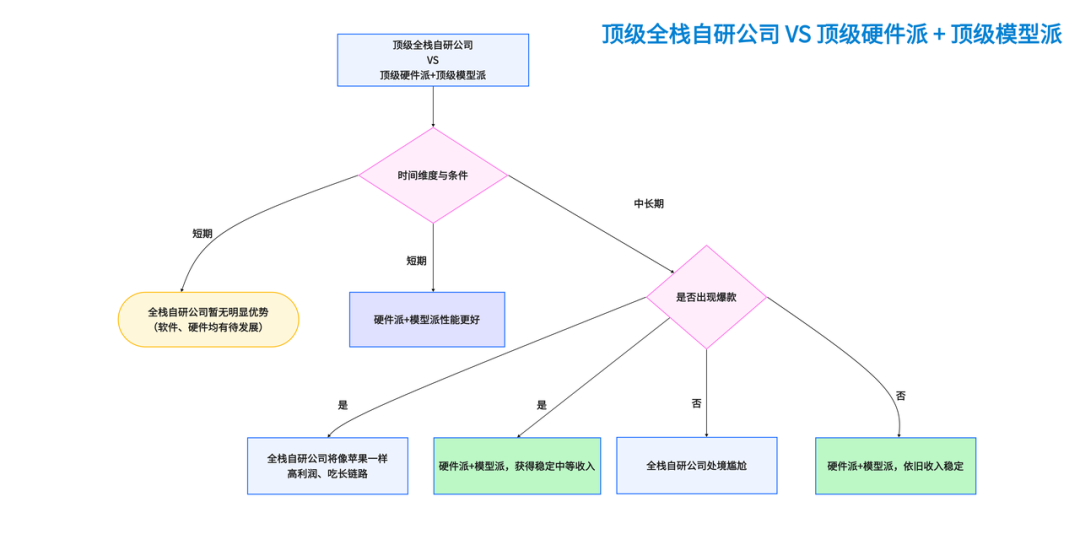
Xinghe Frequency: Currently, who performs better: a top full-stack self-developed company or a top form-factor company paired with a top model company?
Gao Haichuan: In the short term, the full-stack self-developed model requires simultaneous optimization at the hardware, algorithm, and product levels, making it more complex overall. However, once a blockbuster product emerges, it has the opportunity to dominate a longer value chain. Without such a product, this model faces greater pressure.
In contrast, form-factor and model companies can each focus on their strengths and compete through ecological collaboration, which is a relatively more stable path.
Xinghe Frequency: Some say that many full-stack self-developed companies are hesitant to invest heavily in algorithms due to uncertainty in their technical routes. Is this reasonable?
Gao Haichuan: I think it is. In the short term, excessive investment does not necessarily promote the sale of their robot brands and may not yield clear benefits in the medium to long term.
Moreover, their models cannot be used by other form-factor companies, so heavy investment feels like a waste.

Frontier technology companies are targeting the home scenario
Xinghe Frequency: What were Qianjue's overall commercialization results in 2025?
Gao Haichuan: In 2025, we achieved industry-leading household robot access volumes and expect to reach 100,000 accessions in the first half of 2026.
Xinghe Frequency: How do you define household robots?
Gao Haichuan: Simply put, they are robots designed specifically for home scenarios.
These categories share the characteristics of high shipment volumes, high demands for brain generalization, and relatively higher error tolerance compared to industrial scenarios.
Xinghe Frequency: Is the leading access volume due to a large number of small clients or a few major clients?
Gao Haichuan: Both. In each subcategory (niche category), Qianjue has collaborated with at least one leading company, as well as companies ranked third or lower. The contribution ratio is 1:1.
Xinghe Frequency: Many full-stack self-developed companies prioritize factories over homes. Why does Qianjue take the opposite approach?
Gao Haichuan: This is determined by our ecological niche. For full-stack self-developed companies, the key is whether their hardware can sell. If the hardware doesn't sell, the software can't generate revenue either.
We sell robot intelligence solutions and do not anchor to a specific form factor. We serve whoever has volume. Objectively, household products have volume and lower entry barriers.
Additionally, our value propositions differ. Full-stack self-developed companies focus on hardware-driven and cerebellar motor cortex capabilities but often fall short in brain development, limiting their generality and long-term autonomous decision-making—factors essential for entering homes.
Xinghe Frequency: However, many large domestic and foreign companies are deploying robots in factories. What are your thoughts?
Gao Haichuan: For companies with proprietary production lines, considerations of market capitalization management and production line synergy currently lead them to adapt production lines to robots by slowing them down. Under current technological conditions, large-scale promotion in factory scenarios remains challenging.
Secondly, the logic for entering factories is that robots should replace humans, but current technological paradigms differ. The current approach is to augment humans rather than replace them.
Industrial scenarios require robots to reach human-replacement levels, which remains difficult to achieve at scale under current cost and capability conditions.
However, household scenarios do not demand complete human replacement. Examples like robotic vacuum cleaners, quadrupedal dogs, and small humanoid robots, which have already entered homes in large numbers, assist humans, making the economics viable.
Xinghe Frequency: So, is this wave of embodied AI opportunities in homes, not factories?
Gao Haichuan: Yes. Look at Figure, PI, and Sunday—the most cutting-edge companies are all striving to bring robots into homes by 2026. Everyone knows that the most advanced robot brains are not well-suited for factories.
Currently, open scenarios like homes and services are seeing faster implementation, while industrial scenarios, with their higher demands for precision, stability, and efficiency, require further maturation for large-scale adoption.
Therefore, we believe the current opportunity lies in moving robots out of factories and into more open scenarios, not deeper into factories. Of course, industrial scenarios will continue to progress, but at a different pace.
Xinghe Frequency: Besides home scenarios, what other robots access Qianjue's brain?
Gao Haichuan: Commercial service scenarios and a small portion of industrial scenarios, with a distribution of approximately 65%, 25%, and 10%.
Specifically, we cover seven major categories: wheeled-legged, dual-arm wheeled, single-arm wheeled, robotic dogs with manipulators, robotic vacuum cleaners, companion robots, and drones with parallel grippers.
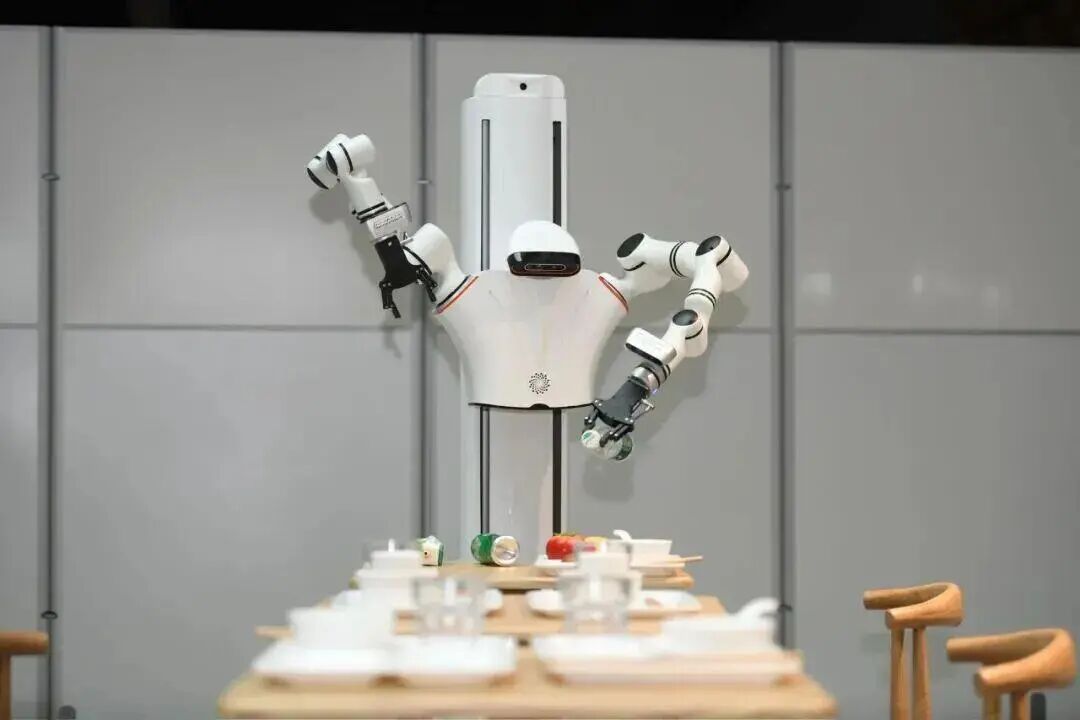
Qianjue's brain enables robots for catering and cleaning
Xinghe Frequency: When collaborating with clients, do you require data feedback to iterate your models?
Gao Haichuan: Of course. This is easier to do in China. Clients do not receive pre-trained models but post-trained ones that require continuous learning with the scenario.
Therefore, data feedback under legal compliance and data anonymization is necessary for optimizing performance.
Galaxy Frequency: Actually, among the clients you serve, there are still industrial scenarios.
Gao Haichuan: Yes, but they are extremely rare, and all of them involve robotic arms rather than mobile robots.
This is because when wheeled robots are used in industrial settings, they often participate in manufacturing or handling processes, which primarily leverage the value of the 'cerebellum' for efficiency and precision. The 'brain' is more about logical decision-making and generalized perception.
Galaxy Frequency: What about swarm intelligence mentioned in industrial scenarios? Does that require more involvement from the 'brain'?
Gao Haichuan: In industrial scenarios, some brain-level capabilities are indeed involved, but the overall reliance is relatively limited. Factories prioritize high-precision execution, stability, and efficiency, making the capabilities of the execution and control layers more critical.
The brain can play a role in perception fusion and task scheduling, but in highly structured environments, its value is more about assistance and optimization.
High dynamics in industrial scenarios mean a high risk of production accidents, so the value of the brain does not fully align with industrial needs.

A Proven Commercial Closed Loop
Galaxy Frequency: What are the advantages of Qianjue's commercialization approach compared to others?
Gao Haichuan: There are two main points. First, our solution does not require manufacturers to make any physical modifications to the actual usage environments of their downstream clients.
Second, Qianjue's core brain capabilities are built on autonomous decision-making models. Unlike traditional rule-based driving modes, they can more efficiently handle various on-site emergencies.
Galaxy Frequency: Why emphasize these two points?
Gao Haichuan: Most of our partners are clients who strongly resist environmental modifications. In household scenarios, there is no room for modification at all, and in service scenarios, there is some but not much.
Our core value is that our products can be used directly, with only some post-training and fine-tuning required for performance improvements, which is a rigid demand for clients.
Galaxy Frequency: What is the approximate price range for your clients?
Gao Haichuan: The specific amount varies by client. We provide zonal prediction models as the robot brain. The price varies depending on how many brain regions or tissues are used. Humanoid robots using the full brain have the highest value and higher costs; robots with simpler body forms or task requirements have lower prices.
Galaxy Frequency: What is the process for clients to integrate your model?
Gao Haichuan: We have an OS and PaaS. We first ask if the other party has a research and development team. They can start with simulation trials on Qianjue's webpage without connecting to devices.
After the experience, they can connect to local machines for trials, with very low experience costs. If the basic model performs well, we will integrate specific functions, helping them connect or letting them do it themselves, followed by pay-as-you-go.
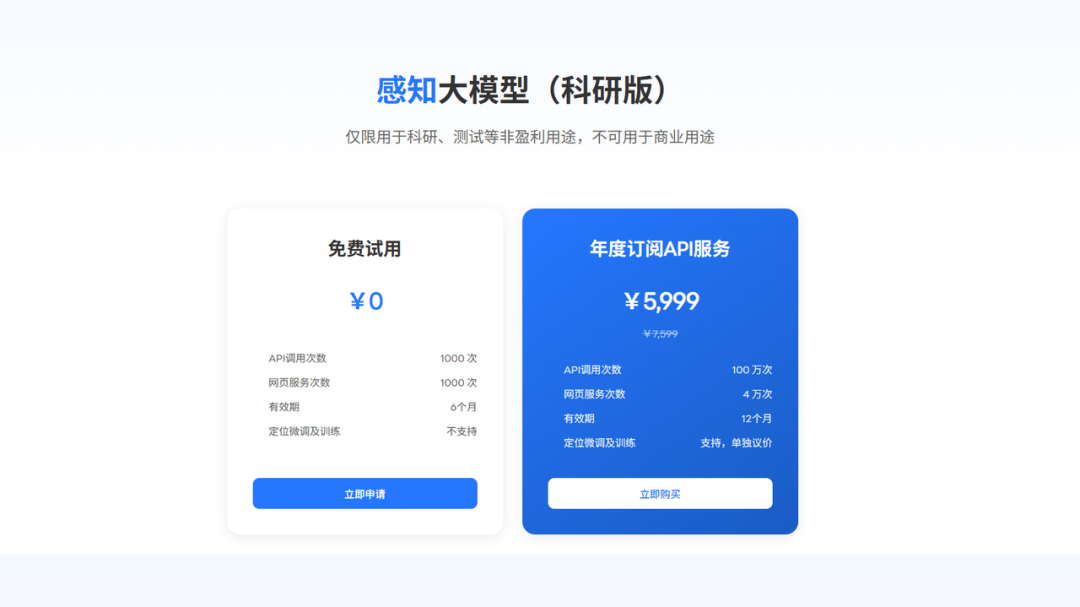
Galaxy Frequency: Do different scenarios require different numbers of operation and maintenance personnel?
Gao Haichuan: Not exactly. Large robots have the highest failure rates, but most are hardware issues, not brain-related. Our colleagues need to help with corrections and re-docking.
If hardware failures are found, they need to connect with another supplier. Brain-related issues are more about automated demand analysis and training, which do not consume much developer effort.
Galaxy Frequency: Do clients care more about cost, deployment cycle, or success rate?
Gao Haichuan: Success rate. Currently, we can achieve over 98% perception accuracy and over 99% closed-loop decision-making success rate, but this also depends on the allowed perception time.
The decision-making baseline has a success rate of over 95% in household scenarios when no operations are performed, and also over 95% for simple rigid visual servoing. It decreases when dealing with flexible objects.
The advantage of the model is its ability for long-term reasoning and self-correction. If slow-speed scenarios are allowed to continue, the success rate can be improved. This also explains why it cannot be done in industrial scenarios, where efficiency is paramount and speed reductions are not allowed.
Galaxy Frequency: How much deployment cost have you saved for clients?
Gao Haichuan: At least tens of millions, equivalent to directly eliminating the costs of research and development teams and continuous training servers.
Galaxy Frequency: Does your model's performance degrade over time?
Gao Haichuan: Yes, just like autonomous driving, when some scenarios perform poorly and data is scarce, it can only be supplemented later.
Galaxy Frequency: The 2026 goal is to integrate over 100,000 units. Will you expand into new areas?
Gao Haichuan: For existing categories, we will penetrate from high-end to low-end markets this year to increase volumes. New category downstream OEMs are launching, so the scale will also be large.
This year, Qianjue will collaborate more with large robots and provide services for large humanoids in institutional healthcare scenarios.
Galaxy Frequency: Do you have plans for overseas market expansion?
Gao Haichuan: Of course. Many of our clients target global markets, with overseas sales even surpassing domestic ones. We will go overseas with our clients' complete machines, giving us the unique capability to provide model cloud services for overseas robots.
Since overseas connections to Chinese models and subsequent necessary data transmissions are sensitive, we currently only connect and do not train with overseas data.
Galaxy Frequency: What are your revenue expectations for 2026?
Gao Haichuan: Revenue will definitely grow exponentially, as Qianjue only officially started commercialization at the end of October 2025. However, we briefly experienced positive cash flow before the Spring Festival. If we do not increase investment this year, we might become profitable.
Galaxy Frequency: What are your financing expectations for 2026?
Gao Haichuan: We are now pursuing large-scale financing, though not as fast as leading companies. The company is advancing a new round of financing, and market expectations for our valuation are high.

Choosing Not VLA, Early Layout of World Models
Galaxy Frequency: In 2025, everyone has been talking about VLA. Qianjue's brain-like zoning seems unique.
Gao Haichuan: Brain-like zoning and VLA are not entirely opposite; they are not in the same ecological niche. VLA includes hierarchical, end-to-end, two-stage, and decoupled approaches.
Our brain-like zoning belongs to the decoupled world model, which competes with end-to-end VLA as two major routes.
Galaxy Frequency: How should we understand decoupled world models?
Gao Haichuan: Simply put, it transforms a single-distribution world model into a multi-distribution world model. The perception, overall planning, and motion planning modules of the previous generation of robot control technologies were constrained by prior knowledge.
We refer to the human brain's zonal structure to assign clear responsibilities to each zone. Just like a company has many departments—finance manages money, sales manages customers, and technology manages R&D.
The model can learn very quickly and quickly identify which link has gone wrong when problems arise. This is highly valued by practical parties for large-scale applications—explainability, accountability, and rapid optimization.
Galaxy Frequency: You mentioned that you and Yann LeCun are in the same school, both following the predictive world model route.
Gao Haichuan: Yes, the core of predictive world models is to construct an internal representation of the world and predict future states or event developments. Just like an experienced driver does not need to remember every detail of every road but can brake or change lanes based on current road conditions.
Galaxy Frequency: It seems that more people are currently working on generative world models, like Li Feifei and Google.
Gao Haichuan: Li Feifei focuses on 3D space generation, and Google on video generation. Both are additive approaches, aiming to reconstruct the real world.
However, these methods consume significant computational power, data, and funds and are more suitable for creating simulated environments. Their disadvantages in energy consumption and response speed make them unsuitable for real robot applications. We, on the other hand, are subtractive, which allows for implementation.
Galaxy Frequency: Last year, you referred to it as brain-like zoning, but this year you added world models. Why?
Gao Haichuan: Last year, the industry's understanding of world models was not unified. We used brain-like zoning to express our core methodology, which had lower communication costs.
This year, as industry discussions have deepened, world models have gradually become a more widely understood framework, and we have unified our external expressions accordingly.
Galaxy Frequency: Which route, world models or VLA, will prevail?
Gao Haichuan: I maintain that they will coexist. Both routes are actually old, with academic research starting as early as 2016 or even earlier, but they are presented differently in the current large model era.
World models correspond to Model-Based, or future rehearsal, which is better in generalization; VLA corresponds to Model-Free, or direct action, which is better in recording fine trajectories and precise operations.
In industrial scenarios, where scenes and tasks are relatively structured and higher execution precision and efficiency are required, the Model-Free route has more advantages at the operational level.
In open environments, where scene uncertainty is stronger, the Model-Based route has more potential in modeling the environment and long-term planning.
Galaxy Frequency: How should we evaluate the quality of a model?
Gao Haichuan: We believe there are three indicators for evaluating AI models: optimality, i.e., the model's upper limit with sufficient data, sample efficiency, and computational efficiency.
Optimality determines the model's upper limit, while the latter two determine the model's lower limit, i.e., how much data is needed to achieve a score of 60 or 70.

Galaxy Frequency: How many players do you think are in the first tier of models now?
Gao Haichuan: Around 10. This judgment is based on which companies with self-developed models have started to have robots operating in real environments, combined with their valuations, financing amounts, and order volumes.
Galaxy Frequency: How does Qianjue's model performance compare to PI, the leading foreign model player?
Gao Haichuan: PI outperforms us in dexterous operations. They have produced many research papers and excel in flexible object manipulation and fine movements, but these often lack practical applications.
In more practical areas like rigid body manipulation, visual servoing, environmental perception, and task planning and decision-making, I believe Qianjue performs better. From a commercialization perspective, we also have more clients and installations than PI.
Galaxy Frequency: Can you provide some specific examples to demonstrate your model's advantages?
Gao Haichuan: From a user experience perspective, a highlight ability of the Qianjue brain is that the robot does not need to receive human instructions. After being turned on, it can move and plan tasks autonomously. For example, wheeled single-arm/dual-arm cleaning robots can operate independently in hotel scenarios without human instructions.
It forms a dynamic decision-making chain through internal world models and task loops, with human instructions only serving as additional information. This is our core value and main selling point. Devices integrated with the Qianjue brain can exhibit autonomous decision-making capabilities and stronger human-robot interaction performance.
Galaxy Frequency: How do you adapt a single top-level brain logic to different hardware forms?
Gao Haichuan: Similar to mammalian brains, the structure is consistent, but the brain tissue capacity and differentiation degree vary. We first developed the most complex full-action-space brain for humanoid robots and then adapted it downward to sub-forms.
They are all derivatives of humanoids. We reduce the brain downward by removing unnecessary functional areas, achieving cross-form adaptation in a downward-compatible mode.
Galaxy Frequency: How does Qianjue view open-sourcing?
Gao Haichuan: We also have plans to open-source some of our capabilities. Open-sourcing is an interface for cultivating ecosystems, especially important for robots. Once people get used to an interface, it becomes a de facto barrier.
Companies that develop brains first will do both, but open-sourcing is weaker than direct APIs. It requires more from developers in terms of size and pre-training volume.

The Biggest Bottleneck in Embodied Intelligence is Tactile Sensing
Galaxy Frequency: At the Chongli Forum earlier this year, you said that the biggest bottleneck in embodied intelligence is tactile sensing. Why?
Gao Haichuan: Currently, many embodied brains still rely on vision and large model reasoning capabilities. However, humans can perform fine operations not just by looking but by relying on the skin and its dense tactile sensors.
Obviously, the tactile sensing industry is still in its infancy.
Galaxy Frequency: How does Qianjue handle tactile sensor data?
Gao Haichuan: When tactile sensors are insufficient, the success rate of dexterous operations inevitably suffers. However, no sensor has seen large-scale application yet. There are many research-grade sensors, each with its pros and cons.
In real applications, the hardware is often inadequate, failing to collect much application data. This stage should be for academic research, not companies. We are taking a wait-and-see approach.
Galaxy Frequency: Some companies say their models cannot ingest tactile data. Is this a big problem?
Gao Haichuan: Of course. We should wait for a mainstream tactile sensor to become popular and have a large customer base before designing algorithms. Blindly guessing a sensor now, only to find it does not become mainstream later, would waste algorithm design efforts.
Galaxy Frequency: Some companies are now working on VTLA. How effective are these results?
Gao Haichuan: I believe VTLA is still in its early stages and is more suitable for universities and research institutes to explore. Companies should focus on creating mature application-level products first.
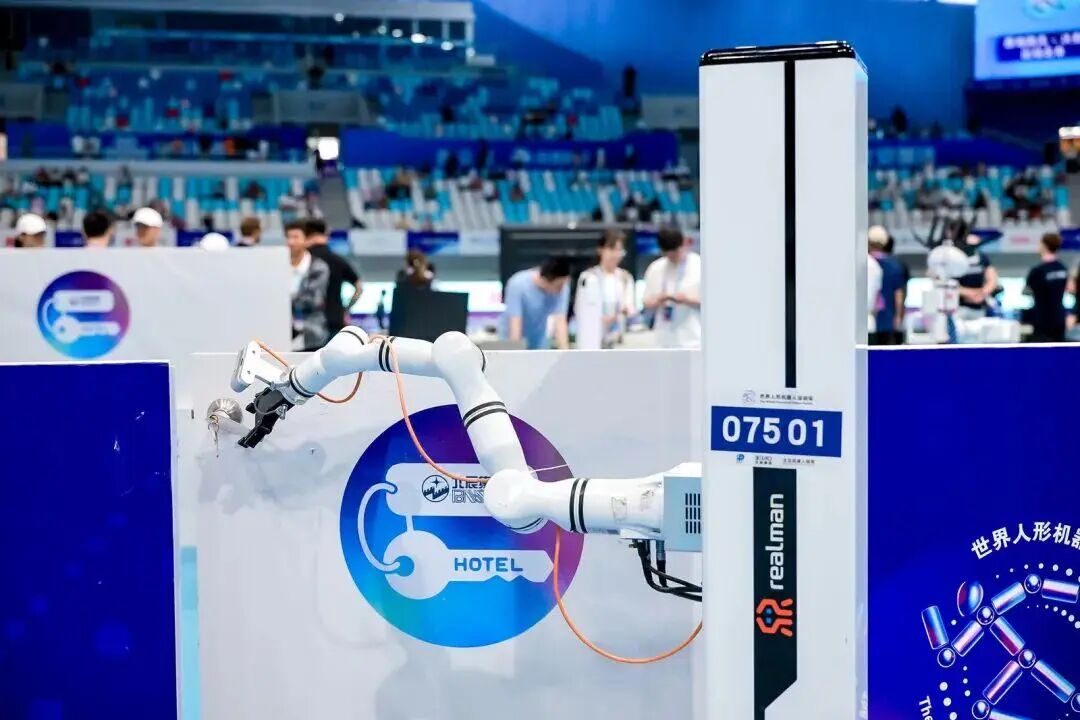
A Robot Equipped with the Qianjue Brain Achieves Autonomous Decision-Making for Door Opening and Cleaning
Galaxy Frequency: But many peers are saying that data is the biggest bottleneck this year.
Gao Haichuan: Data is important at every stage, but to truly break through the intelligence ceiling later, a large amount of tactile data, including dexterous operation data for dexterous hands, will be necessary. Otherwise, relying solely on single-type data collection will be futile.
Galaxy Frequency: Many manufacturers are aiming for million-hour-level data this year, and some even have dedicated data collection centers. What are Qianjue's goals in this area?
Gao Haichuan: Our advantage lies not in the total amount of data but in its diversity. Our data comes from real applications and includes valuable user demand data, i.e., what instructions users give to robots.
Although data collection centers can generate large amounts of data, the categories are highly homogeneous and lack diversity. Robots trained on such data will have poor generalization in real scenarios and can only be used in data collection centers.
Galaxy Frequency: So how much data is needed to make the model increasingly intelligent?
Gao Haichuan: This is not a stock issue.
When training large models, there are at least two dimensions to measure generalization: what is the surface of the data domain, and whether the sampling is independent and identically distributed (i.i.d.) and uniform.
Currently, neither of these points is satisfied. Application is one surface, and data collection is another, with a gap in between that needs real-world scenarios to bridge. Achieving i.i.d. sampling is far from being accomplished; for example, there is more data from Beijing and less from other regions.
So, I am pessimistic about pre-training in data collection centers and then transferring to open scenarios. Models that can truly be transferred must have already entered open scenarios.
Galaxy Frequency: Is data one of Qianjue's technological moats?
Gao Haichuan: Absolutely. The natural advantage brought by our ecological niche is the large number of customers, connected devices, and data, all from real-world application scenarios.
The three key elements of model production are computing power, algorithms, and data. With the development of infrastructure, the barrier to accessing computing power is lowering, and algorithmic capabilities are gradually converging. Data, especially from real-world scenarios, is becoming the key factor determining model performance.
Galaxy Frequency: What are the difficulties or bottlenecks in model applications?
Gao Haichuan: We have a lot of consumer-end scenarios, and we need to iterate together with the market. The requirements for the brain's robustness, generalization, accuracy, and success rate vary at each stage of penetration.
Achieving a general-purpose brain is not an instant event; it has this functionality from the start, but the issue is how much of its capabilities can be exerted and how high the success rate is. There is still a long way to go for full-category implementation, but for existing categories with high customer tolerance, it has already been satisfied.
Galaxy Frequency: Are there any representative products expected to access the Qianjue Brain by 2026?
Gao Haichuan: This year, we should increase the access volume for quadruped and wheeled robots with arms. From our ecological niche, what we always care about most is the actual customer volume we can obtain and the continuous improvement of the model.
-
![]()
Wang Huiwen, Former Meituan Executive, Achieves 20-Fold ROI, Supports 24 AI Startups
-
![]()
Another AI Computing Power Unicorn Launches IPO! Founded by a Changjiang Scholar
-
![]()
OFILM Holdings Secures Zhongke Daojing, Marking a Significant Leap in the Optical Communication Industry!
-
What Will Be the Next Key Battleground for Large Models After AI Coding?
-
![]()
Leapmotor's Sales Soar, Yet Hidden Concerns Loom
-
![]()
China’s Action Camera Market Soars: 3.12 Million Units Sold in Six Months, DJI Secures 74% Dominance
-
![]()
Zhang Yiming: Strategic Retreat as a Path Forward
-
![]()
Exploring Charging for Some Features of QianWen App: Can It Follow the Path of Doubao?