Auto Companies' Chip Manufacturing in the Second Half: NIO Aims to Turn Chips into a Business
 04/13 2026
 536
536
As the competition in smart electric vehicles shifts from electrification to intelligence, computing power is replacing horsepower as the new benchmark for defining product value. The upper limit of computing power is determined not by software algorithms but by the chip encapsulated in automotive-grade modules.
In 2026, this competition will officially enter the year of mass production and monetization. A wave of domestically produced intelligent driving chips, from NIO's Shenji and XPENG's Turing to Li Auto's Mach and Leapmotor's Lingxin, are being intensively integrated into vehicles. Meanwhile, the divergent paths of chip development among automakers are becoming increasingly clear: while most manufacturers view self-developed chips as a tool for "cost reduction and supply security," NIO is attempting to turn it into an independent business.
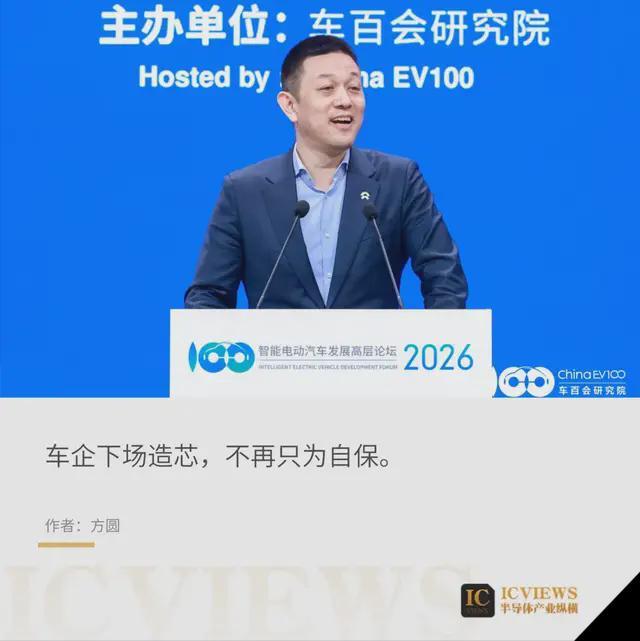
On April 11, 2026, during the Beijing Smart Electric Vehicle Development High-Level Forum, Semiconductor Industry Review interviewed NIO CEO Li Bin. He provided straightforward answers regarding self-developed chips, technology licensing, and NIO's first quarterly profit.
01
A Map of Auto Companies' Chip Manufacturing
Chinese automakers' foray into chips is not a recent phenomenon. Tesla can be considered a pioneer in self-developed chips, with its AI5 chip design nearly complete and AI6 research and development entering its early stages. Under Tesla's demonstration (this word seems out of context here, perhaps 'influence' or 'leadership' was intended, but kept as is for direct translation) , domestic automakers have also entered the same arena.
As of now, the landscape of self-developed chips among major automakers is roughly as follows:
XPENG: Its self-developed Turing AI chip has shipped over 200,000 units cumulatively, with a 2026 target of nearly 1 million units, potentially becoming the top shipper of high-computing-power edge AI chips in mainland China. The Turing chip adopts a 40-core processor plus dual NPU heterogeneous architecture, enabling a single chip to support the local operation of a large model with 30 billion parameters. It has been deployed in models like the MONA M03 and has secured mass production fixed point from Volkswagen, achieving a dual breakthrough in "domestic sales" and "exports."
Li Auto: Its first 5nm automotive-grade self-developed SoC, Mach 100, successfully taped out in May 2025 and will debut in the next-generation Li L9. The L9 Livis model, to be released in the second quarter of 2026, will be equipped with two Mach 100 chips, delivering a total computing power of 2560 TOPS, three times the effective computing power of NVIDIA's Thor-U. However, Qin Dong, the head of Li Auto's chip division SoC, recently resigned, casting a shadow over this progress.
BYD: Its latest successfully taped-out intelligent driving chip targets 80-100 TOPS of computing power, specifically designed for the "Divine Eye C" solution, with plans for vehicle integration in the second half of 2026. It will replace externally procured NVIDIA Orin-N and Horizon J6 series chips, covering mainstream models priced between 80,000 and 300,000 yuan. BYD adopts a hybrid model of self-developed design + internal packaging/testing/automotive-grade verification + external mature process foundry collaboration, with wafer manufacturing entrusted to partners like Hua Hong.
Geely: Its subsidiary, Semiconductor Manufacturing International Corporation (SMIC)-backed Xingqin Technology, completed a Series B funding round of over 1 billion yuan in 2025. Its 7nm intelligent cockpit chip, "Dragon Eagle One," has shipped over 1 million units cumulatively, ranking first in market share among domestically produced intelligent cockpit chips in 2024. Xingqin plans to file for an IPO this year, aiming to go public next year.
Leapmotor: Its self-developed Lingxin chip has been integrated into vehicles, and a joint venture project with NIO's Shenji is reportedly underway.
NIO: The Shenji NX9031 has shipped over 150,000 units cumulatively. In February 2026, its chip subsidiary completed its first round of financing worth 2.257 billion yuan, with a post-investment valuation nearing 10 billion yuan. More importantly, NIO is the first new energy vehicle manufacturer to independently spin off its high-level intelligent driving chip business and explicitly offer it for external supply.
From this map, it is evident that each company is at a different stage and following a distinct path. XPENG leads in shipment volume, Li Auto stands out with impressive computing power parameters, BYD covers all price ranges with its scale advantage, and Geely's Xingqin is nearing an IPO. NIO, while not the largest in terms of "quantity," is pushing the chip manufacturing competition to the next dimension with its strategic moves of spin-off and external supply.
02
One Chip Saves NIO $300 Million
What the outside world is more concerned about is: How much has chip independence helped NIO's financials?
To understand this question, let's first look at an industry background: Li Bin revealed at the forum that chips and batteries combined now account for over 50% of the total vehicle cost. This means the cost-saving potential from self-developed chips is substantial.
In the fourth quarter of 2025, NIO delivered a historic financial report: revenue of 34.65 billion yuan, up 75.9% year-on-year; net profit of 283 million yuan—NIO's first quarterly profit in its 11-year history. The gross margin for complete vehicles was 18.1%, and the comprehensive gross margin was 17.5%, both reaching recent peaks.
One easily overlooked figure is that R&D expenses in the fourth quarter dropped to 2.026 billion yuan, down 44.3% year-on-year.
Where did the money go? The answer lies in Shenji. In 2025, NIO spun off its chip team into a subsidiary. The hundreds of millions of yuan in annual R&D investment for chips, previously an expense for the parent company, became an asset for the subsidiary. This accounting shift turned "burning money" into "valuation."
During the interview with Li Bin, a calculation was made: "We used to rely on NVIDIA's Orin-X. Now, with our self-developed chips, at our peak, we were buying $300 million worth of NVIDIA Orin-X chips annually. Although self-developed chips require significant investment, given NIO's current usage volume, it has become cost-effective." Based on NIO's main brand sales of approximately 179,000 units in 2025, this translates to annual savings of nearly 1.8 billion yuan. This precisely explains the 5-percentage-point jump in the fourth-quarter gross margin for complete vehicles—not through price hikes but by turning the most expensive component into our own.
NIO CFO Qu Yu stated during the earnings call that the fourth-quarter gross margin improvement was primarily due to increased sales volume, optimized product mix, and cost reduction and efficiency improvements. Among the cost-saving factors, the contribution of the Shenji chip is clearly visible.
However, it should be noted that this cost-saving amplitude (this word seems incomplete, perhaps 'magnitude' was intended, but kept as is for direct translation) is calculated based on the current selling price of NVIDIA's Orin-X chip, which still exceeds $300 per unit. Compared to other domestically produced chips, the Shenji NX9031 may not have the same cost advantage. Introducing external investment also helps reduce NIO's capital investment pressure, meaning Anhui Shenji is moving beyond the "nurturing" stage and starting to pursue an appropriate return on investment.
03
From "Forced Self-Development" to "Proactive External Supply"
Shenji did not grow overnight.
In 2021, a chip shortage crisis swept the global automotive industry. The delivery cycle for an ET7 was extended to seven months due to a shortage of a single chip. That year, Li Bin made up his mind: to develop chips in-house.
With a team of 500 people and a 5nm process, the R&D cost for a single chip was equivalent to that of 1,500 battery swap stations. Estimating each station at 1.5 to 2 million yuan, the total investment exceeded 2.25 to 3 billion yuan. At the time, this was seen by many as a "gamble."
In July 2024, the Shenji NX9031 successfully taped out in one attempt. A single chip's performance is equivalent to four NVIDIA Orin-X chips, with a memory bandwidth of 546GB/s, capable of simultaneously processing 25 high-definition cameras with a latency of less than 5 milliseconds. By March 2026, over 150,000 units of this chip had been shipped, and all NIO models were equipped with it.
But Li Bin's plans extend beyond this. He had previously revealed that the second Shenji chip had successfully taped out and was in the process of mass production. This chip, also based on a 5nm process, is not limited to automotive applications—scenarios such as embodied robots and agent reasoning are also being considered. He also mentioned that the Yangjian LiDAR main control chip has been deployed across all NIO models, the Shenji NX9031 is fully integrated, and the LeDao L90 will also be equipped with it.
This means that Shenji's role is evolving from NIO's "cost center" to an independent "profit center." Licensing fees from technology licensing and equity gains from joint ventures will gradually become new sources of revenue for NIO.
04
From Self-Development to Symbiosis: Industry-Wide "Chip Standardization"
NIO is not the only Chinese automaker developing chips, nor is it the fastest. XPENG's Turing has shipped over 200,000 units, Li Auto's Mach 100 dual-chip model is about to be released, BYD demonstrates scale advantages with full price range coverage, and Geely's Xingqin is nearing an IPO. While each company follows a different path, they all point in the same direction: to seize control over the definition of computing power.
Li Bin has proposed a more ambitious industry-wide initiative: chip standardization.
"Our latest ES9 has over a thousand semiconductor part numbers and more than four thousand semiconductor components." Many chips serve the same purpose but have ended up this way for various reasons. NIO has already begun standardization internally, aiming to reduce the number of chip types from over a thousand to 400.
He provided two reasons for this:
First, cost reduction. "Chips and batteries now account for over 50% of the cost of smart electric vehicles." Li Bin believes that if the entire industry can standardize chip types—achieving pin-to-pin interchangeability for each category—then the usage volume of each chip type will significantly increase, and supply chain volatility will also decrease notably. "A rough calculation shows that there is an opportunity for over 100 billion yuan in cost savings across the industry, amounting to several thousand yuan per vehicle. It's definitely achievable."
Second, localization. "Chip standardization is the necessary path to increase the localization rate," Li Bin explained. Currently, automakers face dual pressures of cost and quality when using domestically produced chips. If a basic chip can be used in tens or even twenty units per vehicle, then domestically produced chips priced at a fraction of a dollar can truly become commercially viable. "Without usage volume, there is no business model."
This argument may equally apply to XPENG's Turing, Li Auto's Mach, BYD's Xuanji, and Geely's Dragon Eagle. In 2026, Chinese automakers' chip manufacturing movement has finally moved from the lab to the road. As for how far this path will lead, the answer does not lie in any forum or financial report but in the real computing power, power consumption, cost, and reliability of each chip.
-
![]()
Jitian Xingzhou: A Pioneer in Optical Payloads Secures Hundreds of Millions in Series B Funding!
-
![]()
Orders Secured Through to the Second Half of the Year! The Rationale Behind the 'Surge' in Demand for This Company’s Optical-Grade Base Films
-
![]()
Beyond Patents: The Retail Rivalry of Insta360 and DJI Unfolds
-
![]()
180 Billion Market Cap Vanished! How Did Seres Fall So Far?
-
![]()
Blockbuster! Domestic storage takes the global double crown for the first time, from an AI company
-
![]()
China Spearheads Formulation! World's Pioneering Global Technical Regulation for Automated Driving Systems Greenlit and Unveiled
-
![]()
Farewell to Pulsed Support Policies: Three Major Auto Policy Directions from Multiple Departments Take Effect on the Same Day
-
![]()
Embercore AI’s Accelerated Funding: The Robot Industry’s Shift Toward ‘Learning Systems’