Ali's HappyHorse: A Calculated Move in the 'Token Economy' Game
 04/13 2026
 527
527
Alibaba has officially laid claim to 'HappyHorse'.
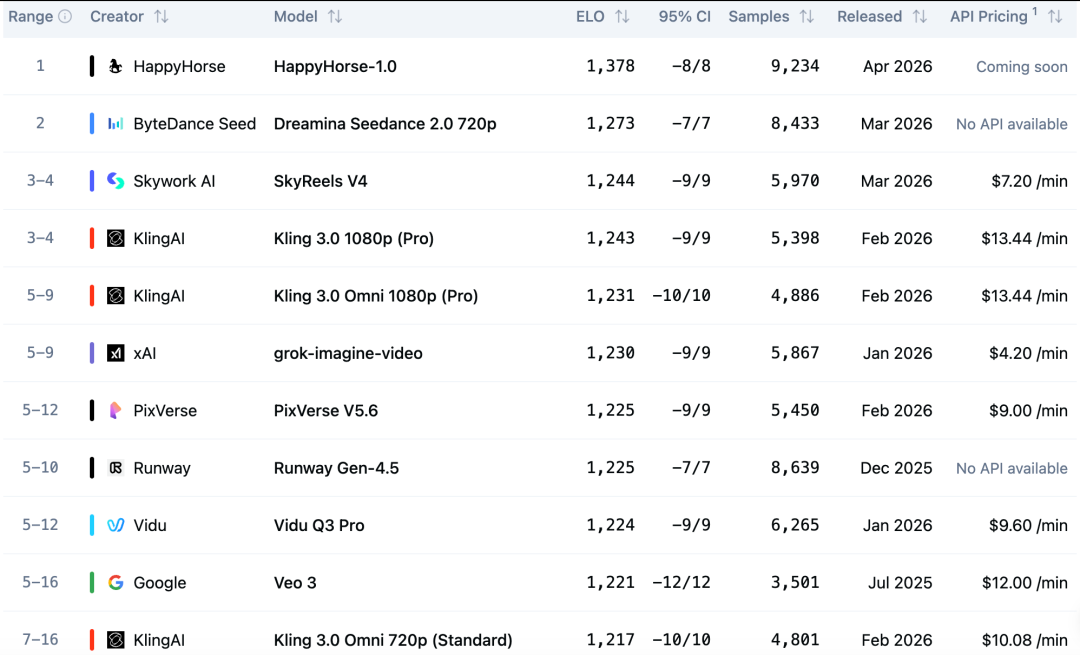
This AI video model, a 'dark horse' in the field, had been shrouded in mystery until it recently surged to the top of the rankings on the authoritative AI evaluation platform, Artificial Analysis, outperforming the highly anticipated ByteDance's Seedance 2.0 and Kuaishou's Kling 3.0.
As of now, HappyHorse-1.0 stands as a leader in text-to-video and image-to-video (audio-free) models, particularly excelling in the realm of pure video generation without audio. It also holds its own against Seedance 2.0 in audio-visual integrated generation models that incorporate sound.
Suddenly, the entire AI community was abuzz with speculation about the true identity of this 'horse.' Was it a strategic move by Alibaba, ByteDance, or Kuaishou?
The mystery surrounding HappyHorse's creator was solved nearly a week later. On April 10th, the official social media account 'HappyHorse_AI' made its debut, with its inaugural post confirming that HappyHorse is an internal test product of Alibaba's ATH Innovation Business Unit. It also dispelled rumors of a fake official website and revealed that the product is still undergoing refinement and has yet to be officially launched.
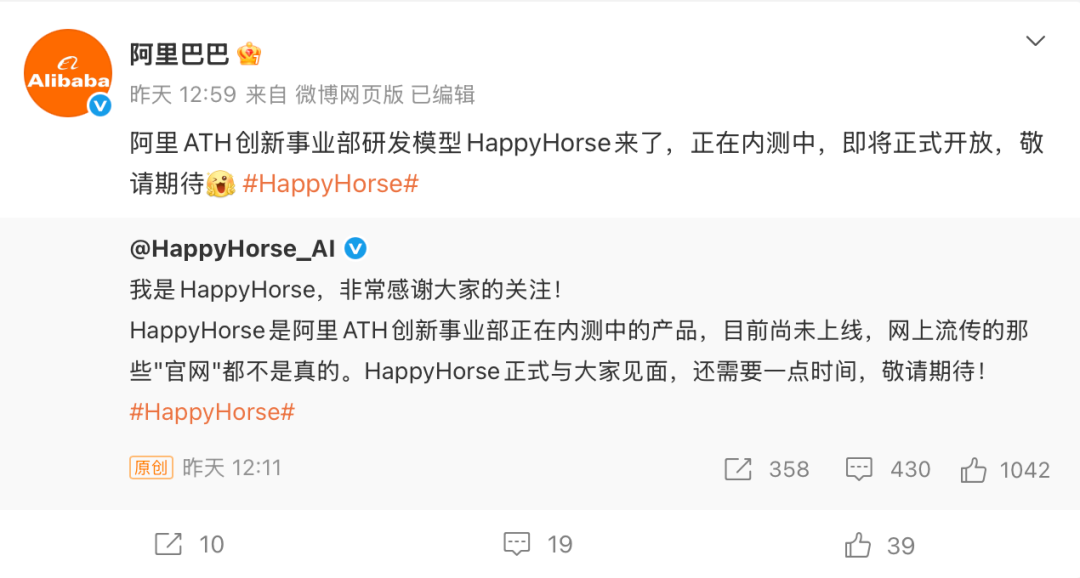 Figure: Alibaba 'Claims' HappyHorse. Screenshot by Tang Chen
Subsequently, Alibaba's official Weibo account reposted the news, solidifying its Alibaba lineage, often colloquially referred to as the 'Ma' family. Further updates indicate that HappyHorse-1.0 is slated to open its API on April 30th. Simultaneously, Alibaba will unveil another multimodal model, distinct from HappyHorse-1.0.
The emergence of HappyHorse follows a well-calculated strategy. Xiaomi's MiMo-V2-Pro and Zhipu's GLM-5 previously employed similar 'blind box' tactics to make a splash on leaderboards. This approach of 'anonymous ranking first, official claim later' serves as a litmus test for the model's inherent strength and the AI company's confidence.
Leveraging the suspense and intrigue that transcend brand recognition, coupled with achieving tangible results in blind testing, proves to be a far more cost-effective strategy than traditional product launches. For major AI players, as long as the model's capabilities are robust, even if some shortcomings are exposed, market and user expectations can be effectively managed.
Beyond marketing considerations, HappyHorse's technological prowess stands up to scrutiny. Based on available technical breakdowns and user feedback, it unifies modeling pathways at the architectural level, employing a pure self-attention single-stream Transformer with approximately 15 billion parameters. It seamlessly integrates text, video, and audio tokens into the same sequence for joint modeling, achieving 'native synchronous generation' of audio and video.
This approach diverges from the prevalent 'video generation + audio post-processing' patchwork solution used in mainstream video models, mitigating the 'uncanny valley' effect of mismatched audio and video in current AI video generation. This means the model 'understands' the video's timing, instructions, and quality requirements while generating the visuals, ensuring precise alignment of human figures, sound, and scene (images).
The direct benefit is 'high efficiency and low consumption.' HappyHorse generates a 5-second 1080p video on a single H100 GPU in about 38 seconds, supporting lip-syncing in seven languages. For AI video producers or users, this translates to 'halving costs'—generating higher-quality video content at a lower expense.
However, as an exploratory product from ATH, HappyHorse is not an all-rounder. Current evaluations suggest it resembles a 'photographer' skilled at capturing aesthetically pleasing empty shots rather than a 'director' capable of handling complex narratives. When dealing with intricate physical movements and long-term logical sequences, the model may exhibit distorted actions or decreased coherence.
Nevertheless, this does not detract from its status as one of the world's most powerful open-source video models. Its practical value to Alibaba and even the broader AI industry, particularly in e-commerce, immersive short videos, and AI-generated comics, transcends its technical merits alone.
The 'Token Economy' Monetization Window Has Opened
In my opinion, HappyHorse represents a 'breakthrough emergence' for Alibaba's AI endeavors. Prior to this, Alibaba's AI efforts have been steadily gaining momentum on both the B2B and B2C fronts. In terms of models, Qwen 3.6 Plus recently topped OpenRouter's global weekly large model call volume rankings.
The driving force behind this momentum is Alibaba's comprehensive AI布局 (strategic layout) over the past two years, including organizational reforms and the construction of 'Tongyunge's' full-stack AI capabilities, which are now entering a rapid 'monetization' phase.
In 2023, Eddie Wu assumed the role of Alibaba Group CEO, partnering with Joe Tsai to establish 'AI-driven' as one of Alibaba's top strategic priorities. Over the next two-plus years, he systematically restructured Alibaba's AI initiatives.
At the 2025 Cloud Town Conference, Wu outlined a long-term strategy for Alibaba centered around artificial superintelligence (ASI). He explicitly stated that AGI is merely the starting point for AI development, with the ultimate goal being the creation of self-iterating, superhuman artificial superintelligence.
To achieve this vision, Alibaba has made the boldest AI infrastructure investments among domestic AI companies, pledging at least RMB 380 billion over the next three years. This sum surpasses Alibaba's total investment in cloud and AI infrastructure over the past decade.
In 2026, the pace of Alibaba's AI advancements has noticeably accelerated. On March 16th, Alibaba CEO Wu personally spearheaded the establishment of the ATH (Alibaba Token Hub) Business Group, consolidating scattered resources such as the Tongyi Lab, MaaS business line, and Qianwen Business Unit. The objective is clear: create tokens, distribute tokens, and apply tokens.
Shortly thereafter, on April 8th, Alibaba further established a Group Technology Committee, headed by Wu with members including Jingren Zhou, Zeming Wu, and Feifei Li. The Tongyi Lab was upgraded to the Tongyi Large Model Business Unit, led by Zhou.
Within a month, Alibaba has centralized its AI technical capabilities and resources through two organizational adjustments, fully committing them to the AI battleground.
Particularly noteworthy is the establishment of the Technology Committee, where Wu has dissected Alibaba's AI capabilities, previously scattered across various business units, into three distinct technical pathways: Zhou oversees models, Li oversees cloud and AI infrastructure, and Zeming Wu oversees the group's business technology platform and AI inference platform.
This model-to-application integration aligns with Wu's assessment of the current AI stage. During Alibaba's Q3 FY2026 earnings call, he stated, 'From the latter half of 2025 to early 2026, we have witnessed AI entering a new era driven by agentic capabilities. The key difference from the early AI stage lies in the close synergy between models and applications.'
According to 'Guangzi Xingqiu,' Alibaba's strategy can be viewed as a 'triangular framework.' A robust infrastructure forms the foundation, a unified organizational structure serves as the hub, and a thriving application ecosystem acts as the outlet. This interlocking system of 'chips-cloud-models-applications' represents the systemic advantage Alibaba aims to establish in the AI era—a core competitiveness difficult for rivals to replicate.
Meanwhile, Alibaba Cloud announced price hikes starting April 18th, with computing power cards increasing by 5% to 34% and storage by 30%. This reflects not only the supply-demand imbalance on the computing power demand side but also Alibaba Cloud's pricing leverage on the supply side.
Through organizational reforms, model 'breakthroughs,' and business acceleration, Alibaba is responding to new trends in the AI industry: the monetization window for the 'Token economy' has opened, and only by advancing collectively can opportunities be seized.
Against this backdrop, tokens are emerging as the new hard currency, ushering in a new token-centric order. In March 2026, the daily average token usage of China's AI large models surpassed 140 trillion.
Sora serves as a counterexample under this new 'rulebook.' OpenAI reluctantly shut it down, demonstrating that the era of competing solely on model parameters and technical sophistication has passed. The 'brute force' approach is no longer sustainable. The next competitive focus will shift from 'whether models can be used' to 'how well and affordably they can be used.' The crux lies in achieving a viable commercialization loop.
According to Alibaba's plans, its goal is to surpass USD 100 billion in annual cloud and AI commercialization revenue within the next five years. This requires Alibaba's AI to demonstrate not just technical prowess in 'having models' but also commercial viability in generating revenue and value.
Wu's pressure stems from this: over the next five years, Alibaba aims for a compound annual growth rate exceeding 40% in cloud and AI commercialization revenue. Alibaba needs to enhance its multimodal capabilities to sell more tokens. Compared to pure text-based chatting, multimodal generation consumes more tokens, profoundly impacting cloud computing services' market share in MaaS (Model as a Service).
Looking back, HappyHorse represents Alibaba's calculated strategy for the 'Token economy.' It brings Alibaba's AI strengths and pressures to the forefront, driving deep integration between technology and real-world scenarios, unleashing synergies across Alibaba's business ecosystem, and serving growth and monetization.
After all, in the AI race, many horses may sprint ahead, but only those carrying provisions and capable of self-sustenance can endure the long marathon, going farther and lasting longer.
So, will the pressure now shift to ByteDance, Kuaishou, or Tencent?
References:
Guangzi Xingqiu, 'Alibaba's Organizational Upgrade: Decisive Battle on the AI Frontline'
Time Weekly, 'Alibaba's AI Acceleration'
-
![]()
Wang Huiwen, Former Meituan Executive, Achieves 20-Fold ROI, Supports 24 AI Startups
-
![]()
Another AI Computing Power Unicorn Launches IPO! Founded by a Changjiang Scholar
-
![]()
OFILM Holdings Secures Zhongke Daojing, Marking a Significant Leap in the Optical Communication Industry!
-
What Will Be the Next Key Battleground for Large Models After AI Coding?
-
![]()
Leapmotor's Sales Soar, Yet Hidden Concerns Loom
-
![]()
China’s Action Camera Market Soars: 3.12 Million Units Sold in Six Months, DJI Secures 74% Dominance
-
![]()
Zhang Yiming: Strategic Retreat as a Path Forward
-
![]()
Exploring Charging for Some Features of QianWen App: Can It Follow the Path of Doubao?