Aiming at Embodied AI, Has AutoNavi Become Alibaba?
 04/20 2026
 475
475
Editor: Liu Zhicheng
Reviewer: Xu Xu
Recently, AutoNavi suddenly dropped a bombshell:
"We have already made in-depth layouts in the field of embodied AI, successively announced multiple embodied models, and are actively exploring hardware product forms such as quadrupedal robots and humanoid robots. It is expected that the first quadrupedal robot will be released soon."

This news immediately drew widespread attention from the market.
After all, according to articles from media outlets such as Securities Daily, AutoNavi officially established its embodied business division early this year and released its self-developed embodied navigation base model in February. On March 31st, AutoNavi fully open-sourced its embodied operation base model, ABot-M0...
In other words, in just over four months, AutoNavi is on the verge of completing the industrial logic for both software and hardware in embodied AI.
This speed of technological innovation and display of strength is truly impressive!
However, upon reflection, some people have raised doubts:
What is the value of AutoNavi's current focus on embodied AI?
If it is seen as a second growth curve, wouldn't it be better to continue investing in autonomous driving?
If it is to explore paths for Alibaba Group, shouldn't this task be left to QianWen and others to try?
How can AutoNavi replicate the success of its "Street-Sweeping Rankings" with embodied AI?
As for why AutoNavi is venturing into embodied AI,
if we continue to view it from the development logic of last year's Street-Sweeping Rankings, a reasonable conjecture emerges:
This time, AutoNavi may still be innovating its business around Alibaba's group strategy.
We all know that the Street-Sweeping Rankings, launched in September last year, can be seen as another attempt by Alibaba to break through in the local services and on-demand sectors.
Against the backdrop of the instant retail wars at the time, this was very much in line with Alibaba's strategic offensive needs.
Firstly, from a public perspective, as a true barometer of local consumer spending, the Street-Sweeping Rankings can precisely connect the two major business scenarios of in-store and home delivery. After discovering options through the Street-Sweeping Rankings, users can either visit the store directly or choose home delivery through Taobao Flash Sales, achieving efficient interconversion of traffic and users.
At the same time, the merchant popularity data and product preferences accumulated by the Street-Sweeping Rankings can also feed back into supply chain selection and fulfillment network optimization, thereby building a core competitive barrier for Alibaba in the local services sector.
Secondly, from a private perspective for AutoNavi, since Alibaba is a typical strategy-driven company, where the strategic direction lies, resources will follow.
So, with the instant retail boom, AutoNavi following the group's strategy is a surefire way to avoid mistakes and "go hungry."
Indeed, this has been the case. After launching the "Street-Sweeping Rankings," AutoNavi quickly followed up with the "Vibrant Store Plan," offering over 1 billion yuan in subsidies to promote offline consumption, and announced a one-year waiver of annual fees for all catering merchants nationwide, generating significant market imagination...
Now, Alibaba's strategic focus has shifted more towards AI.
So, is it possible that AutoNavi wants to replicate the success of the Street-Sweeping Rankings once again by seeking some marginal breakthroughs in the AI field to gain more external attention and internal group resources?
Of course, at first glance, this logic seems closed-loop, but in reality, whether from the perspective of actual business value or the impact on Alibaba Group's management, AutoNavi's current "style" seems somewhat off track.
On one hand, the Street-Sweeping Rankings not only assist Alibaba's local services operations but are also a natural product derived from AutoNavi's map, data, and user resources.
With relatively authentic and reliable user reviews and recommendations, the Street-Sweeping Rankings can drive AutoNavi's upgrade from a tool to a content community and transaction platform, as well as bring about growth in revenue and profitability, representing an overall win-win approach.
However, even though AutoNavi's expertise in navigation and spatial intelligence technologies has some commonalities with robotics,
in terms of business scenarios, do embodied AI robots currently hold any substantive significance for AutoNavi's or Alibaba's business growth and strategic empowerment?
Of course, some would argue that as a delivery service, integrating with instant retail for fulfillment purposes.
This argument clearly doesn't hold water for an extremely practical reason—livelihood issues. I won't elaborate on this further. Even for Meituan, drone delivery is only supplementary, more of an icing on the cake.
And if the sole purpose is to lay out a second growth curve, given the current crowded field of embodied AI players and the fact that AutoNavi's robotics are just getting started, isn't the long-term uncertainty behind this a bit too great?
Even now, it makes perfect sense for Cainiao to focus on unmanned vehicles and develop climbing robots because there are very tangible application scenarios. However, AutoNavi's sudden move gives off an inexplicable sense of abruptness...
On the other hand, from a recent strategic layout and organizational structure transformation perspective, AutoNavi's foray into embodied AI is not necessarily an absolute increment (incremental addition) for Alibaba.
Why?
It's simple:
1. From the perspective of failure, if AutoNavi's robots ultimately fail to break through in the market, will the investment in embodied AI be a waste of resources and a disperse one's energies (distraction)?
Keep in mind that these resources could have been concentrated on the Street-Sweeping Rankings and local services sector. Over time, could this reverse burden Alibaba's development pace in the local services sector?
Furthermore, in terms of priority, with Alibaba Group currently focused on the AI battlefield, the home front businesses should stabilize morale, avoid recklessness, prevent mistakes, and prevent distractions for executives like Wu Yongming, which would be a significant contribution.
Therefore, instead of exploring a highly uncertain new business, it might be more strategically valuable for AutoNavi to stabilize Alibaba's hard-won local services territory in its area of expertise...
2. From the perspective of success, if AutoNavi's robots do make a breakthrough and prove successful from a business standpoint, it would be commendable. However, from an internal management perspective within Alibaba Group, things become a bit subtle (subtle).
Mainly, from the establishment of the QianWen consumer-facing business group last year to the subsequent unification of the QianWen (Qwen) brand and the push into AI hardware, and then to the integration of the ATH business group and the Technology Committee, what is Alibaba clearly doing?
It is coordinating group technical resources and addressing the issue of each business line working in silos on AI, avoiding duplication of efforts.
But now, AutoNavi is going its own way.
Although its performance is commendable, how should the group treat it? How will other Alibaba business lines react? Might they also quietly pursue independent AI development?
If so, what does Alibaba's painstaking AI organizational structure transformation amount to?
Moreover, AutoNavi is only now starting to focus on embodied AI, but in October last year, Lin Junyang, then head of Tongyi QianWen, already announced on social media the formation of a robotics and embodied AI team, explicitly proposing the strategic vision that "multimodal agents should move from the virtual world to the physical world."
In other words, AutoNavi not only overlaps with QianWen's goals but may also end up competing with itself in the same river in the future...
However, to some extent, AutoNavi's move aligns with its development logic and is not simply about preempt resources (seizing resources).
Previously, QianWen integrated Alibaba ecosystem businesses like AutoNavi and Fliggy, gaining AI capabilities to complete tasks like hailing a ride, shopping, and running errands with a single sentence.
But this also means that QianWen is gradually encroaching on the traffic entry points of AutoNavi, Fliggy, and others.
After all, if you become accustomed to using QianWen, is there still a need to open AutoNavi?
Moreover, recently, the AI ride-hailing function has been handed over to QianWen, leaving AutoNavi as merely a transportation infrastructure platform. Even now, it has not acquired AI ride-hailing capabilities that can support users' personalized needs, causing it to fall further behind Didi in the market.
Therefore, AutoNavi needs to tell a new story, even if this robot story is still filled with various uncertainties...
How Can AutoNavi Be a Kite Runner?
In retrospect, as a member of the Alibaba family, it is undoubtedly correct for AutoNavi to follow the group's strategy.
However, sometimes, business alignment also needs to be considered.
Just like with embodied AI, it's not that AutoNavi cannot pursue it, but rather that there are better, more win-win options within its area of expertise.
This mainly focuses on two aspects:
Firstly, from the perspective of aligning with the group's strategy, with the regulatory crackdown on the intense competition in the food delivery sector, it means that Alibaba Group's consumer business may gradually shift from a 1.0 subsidy phase to a 2.0 phase of refined operations and full-link deep cultivation.
At this point, maintaining strategic focus and executing plans like the Street-Sweeping Rankings and the "Vibrant Store Support" initiative with over 1 billion yuan in subsidies may be the optimal solution for AutoNavi.
As mentioned earlier, the Street-Sweeping Rankings not only connect local service scenarios and activate in-store and home delivery traffic for Alibaba but also drive supply upgrades through data and ranking mechanisms, becoming a key pivot point for Connect the large consumer ecosystem (connecting the consumer ecosystem) and building differentiated competitive barriers.
But at the same time, this is also a perfect key for AutoNavi to unlock its current development bottleneck.
Simply put, if AutoNavi is merely a navigation tool, QianWen's integration of entry points and functional replacement for AutoNavi is indeed inevitable.
However, if AutoNavi can transform into a content community transaction platform or even support Alibaba's entire in-store business imagination, it would undoubtedly possess unique value that QianWen AI cannot replace.
Secondly, from the perspective of a second growth curve and consolidating market position, compared to venturing into robotics, AutoNavi continuing to invest in the autonomous driving sector may hold more imagination.
After all, maps are one of the core infrastructures for autonomous driving.
Especially as a top-tier map provider, AutoNavi's map navigation data and high-definition map technologies are invaluable strategic resources for companies focused on autonomous driving solution development.
This means AutoNavi can more easily and quickly enter the entire autonomous driving track (arena).
Moreover, for its core ride-hailing business, it can also defend against the impact (impact) from Robotaxi services.
After all, Baidu's Apollo Go has already showcased the future of travel in the era of autonomous driving and its impact on traditional ride-hailing models.
More importantly, now Didi, Cao Cao Mobility, and Hello are all accelerating their layout (layouts).
For example, Didi recently announced that the UAE will be its first international market for autonomous driving, with plans to conduct testing and pilot explorations within the year.
Another example is Cao Cao Mobility, which has already deployed over 100 Robotaxis and plans to accelerate its Robotaxi business domestically and internationally...
In comparison, whether it's collaborating with various automakers on intelligent driving or deploying Robotaxis, although AutoNavi has made moves, its overall investment intensity remains to be increased, and its collaboration model is relatively "light."
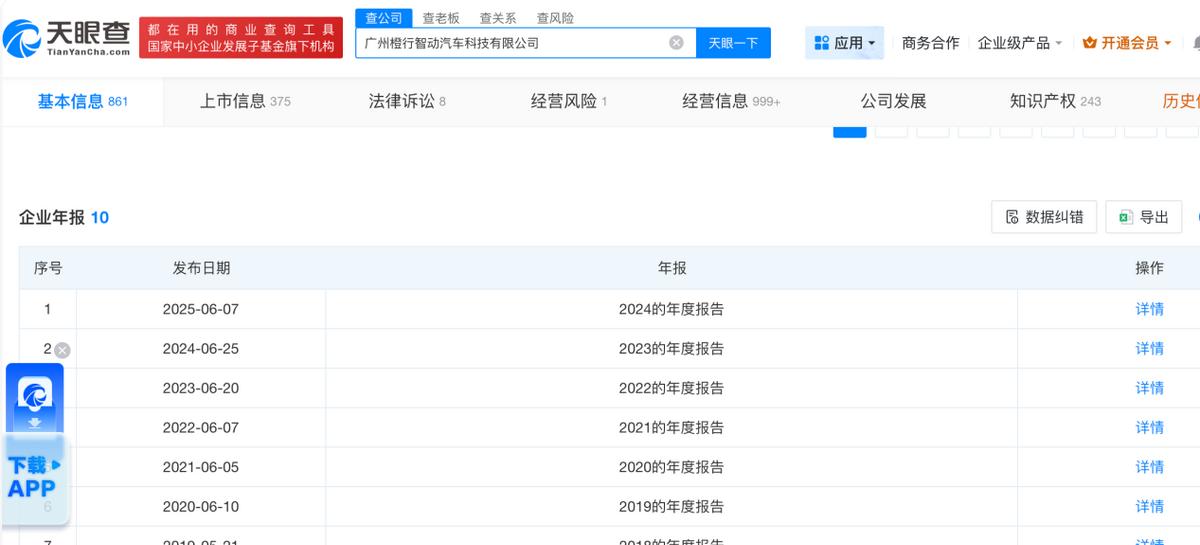
For instance, according to Tianyancha APP, last year AutoNavi announced a global ecological cooperation with XPENG Motors, with XPENG's Robotaxis officially integrating into the AutoNavi platform, aiming to build the largest Robotaxi aggregation platform...
At first glance, this approach seems fine, but it actually harbors a hidden concern:
Currently, Robotaxis are still in their infancy in the market, so everyone is willing to work with AutoNavi to grow the market pie.
But what about the future?
When autonomous driving becomes fully mainstream, will automakers like XPENG and Pony.ai willingly cede the matching focus of Robotaxi travel to platforms like AutoNavi?
If there are changes, what should AutoNavi do then?
The second area for improvement is its own AI capabilities.
Recently, it's not just AI ride-hailing that's gaining traction but also AI personal travel assistants like Longxia Travel.
These are also impacting the traffic entry point value and the aggregated ride-hailing model of AutoNavi and others.
From Longxia's operational logic, once Longxia ride-hailing is embedded at the mobile system level, the daily and monthly active user values of AutoNavi and others will be infinitely diluted, leaving only the core value of ride-hailing.
However, under Longxia's strength in cross-platform price comparison competition, this core value may also face significant performance pressure.
Additionally, although Doubao Mobile has been banned, many mobile phone manufacturers are now in contact with Doubao or developing their own Longxia-like phones. Once a consensus is formed at the mobile system level, the impact from Longxia AI may be imminent.
Therefore, AutoNavi needs to continuously strengthen its various AI capabilities during the early stages of the Longxia craze, enhancing user stickiness and cultivating user habits to prevent a dimensionality reduction strike in the AI era...
From this, it is evident that AutoNavi has many options for breaking through, and embodied AI is not necessarily the most perfect answer.
Therefore, regardless of the past, AutoNavi is still a national-level APP with infinite traffic advantages and possesses the "definitive coordinates" of millions of merchants and billions of users.
Moreover, the speed of its embodied AI launch has shown us AutoNavi's solid technical foundation.
Therefore, as long as it maintains strategic focus, makes the Street-Sweeping Rankings an irreplaceable consumer mindset, and refines its map navigation into an unavoidable ecological hub, we believe that AutoNavi will undoubtedly forge its own in-depth path in the future!
-
![]()
Wang Huiwen, Former Meituan Executive, Achieves 20-Fold ROI, Supports 24 AI Startups
-
![]()
Another AI Computing Power Unicorn Launches IPO! Founded by a Changjiang Scholar
-
![]()
OFILM Holdings Secures Zhongke Daojing, Marking a Significant Leap in the Optical Communication Industry!
-
What Will Be the Next Key Battleground for Large Models After AI Coding?
-
![]()
Leapmotor's Sales Soar, Yet Hidden Concerns Loom
-
![]()
China’s Action Camera Market Soars: 3.12 Million Units Sold in Six Months, DJI Secures 74% Dominance
-
![]()
Zhang Yiming: Strategic Retreat as a Path Forward
-
![]()
Exploring Charging for Some Features of QianWen App: Can It Follow the Path of Doubao?