Now, Even 3-Year-Olds Are Chatting with Doubao
 05/07 2026
 668
668

Source | YuanSight
After making substantial investments in AI, it's only logical to seek ways to make this 'golden goose' lay eggs.
Recently, news surfaced that Doubao, ByteDance's AI product, is set to introduce paid services, sparking heated discussions online. Some netizens reported that Doubao quietly posted a notice about a paid version on its App Store page, offering three tiers—Standard, Enhanced, and Professional—with monthly fees ranging from 68 RMB to 500 RMB, and annual subscriptions reaching up to 5,088 RMB.
However, Doubao's official response clarified that it has consistently provided free services and is exploring additional value-added offerings. Details of these plans are still under testing.
This pricing rumor serves as a microcosm of ByteDance's journey toward AI commercialization. Since the global rise of generative AI in recent years, ByteDance has undergone several iterations, constructing a full-stack commercialization system centered around its Seed large model. This system spans consumer-facing products, enterprise services, and developer ecosystems.
Doubao's foray into paid services represents ByteDance's trial run in AI commercialization and mirrors the broader industry's shift from burning cash to seeking profitability. After all, AI large models must ultimately generate revenue.
01
The National APP Factory
Over the past few years, leveraging its vast traffic pool and R&D resources, ByteDance has successfully incubated phenomenal products like Doubao, Hongguo, and Qishui Music.
Data indicates that Hongguo's daily active users (DAUs) have surpassed 100 million, firmly establishing it in the industry's top tier. Qishui Music's monthly active users (MAUs) have also reached the 100 million mark, positioning it as a contender for industry leadership.
Furthermore, according to QuestMobile, during the AI "Spring Festival Battle" campaign, Doubao set a new record for DAUs, peaking at 145 million.
Compared to its peers, ByteDance has once again cultivated leading national-level products on the consumer side, alongside offerings like Douyin.
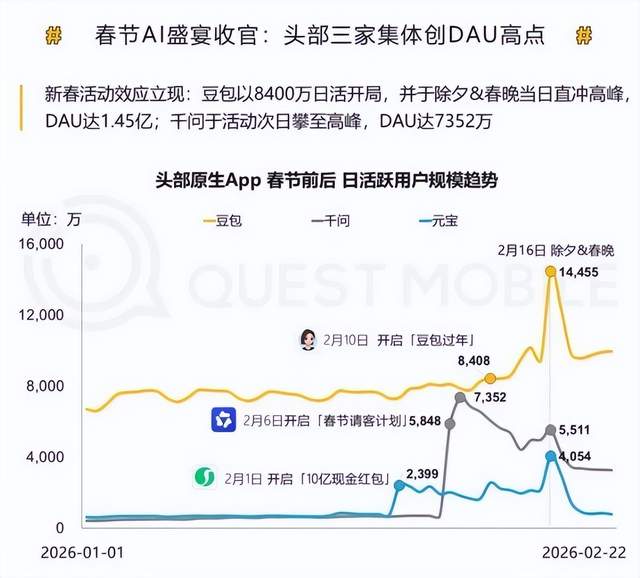
Source: QuestMobile Data
The widespread attention surrounding Doubao's rumored paid services stems from its status as China's largest AI-native application by user base.
Surpassing 100 million DAUs means Doubao's free model has deeply resonated with users. In many households, even toddlers as young as two or three are learning to converse with Doubao, while older children frequently use it for practical tasks like image recognition and knowledge queries.
For ordinary users, concerns about Doubao's paid services likely arise from fears of reduced free benefits, such as restricted access to core features like daily conversations, web searches, and basic content creation, compelling them to pay for value-added services.
However, considering both official responses and industry logic, Doubao's exploration of paid services is a pragmatic choice driven by necessity.
02
ByteDance’s New Vision
After achieving significant user growth, ByteDance is now exploring strategies to enable Doubao, Hongguo, and Qishui Music to achieve scalable profitability and contribute to the group's overall performance.
Given the industry context, R&D and operational costs for AI large models are exorbitant, necessitating continuous investment in computing power, talent, and data.
Previously, ByteDance's AI business relied heavily on internal group funding. As the technology matures, exploring commercialization and achieving financial self-sufficiency has become imperative. Doubao, as a consumer-facing traffic entry point, naturally serves as the primary vehicle for commercialization trials.
On April 20, Red Star News reported that ByteDance's net profit in 2025 had declined by over 70% year-on-year, with a significant drop in profit margins. The report attributed this to substantial increases in AI business investment during the third and fourth quarters of the previous year.
However, Li Liang, Vice President of Douyin Group, clarified that the 70% profit decline cited in related reports was based on international accounting standards.
Li explained that under these standards, the figure reflects not only increased investments in emerging businesses but also changes in preferred stock and option costs (which do not reflect operational fundamentals).
“In reality, due to slower growth in Douyin E-commerce and increased investments in emerging businesses, operating profit margins saw a slight decline in the second half of the year, but nowhere near the reported magnitude. Excluding changes in preferred stock and option costs, overall revenue and profits still grew, and TikTok’s e-commerce business and emerging businesses are showing strong development trends,” he said.
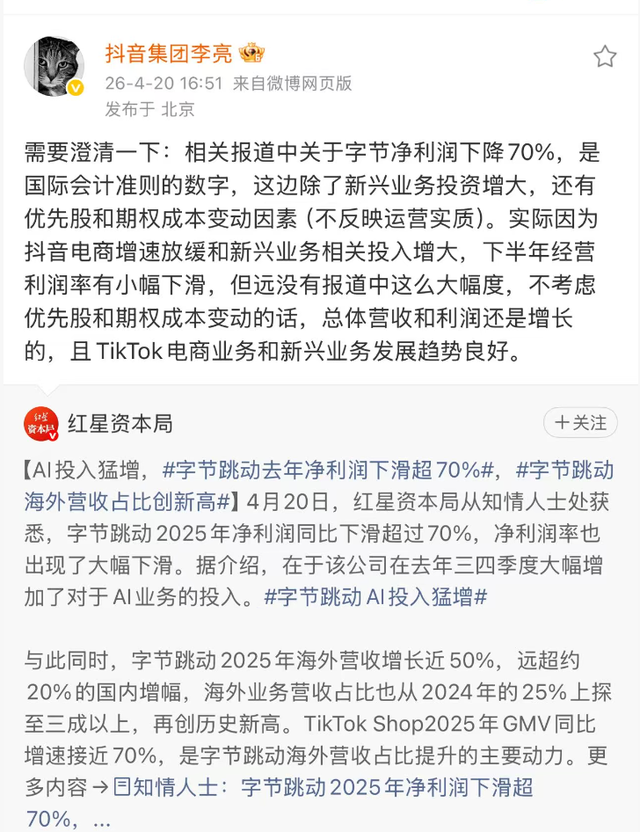
Source: Weibo of Li Liang, Vice President of Douyin Group
Regardless of the final performance outcomes, the rumors about Doubao's paid services underscore ByteDance's current need to make products like Doubao capable of "laying eggs."
However, finding a balance between user retention and commercialization remains a key challenge for Doubao. As a national-level application, its free model has been crucial for rapid user acquisition, but excessive commercialization could lead to user churn. Conversely, prolonged reliance on cash injections cannot sustain continuous technological iteration.
03
Diversified Monetization
While ByteDance is known as an "App Factory," most of its products revolve around content ecosystems. Its vast product matrix and massive user behavior data provide unique advantages for Doubao's model training in areas like image-text understanding, video analysis, and multi-round voice interactions.
However, to further scale, Doubao must expand beyond content ecosystems and deeply integrate into lifestyle services, addressing gaps in daily convenience, consumer services, and local life capabilities.
Thus, the consumer market represents ByteDance's frontline for AI commercialization, with Doubao serving as a critical anchor. Leveraging ByteDance's massive traffic ecosystem, Doubao has quickly amassed users to become a benchmark for AI-native applications in China. Its exploration of paid services marks a pivotal step in consumer-side commercialization.
Predictably, ByteDance's core logic for consumer-side AI commercialization involves two prongs: first, using a free model to reach mass users, accumulate vast user data, and feed model iterations; second, introducing differentiated value-added services tailored to diverse user needs to achieve monetization.
Based on Doubao's paid plans, its value-added services will likely focus on complex productivity scenarios, such as PPT generation, data analysis, and film production, where computational and technical demands are higher, and user willingness to pay is stronger. Meanwhile, everyday needs like casual conversations and basic searches will remain free to prevent user attrition.
It is even foreseeable that, given current user behavior, Doubao could also gain a foothold in education, office productivity, and other sectors.
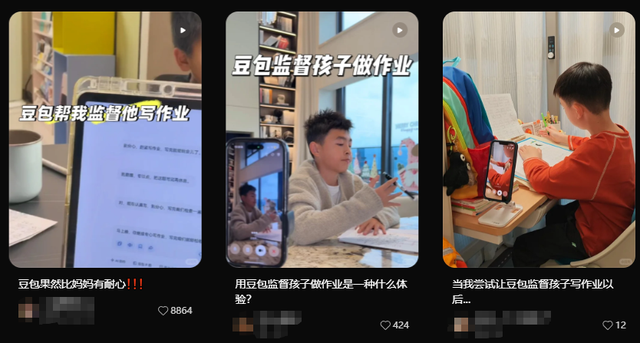
Source: Xiaohongshu
Additionally, monetization through hardware integration represents a viable strategy.
Late last year, ByteDance partnered with ZTE to launch the first Doubao smartphone, embedding the Doubao AI assistant at the system level. This allows AI to gain system-level permissions and simulate human-like phone operation.
The Doubao phone represents ByteDance's first attempt at hardware-software integration, aiming to break down barriers between standalone apps and enable seamless, cross-platform smart operations and service access, transforming the phone into a true AI agent.
Naturally, industry players like WeChat and Taobao have responded with traffic restrictions and isolation measures to counter this potential disruption. However, ByteDance's determination appears unshaken.
In mid-April, multiple media outlets reported that several top-five domestic manufacturers, including Honor, had engaged in talks with ByteDance about collaborating on Doubao phones. Honor responded that internal confirmations found these rumors untrue, though sources cited by some media suggested that “details had not yet been finalized.”
Just days ago, a blogger revealed that the second-generation Doubao AI phone could officially launch in the first half of 2026.
Given the current landscape, ByteDance holds many cards to make Doubao self-sustaining. However, calibrating the right approach, finding the optimal commercialization pace and model, and striking a balance that “offends neither side” will test its long-term patience.
Some images sourced from the internet; please notify us for removal if infringement occurs.
-
![]()
Tesla Restructures Its Balance Sheet
-
![]()
Accelerating the High-Speed Interconnection Upgrade of AI Computing Clusters! JONHON Releases ELSFP External Light Source Optical Connectors
-
![]()
Breaking the overseas blockade of volumetric holographic materials, this optical enterprise secures nearly 100 million yuan in financing!
-
![]()
Why Does Jensen Huang So Openly Praise China’s AI?
-
![]()
"Wudang" Unveiled: Arm China's Next-Gen AI VPU Redefines Video Encoding
-
![]()
From Energy Conservation and Carbon Reduction to AI Decision-Making: GECON East Intelligence and Chery Group Explore a New Green and Smart Paradigm for Automobile Manufacturing
-
![]()
WAIC 2026 Observation | AI Accelerates Towards the Core of Industries, Industrial AI Enters a Critical Phase
-
![]()
Volkswagen China Fires the First Shot in Foreign-Funded 'White Box Delivery'!