Can Doubao, a Popular Snack-like App, Command Premium Prices?
 05/07 2026
 478
478

Is Zhang Yiming facing resource constraints?
The topic of 'Doubao Going Paid' has recently surged in popularity as Doubao announces its introduction of fees. According to its updated paid service statement on the App Store, Doubao users will be categorized into four tiers once the paid model is implemented:
Basic Version: Remains free, catering to daily needs;
Standard Version: 68 RMB per month for a continuous monthly subscription, or 688 RMB per year for a continuous annual subscription;
Enhanced Version: 200 RMB per month for a continuous monthly subscription, or 2048 RMB per year for a continuous annual subscription;
Professional Version: 500 RMB per month for a continuous monthly subscription, or 5088 RMB per year for a continuous annual subscription.
Sources close to Doubao reveal that the paid features will primarily focus on complex tasks and productivity scenarios, such as PPT generation, data analysis, and film and television production.
ByteDance, despite its financial prowess, faces significant financial pressure from its AI endeavors.
Judging from the subscription fee plan alone, Doubao has clearly put significant thought into its strategy. The Standard Version at 68 RMB is less than half the price of ChatGPT Plus's 142 RMB per month. The Professional Version's annual subscription at 5088 RMB exceeds the standard willingness to pay for personal chatbots, directly targeting enterprise-level services.
This indicates that ByteDance aims to demonstrate its 'cost-effectiveness' while accurately targeting users at different levels to achieve better paid conversion rates.
Currently, Doubao has not yet launched paid access on any of its product platforms, nor has it clarified the differences in benefits between various versions. The official response merely states that Doubao will explore offering more value-added services while continuing to provide free services, with related scheme details still under testing.
Despite ByteDance's discreet and strategic approach, such as choosing to announce the news during the latter half of the May Day holiday and only disclosing information in the App Store's development notes, Doubao's move to charge fees has still sparked significant attention from users and the industry, becoming a polarizing topic of public opinion.
A major concern among users is the fear that the 'free version will be crippled.' Some even joke, 'You think you're using Doubao for free, but actually Doubao is using you,' as each use helps label data, refine models, and ultimately sell to those who truly pay.
Many also speculate whether ByteDance is facing resource constraints and is now treating Doubao as a primary source of revenue to support its operations.
Not long ago, media reports claimed that ByteDance's net profit in 2025 fell by more than 70% year-on-year. Li Liang, Vice President of Douyin Group, clarified that the figure was based on international accounting standards, and the actual operating profit margin only saw a 'slight decline,' 'far less dramatic than reported.'
However, he also acknowledged that 'the slowdown in Douyin E-commerce growth and increased investment in emerging businesses' had indeed put pressure on the operating profit margin in the second half of the year.
Li Liang's response is intriguing. He strived to prove that ByteDance's actual operations were not problematic, with businesses like Douyin E-commerce still growing and the company overall healthy. The 'slight decline' was also attributed to accounting standards.
The real issue lies in the increased investment in emerging businesses, namely AI, including soaring infrastructure costs for computing power procurement, model research and development, and talent recruitment.
In early 2026, ByteDance CEO Liang Rubo defined AI as a 'core industry opportunity larger than PC plus Web' at a company-wide meeting, explicitly stating that the short-term priorities were 'Doubao' and the MaaS (Model as a Service) business in the ToB sector.
This positioning determines ByteDance's resource allocation logic for 2025 and the coming years: profit is not the top priority; securing a foothold in the AI era is.
This has created an internal 'tug-of-war' within ByteDance: on one side is the traditional internet traffic business, mainly selling ad space, which is highly profitable; on the other side are emerging AI businesses with hundreds of millions of users on paper but still unable to generate revenue independently, relying on the ad business for support.
As a result, ByteDance's capital expenditures exceeded 150 billion RMB in 2025, with about 90 billion RMB allocated to AI computing power procurement. In 2026, this figure is set to rise to 160 billion RMB, with AI chip procurement accounting for 85 billion RMB.
AI business has become the core sector of ByteDance's capital investment.
On the surface, ByteDance's business model of 'earning while spending' now resembles that of peers like Alibaba, Baidu, and Tencent. These AI companies are still in the stages of technology implementation, scenario deepening, and commercial validation, far from forming a healthy commercial or even profitable closed loop.
Continuous investment in AI model iteration, computing power cluster construction, and technical talent reserves has created a cost gap that is difficult to fill. In practical terms, this means that each AI dialogue task consumes computing resources. The larger the user base, the higher the demand for computing resources.
However, unlike Alibaba, Baidu, and Tencent, which have B-end businesses to support them besides C-end operations, ByteDance's revenue, whether from ad or AI businesses, primarily comes from C-end scenarios. Doubao's experiment with a paid model more strongly conveys that ByteDance AI is seeking a self-sustaining business path.
As the industry media 'Beyond the Headlines' commented, ByteDance's ad and AI businesses are fundamentally at odds. ByteDance is not running out of money; its methods of making money and spending money are internally conflicting. The more AI users it has, the faster ad profits are eroded.
Who will pay for Doubao?
Facing the common issue of user growth outpacing the establishment of a commercial model, ByteDance feels the most urgency. 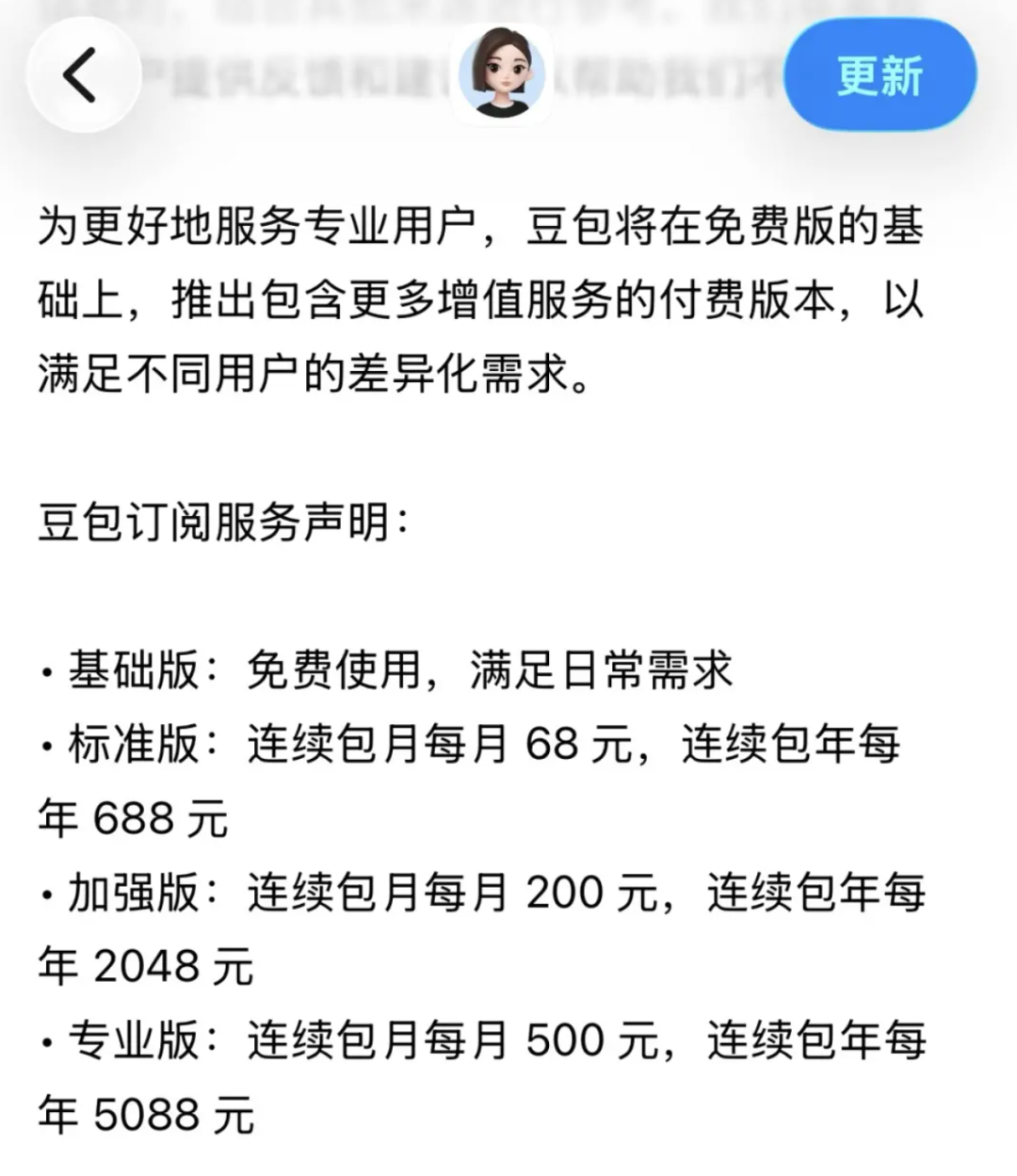
Figure | App Store Screenshot
Doubao's launch of a multi-tier monthly subscription system can be summarized as follows: basic features remain free to retain the mass user base, while heavy productivity scenarios require paid access, verifying the monetization model through user segmentation.
This commercialization framework is mature and almost entirely mirrors the value-added paid models of overseas leading companies like OpenAI and Anthropic. Previously, domestic AI companies' paid explorations mostly remained in niche trial-and-error stages, cautious and conservative.
For example, Baidu's ERNIE Bot briefly launched a membership system but ultimately rolled it back due to public backlash; paid services from AI newcomers like Kimi, Zhipu Qingyan, and iFlytek Spark were priced low, with blurry functional distinctions, covering only a small number of professional users and remaining niche commercial experiments never facing the mass user market.
In contrast, Doubao's approach appears bold and 'Western,' designating high-computing-power scenarios as 'paid zones' and attempting to establish the value perception that 'paid = professional productivity.'
Meanwhile, scenarios like content creation, office work, and operations within ByteDance's ecosystem, such as Douyin, Feishu, and Toutiao, will also become 'selling points' for AI's paid capabilities.
The model is mature and logically sound, but whether it fits the domestic AI user ecosystem and competitive environment remains questionable.
Doubao's user structure further amplifies this contradiction. Most Doubao users come from Douyin ecosystem referrals and phone pre-installations, with a high proportion of users from lower-tier markets, middle-aged and elderly users, and casual entertainment users. This aligns with QuestMobile's report that in Q1 2026, AI industry user growth began to extend bidirectionally toward 'silver-haired + lower-tier' demographics.
The core needs of such users can be met by the basic free version, but they may also have concerns about whether the free version is slower or more prone to errors.
Doubao's paid model truly serves professionals, creators, and developers, stepping into the niche circle similar to Kimi's paid group and struggling to support large-scale paid conversion.
More critically, competitors like Alibaba's Qianwen, Tencent's Yuanbao, and Baidu's ERNIE, which are on par with Doubao in model capabilities and product experience, will inevitably divert users by offering free advanced features or low-cost package subsidies once Doubao fully implements its paid system, directly diluting Doubao's paid value.
In my view, Doubao's current signal of launching a paid model holds far greater strategic value than revenue value. Given its current paid conversion rate, Doubao's revenue volume cannot possibly cover its multi-billion-dollar computing power investments.
Expecting Zhang Yiming to make it self-sufficient and independently support the family in the short term is even harder than creating another Doubao.
ByteDance itself lacks great confidence in pushing Doubao toward full paid access. Its core goal is to use public paid testing to uncover three industry secrets: the payment threshold of domestic mass users, the value ceiling of AI productivity services, and the strategic bottom line of competitors' commercial responses.
Looking at the domestic AI industry, this is also a comprehensive stress test led by top AI companies. Before Doubao's entry, the question of 'whether Chinese users are willing to pay for AI' hung over the industry, with most vendors choosing to wait and see conservatively, daring not to break free from the free comfort zone.
ByteDance has broken this 'silence.' The current paid exploration's core significance lies not in making money but in trial and error, breaking through, and establishing industry rules to end the awkward situation where the AI industry only burns money without generating revenue.
As for whether Doubao, this 'staple food,' can fetch a good price, it matters less.
References:
iFanr, 'Doubao is Launching a Paid Version—One Thing Matters More Than Whether It's Worth It'
Beyond the Headlines, 'The More Users ByteDance Has, the Poorer It Gets'
-
![]()
Tesla Restructures Its Balance Sheet
-
![]()
Accelerating the High-Speed Interconnection Upgrade of AI Computing Clusters! JONHON Releases ELSFP External Light Source Optical Connectors
-
![]()
Breaking the overseas blockade of volumetric holographic materials, this optical enterprise secures nearly 100 million yuan in financing!
-
![]()
Why Does Jensen Huang So Openly Praise China’s AI?
-
![]()
"Wudang" Unveiled: Arm China's Next-Gen AI VPU Redefines Video Encoding
-
![]()
From Energy Conservation and Carbon Reduction to AI Decision-Making: GECON East Intelligence and Chery Group Explore a New Green and Smart Paradigm for Automobile Manufacturing
-
![]()
WAIC 2026 Observation | AI Accelerates Towards the Core of Industries, Industrial AI Enters a Critical Phase
-
![]()
Volkswagen China Fires the First Shot in Foreign-Funded 'White Box Delivery'!