Zhu Xiaohu’s Misjudged Bet on Zhang Yutong
 05/07 2026
 614
614

On May 6, 2026, news emerged that Moonshot AI was on the verge of finalizing a new round of financing.
The round amounted to $2 billion, with a post-money valuation of $20 billion. Meituan Longzhu took the lead in the investment, contributing over $200 million alone, while China Mobile and CPE Source Peak also participated.
Just six months earlier, Moonshot AI was valued at $4.3 billion.
The company has raised a total of $3.9 billion in the past six months, with its valuation soaring more than fourfold. Its annual recurring revenue (ARR) surpassed $100 million in March and $200 million in April, making it the domestic large-scale model startup with the highest cumulative financing to date.
Zhu Xiaohu likely refrained from posting on WeChat Moments about this development.
Over the past three years, his WeChat Moments posts about "independent large-scale models" and this company could nearly fill a book of predictions. Unfortunately, almost none of them have materialized.
Zhu Xiaohu's Predictions on Large-Scale Models
Zhu Xiaohu made his first prediction in March 2024.
At that time, Kimi had just gained attention for its long-context capabilities. He publicly stated, "I’m not optimistic about large-scale models. It’s clear they won’t succeed." Adding, "I don’t even want to discuss it, you know? It’s pointless."
He later revealed that when large-scale model companies sought financing in 2023, Jinsha Jiang Capital had no intention of investing.
In June 2024, at a venture capital forum, he doubled down on his stance. "In five years, there will be no independent large-scale model companies because there’s no viable business model." His reasoning was that general-purpose large-scale models suffer from a first-mover disadvantage—early adopters burn through money on trial and error, while later entrants face lower costs. "Americans have deep pockets now; let them throw money at GPUs. They can experiment with 200,000 or 300,000 cards. Once they exhaust their funds, we won’t have to."
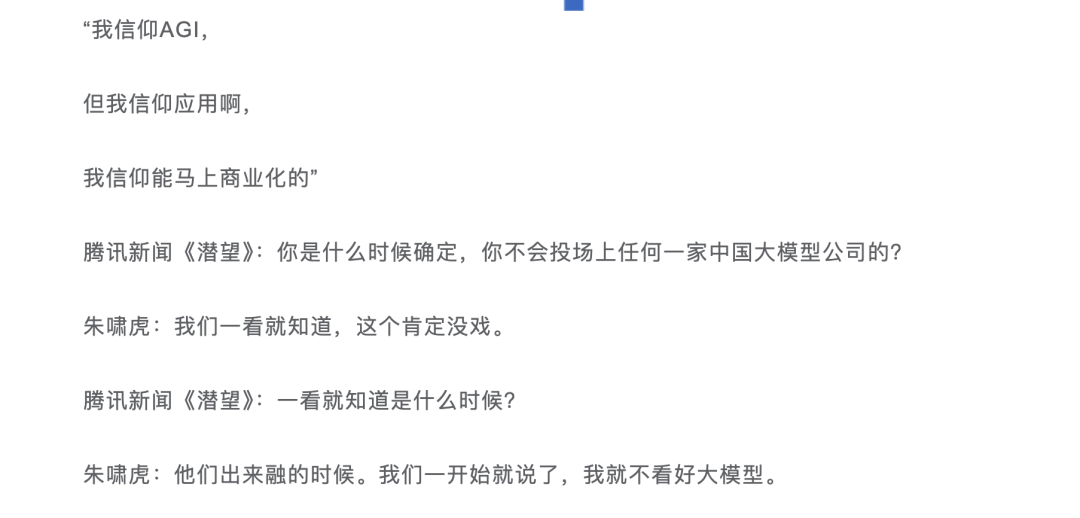
Interview content sourced from Tencent News 'Potential'
By August 2024, he had passed judgment on the entire sector:
"The best outcome for the 'Six Little Tigers' is to be acquired by major firms."
However, the final chapter of this prediction book was written in December 2024—something Zhu Xiaohu hadn’t anticipated.
That November, old shareholders from Jinsha Jiang’s Cycle Intelligence era filed arbitration in Hong Kong against Yang Zhilin and Zhang Yutao. The case alleged that prior to founding Moonshot AI and initiating financing, they had failed to obtain consent from old shareholders.
In December, Zhu Xiaohu personally intervened, targeting Zhang Yutong—a former Jinsha Jiang partner who later joined Moonshot AI as a co-founder. He accused Zhang of holding a significantly larger stake in Moonshot AI than in their parent company, Cycle Intelligence, claiming she "concealed and deceived" the fund’s limited partners (LPs) and Cycle Intelligence shareholders, violating fiduciary duty, and was subsequently fired by Jinsha Jiang.
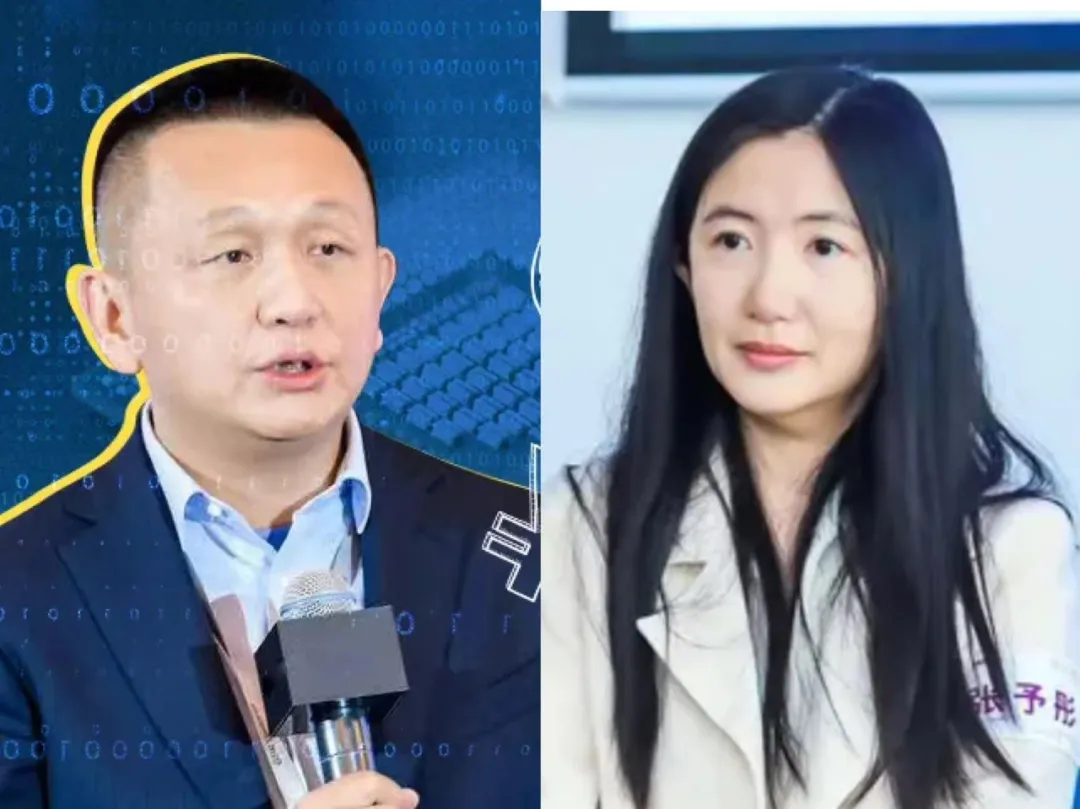
His statement was measured: "We support young people’s AGI dreams but cannot tolerate ethical violations."
Yang Zhilin responded: "Zhang Yutong is a co-founder, and her shares vest over multiple years."
The arbitration case remains unresolved—but at that moment, Moonshot AI’s narrative was forcibly shifted from "AGI startup star" to "defendant in a shareholder dispute." This was Zhu Xiaohu’s heaviest blow, and his closest brush with victory.
The Market Doesn’t Believe in Prophets
The capital market responded to Zhu Xiaohu’s predictions in a way he likely dislikes.
A $20 billion valuation means Kimi’s current valuation-to-ARR multiple is roughly 100x—for reference, OpenAI’s multiple reached ~30x in mid-2025, then fell to ~20-25x by early 2026 as its ARR surpassed $25 billion.
The gap isn’t all bubble. It’s a credit premium.
This is evident from the capital lineup in this round.
Meituan Longzhu leading isn’t surprising—the corporate venture capital (CVC) arm had already led Moonshot AI’s Pre-A round in 2023, and Wang Huiwen’s connection remained. But contributing over $200 million alone means Meituan upgraded from "old friend" to "deep strategic shareholder." CPE Source Peak is also unsurprising; backed by insurance/state-owned "mother funds," it’s typical patient capital—aligning perfectly with Yang Zhilin’s statement about "not rushing to go public."
The real news is China Mobile.
This is almost the first time a top large-scale model startup has direct shareholding from a central state-owned enterprise (SOE) (if this round’s financing closes). China Mobile brings more than just money to Moonshot AI—priority access to Mobile Cloud’s computing power, government-enterprise channels, regulatory endorsement, and, crucially, being tacitly recognized as a "first-tier player in China’s AI."
Who does this lineup resemble?
Not Zhipu (backed by local state-owned funds in Beijing/Shanghai/Hangzhou/Chengdu/Zhuhai + diversified capital like Hillhouse), not MiniMax (deeply involved by Shanghai State Investment but still supported by Alibaba, Tencent, IDG, and Abu Dhabi Investment Authority), and certainly not DeepSeek, which is wholly funded by Fantastic Quantization with Liang Wenfeng holding over 84% of shares. Moonshot AI’s current round features central SOE + CVC + patient capital—industrial capabilities, policy resources, and long-term funding, three of the rarest assets, all appearing on the same shareholder list for the first time.
But you can’t claim "national team" backing is the only path to success.
DeepSeek itself is a rebuttal. This company has zero external financing, zero VC, zero national team support—relying solely on Fantastic Quantization for funding, with Liang Wenfeng directly and indirectly holding over 84% of shares. In early 2025, its R1 model disrupted the market at less than 1/10th the industry’s cost; by late 2025, its V3 model shook Silicon Valley. It has no Meituan, no China Mobile, no CPE Source Peak, no Zhu Xiaohu, no anything. It simply proved another logic: When technological prowess reaches its extreme, the capital structure itself can be redefined.
Meanwhile, Manus demonstrated another possibility. Butterfly Technology isn’t building foundational models but general-purpose AI Agents—leveraging existing models to achieve task execution capabilities that surprised Silicon Valley through an "envelopment" approach. It doesn’t burn GPUs or train base models, yet it has secured far stronger user payment willingness than most large-scale model companies.
But you can’t say Zhu Xiaohu was wrong.
When the term "Six Little Tigers" was coined, at least six companies were in the race—Baichuan, 01.AI, Moonshot AI, Zhipu, MiniMax, and Jieyue. Two years later, Baichuan and 01.AI have largely exited foundational large-scale models, leaving only four at the table. Zhu Xiaohu did correctly predict the business model layer: Most independent large-scale model companies indeed cannot survive.
He did miss a few variables.
The Overlooked Variables
Zhu Xiaohu didn’t misjudge Kimi. He’s executing a coherent VC philosophy—one that once defined his position in China’s VC industry.
The core of that philosophy is product-market fit (PMF): Focus on business models, aim for 18-month payback, and exploit "first-mover disadvantage" to your advantage. It emerged from China’s internet consumer era, validated repeatedly by Didi, Ele.me, ofo, and Xiaohongshu. It’s not a wrong philosophy—it was designed for another era.
In March 2025, Zhu Xiaohu announced a "mass exit from humanoid robot companies." Many misinterpreted this as a judgment on humanoid robots, but it was actually a reaffirmation of his philosophy: Avoid long-cycle, capital-intensive, and unclear business model sectors. This has been his unwavering persona for two decades.
Meanwhile, Moonshot AI’s current capital lineup represents a different philosophy.
What’s happening in 2026 isn’t just about one company’s success—it’s the AI sector entering an era of "stratified competition." At the base layer, DeepSeek uses Fantastic Quantization’s money and Liang Wenfeng’s ambition to prove China can create global-tier foundational models. In the middle layer, Kimi enlists national teams for scale, using a $20 billion valuation and billions in cash to prove "independent large-scale models" can access unprecedented resources under national narratives.
Zhu Xiaohu’s abacus keeps clicking—his WeChat Moment about exiting humanoid robots proves it never stops. His attitude toward DeepSeek did a 180 by late 2025: "I’d definitely invest!" He didn’t cling to outdated views.
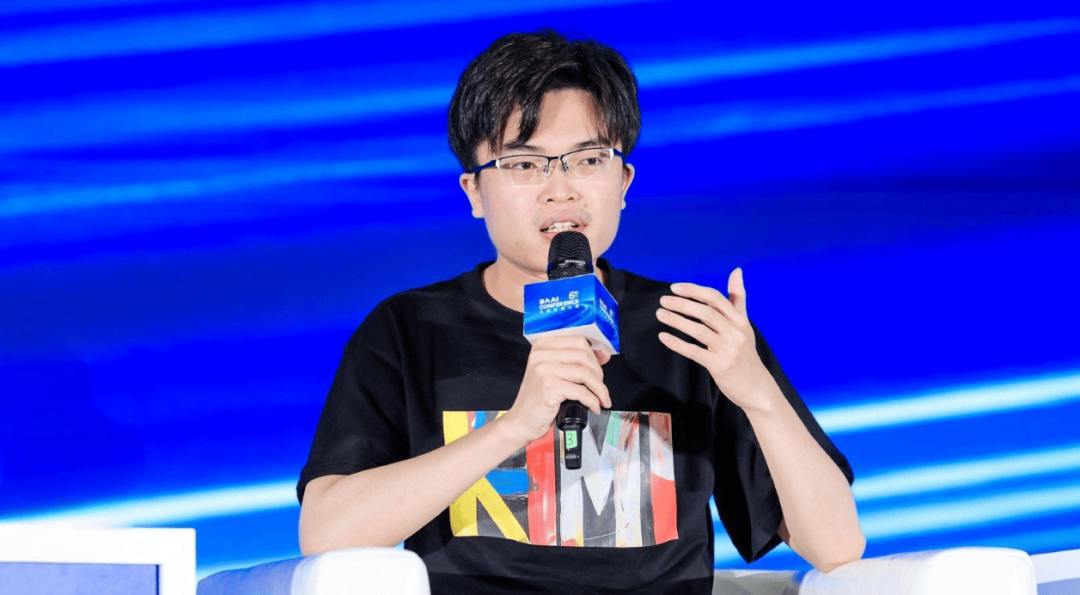
Moonshot AI’s $2 billion isn’t just for Yang Zhilin. It’s a necessary deposit for "China’s AI must have its own first-tier players" and a market guarantee that "independent large-scale model companies don’t have to be sold."
The predictions about large-scale models are far from over.
They’ve simply turned to the next chapter. Four forces are now playing simultaneously: Zhu Xiaohu’s PMF, China Mobile’s SOE credibility, DeepSeek’s technological prowess, and Manus’s Agent monetization. It’s too early to declare a winner, but one thing is certain—as of May 6, 2026, the judgment that "independent large-scale models have no future" has been temporarily disproven by a $20 billion valuation. How long this disproof lasts depends on whether Yang Zhilin can grow ARR from $200 million to $2 billion before burning through the billions in cash on hand.
-
![]()
Tesla Restructures Its Balance Sheet
-
![]()
Accelerating the High-Speed Interconnection Upgrade of AI Computing Clusters! JONHON Releases ELSFP External Light Source Optical Connectors
-
![]()
Breaking the overseas blockade of volumetric holographic materials, this optical enterprise secures nearly 100 million yuan in financing!
-
![]()
Why Does Jensen Huang So Openly Praise China’s AI?
-
![]()
"Wudang" Unveiled: Arm China's Next-Gen AI VPU Redefines Video Encoding
-
![]()
From Energy Conservation and Carbon Reduction to AI Decision-Making: GECON East Intelligence and Chery Group Explore a New Green and Smart Paradigm for Automobile Manufacturing
-
![]()
WAIC 2026 Observation | AI Accelerates Towards the Core of Industries, Industrial AI Enters a Critical Phase
-
![]()
Volkswagen China Fires the First Shot in Foreign-Funded 'White Box Delivery'!