A Valuation of 45 Billion USD: Liang Wenfeng 'Steps Down from the Summit'
 05/08 2026
 554
554

By Ling Du
Source: Node Finance
45 billion USD.
In early May 2026, this staggering figure burst forth like a thunderbolt, shattering the prolonged lethargy that had enveloped the venture capital arena for nearly three years.
Two weeks prior, whispers abounded that Alibaba and Tencent were poised to inject 20 billion USD to 'revitalize' DeepSeek's funding. Yet, the tides swiftly turned. As per the Financial Times, the National Big Fund (National Integrated Circuit Industry Investment Fund) was set to personally helm this financing round, directly pegging the valuation at a lofty 45 billion USD.
In a mere half-month, the valuation soared, doubling its previous worth.
Amidst a scarcity of computing power, a financing drought, and even murmurs of an AI downturn, DeepSeek proclaimed itself as China's undeniable AI frontrunner. However, Node Finance posits that this is not merely a numerical game played by a handful of titans on paper; rather, it signifies a profound reshaping of China's AI foundational logic.
Liang Wenfeng's 'Descent from the Summit'
To delve into DeepSeek, one cannot overlook Liang Wenfeng.
For an extended period, Liang Wenfeng remained an enigmatic figure within the industry. Backed by High-Flyer Quantitative Trading as his financial fortress, his initial stance was unwavering: no external financing, no flamboyant product launches, and minimal engagement with investors.
This 'I possess wealth and solely focus on technology' confidence enabled DeepSeek to sidestep the hype and forge an international path through algorithmic refinement.
So, why did Liang Wenfeng, who had consistently spurned financing, opt to embrace capital in 2026?
Node Finance believes a direct catalyst is that AI has metamorphosed from a 'cerebral pursuit' into a 'heavyweight industry'.
Early DeepSeek relied on ingenuity, leveraging sophisticated algorithms to navigate between NVIDIA chips. However, by 2026, the large model competition had entered the era of L4-level intelligent agents (Master Agents), which was not merely an algorithmic duel but also a contest of electricity, computing prowess, and even national-level resource allocation rights. No matter how affluent High-Flyer was, it remained a premier 'private workshop' incapable of providing DeepSeek with the 'passport' to mobilize the entire semiconductor industry chain.
Liang Wenfeng's 'descent from the summit' was essentially a strategic concession. He realized that in the current international landscape, being a 'reclusive master' was no longer tenable. Without participation, suffocation under the iron curtain of computing power blockades was inevitable.
An even more pivotal reason was talent acquisition.
Recently, some early core technical staff, such as Guo Daya (who joined ByteDance) and Luo Fuli (who joined Xiaomi), departed one after another. This stirred quite a commotion in the industry, with some even believing DeepSeek was facing a 'talent exodus'.
However, if one scrutinizes the author list for DeepSeek V4's release, the data speaks volumes: its core research and engineering team comprised approximately 270 individuals, with only around 10 departures during the development phase. An attrition rate of less than 4% is a remarkable feat for any large model company—OpenAI's core talent attrition rate surpassed 25% in the preceding two years.
The perception of a 'mass exodus' stems from DeepSeek's early team being exceptionally lean and brilliant. When any of these dozens of 'prodigious youths' were lured away by major companies with significantly higher salaries and more prestigious titles, the outside world perceived it as earth-shaking.
Nevertheless, from another vantage point, competition for talent is indeed intensifying.
Why raise funds now? It is precisely to provide talent with a 'tangible value'. Previously, without financing, the stock options held by DeepSeek employees were merely 'paper riches', invisible and intangible. Now, with a 45 billion USD valuation, everyone suddenly realized that the shares in their hands were truly valuable. When tempted by high salaries from major companies, employees would ponder: Should they accept the cash from a big company or remain at DeepSeek and await the 45 billion USD pie to multiply severalfold?
Additionally, to counter the 'financial clout' of major companies like ByteDance, Tencent, and Xiaomi, which offer equity plus bonuses to poach talent, Liang Wenfeng needed this round of financing to transform DeepSeek from a 'geek lab' into a 'super unicorn' with robust capital backing, regaining the upper hand in the talent market.
Rumors of the Big Fund's 'Entry'
According to the Financial Times, the National Integrated Circuit Industry Investment Fund (dubbed the 'Big Fund') is in negotiations with DeepSeek for its inaugural financing round.
The Big Fund investing in a large model company is an unprecedented move in the industry.
To date, the Big Fund has established three phases of funds. The first phase concentrated on 'strategic布局 (layout)', addressing the issue of 'existence'; the second phase aimed at 'precise demining', focusing on resolving 'bottleneck' issues and making every effort to conquer core upstream segments such as equipment and materials. In May 2024, the third phase of the Big Fund was inaugurated, with a scale surpassing the combined total of the first two phases, beginning to expand toward AI chips.
Overall, the Big Fund's funds were previously channeled into hardcore hardware like chip manufacturing, photolithography machines, and etching machines, emphasizing 'strengthening the foundation'. Now, suddenly pivoting to propel DeepSeek to a 45 billion USD valuation reflects a precise strategic resource exchange.
From Node Finance's vantage point, the Big Fund's investment in DeepSeek ultimately boils down to DeepSeek holding three 'aces' capable of altering the game's outcome:
Firstly, it is the 'chief tuner' of domestic computing power.
After years of investing in semiconductors, the Big Fund's foremost concern has been that domestic chips are 'easy to produce but hard to utilize'.
Although domestic AI chips like Huawei's Ascend, Cambrian, and Biren have improved in hardware specifications, they have consistently lagged behind NVIDIA in terms of ecosystem and compatibility. Many model manufacturers, for convenience, still prefer the CUDA ecosystem.

DeepSeek stands out—it is a quintessential 'tough nut'. Its greatest strength lies in employing extreme algorithmic optimization to enable domestic chips, which are somewhat cumbersome at the software level, to achieve far beyond their stated practical performance. The Big Fund's investment in DeepSeek is, in essence, an investment in a super engine capable of 'elevating' the domestic semiconductor industry chain. If DeepSeek successfully runs L4-level intelligent agents (Master Agents) on domestic computing power platforms, it will issue a 'certificate of qualification' for domestic chips to enter the global market.
Secondly, it is the 'disruptor' breaking through competition.
In the large model domain, following OpenAI's lead by amassing computing power and throwing money would only result in perpetual followership.
DeepSeek is valued by the national team because it demonstrates another possibility: achieving more with less money and fewer resources.
This asymmetric approach of 'algorithmic substitution for computing power' aligns seamlessly with China's survival logic under extreme pressure. The Big Fund's leadership in financing aims to establish this 'low-power, high-intelligence' technological path as the mainstream direction for domestic AI, averting ineffective internal friction in the computing power red ocean.
Thirdly, it is the 'missing piece' for an ecosystem closed loop.
Previously, China's AI industry operated in silos: the Big Fund invested in chips, Alibaba and Tencent developed applications, and startups built models.
The Big Fund's lead investment this time is akin to extending a hand to string scattered pearls into a necklace.
Bottom layer: The Big Fund ensures priority for domestic chips.
Middle layer: DeepSeek provides a fully self-developed core brain.
Top layer: Internet giants' scenarios feed data to the models and find outlets.
This amalgamation of 'national team guarantees + geeks lead + giants execute' is the full industry chain security closed loop that the Big Fund truly aspires to achieve.
Thus, the Big Fund is not investing in a chatty robot but in a software-hardware integrated commander capable of forcibly carving out an oasis in China's 'computing power desert'.
The 45 billion USD valuation purchases an opportunity to truly 'invigorate' the domestic semiconductor industry. In the current geopolitical context, this opportunity is indeed an invaluable 'treasure'.
Behind the 45 Billion USD Valuation: Not Just a Sino-US Rivalry but an 'Ecosystem Integration'
Many are inclined to interpret DeepSeek's ascent as a 'rivalry' between China and the United States. However, Node Finance believes this perspective is somewhat superficial.
At this juncture in 2026, the United States holds sway over B200 chips, attempting to confine China's AI development within a 'computing power barren zone'. DeepSeek's stance represents China's most formidable response. The Big Fund's leadership in this financing round values not DeepSeek's ability to compose poems but its capabilities.
DeepSeek is orchestrating an unprecedented 'ecosystem integration':
Upward, it 'nurtures' computing power: During the critical phase when domestic chips are still struggling to scale, DeepSeek employs top-tier algorithmic optimization to compel domestic chips to achieve beyond-expected practical results. Since the top-tier cards are unattainable, it utilizes top-tier logic to extract every ounce of value from domestic chips. This is not merely about cost savings; it is about 'sustaining' the domestic computing power industry.
Downward, it 'creates' a closed loop: Previously, China's AI ecosystem was fragmented—chips were chips, models were models, and applications were applications. This financing round, led by the Big Fund and followed by internet giants, essentially completes a full-link connection: the Big Fund secures the bottom layer, DeepSeek provides the brain, and internet giants offer the scenarios.
This approach furnishes a unified, hard-hitting 'command center' for domestic resources scattered across various sectors for the first time.
Within this 45 billion USD framework lies a subtle wisdom.
From Node Finance's perspective, the participation of internet giants is no longer the 'land grab' of yore but more akin to ecological complementarity. The giants possess user bases numbering in the hundreds of millions and enterprise-level scenarios—the practical training grounds DeepSeek, as a 'geek lab', most lacks. Meanwhile, the national team's entry injects the strongest possible confidence boost into this uncertain industry.
For Liang Wenfeng, this financing round is a 'coming-of-age ceremony'. He bids adieu to the era of pure laboratory work and steps into the most intricate center of interest game theory. This transformation may lack the geek's aloofness but gains resilience for survival amid great power rivalry.
Is 45 billion USD expensive? If merely purchasing a model, it is exorbitantly priced; however, if buying an AI ecosystem capable of self-evolution under extreme blockades, this price represents a discounted future of national destiny.
At the storm's epicenter in 2026, DeepSeek has secured its heaviest chip. Whether it can truly become the 'digital Great Wall' rivaling Silicon Valley hinges not only on its algorithmic depth but also on its ability to integrate resources amid this capital wave.
After all, in the AI game dubbed 'infinite game theory', surviving and becoming irreplaceable is the sole truth.
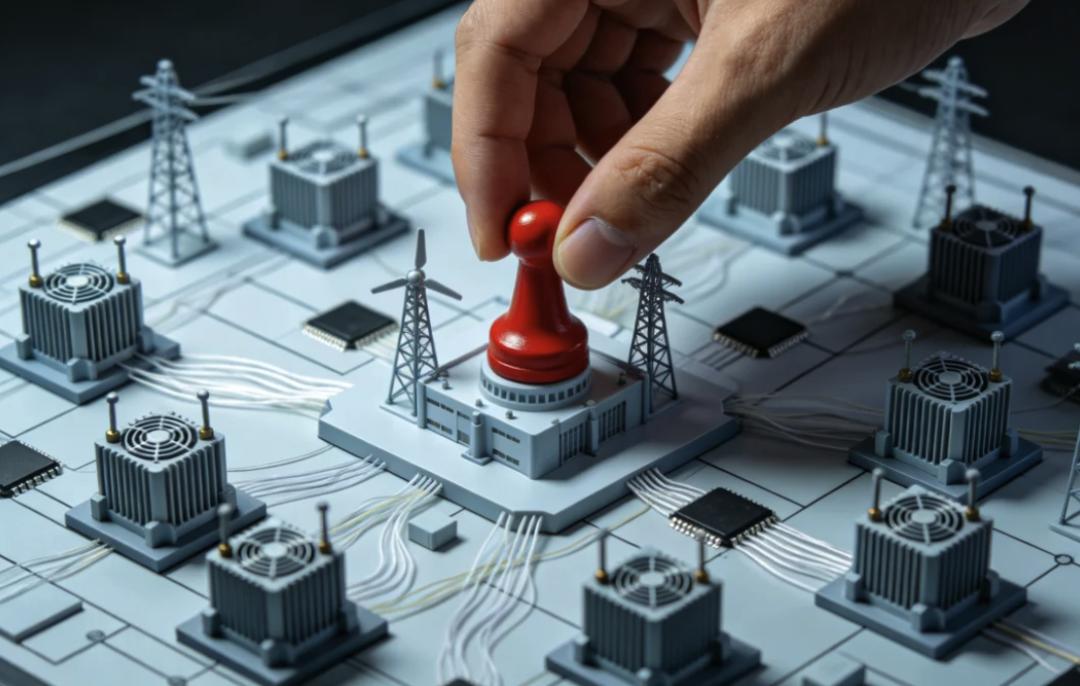
*The featured image is generated by AI.
-
![]()
Tesla Restructures Its Balance Sheet
-
![]()
Accelerating the High-Speed Interconnection Upgrade of AI Computing Clusters! JONHON Releases ELSFP External Light Source Optical Connectors
-
![]()
Breaking the overseas blockade of volumetric holographic materials, this optical enterprise secures nearly 100 million yuan in financing!
-
![]()
Why Does Jensen Huang So Openly Praise China’s AI?
-
![]()
"Wudang" Unveiled: Arm China's Next-Gen AI VPU Redefines Video Encoding
-
![]()
From Energy Conservation and Carbon Reduction to AI Decision-Making: GECON East Intelligence and Chery Group Explore a New Green and Smart Paradigm for Automobile Manufacturing
-
![]()
WAIC 2026 Observation | AI Accelerates Towards the Core of Industries, Industrial AI Enters a Critical Phase
-
![]()
Volkswagen China Fires the First Shot in Foreign-Funded 'White Box Delivery'!