Can Doubao's Paid Subscription Model Succeed?
 05/11 2026
 536
536

The commercialization of large models may see new changes this year.
Recently, Doubao has been considering introducing a paid subscription model for general users.
On May 4th, Doubao quietly announced on its App Store product details page that it will soon launch a paid subscription service. The basic version will be free, with the standard version priced at 68 yuan/month, the enhanced version at 200 yuan/month, and the professional version at 500 yuan/month.
These pricing tiers currently lack specific paid features or services, resembling a sound out (market feedback test).
Commercialization has always been a part of large models, but previously, it was primarily B-end focused, providing API access, data analysis, and other services for enterprise users.
For instance, Kimi, which has been frequently raising funds recently, secured a new round of $2 billion in financing for its parent company, Moonshot AI. Including the three rounds earlier in the year totaling $1.9 billion, the cumulative financing in less than six months exceeded $3.9 billion, approximately 37.6 billion yuan.
Behind the continuous financing, Kimi leveraged the lobster craze to accelerate its paid user base and API commercialization, with annual recurring revenue surpassing $200 million (approximately 1.362 billion yuan) by April.
Similarly, DeepSeek, which had been relatively quiet, is also enhancing its paid API tools and is rumored to be planning to raise over $7 billion (around 50 billion yuan) in financing.

Image Source: AI
Of course, Doubao's C-end paid subscription is drawing more attention. If successful, it is likely that other large models will follow suit.
The reason is simple: developing AI large models is extremely costly.
01
Is C-End Charging Feasible?
Currently, Doubao has only disclosed three monthly pricing tiers without revealing the corresponding benefits.
ByteDance's star product, the AI video generator Seedance 2.0, primarily commercializes through subscriptions on the Jimeng platform, offering a basic membership at 79 yuan/month and a premium membership at 649 yuan/month.
Referring to ChatGPT's three monthly pricing tiers, the free version limits message frequency and image creation per day. The $8/month Go membership offers higher limits and includes a voice mode. The $20/month Plus membership provides access to advanced features, thinking mode, Codex agents, and in-depth research. The $100/month Pro membership includes Pro cutting-edge models, 5-20x usage limits, and unlimited image generation.
Kimi's four membership tiers, priced at 49, 99, 199, and 699 yuan/month, differ mainly in Agent quotas, Kimi Code quotas, professional databases, Kimi Claw, and Agent clusters.
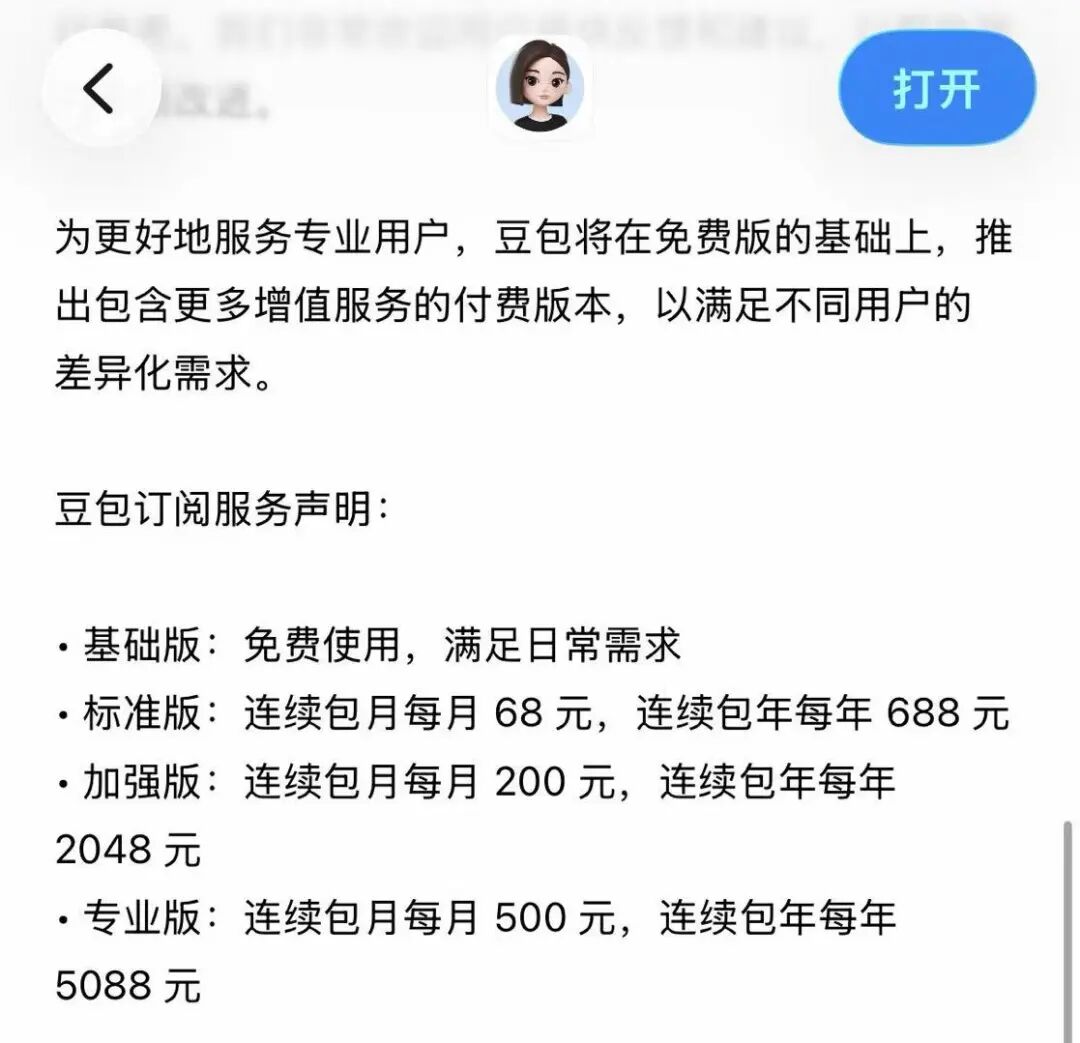
Image Source: App Store Screenshot
It is evident that both ChatGPT and Kimi focus their pricing on productivity features, including programming capabilities and Agent intelligence. Recently, ChatGPT's image generation capabilities have become highly realistic.
Some media outlets have also investigated Doubao's situation.
According to a report by the
In reality, current AI large model services are relatively homogeneous, making it difficult to convince users to pay if there is no clear differentiation.
In November 2023, Baidu's ERNIE Bot launched a professional membership at 59.9 yuan/month but reverted to a fully free model by April 2025.
Inevitably, some users have begun to worry that the free version may face computational resource allocation and quota restrictions in the future.
Overall, the success of charging depends not only on one's own service capabilities but also largely on competitors.
If other large models do not follow suit and continue to offer free services, the market dynamics will become complex.
In fact, the general public is well aware that charging is inevitable. There is no such thing as a free lunch, making timing crucial.
02
Is B-End Revenue Insufficient?
The commercialization path for large models targeting the B-end is relatively clear.
Previously, Kimi faced a downturn after major players entered the market in 2025.
According to QuestMobile, Kimi App's monthly active users (MAUs) dropped from 21.653 million in the first quarter of 2025 to 9.027 million by the end of the year.
However, after the lobster craze in early 2026, Kimi found an opportunity to explode.
On the one hand, the Kimi K2.5 model, launched and open-sourced in late January 2026, performed strongly and was even rebranded by the renowned U.S. AI programming tool Cursor, an fact publicly acknowledged by Elon Musk.
According to the global payment platform Stripe, since the release of the K2.5 model, Kimi's revenue in the past 20 days has surpassed the total for 2025. The number of individual subscription user payments increased by over 80x month-over-month in January and rose by another 120% in February.
At the same time, Kimi Code and Kimi Claw quickly capitalized on the lobster craze, with memberships selling well globally.
In November 2025, Kimi's valuation was around $4.3 billion but has now soared to $20 billion.
According to Wang Xinyu, a partner at Meituan Dragonball Capital, Kimi's annual recurring revenue (ARR) exceeded $100 million by early March and continued to surpass $200 million in April, doubling monthly and demonstrating impressive commercialization capabilities.
Image Source: DeepSeek Official Website
DeepSeek primarily targets B-end by partnering with major companies.
The DeepSeek V4 open-source large model, released in late April 2026, offers standard capabilities for handling up to one million words of context. The quality of its Agent capabilities is close to that of Claude Opus 4.6's non-thinking mode, and its official API pricing is very low.
Input tokens with cache hits are as low as 0.2 yuan/million tokens, and output tokens are priced at 2 yuan/million tokens.
A programmer friend told Heiban Jun that DeepSeek V4 offers high cost-effectiveness in programming productivity and can be used in conjunction with foreign large models as needed.
This means that on the B-end, DeepSeek can attract more enterprise paying users with its extremely high cost-effectiveness and compatibility with Huawei's Ascend solutions.
Rumors suggest that DeepSeek will accelerate the iteration of its large models, with V4.1 potentially updating in June. In addition to improved algorithms, it will offer more B-end customization options, further accelerating commercialization capabilities.
In fact, compared to the massive investments, Kimi's B-end revenue is relatively small and unlikely to catch up with the burning rate in the short term.
03
It's Indeed Extremely Costly
Doubao is indeed an industry leader, and leaders often need to take the first step.
According to QuestMobile, as of March 2026, Doubao App ranked first in monthly active users with 345 million, more than the combined total of the second and third-ranked apps, Qianwen and DeepSeek.
However, Doubao's current C-end revenue is zero.
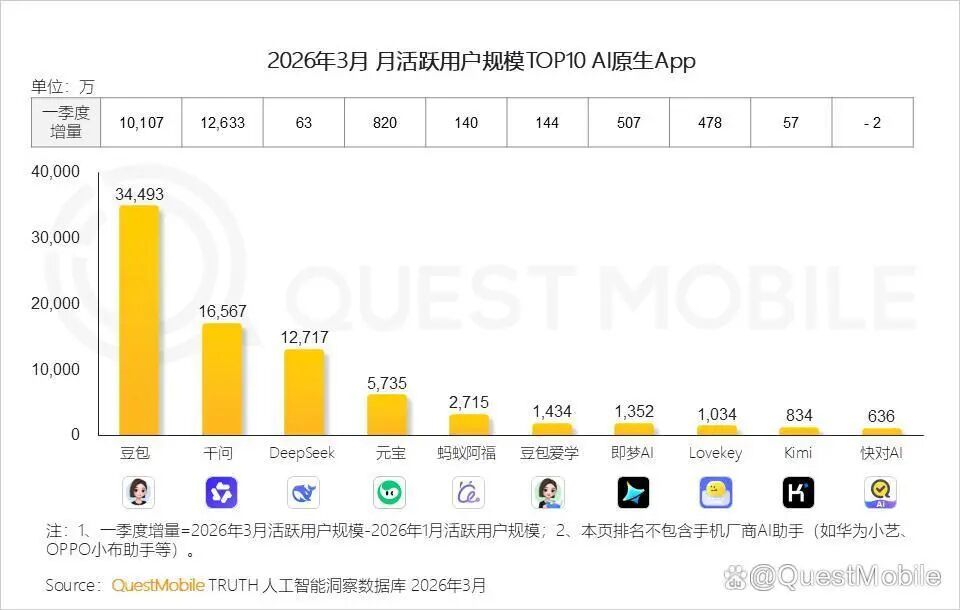
Image Source: QuestMobile
This situation is normal. The phase of internet giants burning money to acquire users seems not over yet. The Lunar New Year AI assistant red envelope war burned a significant amount of money.
The reason Doubao is willing to be the first to charge, despite the current difficulty, is self-evident: cost investment.
More users mean more resource consumption. While users enjoy free services, ByteDance has to cover the computational costs.
According to ByteDance's official disclosure, the daily token usage of Doubao's large model has exceeded 120 trillion, 1,000 times that of May 2024.
Behind every user's query lies substantial costs.
Moreover, with the rapid increase in GPU and storage chip costs this year, operational costs have surged.
According to April data from semiconductor research firm SemiAnalysis, the rental price of NVIDIA H100 GPUs rose from $1.70 per GPU per hour in October 2025 to $2.35 per GPU per hour in March 2026, a nearly 40% increase. Various AI computational services from Tencent Cloud and Alibaba Cloud have also seen price hikes.
More importantly, unlike other internet products that quickly reduce marginal costs as the user base grows, AI assistants like Doubao consume a significant number of tokens with each conversation.
According to a report by
In response, Li Liang, Vice President of Douyin Group, stated that the data includes non-cash factors such as preferred stock and option costs.
According to analysis reports from multiple securities firms, ByteDance's capital expenditures in 2025 were approximately 160 billion yuan, with a significant portion allocated to AI computational power procurement and infrastructure.
Epilogue
With such high costs, how can AI large models generate revenue?
Looking at U.S. data, B-end productivity barrier applications are more profitable than C-end ones.
In April 2026, Anthropic, which focuses on AI programming, surpassed the famous OpenAI in annualized revenue and may achieve profitability by the end of 2027.
Claude's annualized revenue has exceeded $30 billion, surpassing OpenAI's $25 billion annualized revenue disclosed in February.
Anthropic's core revenue comes from APIs. In February 2026, it had 500 enterprise clients with annualized spending exceeding $1 million, which doubled to 1,000 by April.
Of course, each company faces its own unique challenges. Doubao, having achieved the top C-end user base domestically, still has logic and potential for charging.
The subscription model for internet products has been around for years, and many users are now willing to pay as long as it is reasonable. They will pay when necessary.
If Doubao's charging model succeeds, it will likely prompt other competitors to change their strategies. Whether they follow suit or remain free will create a butterfly effect, reshaping the market landscape.
-
![]()
Tesla Restructures Its Balance Sheet
-
![]()
Accelerating the High-Speed Interconnection Upgrade of AI Computing Clusters! JONHON Releases ELSFP External Light Source Optical Connectors
-
![]()
Breaking the overseas blockade of volumetric holographic materials, this optical enterprise secures nearly 100 million yuan in financing!
-
![]()
Why Does Jensen Huang So Openly Praise China’s AI?
-
![]()
"Wudang" Unveiled: Arm China's Next-Gen AI VPU Redefines Video Encoding
-
![]()
From Energy Conservation and Carbon Reduction to AI Decision-Making: GECON East Intelligence and Chery Group Explore a New Green and Smart Paradigm for Automobile Manufacturing
-
![]()
WAIC 2026 Observation | AI Accelerates Towards the Core of Industries, Industrial AI Enters a Critical Phase
-
![]()
Volkswagen China Fires the First Shot in Foreign-Funded 'White Box Delivery'!