Understanding China Through DeepSeek's Triple Leap in Valuation
 05/11 2026
 530
530
In less than 20 days, DeepSeek's valuation has quadrupled. Behind this lies DeepSeek's Huawei-like mission in the large model domain.

Author: She Zongming
DeepSeek doesn't even need to speak—its valuation says it all.
From $10 billion in mid-April to $20 billion in late April, then $45 billion a few days ago, and now $51.5 billion just revealed today, DeepSeek's valuation has completed a triple leap in under three weeks.
In less than 20 days, its valuation has quadrupled. Such a formidable "model" life needs no explanation.
In "Kung Fu Hustle," Feng Xiaogang's line—"Who else?"—should really be said by Liang Wenfeng.
Don't ask why; the answer is: "Our DeepSeek has the capabilities."
From a historical long-focus lens, it was inevitable that DeepSeek would either not raise funds or raise them astonishingly after two key milestones.
These two milestones are: the debut of DeepSeek-R1, which brought about the landmark "DeepSeek Moment" in AI development history; and the deep adaptation of the DeepSeek V4 model with Huawei's Ascend chips, achieving a historic breakthrough in "chip-model synergy" between domestic large models and domestic computing power.
Together, these milestones summoned an equation: Investing in DeepSeek = Betting on China's national destiny.
After all, DeepSeek carries a Huawei-like mission in the large model field: to take root in domestic computing power and rebirth amidst the "intellectual blockade" on computing power, breaking free from being strangled.
Thus, the buffs that once belonged to Huawei now fall upon DeepSeek.
01 /
Not all milk is called 'Tesu,' and not all large models are called DeepSeek.
In the global AI landscape, among leading large model companies, DeepSeek's position is somewhat unique.
It's not a super platform like OpenAI, blessed by Silicon Valley's "ironclad alliance" and aiming for a trillion-dollar valuation, nor a commercial giant like Anthropic, which soared to $44 billion in annual recurring revenue (ARR) through breakthroughs like Claude Code.
Want a ChatGPT-style AI2C blockbuster product? It'd have to line up behind Doubao.
When BAT launched their "red envelope wars" to attract users earlier this year, DeepSeek remained an outsider: "The excitement is yours; I have nothing."
Want a Claude-like commercial revenue curve? It can only shrug.
DeepSeek has yet to commercialize on a large scale, and its annual revenue has not been disclosed publicly.
Yet, its valuation growth rate rivals these two of Silicon Valley's Big Three.
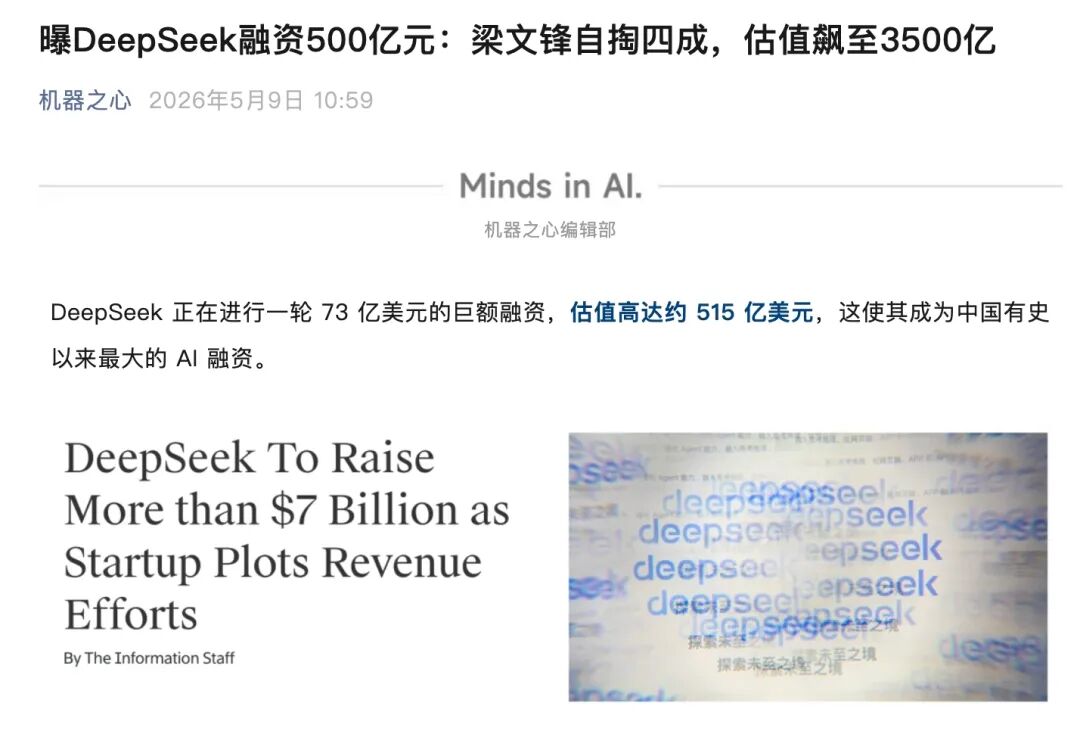
▲ Multiple media outlets report that DeepSeek's latest valuation has reached $51.5 billion.
Although still a magnitude lower, its initial funding valuation set a record among global open-source model companies. Even compared to secondary market valuations, it approaches Zhipu's market cap (around $52.5 billion).
Remember, this was achieved before DeepSeek completed any actual funding transactions.
Leaping from zero capital operation to a $50 billion valuation platform—this takeoff height... even Sam Altman would envy and consider studying "fully automated quantitative trading."
02 /
Such an extremely compressed valuation expansion naturally invites the question: "Why?"
Why has DeepSeek's valuation risen so fast?
Clarifying the valuation logic here is crucial.
Just as Cai Genhua's baby (baby) doesn't value Su Daqiang for his age or hygiene, capital markets don't invest in large model startups for their ability to lose money.
Buying OpenAI means buying the imagination of "the next internet gateway."
Its 35x ARR valuation multiple is essentially a gamble on super-gateway status.
Buying Anthropic means buying the growth trajectory of "the fastest-growing enterprise software company in history."
Surpassing OpenAI's ~$900 billion valuation is a vote of confidence in Claude Code's explosive growth in enterprise programming markets.
So, what about buying DeepSeek? Technologically speaking, it's buying the possibility of it becoming the Android of the AI era.
Why did DeepSeek R1's debut shake Silicon Valley?
Was it due to MLA (Low-Rank Key-Value Joint Compression) technology and MoE architecture optimization? Yes. Was it due to its cost-cutting structure? Yes.
But more importantly, it shattered the "impossible trinity" of high performance, low cost, and open-source.
Remember the data released by MIT and open-source community Hugging Face? By August 2025, Chinese open-source models accounted for 17.1% of global downloads, surpassing America's 15.86% for the first time. DeepSeek and Alibaba's Qwen contributed most to this reversal.
Breaking the "impossible trinity" made DeepSeek a "source god"-level existence in the global developer community.
You might argue that this community influence doesn't directly translate to revenue.
But didn't Linux not make money directly either? That didn't stop it from becoming a Bottom level rule definer (bottom-layer rule definer) and achieving benefits higher than short-term gains.
03 /
Hardcore technology fuels the valuation rocket; strategic value is the engine.
Had DeepSeek been born in the U.S., its impact would have been overshadowed by OpenAI and Anthropic. (In fact, a DeepSeek couldn't have emerged in the U.S.)
But it was born in China.
As we all know, " family of origin " (original family) matters greatly.
Born in China, DeepSeek possesses strategic scarcity that OpenAI and Anthropic lack: localization adaptation capabilities.
In DeepSeek-V4's hardware verification list, Huawei's Ascend is listed alongside NVIDIA.
This means it's building the world's first cutting-edge large model ecosystem independent of U.S. chips.
Why is Huawei highly regarded overseas?
Because in the context of Sino-U.S. tech rivalry, a "de-attachment" technical route is the ultimate valuation support.
This logic applies to DeepSeek as well.
If the initial $10 billion valuation corresponded to legal pricing for employee option pools, and the subsequent $20 billion valuation reflected multi-layered industrial value pricing, then the later $40-50 billion valuations clearly include a premium for strategic scarcity.
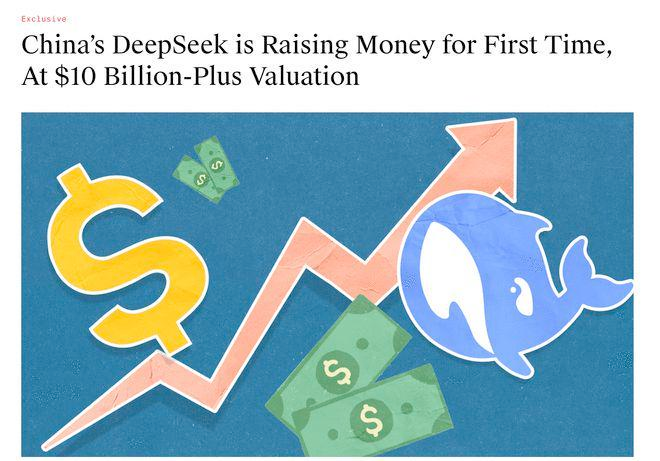
▲ On April 18, DeepSeek was reported to be planning its first external funding round with a target valuation of no less than $10 billion, aiming to raise at least $300 million.
This rewards DeepSeek for transforming from a pioneer of inclusive and open-source models to a pioneer of the domestic computing power ecosystem.
04 /
It's worth noting that a key catalyst for DeepSeek's valuation swiftly surging past $40 billion was the entry of the National Integrated Circuit Industry Investment Fund (the "Big Fund").
Previously, the Big Fund only invested in semiconductor equipment, materials, and manufacturing. This marked its first investment in "software."
The implications are profound.
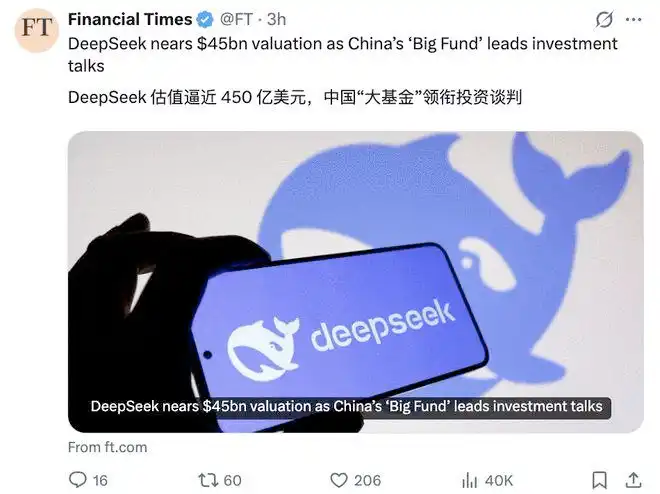
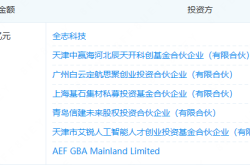
▲ On May 6, multiple media outlets reported that the Big Fund was negotiating to lead DeepSeek's first external funding round, which would value it at $45 billion post-investment.
To paraphrase Officer Zhang Yi'ang from the hit drama "Low-IQ Crime," who says, "suspicion of suspicion's suspicion," this is "recognition of recognition's recognition."
Remember, DeepSeek paid the price of slowing V4's rollout to adapt to Huawei's Ascend chips.
While Huawei's CANN heterogeneous computing architecture advances rapidly, specific scenarios like sparse operators and mixed-precision computing still require extensive engineering rework.
DeepSeek migrated V4's operators one by one, investing substantial underlying engineering resources.
Thus, while U.S. AI giants' funding narratives focus on "commercial ecosystem expansion," DeepSeek's narrative centers on "technological sovereignty construction."
Judging by localization adaptation capabilities alone, DeepSeek currently has no equal.
Speaking of which, when Manus gained fame last March, many called it another "DeepSeek Moment."
Now, the two couldn't be more different—they've walked entirely opposite paths.
The most obvious distinction? DeepSeek is powered by "Chinese chips."
Liang Wenfeng's willingness to invest $20 billion of his own money in DeepSeek versus Manus' founding team selling Manus for $2 billion carries different meanings in capital markets and in the eyes of "relevant departments."
05 /
Once DeepSeek is assigned the role of "representative," its valuation logic transcends itself—the forces behind it won't allow its valuation to remain a fraction of OpenAI's or Anthropic's.
As a landmark Chinese AI startup, DeepSeek's valuation provides a reference point for revaluing China's AI sector.
Since DeepSeek-R1's debut last January, its chain reaction has extended to an overall upward shift in China's AI valuation benchmarks.
After "global large model IPO" Zhipu went public, its market cap surged from HK$50 billion to over HK$400 billion—an 8x increase in four months.
Kimi's parent company, Moonshot AI, saw its valuation rise from $4.3 billion in early December last year to $18 billion in February-March this year, and now exceeds $20 billion—all in a few months.
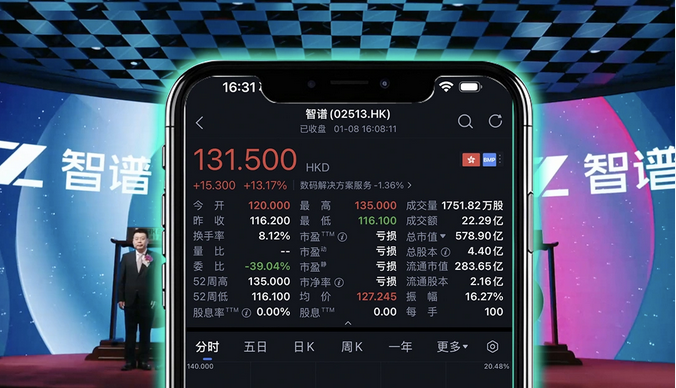
▲ Compared to its IPO debut, Zhipu's market cap has surged about 8x.
Whether Zhipu, Minimax, or Kimi, their valuation systems are trending upward.
This inevitably pushes DeepSeek's valuation higher as well.
To some extent, DeepSeek's valuation includes delayed incentives for the "DeepSeek Moment."
Before the "DeepSeek Moment," global capital markets only looked at U.S. AI—large models were divided into "American" and "Others."
After the "DeepSeek Moment," the world saw China's relative AI strengths in a "low-cost, high-efficiency (China) vs. high-computing-power, full-stack (U.S.)" differentiated competition landscape.
With Sino-U.S. AI in direct competition and Li Feifei's team noting that "the performance gap between top Chinese and U.S. AI large models has narrowed from 17.5% in 2023 to 0.3%, nearly erased," sending a rocket boost to Chinese AI, the systematic undervaluation of Chinese AI assets is bound to correct.
This rebound momentum will also reflect in DeepSeek's stock price.
06 /
What sustains OpenAI's $852 billion and Anthropic's ~$900 billion valuations is the endgame vision that "AI will reshape everything."
What supports DeepSeek's $51.5 billion valuation is the strategic imperative that "China needs fully sovereign AI."
In the end, it comes down to a few words: timing, trend, destiny, fortune.
Admittedly, DeepSeek's complex valuation logic will inevitably subject it to scrutiny on two fronts.
Side A writes opportunity.
If AI is the electricity of the next era, DeepSeek is the first to prove that "generators can operate independently across different grids."
Given its technical capabilities and strategic value, a $50 billion valuation is merely an opening whistle.
Side B writes challenge.
Previously, DeepSeek only pursued AGI dreams without other concerns.
But after funding, idealism must partially bow to the realism of "needing to make money."
Can DeepSeek sustain its valuation with commercial revenue beyond its open-source reputation and strategic value?
This is a must-answer question for it.
But regardless, after DeepSeek-R1 became a "national destiny-level product" last January, DeepSeek is no longer the same DeepSeek.
Since then, its fate has become a subtle window into understanding China.
Operations | Li Wan
-
![]()
Tesla Restructures Its Balance Sheet
-
![]()
Accelerating the High-Speed Interconnection Upgrade of AI Computing Clusters! JONHON Releases ELSFP External Light Source Optical Connectors
-
![]()
Breaking the overseas blockade of volumetric holographic materials, this optical enterprise secures nearly 100 million yuan in financing!
-
![]()
Why Does Jensen Huang So Openly Praise China’s AI?
-
![]()
"Wudang" Unveiled: Arm China's Next-Gen AI VPU Redefines Video Encoding
-
![]()
From Energy Conservation and Carbon Reduction to AI Decision-Making: GECON East Intelligence and Chery Group Explore a New Green and Smart Paradigm for Automobile Manufacturing
-
![]()
WAIC 2026 Observation | AI Accelerates Towards the Core of Industries, Industrial AI Enters a Critical Phase
-
![]()
Volkswagen China Fires the First Shot in Foreign-Funded 'White Box Delivery'!