Samsung Home Appliances Exit China: A Strategic Withdrawal Rather Than a Forced Retreat
 05/11 2026
 343
343
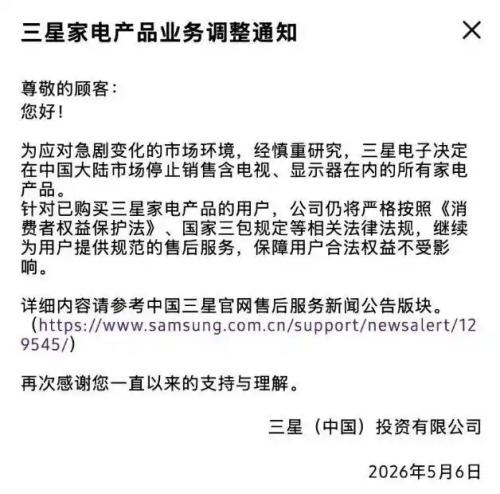
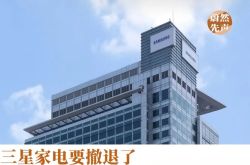
Recently, Samsung declared its intention to cease the sale of a comprehensive array of home appliances, including TVs, monitors, refrigerators, and washing machines, in the Chinese mainland, while maintaining only after-sales services. Its Chinese factories will persist in production, primarily catering to the global market. This news immediately stirred up a wave of nostalgia, with numerous netizens mourning the brand's transformation into a relic of a bygone era. Yet, upon deeper contemplation, this move appears somewhat inevitable.
Samsung Home Appliances' departure from the Chinese market is not merely a defeat but an inevitable consequence of fierce market competition and the company's proactive strategic adjustment. This event not only marks the end of a foreign home appliance giant's reign in China but also mirrors the broader trend of China's domestic home appliance industry's ascent.
You might wonder why Samsung Home Appliances, once a dominant force in the Chinese market, has reached this juncture. I have identified three primary reasons:
1. Market Dynamics: Domestic Brands Ascend, Samsung's Market Share Declines
Samsung Home Appliances' loss of the Chinese market was not an overnight occurrence. As early as around 2010, Samsung TVs commanded a market share of up to 20% in China. However, with the comprehensive rise of domestic brands like Hisense, TCL, Haier, and Midea, Samsung's market share witnessed a sharp decline.
By 2026, Samsung's online market share for TVs in China had dwindled to a mere 1.33%, with offline market share hovering around 3.5%. Its market share for refrigerators and washing machines had plummeted to a paltry 0.4%, falling out of the top ten and essentially fading from mainstream consumers' memories. In essence, Samsung Home Appliances has been marginalized in the Chinese market, with its influence significantly waning.
A key factor contributing to Samsung Home Appliances' continuous decline is its lack of product competitiveness. Under similar configurations, domestic brands generally offer prices 30%-50% lower than Samsung's. Domestic home appliances have not only matched but even surpassed Samsung in core technologies (such as Mini LED and whole-house smart systems) but also boast a more complete industrial chain and highly efficient supply chain responsiveness, naturally making them more attractive to consumers.
2. Internal Challenges: Lack of Localization, Operations Plunge into Red
As a multinational corporation, Samsung Home Appliances suffered from severe "climate sickness" (maladjustment to local conditions) in the Chinese market. On one hand, product definition and decision-making authority were highly centralized at the Korean headquarters, leaving the Chinese team with limited real power and resulting in extremely sluggish responses to Chinese market demands. For instance, technologies introduced by domestic brands in 2021 were not massively promoted by Samsung until 2022, and even then, at prices 3-5 times higher.
On the other hand, Samsung's home appliance product designs adhered to European and American large-household standards, which were incompatible with China's predominantly small-apartment kitchens and balconies. Its smart systems also failed to deeply integrate with domestic mainstream smart ecosystems (such as Xiaomi and Huawei). Additionally, while domestic brands could complete project approval to market launch in just 4-5 months, Samsung's global approval process was lengthy, and by the time it landed in China, domestic brands had already undergone two iterations.
Rigid decision-making, disconnected designs, and slow iteration cycles gradually left Samsung Home Appliances in a passive state in the Chinese market, facing continuous losses. In 2025, Samsung's departments responsible for TVs and home appliances collectively incurred losses of approximately 200 billion Korean won (about RMB 930 million), marking the first full-year operating loss in its 34 years in China and signaling a clear negative trend, foreshadowing its subsequent withdrawal.
3. Strategic Shift: A Strategic Withdrawal to Focus on Semiconductors and AI Computing Power
Rather than being forced out, Samsung's withdrawal from the home appliance market can be viewed as a prudent strategic move to cut losses and concentrate on more profitable areas. In the first quarter of this year, Samsung's semiconductor business reported an operating profit of 53.7 trillion Korean won (about RMB 249.7 billion), accounting for 93.4% of the company's total profit. In contrast, the home appliance business yielded meager profits or even losses, becoming a "drag on performance." Given the stark profit contrast, Samsung naturally made a strategic choice.
In the era of AI computing power, semiconductors are the absolute core sector. Samsung decisively cut its unprofitable home appliance retail business to concentrate its resources, technology, and manpower on high-margin areas such as semiconductors and premium smartphones, effectively reallocating its resources. This decision was recognized by the capital market; on the day Samsung announced its withdrawal from the Chinese market, its stock price surged, and its market value exceeded $1 trillion.
It should be noted that Samsung has not completely withdrawn from China; it is exiting sales, not manufacturing. Its production lines for refrigerators, washing machines, etc., in Suzhou will continue to operate but will transition into export production hubs for overseas markets such as North America and Southeast Asia. Meanwhile, Samsung's core businesses, including smartphones and semiconductors (such as its Xi'an memory chip factory), will continue normal operations in China.
In fact, Samsung Home Appliances' withdrawal is not an isolated case. Previously, Japanese brands such as Toshiba, Sharp, and Sony had also successively contracted or exited their self-operated home appliance businesses in China. With Samsung's exit, the golden era of Japanese and Korean brands dominating China's high-end home appliance market has officially come to an end. China's home appliance market has transformed from foreign-dominated to a hardcore arena where domestic brands reign supreme.
In my view, this marks the third major shift in global home appliance industry dominance—from Europe and America to Japan, then to Korea, and now accelerating towards China. Chinese home appliance companies have transitioned from past followers to current leaders, demonstrating strong competitiveness in the global market. The future looks promising!
However, it should be noted that this is not a complete rout of foreign home appliance brands but a fundamental change in competitive logic: from foreign brands equating to premium to technology, experience, ecosystem, and service becoming the core. Meanwhile, Chinese home appliances have evolved from importing technology to going global, entering a new phase of global competitiveness. In other words, this is not the endpoint but a watershed. Looking ahead, competition in the home appliance industry, both globally and in China, is destined to become even more fierce.
For consumers, Samsung Home Appliances' departure from the Chinese market means that after-sales services will remain guaranteed in the short term, as the company has promised to continue providing standardized after-sales support. However, when choosing home appliances in the future, domestic brands will undoubtedly become the absolute mainstream and a superior choice. After all, domestic brands offer more options, better cost-effectiveness, and superior service—there's no reason for consumers not to vote with their feet. What do you think?
-
![]()
Samsung’s Home Appliance Business: A Seemingly Inevitable Decline
-
![]()
Zhipu’s GLM-5V-Turbo ‘Crosses the Rubicon’: The Dawn of a Domestic Multimodal Agent War
-
![]()
Doubao Introduces Charges: Fewer and Fewer Purely Free Large Models
-
![]()
Q1 Financial Reports Released: Cumulative Profits of Ten Automakers Lag Behind CATL
-
![]()
Can Doubao's Paid Subscription Model Succeed?
-
![]()
Understanding China Through DeepSeek's Triple Leap in Valuation
-
![]()
Samsung Home Appliances Exit China: A Strategic Withdrawal Rather Than a Forced Retreat
-
![]()
The Inseparable Dilemma of Gasoline and Electric Vehicles: A Challenge for New Car Sales