"AI Broker" Liblib: What Supports Its $2 Billion Valuation?
 06/29 2026
 443
443

Where is Liblib's Moat?
Recently, the AI video sector has seen another major financing round. Evoken Technology, the parent company of Liblib, completed a B+ round financing of nearly $300 million, co-led by Granite Asia, Tencent, and Shunwei Capital, with a post-money valuation exceeding $2 billion, making it a new unicorn in AI applications.
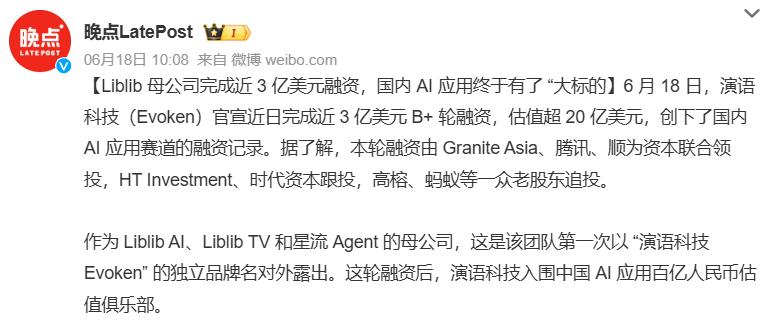
Image source: Weibo screenshot
This marks another company in the AI video generation field to reach a $300 million financing record, following AISPEECH Technology. However, unlike AISPEECH Technology, Evoken Technology is a product company that has rapidly grown by aggregating mainstream models on the market for designers and creators, without developing its own models.
As large models iterate faster, a single model update may render most of a product's functions obsolete. Whether AI application layers have true moats has been a hot topic in the industry. Against this backdrop, why has Evoken Technology managed to gain capital favor against the trend? Do its products truly have the competitiveness to withstand model iterations?
To discuss a company's "ability to attract capital," we must consider its founder. Chen Mian, the founder of Evoken Technology, has worked at several major companies, including Tencent, 360, Baidu, Didi, and ByteDance. Before starting his own venture, Chen Mian served as the global commercialization leader for CapCut and Jianying at ByteDance. Born in 1992, he became the youngest 4-1 at ByteDance at the time.
His "ByteDance background" may have made it easier for Chen Mian to gain capital favor. "Tianyancha" shows that the company secured angel round financing from Source Code Capital, GaoRong Capital, and GSR Ventures just two months after its establishment. As of June this year, Evoken Technology has secured six rounds of financing, with Tencent, Ant Group, Sequoia Capital, and Shunwei Capital appearing in the recently completed B+ round.
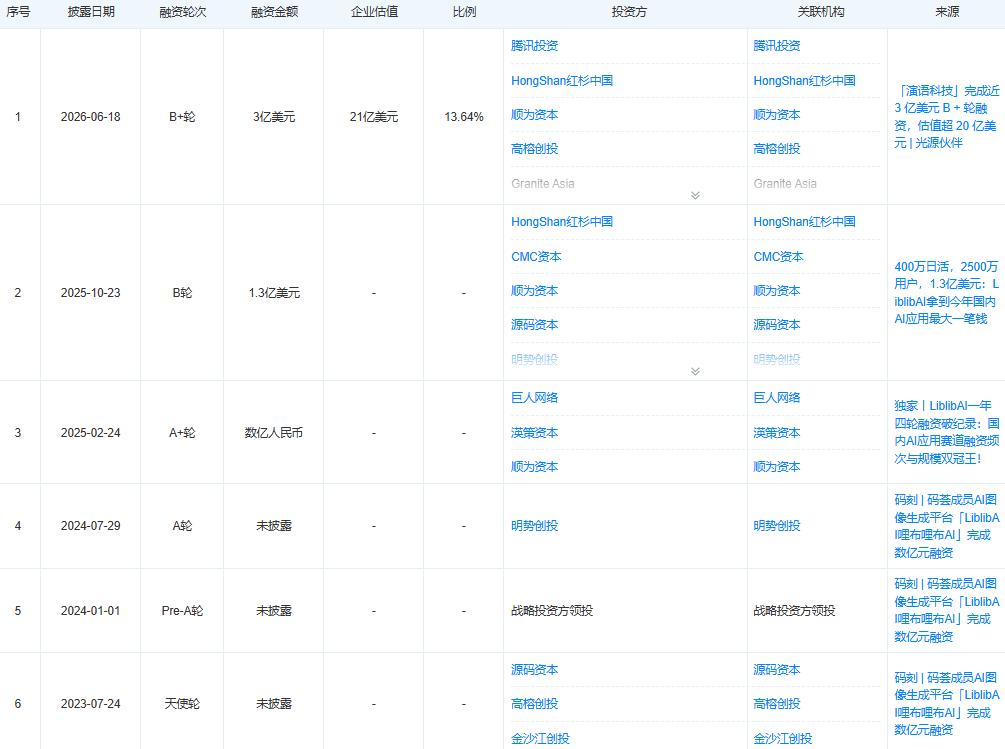
Image source: Tianyancha screenshot
In addition to Chen Mian's background, Evoken Technology's user base and revenue growth have also supported its rapid capital inflows. Its core products include the AI creation community Liblib AI, launched in 2023; the AI design agent Xingliu and Lovart (overseas version), launched in 2025; and the AI video creation platform LibTV, launched in March this year. Among them, Liblib AI has over 30 million cumulative users, making it one of China's largest AI material websites and creator communities.
According to disclosed ARR figures, the company's total ARR (annualized revenue) has exceeded $300 million, with Lovart's ARR surpassing $80 million five months after launch. While no specific revenue figures are available for LibTV, Evoken Technology stated that LibTV's monthly revenue increased more than 13-fold two months after launch.
Lovart's strong popularity overseas stems from addressing designers' pain points of "fragmented tools." Traditional AI design tools generate images based on prompts, requiring users to manually switch to Photoshop for retouching and Figma for layout. In contrast, Lovart can generate complete design solutions.
The same applies to Liblib, which aggregates multiple models to provide video creators with a more convenient workflow. This convenience is the foundation for the survival of tool-based agents.
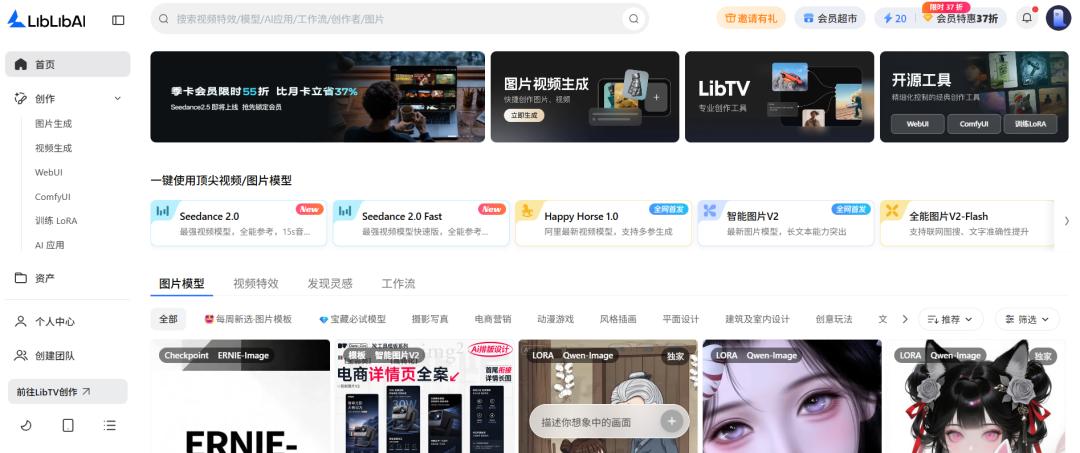
Image source: LibLibAI official website screenshot
"Qujie Business" noted that Evoken Technology's product iterations are rapid. During LibTV's initial launch, some netizens new to AI editing remarked that their learning pace couldn't keep up with the software's update speed.
Fortunately for LibTV, its launch coincided with the shift from live-action to animated short dramas. After the Spring Festival this year, Hongguo Short Drama doubled down on AI-generated short dramas, prompting many producers to seek efficient video generation tools. To date, LibTV has attracted a significant number of short drama users, who are currently the core consumer group in the video generation field. Additionally, teams requiring high-frequency visual content and marketing material production, such as 4A companies and brand creative departments, are also major consumers of LibTV.
However, compared to convenient workflows, LibTV's greatest competitive advantage lies in its pricing.
Due to scarce computing power and surging user demand, Jimeng adjusted its prices three times in April, with video generation costs nearly sextupling. As a result, LibTV, which also supports "Seedance2.0," has become a cost-effective alternative for many AI video practitioners.
According to LibTV's official website, its creative memberships come in standard, premium, and ultimate versions with varying video generation limits, priced at 569-8,499 RMB/year. Some editors mentioned that after Jimeng's April price hike, their teams switched to LibTV for video production. Despite the lack of editing tutorials and difficulty in finding solutions to problems, the affordability and lack of queues were paramount.
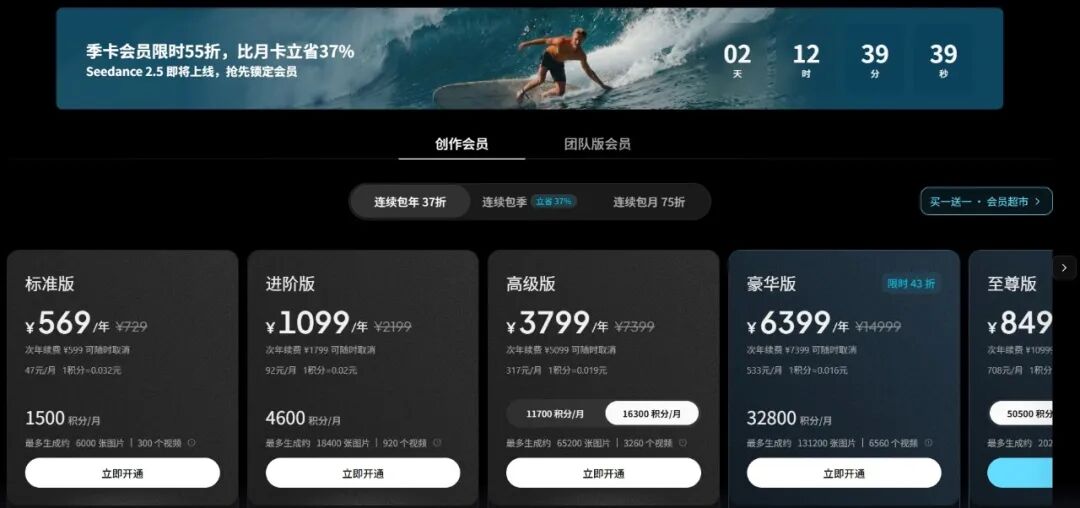
Image source: LibTV screenshot
Some animated short drama practitioners noted that LibTV's cheapest rate was 20 RMB per minute, whereas achieving a lower price on Jimeng would require stringent conditions like off-peak computing power and limited points (points).
As a "model aggregator," how can Liblib offer lower prices than the original platforms?
This relates to the business essence of aggregation platforms. Liblib provides creators access through model providers' API interfaces, with all computing power consumption on Liblib originating from the model providers' centers. In other words, user spending on Liblib primarily depends on computing power procurement prices, with Liblib earning a margin as the "middleman."
If Liblib commits to consuming a certain volume of tokens annually with Volcano Engine, it may secure lower discounted prices. However, these discounts would not be sufficient for LibTV to sell at significantly lower prices than Jimeng while remaining profitable.
To maintain "cost-effectiveness" among consumers, Liblib has two options: subsidize users out of pocket or source computing power quotas through cheaper channels like intermediary APIs.
This may explain Evoken Technology's frequent financing rounds. Without model development capabilities, it relies heavily on subsidies to retain users, reminiscent of the subsidy wars in the early mobile internet era, where platforms traded scale for user habits through subsidies.
However, if creators switch to Liblib due to Jimeng's price hikes, they may also abandon Liblib for cheaper platforms or if Jimeng lowers its prices.
Additionally, platforms often overlook content compliance when vying for market share. In April, CCTV Finance reported that LiblibAI had "AI-generated pornography" issues, where users could bypass reviews using vague prompts to generate violation (non-compliant) content. Liblib subsequently apologized and claimed to have fixed the issue technically.
For AI tools, strengthening precautions against security risks and compliance issues is essential.
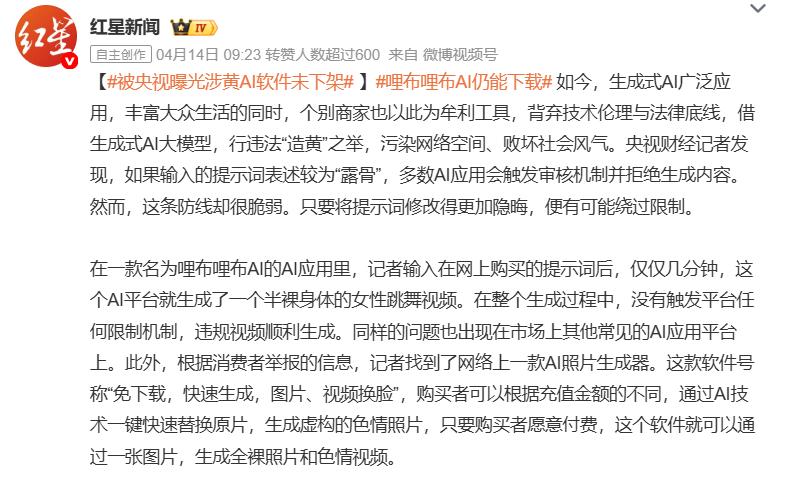
Image source: Weibo screenshot
A hard tech investor bluntly stated that AI aggregation platforms have shallow moats. Once major companies open their APIs, lower prices, or launch better native applications, these platforms can be easily replaced. More critically, given the current "intensity" and speed of model iterations, their differentiated advantages are fragile. Features refined over six months may be rendered obsolete by a single model update.
This is not just a Liblib issue; most AI application-layer tools face similar structural dilemmas, with product value highly dependent on upstream models' capabilities.
The question of "whether AI will kill software" has also been repeatedly debated this year.
In January, Anthropic launched Claude's tool Cowork and its industry-specific plugins, covering legal, financial, and sales fields, replacing some vertical SaaS software and triggering multiple rounds of declines in Nasdaq software stocks. Anthropic's CEO, Dario Amodei, has expressed a similar view: once large models mature, software capabilities (e.g., video generation, graphic design) will be built into general-purpose foundational models, eliminating the need for separate development and sale of third-party tools.
However, NVIDIA's CEO, Jensen Huang, publicly disagrees with the notion that "AI will hollow out software," arguing that agents will be built on enterprise systems and structured data. Software service providers will not be replaced but will need to transform.
The relationship between software and AI has yet to reach a consensus in the industry. Thus, some evaluate platforms like Liblib as "transitional products from an era of model convergence." LibTV's achievement of over 13-fold monthly revenue growth within its window of opportunity makes it a rare winner, where "speed" itself is a scarce capability.
However, Liblib's sustained growth largely depends on continued financing and whether it can evolve from a "model aggregator" into an indispensable creative infrastructure for users before the window closes.
-
![]()
Depreciation Rate on Par with Mobile Phones: Just 40% Value Retention After Three Years—Why Do Battery Electric Vehicles Lose Their Worth?
-
![]()
Clearing Bugatti Stock Worth 7 Billion: Why is Porsche 'Cutting Ties'?
-
![]()
Don’t Dismiss Huawei’s Potential in Sedans Just Because the Shangjie Hasn’t Hit It Big Yet
-
![]()
Unsold Cars in China Find Success Overseas
-
![]()
Ghosn: Only I Can Save Nissan, Shareholders Beg Me to Return
-
![]()
Expanding Automobile Consumption: It's Time to Address the High Cost of Electric Vehicle Repairs
-
![]()
Luna Ultra Entangled in 'National Subsidy Fraud' Controversy, Insta360 Pushed to the Brink by DJI
-
![]()
People have long suffered from splash ads. Will the 'temporarily disappeared' traffic behemoth make a comeback?