Luna Ultra Entangled in 'National Subsidy Fraud' Controversy, Insta360 Pushed to the Brink by DJI
 06/29 2026
 676
676
Author|Haotian
Insta360's highly anticipated new offering, the Luna Ultra, has found itself at the center of a controversy over alleged 'national subsidy fraud.'
On June 10, 2026, Insta360 unveiled its first Leica dual-camera gimbal camera, the Luna Ultra, explicitly stating that the standard package would start at 3,999 yuan.
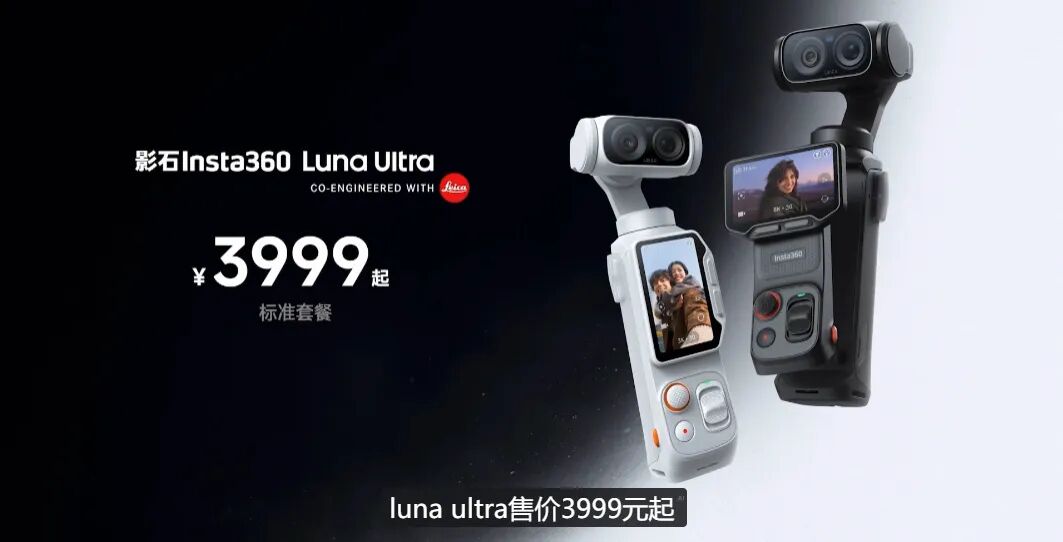
Image Source: Insta360
However, many consumers found that when placing orders on e-commerce platforms, the original price of the Luna Ultra was actually 4,729 yuan. It was only after applying a 15% 'national subsidy' and additional store discounts that the final price dropped to 3,999 yuan. Similarly, in offline stores without national subsidies, the Luna Ultra was also priced at 3,999 yuan after discounts.
In response, Insta360 staff informed the
Insta360 customer service clarified that 3,999 yuan is the post-promotion price for the standard version of the Luna Ultra. 'In channels without national subsidies, to ensure users enjoy the same 3,999 yuan discount, the company absorbs the subsidy amount originally covered by national support,' the representative explained.
Clearly, based on Insta360's statement, the online discounts for the Luna Ultra primarily rely on national subsidies. This has led many netizens to question whether Insta360 is illegally obtaining state subsidies and occupying consumers' subsidy quotas.
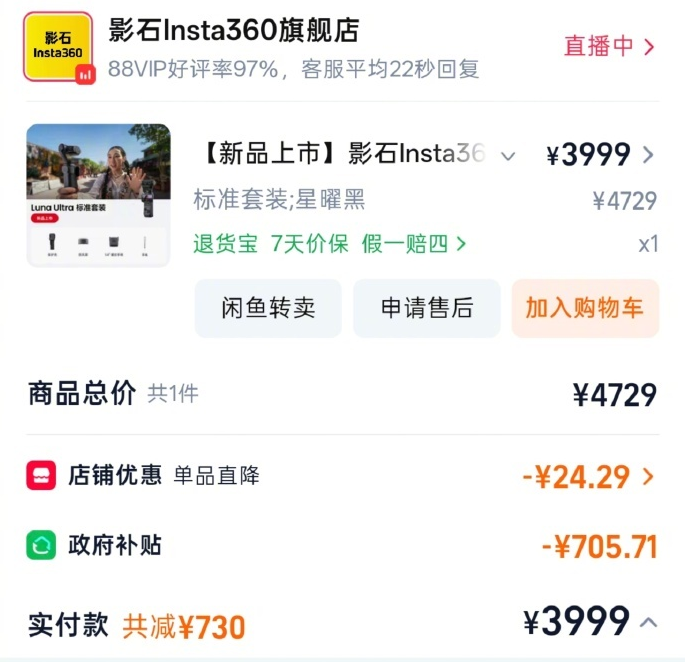
Image Source: Taobao
Faced with escalating public controversy, on June 22, Insta360 removed the national subsidy application portal for the Luna Ultra from online channels and instead offered coupons to maintain the starting price of 3,999 yuan.
Whether the Luna Ultra actually 'defrauded national subsidies' remains undetermined, but its aggressive discounting at launch strongly suggests Insta360's acute anxiety.
Due to an unstable foundation in the panoramic camera market, Insta360 is pursuing diversified expansion. Faced with formidable competitors, it has been forced into a price war.
However, lacking technological and supply chain advantages, Insta360 has failed to establish a strong competitive edge. This has not only sparked public controversy over 'subsidy fraud' but also trapped the company in a profit squeeze.
01 Insta360 and DJI Clash Head-On in the Gimbal Camera Arena
As the pioneer of 'pocket gimbal cameras,' DJI has long dominated the market with its strong first-mover advantage. IDC data shows that in 2025, global shipments of handheld smart cameras reached 16.65 million units, with DJI accounting for 10.4 million units (62.4%).
Despite its lead, DJI has not aggressively iterated products based on consumer demand. Instead, it has adopted a slow, 'drip-feed' update strategy. For example, its Pocket series maintained a two-to-three-year refresh cycle and delayed adding optical zoom lenses despite consumer expectations.
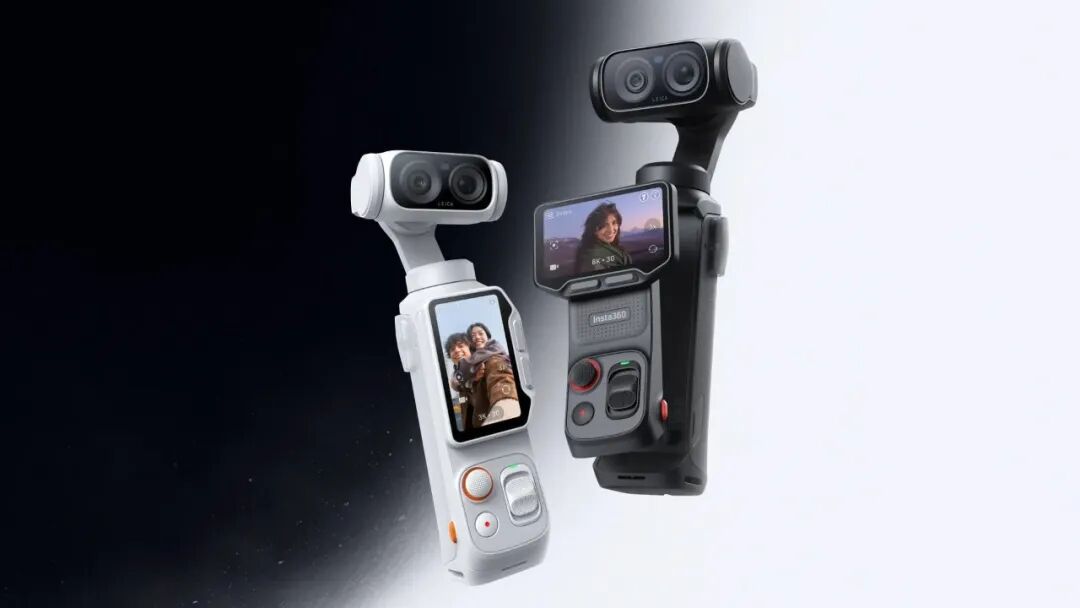
Image Source: Insta360
Observing a significant market vacuum behind DJI, Insta360 entered the gimbal camera market in June 2026 with the Leica dual-camera Luna Ultra. Equipped with a 1-inch main sensor and a 1/1.3-inch Leica telephoto lens, it supports 6x lossless zoom for greater compositional freedom.
While the Luna Ultra's overall design resembles DJI's Pocket series, it introduces innovations such as a detachable 2-inch OLED remote control screen for live monitoring and camera control, enhancing shooting convenience.
Facing Insta360's aggressive entry, DJI did not remain passive and initiated a 'patent war.'
On June 10 and 11 (local time), DJI filed two patent infringement lawsuits against Insta360 and its affiliates in the U.S. District Court for the Eastern District of Texas, alleging that the Luna Ultra infringed six core patents covering gimbal control systems, handheld gimbal integration, and target tracking technology.
Insta360 responded by countersuing DJI in the U.S., accusing the latter of infringing six of its patents, including gimbal stabilization algorithms, gimbal pointing control, and camera smooth anti-shake technology.
Given the lengthy patent litigation process, which cannot quickly curb the Luna Ultra's growth, DJI did not rely solely on legal action. It simultaneously launched a new product to directly compete with Insta360.
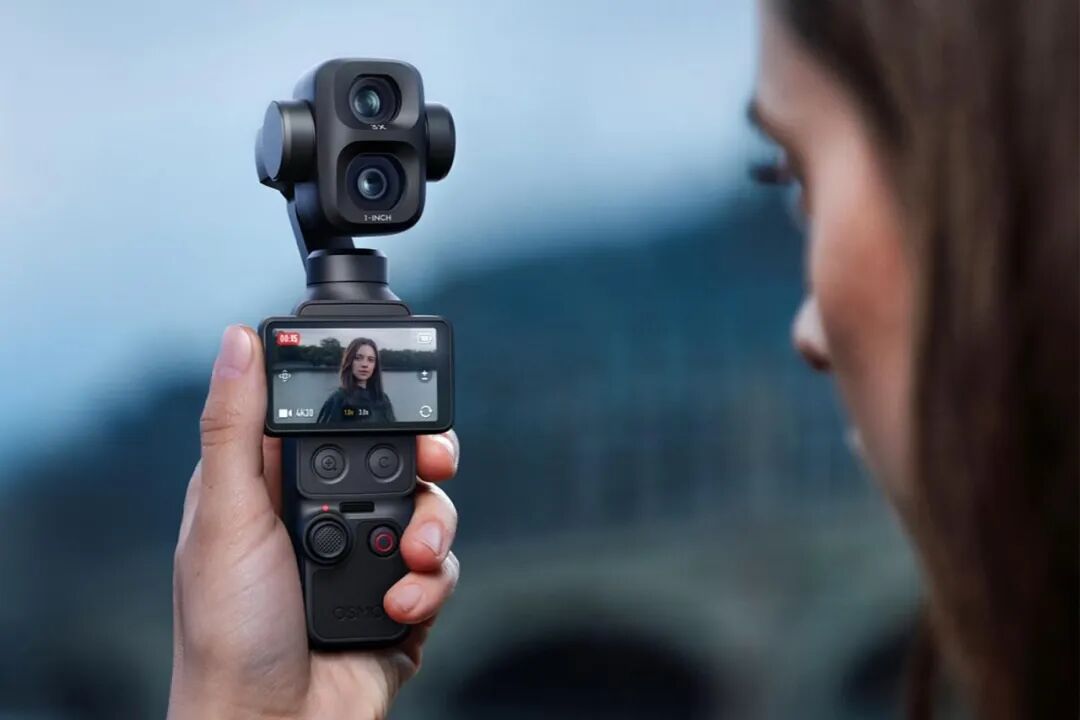
Image Source: DJI
On June 15, DJI released the Pocket 4P, also featuring a 1-inch main sensor and a 1/1.28-inch telephoto lens. With 103GB of built-in storage (56GB more than the Luna Ultra), a new pearl white color option, and a starting price of just 3,799 yuan—nearly 1,000 yuan lower than the Luna Ultra's original price and 200 yuan cheaper than its discounted price—the Pocket 4P undercut Insta360's offering.
The Luna Ultra's price disadvantage reflects Insta360's failure to establish a supply chain advantage comparable to DJI's.
For the market, the Luna Ultra's greater significance may lie not in the product itself but in reinvigorating competition in the gimbal camera sector. As DJI increases investment, consumers can expect higher-performing products at lower prices.
02 DJI Strikes at Core Markets, Insta360's Foundation Wavers
The clash between Insta360 and DJI in the gimbal camera market is no coincidence. Over the past few years, both companies have repeatedly crossed original business boundaries to invade each other's core markets. As their competitive landscapes increasingly overlap, a direct confrontation became inevitable.
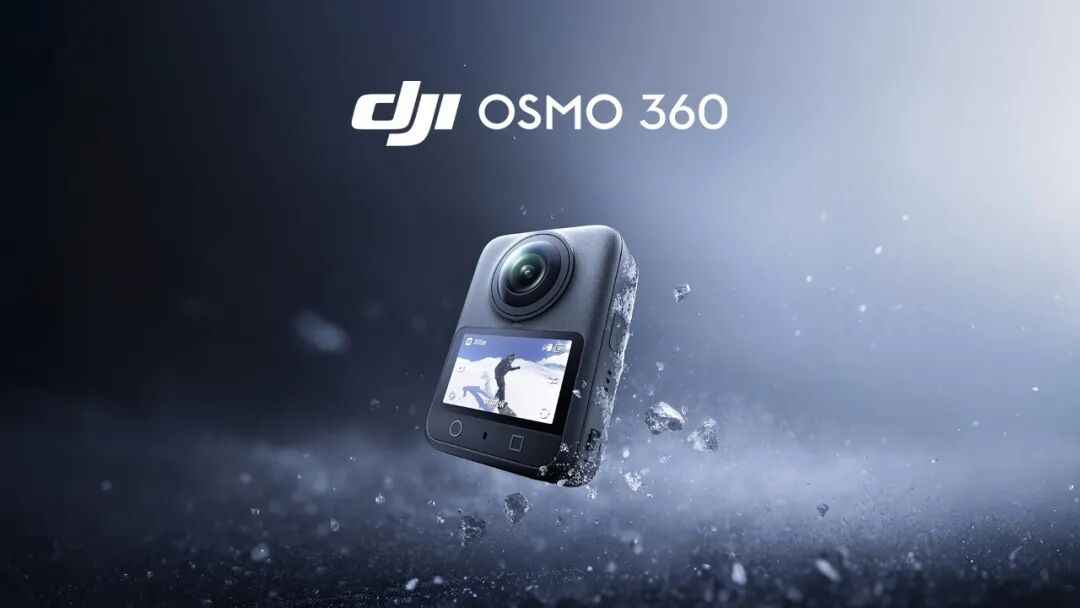
Image Source: DJI
In July 2025, DJI launched its first panoramic camera, the Osmo 360, priced at 2,999 yuan—about 800 yuan cheaper than Insta360's comparable X5 model.
Coinciding with the Osmo 360's release, Insta360 announced a joint venture with a third party to develop a consumer drone brand, Antigravity. In December 2025, Insta360 released its first panoramic drone, the Antigravity A1, starting at 7,999 yuan.
While both companies invaded each other's markets, their outcomes differed sharply: DJI overtook Insta360 in the panoramic action camera segment, while Insta360's drones failed to pose significant competition to DJI.
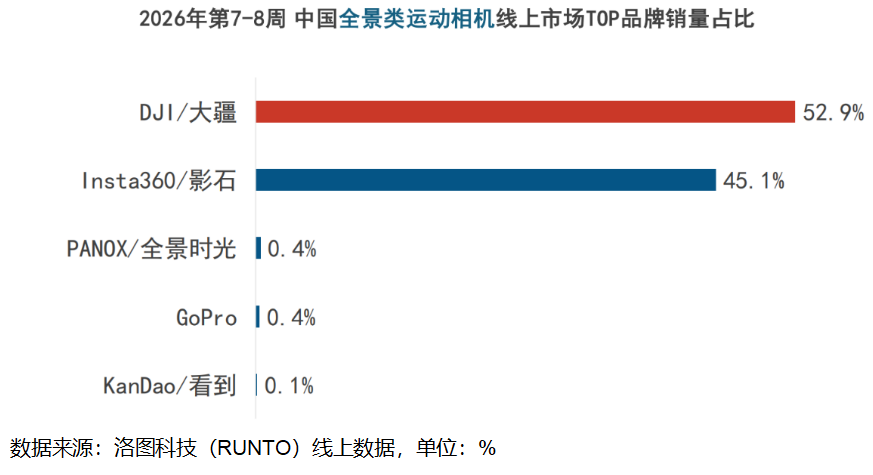
Image Source: LoTech
IDC data shows that in 2025, Insta360 held 66% of both global shipment volume and sales revenue in the panoramic camera market. However, LoTech data reveals that in China's online panoramic action camera market during Week 7-8 of 2026 (February 9–22), DJI captured 52.9% of sales volume, 7.8 percentage points higher than Insta360.
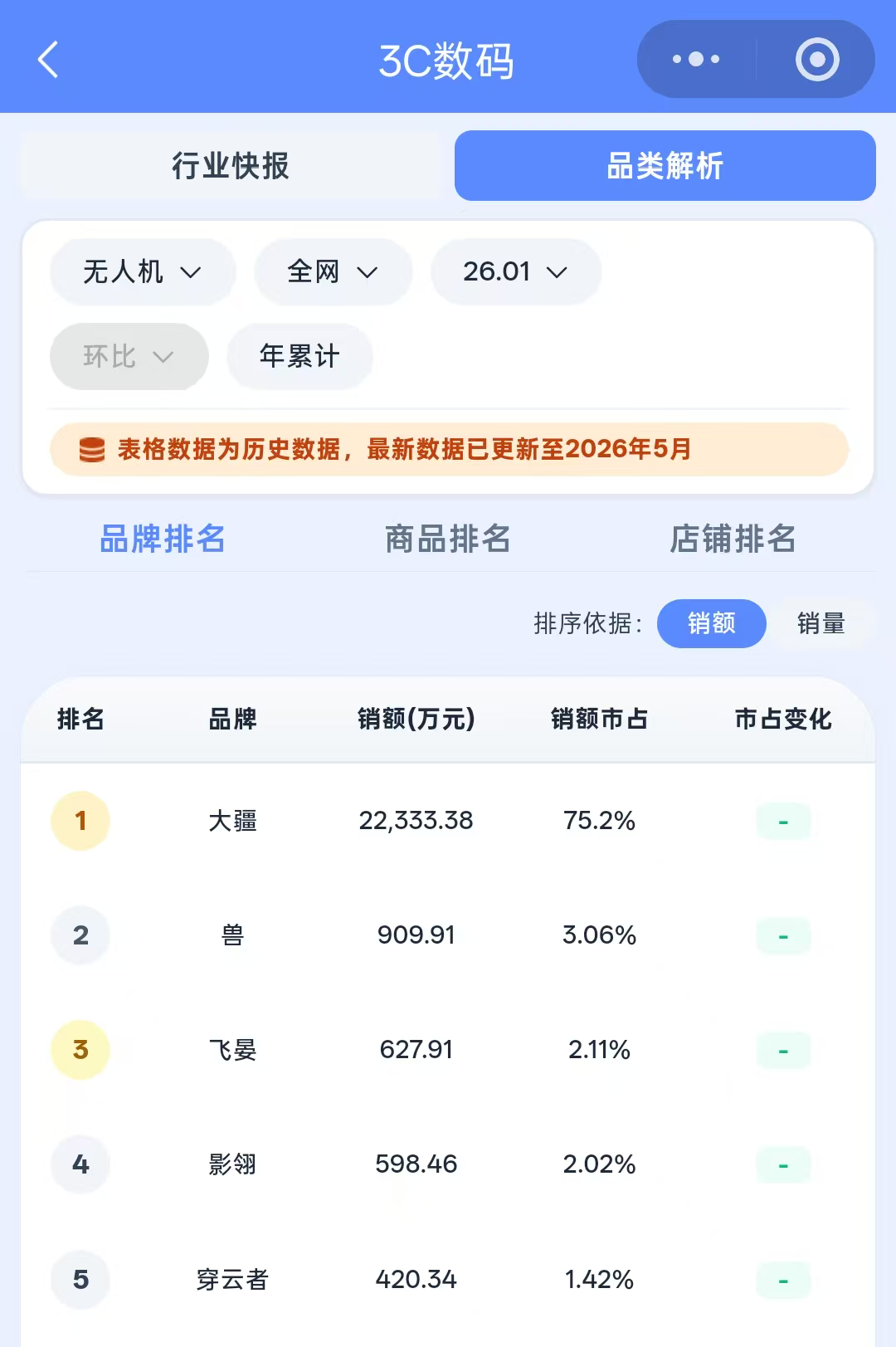
Image Source: Aowei Cloud
In contrast, Aowei Cloud data shows that in January 2026, DJI dominated China's online drone market with approximately 223 million yuan in retail revenue (75.2% market share). Meanwhile, Insta360's Antigravity brand generated just 5.9846 million yuan in sales (2.02% market share), a negligible threat to DJI.
Thus, Insta360's entry into the gimbal camera market appears less like proactive expansion and more like a reactive move after failing to establish itself in the drone sector.
Recognizing weaknesses in DJI's Pocket series regarding imaging capabilities and use cases, Insta360 targeted unmet market demands to attempt a strategic overtake. However, DJI swiftly countered with the cost-effective Pocket 4P, making it difficult for Insta360 to gain traction in the gimbal camera market.
03 Diversification Strains Insta360's Profits
Insta360's aggressive diversification strategy, aimed at countering DJI, initially appeared to seize the initiative. However, rapid business expansion has dramatically increased costs, imposing significant operational burdens.
Due to high technical barriers in drones and gimbal cameras, Insta360 has had to invest heavily in R&D to enhance product competitiveness. Financial reports show that in 2025 and Q1 2026, R&D expenses reached 1.529 billion yuan and 465 million yuan, up 96.95% and 100.59% year-over-year, accounting for 15.7% and 18.73% of revenue, respectively.
Insta360 explained, 'Our R&D investments focus on new categories like drones, gimbal cameras, microphones, and custom chip development. We believe high-intensity strategic investment is essential for long-term growth and core capability enhancement.'
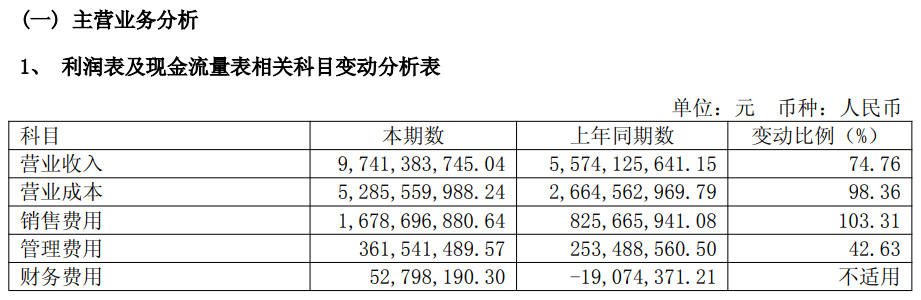
Image Source: Insta360 2025 Financial Report
Simultaneously, Insta360 increased marketing spending to promote new products. In 2025 and Q1 2026, sales expenses reached 1.679 billion yuan and 449 million yuan, up 103.31% and 75.54% year-over-year, accounting for 17.23% and 18.1% of revenue, respectively.
While these investments drove double-digit revenue growth, soaring costs significantly compressed profit margins. Financial reports show net profits of 929 million yuan in 2025 and 85 million yuan in Q1 2026, down 6.62% and 52.02% year-over-year, respectively.
Faced with shrinking profits, Insta360 founder, chairman, and CEO Liu Jingkang attributed the situation to 'strategic pressure': 'Short-term profits face multiple pressures but also buffers, aiming to secure long-term growth and healthy development.'
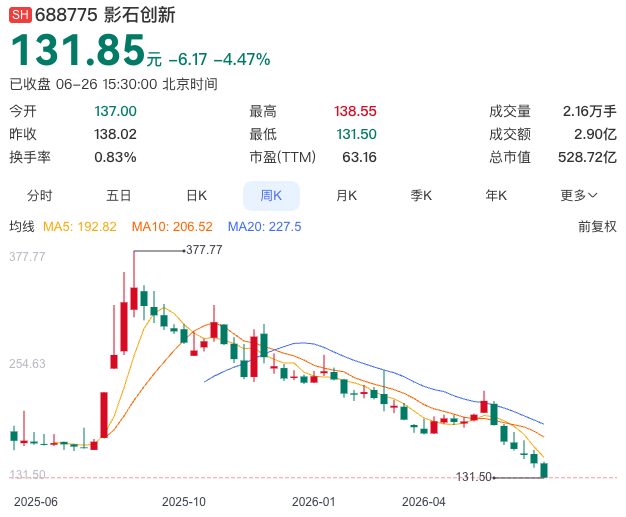
Image Source: Baidu
The capital market, however, has shown impatience. As of June 26, 2026, Insta360's stock price closed at 131.85 yuan per share, down 65.1% from its September 2025 peak of 377.77 yuan.
Ultimately, the 'national subsidy controversy' surrounding the Luna Ultra is merely symptomatic of Insta360's deeper diversification challenges. While it is understandable that Insta360 seeks a second growth engine as its panoramic camera market share erodes, the competitive dynamics in drones and gimbal cameras are far more complex and brutal than in panoramic cameras.
In recent years, Insta360 built unique advantages in the panoramic camera sector through user-friendly innovations, becoming a market leader. However, when forced out of its comfort zone to compete with DJI across multiple fiercer battlegrounds, fragmented innovations alone cannot rapidly reshape market dynamics. Only companies with superior technological accumulation, supply chain efficiency, and brand momentum can thrive long-term.
Thus, the Luna Ultra's market performance matters less than whether Insta360 can transform its rising R&D investments into differentiated core competitiveness and chart new growth trajectories amid diversification. Without building a deep competitive moat, Insta360's diversified layout risks becoming a profit-draining black hole.
Interactive Topic
Have you used Insta360's products? How do they compare to DJI's?
This article is original content from Farsight and cannot be reproduced without authorization.
-
![]()
Doubao Work Unveiled! Domestic AI Leaders Fully Commit to the 'Work' Sector
-
![]()
Who’s Sounding the Alarm on ‘Rushed Vehicles’?
-
![]()
Over 5.3 Billion Yuan in Losses Over Three and a Half Years! Can Yonyou Reverse Its Fortunes Through Streamlining and AI Transformation?
-
![]()
Baidu AI Adopts Free Model: A Strategic Maneuver in Traffic and Monetization
-
![]()
Silicon-Based OLED Pioneer Unveils Financial Results: H1 Shipments Outpace Entire 2025 Volume
-
![]()
AI's First "Lost Summer"
-
![]()
Zeiss Makes Another €2.2 Million Bet: Will Eye Tracking Be the Next Big Thing in the Smart Glasses Industry?
-
![]()
RUNTO Ranking | Global Top TV ODM Factories' Shipment Figures for July 2026