Wenxin Integration by Baidu and Doubao’s Subscription Model: The Strategic Showdown Between Baidu and ByteDance
 06/29 2026
 537
537
By Duo Le
In late June 2026, China’s AI large model industry witnessed a striking divergence in strategies.
Baidu unveiled a consolidation and upgrade of its Wenxin-series platforms, unifying multiple access points—including ERNIE Bot Web, Wenxin, and Wenxin Assistant—under chat.baidu.com. Concurrently, it launched the Wenxin EB5.1 large model, expanding its functional suite to include Office document editing, AI-generated volunteer reports, AI-powered PPT creation, and in-depth research tools, all accessible free of charge.

(Image sourced from Wenxin’s official website)
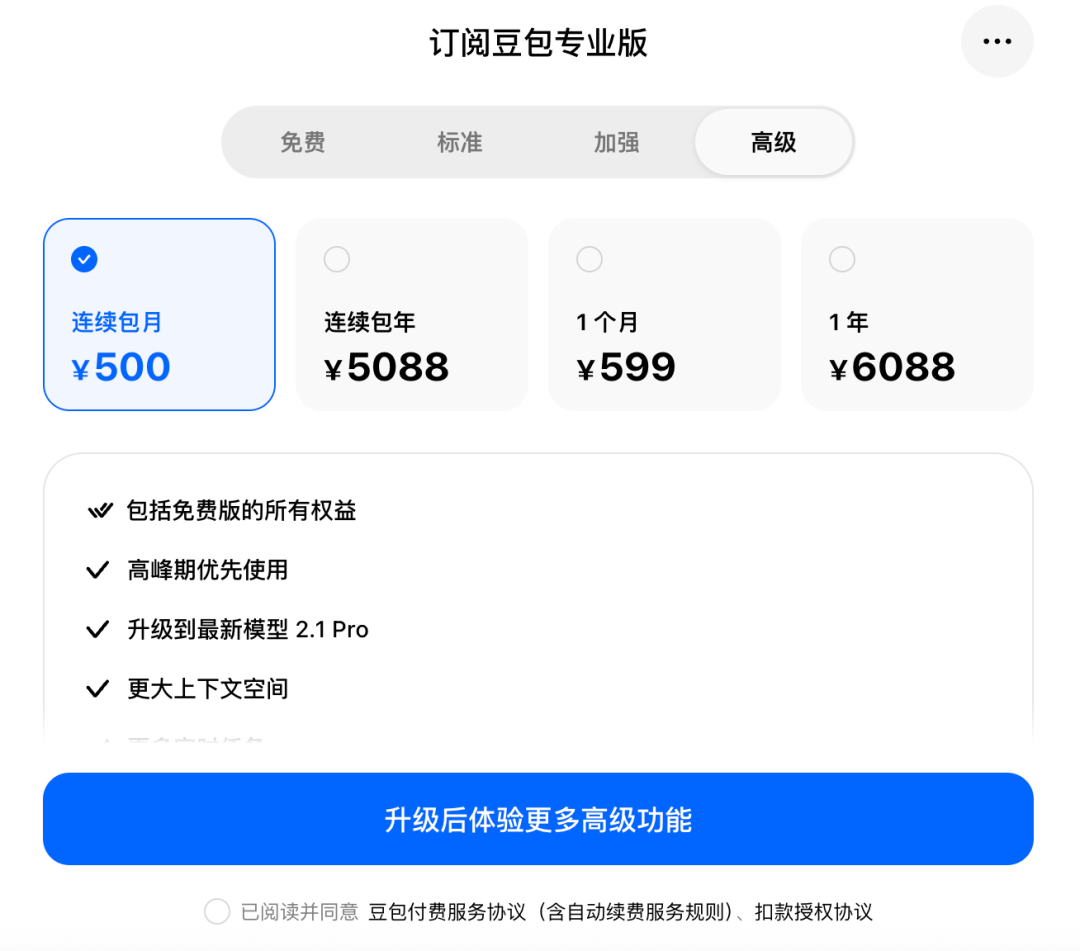
Meanwhile, ByteDance’s Doubao rolled out a three-tiered paid subscription model: Standard (¥68/month), Premium (¥200/month), and Advanced (¥500/month). All Doubao products now integrate the Doubao 2.1 series large models, marking the platform’s entry into C-end monetization.
The two companies adopted starkly contrasting approaches within the same timeframe—one expanding free access, the other implementing tiered pricing. This divergence underscores the divergent commercialization paths emerging in China’s AI large model sector, with two distinct business philosophies set to clash in the AI arena.
01 Free vs. Paid: Vulnerabilities in Both Logics
Wenxin’s decision to expand free access aligns with a classic gateway strategy: AI large models are still in their early adoption phase, and the industry’s primary challenge lies in attracting users rather than monetizing existing ones.
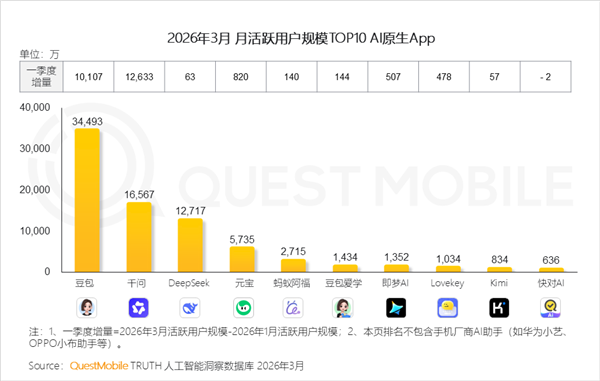
This assessment holds merit. The monthly active user base for AI assistants in China remains far smaller than mature categories like search engines and short videos, with many potential users yet to integrate AI into their daily workflows. Charging fees at this stage would risk stifling growth before market education is complete.
However, “free” is not a strategy—it’s a tactic.
Baidu’s confidence in offering free services stems from its ability to avoid relying on C-end subscriptions for cost recovery. Its revenue streams—search advertising, intelligent cloud services, and enterprise-grade AI solutions—form the backbone of its business. For Wenxin, the C-end serves as an ecological gateway rather than a profit center. Scaling this gateway drives traffic to backend services like search and cloud, potentially amplifying their monetization potential. This indirect model allows Baidu to sustain free C-end access.
(Image sourced from Wenxin’s official website)
The risk lies in a critical assumption: that traffic from Wenxin’s AI gateway will effectively convert into backend monetization. However, the link between users employing Wenxin for PPT creation, research, or college application guidance and search ad clicks remains tenuous.
If the conversion pathway is unclear, the entire model collapses. The greatest danger of free access is not cost but the inability to scale meaningfully—or scaling without successful monetization. Baidu must prove in the coming quarters that Wenxin’s user base is not merely seeking free perks.
Doubao’s paid model follows a more straightforward logic. ByteDance lacks the search and cloud ecosystems to indirectly monetize AI traffic. Its core businesses—information feed advertising and e-commerce—treat AI assistants as efficiency tools but struggle to create closed-loop monetization akin to search ads.

(Image sourced from Doubao’s WeChat official account)
For ByteDance, sustaining free AI assistant services without clear commercial returns means absorbing soaring computing and R&D costs as pure expenditures. C-end subscriptions represent the most realistic and direct path forward.
Doubao’s pricing strategy is deliberate. The three tiers—¥68, ¥200, and ¥500—target casual users with the Standard plan while steering power users toward Premium and Advanced plans for high-computing tasks like PPT generation, data analysis, and expert modes.
The free version retains basic dialogue capabilities to drive traffic, while paid tiers monetize advanced features. This tiered design essentially price-segments the market: users willing to pay for productivity bear higher costs, while casual users remain engaged.
However, the subscription model faces inherent scalability limits. How many users will pay ¥500 monthly for AI services? This demographic likely consists of professionals, leaving limited room for growth. More critically, paywalls act as double-edged swords in early industry penetration—they generate revenue but also block users. If competitors offer comparable capabilities for free, the paywall could accelerate user attrition rather than serve as a moat. Doubao must continually prove that its paid offerings deliver irreplaceable value.
Notably, Doubao’s monetization is not an isolated case. In the first half of 2026, competitors like Tongyi, Hunyuan, Zhipu, Kimi, and MiniMax reduced free quotas or introduced paid subscriptions. This wave of monetization reflects the industry’s shift from burning cash for scale to securing survival amid tightening financing conditions.
02 Playing the Cards in Hand
The divergent paths of Baidu and ByteDance reflect not strategic vision disparities but the resources each company holds.
Baidu’s free route is underpinned by its cost structure. From Kunlunxin’s computing layer and Baidu Intelligent Cloud’s platform layer to Wenxin’s algorithm layer and applications like search, Wenku, and Netdisk, this vertically integrated chain grants Baidu greater control over model inference and training costs.
Beyond cost advantages, Baidu possesses a commercial foundation to absorb AI traffic. Its search engine handles vast daily queries, and AI assistant adoption could significantly expand search ad monetization. This structural prerequisite enables Baidu’s free model.
Yet structural advantages come with structural risks. Full-stack investment entails high fixed costs. If competitors match Baidu’s model capabilities, the user scale advantage from free access will diminish, while the full-stack cost structure becomes a burden.
Baidu’s AI capital expenditures and R&D investments are substantial, requiring sustained growth in backend businesses to offset frontend costs. The viability of its free strategy ultimately depends on whether backend monetization efficiency outpaces frontend costs.
ByteDance’s paid route similarly stems from its business structure. Its core revenue engines are Douyin’s information feed ads and e-commerce, with AI assistants operating as a relatively independent product line. While AI tools enhance e-commerce customer service and creator content production, these synergies currently lack scalable, mature indirect monetization pathways. AI computing, R&D, and acquisition costs must be recovered independently. C-end subscriptions offer the most direct solution.

(Image sourced from Doubao’s official website)
ByteDance holds one advantage in subscriptions: Douyin has cultivated mature payment habits among users. Livestream rewards, e-commerce purchases, and content subscriptions have established payment pathways, allowing Doubao to launch subscriptions without building payment infrastructure from scratch. However, this advantage has limitations. The subscription model’s scalability within ByteDance’s ecosystem depends on whether AI assistants evolve from efficiency tools into indispensable productivity solutions. If user willingness to pay remains experimental, initial subscription uptake may mask poor retention rates.
(Image sourced from QuestMobile report)
The divergence between the two approaches reflects the natural evolution of AI large models from technological competition to commercialization. Companies with ecosystems enabling indirect monetization pursue free gateway strategies, while those lacking such conditions opt for direct product monetization. Resource endowments define feasible paths.
However, paths are not static. If computing costs decline faster than expected, paywall logic faces fundamental disruption. Conversely, if user willingness to pay grows unexpectedly, the opportunity cost of free models rises. Both paths exist in dynamic equilibrium, with neither occupying an absolutely secure position.
03 Path Divergence: Key Variables to Watch
The true significance of Wenxin and Doubao’s divergence lies in how far each path can extend and which variables will alter their trajectories.
The first critical variable is the pace of computing cost reductions—the most fundamental factor influencing both paths. If computing costs continue declining rapidly, free models gain further advantage. When marginal costs approach zero, why would users pay fixed monthly fees for services with diminishing costs?
The second variable is C-end user willingness to pay and scale. A competitive dynamic exists here: when high-quality free options coexist, user tolerance for paid services drops significantly. Doubao must continually demonstrate that its paid offerings deliver irreplaceable value.
The third variable is whether AI capabilities truly constitute irreplaceable productivity value. Only when AI tools become embedded in users’ daily workflows as indispensable solutions will user stickiness and payment willingness improve qualitatively. Wenxin must prove that sustained free expansion cultivates user habits and ecosystem loyalty rather than being perceived as a freely replaceable tool. Doubao must demonstrate that its fees correspond to irreplaceable capability enhancements. Both companies’ answers remain pending.
The simultaneous contrast between Wenxin and Doubao represents a divergent cross-section of China’s AI large model industry. Through opposing actions, both companies address the same question: how to transform AI capabilities into sustainable businesses.
Both answers remain unverified, each with its prerequisites and vulnerabilities. Their ultimate success hinges on user retention data, cost reduction curves, and competitive landscape evolution over the coming quarters.

-
![]()
Depreciation Rate on Par with Mobile Phones: Just 40% Value Retention After Three Years—Why Do Battery Electric Vehicles Lose Their Worth?
-
![]()
Clearing Bugatti Stock Worth 7 Billion: Why is Porsche 'Cutting Ties'?
-
![]()
Don’t Dismiss Huawei’s Potential in Sedans Just Because the Shangjie Hasn’t Hit It Big Yet
-
![]()
Unsold Cars in China Find Success Overseas
-
![]()
Ghosn: Only I Can Save Nissan, Shareholders Beg Me to Return
-
![]()
Expanding Automobile Consumption: It's Time to Address the High Cost of Electric Vehicle Repairs
-
![]()
Luna Ultra Entangled in 'National Subsidy Fraud' Controversy, Insta360 Pushed to the Brink by DJI
-
![]()
People have long suffered from splash ads. Will the 'temporarily disappeared' traffic behemoth make a comeback?