Wenxin Once Integrated Multiple Web Portals, but Its Impact Has Diminished
 06/29 2026
 540
540
Yesterday, Baidu officially merged the web versions of Wenxin Yiyan, the Wenxin App, and Baidu Wenxin Assistant. With this merger, the era of multiple brands for Baidu's web-based AI assistants has come to an end, with all services now unified under the Baidu Wenxin Assistant web portal (chat.baidu.com).
The coexistence of these various Wenxin portals was indeed perplexing, and it couldn't be simply explained by the usual internal product competition strategies.
If there was to be competition, users should at least be able to easily distinguish between different products.
For instance, when Tencent launched its battle royale products, TiMi Studio and Lightspeed Studio each released a beta version. Although both carried the "Battle Royale" prefix, they were distinctly named "Joint Operations" and "PUBG Mobile: Stimulate Battlefield," respectively.
However, with Wenxin's products, not only ordinary users but even industry observers like myself find it challenging to understand their relationships.
I just conducted a test: currently, on Google, the first two search results for the keyword "Wenxin" are the web versions of the Wenxin App and Wenxin Yiyan. One redirects directly to the Wenxin Assistant web portal, while the other has been discontinued, prompting users to visit a new URL.
On the Wenxin Yiyan website, I even stumbled upon chat records from three years ago.
Initially, Baidu's large model was named Wenxin Yiyan, marking it as the first domestic competitor to ChatGPT. Although there was a noticeable gap between Wenxin Yiyan and ChatGPT, it still represented a significant milestone for Baidu.
It's astonishing to think that three years later, Baidu, which was the pioneer, has now nearly vanished from the native AI portal space for consumer-facing (C-end) applications. Consolidating and unifying the web portals was a move that should have been made much earlier, but its current significance is limited.
Confusion Imposes a Cognitive Burden on Users
There's no need to delve deeply into the fierce competition in the AI-native portal space. The intensity of this competition stems from the immense opportunities at hand—so vast that no company can afford to experiment with multiple competing products.
When ByteDance entered the short-video market, it launched products like Douyin, Huoshan, and Xigua. However, in the AI era, its counterpart to ChatGPT is solely Doubao. Alibaba initially bet on Kuake and later fully promoted Qianwen, but these two were not in direct competition due to their significantly different launch timings, positioning, and product forms.
Therefore, although Baidu previously had multiple web portals, I tend to believe that this was not a deliberate attempt at internal competition by the CEO but rather a natural expansion of different business units' spheres of influence.
I recall an AI summit where Lin Junyang invited the audience to experience Qwen, but the demo URL used was not Alibaba's official Qianwen App but rather one from Tongyi Laboratory itself.
Such situations arise due to a lack of coordination and unification among different business units.
With Baidu's recent merger of several web portals, users will no longer need to switch between multiple similar yet distinct portals when using Baidu's C-end AI services. Instead, they will be directed to a unified "Baidu Wen" portal, at least avoiding the inconvenience of not being able to locate chat records.
Viewed within the context of Baidu's AI product evolution over the past two to three years, this move carries strong symbolic significance.
Baidu's AI portal-related concepts were once extremely diverse, with various terms appearing across different products and scenarios, each with its own positioning and explanation. However, when combined, they created a cognitive burden for users.
For ordinary users, AI products primarily present a product recognition issue. They may not be concerned with the names of the underlying models or the organizational relationships among search product lines, assistant product lines, etc.
What truly matters to them is which product to use to accomplish their tasks. If users need to understand these relationships from the outset, no matter how rich the product capabilities are, it will be challenging to translate them into stable daily usage habits.
Baidu's previous approach indeed created this kind of cognitive burden.
Initially, Wenxin Yiyan served as Baidu's representative public-facing portal for its large model, giving users the impression of being the "Baidu version of ChatGPT." However, later, the Wenxin Yiyan App was upgraded and renamed "Wenxiaoyan," with its positioning shifting from a chat assistant to a "new search intelligent assistant."
This change had its strategic logic: Baidu's core strength lies in search, and AI should not be limited to just chat but should redefine the relationship between information and people, especially since the integration of AI and search was generally not well executed at the time.
However, from a brand perception standpoint, "Wenxiaoyan" seemed like a new product, weakening the continuity with "Wenxin Yiyan" and the "Wenxin Large Model."
Meanwhile, Baidu Search was also continuously advancing its AI capabilities. Around the search box, web, and mobile ends, Baidu had various names such as Baidu AI Assistant, Baidu AI Search, and Baidu Wenxin Assistant.
The logic behind this line was also understandable: Baidu hoped to upgrade traditional search to AI search, allowing users to obtain answers or even complete tasks directly through dialogue, in-depth search, intelligent agents, etc., rather than just entering keywords and browsing links.
But the problem was that when AI brands on the search side and the Wenxin side coexisted, users could easily become confused about their relationships.
Decisiveness is Needed for AI to Transform the Ecosystem
Baidu's unification of Wenxin-related portals is, of course, the right move—and one that should have been made much earlier.
However, it must be admitted that this move now holds limited significance.
It comes far too late, aiming to address Baidu's previous brand confusion and fragmented access points. But today, with the Wenxin App having only around 5 million daily active users, it has basically lost its competitive edge in the native AI portal space.
What's the point of reorganizing and integrating the positioning of something that's nearly obsolete? Although Baidu has integrated three web-based AI portals, the user base of these portals is, in fact, very limited.
The AI-native portal space has already passed its most aggressive customer acquisition phase.
Doubao has officially launched a paid version, shifting its focus from user scale expansion to revenue generation. This typically indicates that an internet product sector has entered a new stage.
In the early stages, it's about staking claims and competing for user mindshare; in the middle stages, the market landscape begins to take shape, with leading products improving retention, optimizing costs, and exploring revenue streams; later on, the market gradually shifts from incremental to existing user competition.
For industry practitioners, the best window of opportunity has often already passed. Once users' habits are formed, it becomes significantly more difficult to migrate them en masse to another portal.
In recent times, the monthly active users of native apps like Wenxin have declined, and Baidu hasn't put up much of a struggle or provided much support. There has been no large-scale promotion to acquire new users, nor has Baidu leveraged the massive user base of its main App to forcibly drive traffic.
Perhaps Baidu has already judged that the native app track is too crowded, with competitors too formidable, and that it's better to allocate its energy and resources toward intelligent cloud services and the AI transformation of existing apps like Baidu's main portal.
According to QM statistics, the application plugin version of the Wenxin Assistant reached 330 million monthly active users last year. The value of this data certainly can't compare to that of a standalone app, as it fully leverages Baidu's existing user base.
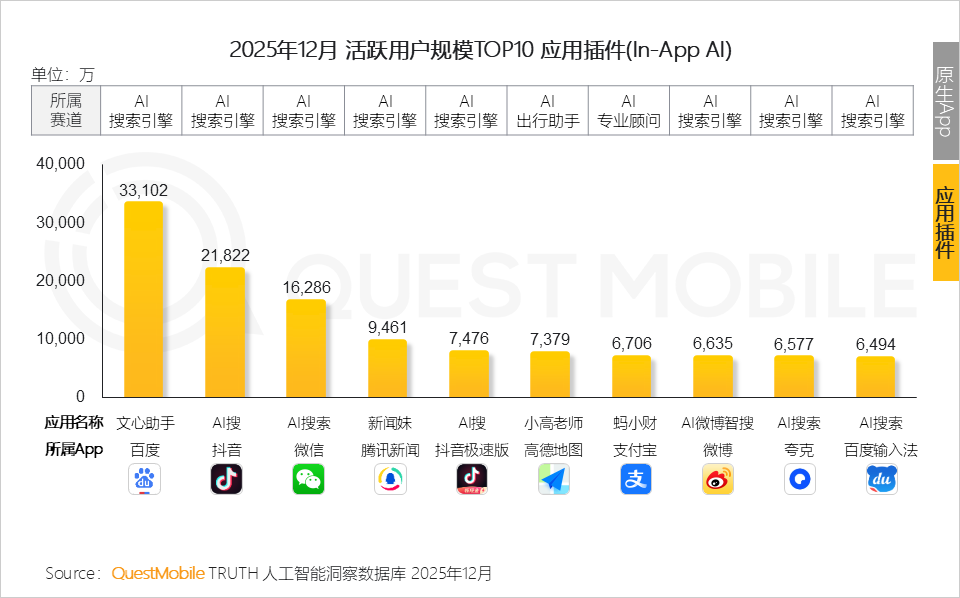
However, it cannot be denied that over the past two decades, as a veteran in the Chinese internet industry, Baidu's product ecosystem, including apps like Baidu App, Wenku, Wangpan, and Maps, harbors enormous real demands that are worthy of—and capable of—being transformed by AI.
The point is, Baidu's unification of Wenxin portals is correct but should not be overestimated. With the Wenxin App's user base already so dismal, and given that the scale of China's mobile internet far exceeds that of PC internet, the significance of Wenxin's web portals is even further diminished.
For Baidu, the real anticipation should not be whether users will choose Wenxin as their primary portal (which seems hopeless) but rather how the old Baidu can be remade with AI.
Based on my previous personal experience, just looking at how AI has transformed Baidu's core search business (here's the link: https://mp.weixin.qq.com/s/8fusfWBucUz51htN3wL7lg) as a microcosm, it's clear that Baidu needs to show even greater decisiveness in this area.
-
![]()
Depreciation Rate on Par with Mobile Phones: Just 40% Value Retention After Three Years—Why Do Battery Electric Vehicles Lose Their Worth?
-
![]()
Clearing Bugatti Stock Worth 7 Billion: Why is Porsche 'Cutting Ties'?
-
![]()
Don’t Dismiss Huawei’s Potential in Sedans Just Because the Shangjie Hasn’t Hit It Big Yet
-
![]()
Unsold Cars in China Find Success Overseas
-
![]()
Ghosn: Only I Can Save Nissan, Shareholders Beg Me to Return
-
![]()
Expanding Automobile Consumption: It's Time to Address the High Cost of Electric Vehicle Repairs
-
![]()
Luna Ultra Entangled in 'National Subsidy Fraud' Controversy, Insta360 Pushed to the Brink by DJI
-
![]()
People have long suffered from splash ads. Will the 'temporarily disappeared' traffic behemoth make a comeback?