Exclusive Report | Meituan’s Intranet Restricts Access to Doubao Qianwen; Many Employees Report Never Using It
 07/03 2026
 488
488

Doubao: "I haven't even started yet!"
On July 2, according to a report by Dachang Ribao, Meituan issued a notice this week mandating all business teams to conduct self-assessments and plan migrations from Doubao to models such as LongCat and DeepSeek.
Teams that are genuinely unable to migrate must provide detailed reasons and justifications, undergoing a separate approval process. The directive applies to all business departments within the company that currently utilize Doubao, prompting outsiders to humorously refer to this as an intensification of "business rivalry."
As early as April, Meituan had already issued a notice discouraging the use of Alibaba Cloud's Qwen model for business purposes. If businesses still found it necessary to use Qwen, they were required to seek approval from their superiors (typically at the x3 level).
Through internal testing by Meituan employees, it was discovered that the current web versions of Qianwen and Doubao cannot be accessed within Meituan’s intranet, while domestic web versions of Yuanbao, Zhipu, and Kimi remain accessible.
Moreover, regarding internal AI model selection, in addition to the self-developed LongCat model, Meituan offers employees multiple versions of models such as GPT, Claude, Gemini, and DeepSeek to choose from. However, overseas models are currently experiencing a "shortage of resources."
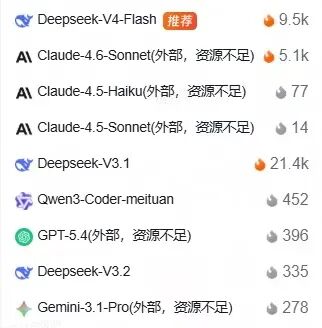
Meituan employees generally exhibit low awareness regarding the "ban" on Doubao. Several employees from various departments informed Chaojujiao that as early as April, the use of Doubao had already been restricted on the intranet. Employees can observe the popularity of model usage, and in practical tests, Doubao's performance falls short compared to other models. Most individuals have not taken notice of or actively utilized Doubao's large model, resulting in no significant impact on their work.
Furthermore, they mentioned that the Qwen model was seldom used previously. Meituan's internal AI capabilities are already well-established, and there is generally no need to rely on external models for daily tasks.
A former Meituan employee, Peng Peng (pseudonym), stated that restricting external AI does not equate to "business rivalry." It is likely because Longcat 2.0 has recently been successfully debugged, and internally, the company believes that Doubao's capabilities do not match or are equivalent, leading them to opt for their own models, which are both secure and cost-effective.
From establishing approval thresholds for Alibaba's Qwen in April to mandating a comprehensive migration from Doubao to LongCat and DeepSeek in July, Meituan has executed two significant reductions in external mainstream large model usage within three months.
The timing of these actions closely aligns with the development rhythm of Meituan's self-developed large models. April marked the period just before the release of the LongCat-2.0-Preview version, while July followed shortly after the official release and open-sourcing of LongCat-2.0 on June 30.
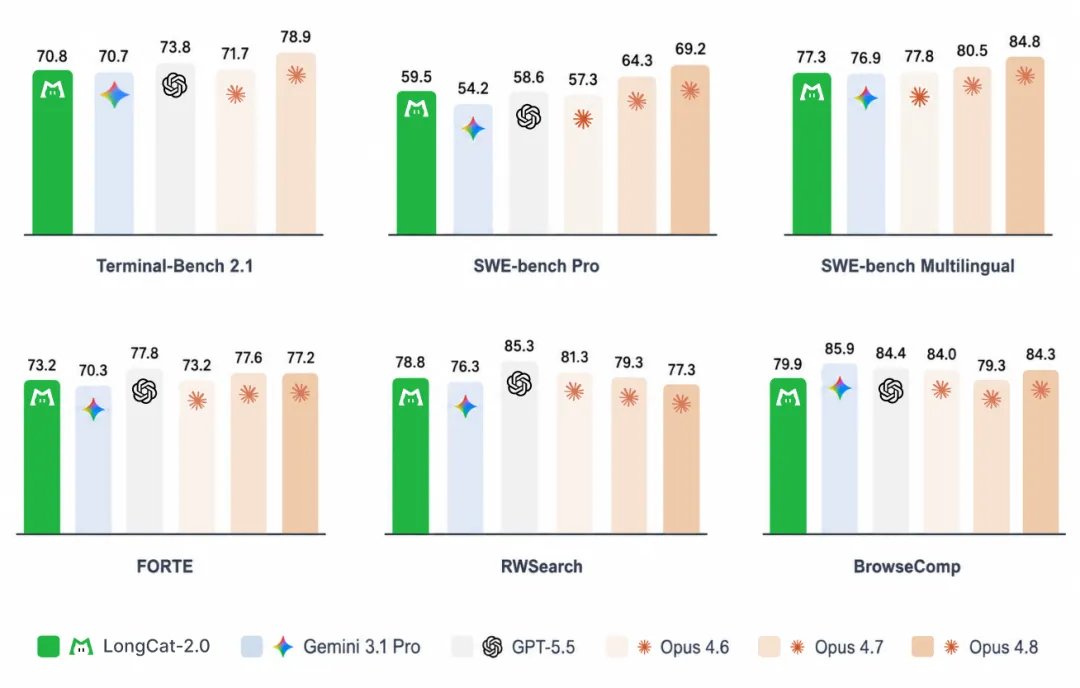
On the authoritative code capability evaluation set SWE-bench Pro, LongCat-2.0 achieved a score of 59.5, outperforming mainstream models such as GPT-5.5 and Claude Opus 4.6. Critically, its preview version was already available for calling on the OpenRouter platform, with monthly call volumes ranking among the top three globally.
Microsoft, as the largest investor in OpenAI, recently unveiled its self-developed reasoning model MAI-Thinking-1, driven by the core motivations of commercial autonomy and cost control. Meta has curbed cost inflation by setting Token usage limits and constructing a real-time tracking platform, while strictly restricting employees from using external AI tools such as Claude and Codex. JD.com officially commenced restricting employee access to external AI-related websites at the end of March.
After self-developed large models achieve international first-tier levels in technical indicators and attain ecological closures in computing power infrastructure, internet giants are no longer content with merely being "users" of external models. Instead, they possess the capability and willingness to become "architects" of their own AI infrastructure.
This could offer a glimpse into the latter half of the AI industry competition.
- END -
-
![]()
Rokid's Ambition and Embarrassment: 300,000 Sales Can't Support Its Ecosystem Dream
-
Are Gaming Ventures No Longer in Vogue Among Tech Titans?
-
![]()
Kuaishou’s Keling AI, Valued at $18 Billion with a Five-Year IPO Pledge, Faces a Make-or-Break Challenge
-
![]()
Valued at $18 Billion with a Five-Year IPO Plan: Kuaishou’s Kling AI Takes a Bold Leap
-
![]()
NVIDIA Launches 'Computing Power Financing'
-
![]()
Following Up on the 'Safety Net' for Intelligent Driving: Is Huawei's Strategy Astute or Perilous?
-
![]()
ICML 2026 | One Model to Unify Humans, Objects, Sounds, and Actions: OmniShow Revolutionizes Multimodal Controllable Video Generation as a Systematic Engineering Feat!
-
![]()
Mid-Year Sales Analysis: Leapmotor Faces Challenges Alone, NIO Breaks Free from the 'NIO 30K' Stigma