Valued at $18 Billion with a Five-Year IPO Plan: Kuaishou’s Kling AI Takes a Bold Leap
 07/03 2026
 500
500
Kuaishou has propelled Kling AI onto a broader global stage.
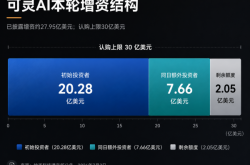
On the evening of July 2, Kuaishou Technology officially confirmed on the Hong Kong Stock Exchange that the previously rumored spin-off financing of Kling AI has now been finalized into a legally binding agreement. This development marks the most significant milestone in Kling AI’s capitalization journey since Kuaishou first acknowledged on May 12 that “the board is exploring restructuring options.” It also signifies the largest financing round in the global video generation large model sector to date. 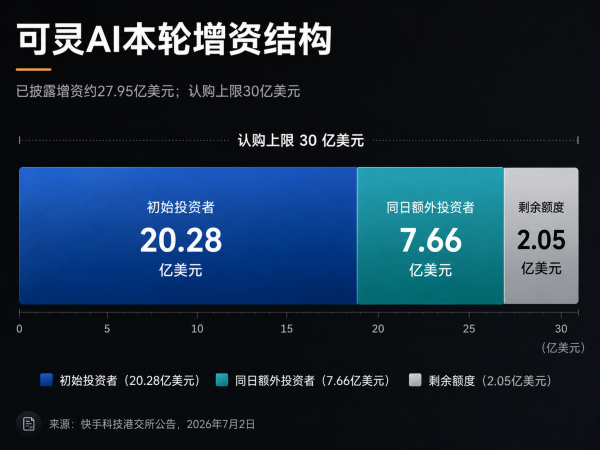
Based on the disclosed subscription cap and equity ratio, Beijing Kling’s pre-money valuation stands at approximately $15 billion, with a post-money valuation nearing $18 billion.
With the secured funding, Kling AI faces heightened expectations. It must now demonstrate how a publicly traded entity can revalue its rapidly expanding AI assets, retain top technical talent through independent financing, and differentiate itself amid fierce competition from ByteDance’s Seedance and Alibaba’s HappyHorse.
1 · Revaluing Kling
Once the financing is complete, assuming full utilization of the subscription cap and employee incentive plan, Kuaishou’s indirect stake in Beijing Kling will decrease from 100% to roughly 68.33%. Beijing Kling will remain consolidated into Kuaishou’s financial statements, ensuring Kuaishou retains control. 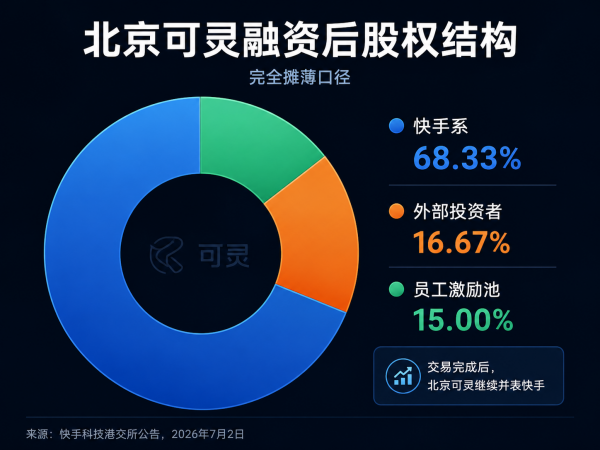
Thus, the essence of this transaction lies not in “divestiture” but in “revaluation.”
Over the past year, Kling has emerged as Kuaishou’s most strategic asset in the AI video domain. Within the company, it has primarily manifested as R&D investment, computing expenses, and losses from innovative ventures. Post-restructuring, Kling will boast an independent equity structure, external investors, and management incentives, enabling capital markets to evaluate its growth potential separately.
This shift is pivotal for Kuaishou. While short videos, livestreaming, e-commerce, and advertising remain its core revenue streams, Kling represents new valuation opportunities. Financing Kling independently allows Kuaishou to open external funding channels for its AI business without surrendering control, providing the market with a clear valuation benchmark.
The announcement also unveiled Kuaishou’s intention to initiate Kling AI’s Hong Kong IPO process within the next 12 months, targeting the submission of application materials by early 2027. The proceeds will primarily fund computing power and data center construction, attract core technical talent, and incentivize teams.
Kuaishou has designed a performance-based incentive structure for the Kling AI team. Should the future IPO valuation reach $40 billion, the team stands to receive substantial rewards. Within the parent company, team compensation was constrained by Kuaishou’s stock price system. Independence empowers them to secure pricing rights commensurate with their value creation.
This strategic move is not merely prescient. After Kling AI’s former technical lead, Zhang Di, joined Alibaba in August last year, he spearheaded the development of HappyHorse-1.0 in just five months. Reports indicate that it temporarily outperformed both Seedance and Kling 3.0 on authoritative benchmarks, posing a persistent challenge to Kuaishou.
2 · The ‘Spillover Value’ Backed by Industry Giants
More revealing details lie in the shareholder list. Tencent, Alibaba Cloud, and Baidu, rarely seen investing together, have each made significant contributions. Tencent and Alibaba Cloud invested RMB 1.363 billion each, while Baidu invested RMB 341 million. Additionally, Shanghai Guofang Digital Technology, Yuanfeng Capital, CPE, Beijing Guoke Generation Fund, Shenzhen Hongtu, Suzhou Gongrong Jinzhi, China Internet Investment Fund, and the Beijing AI Industry Investment Fund are also on board. 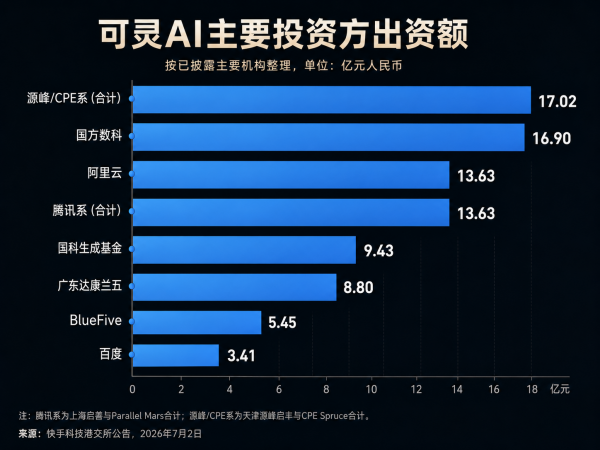
This marks a coordinated entry by “industrial capital + state-owned platforms + top-tier financial investors.”
In the burgeoning sector of video generation large models, leading internet companies are unwilling to cede dominance to ByteDance alone.
ByteDance boasts Seedance, Doubao, Jianying, Jimeng, Volcano Engine, and the Douyin ecosystem, naturally controlling creator distribution, content feedback, and commercialization closed loops. If AI video becomes the foundational production tool for short videos, advertising, e-commerce materials, short dramas, and gaming assets, ByteDance’s advantages will further amplify.
By enlisting Tencent, Alibaba Cloud, Baidu, and a cohort of industrial capital, Kuaishou is essentially constructing a broader industrial network for Kling. It requires more than just capital—more clients, more scenarios, more computing synergy, and more leverage against ByteDance’s ecosystem.
However, resource stakes do not guarantee contract wins. Kling must prove whether these shareholders can translate into actual business opportunities, rather than mere endorsements on an investment list.
3 · The Real Pressure Lies in Repurchase Clauses
The most challenging aspect of this announcement is not the financing scale but the repurchase rights.
Under the agreement, if Beijing Kling fails to complete an IPO by the latest listing deadline or before October 30, 2031, investors may demand a repurchase of all or part of their equity. The repurchase amount includes the original investment, plus an 8% annual simple interest return, minus any dividends or distributions received.
Furthermore, if Beijing Kling fails to complete related restructuring items within the agreed timeline, repurchase arrangements may be triggered. These items include acquiring 100% of overseas operating companies, obtaining value-added telecom business licenses, and completing AI large model and algorithm filings.
This indicates that investors are not unconditionally buying into an AI narrative. Behind the high valuation, exit paths, IPO timelines, and restructuring progress are all contractually stipulated.
In the same announcement, Kling also established a governance structure akin to a pre-IPO company. Beijing Kling adopted share incentive, shareholding, and share option plans, with a total authorized limit of 15% of the expanded registered capital. Cheng Yixiao received approximately 1% in equity awards, while Gai Kun received about 3%. Notably, Gai Kun’s 3% equity carries tenfold voting rights, corresponding to a 23.62% voting power ratio. 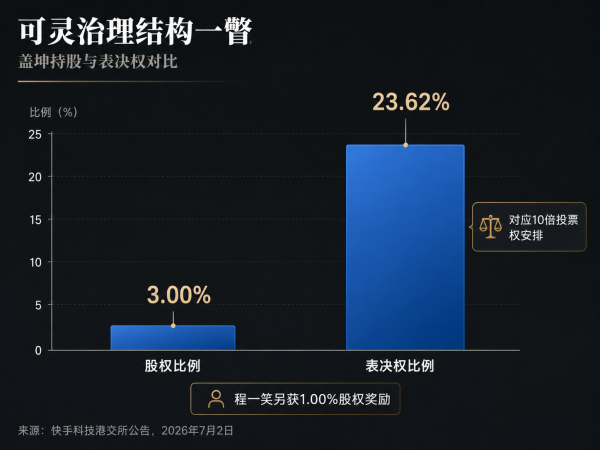
This setup reflects Kuaishou’s intent to govern Kling as an independent AI entity: the group retains control, the core team is bound to long-term value creation, and investors receive exit protections.
4 · Unavoidable Rivals
While financing and spin-offs address capital and talent challenges, Kling AI’s true test lies in the competitive landscape.
The domestic video large model market now features a “Big Three”格局 (landscape): ByteDance’s Seedance, Alibaba’s HappyHorse, and Kuaishou’s Kling.
ByteDance is the most resource-endowed player in this race. Its Seedance 2.0, released in February, garnered global attention with its unified multimodal audio-video joint generation architecture. Its computing demands once strained even ByteDance’s own resources. ByteDance’s response was direct: a 25% increase in capital expenditures to approximately RMB 200 billion in 2026, nearly eight times Kuaishou’s budget. On June 23, ByteDance unveiled Seedance 2.5 at the Volcano Engine FORCE Conference, supporting 30-second single-shot native output and up to 50 material joint references, with a formal launch expected in early July—almost coinciding with Kling’s financing announcement.
Yet Kling is not defenseless. According to Orient Securities research, based on API pricing for generating one-minute videos, HappyHorse-1.0 costs approximately $14.4, Seedance 2.0 about $22.4, and Kling 3.0 around $13.4, making it the most cost-effective among the three.
Goldman Sachs’ February research also noted that while Seedance 2.0 may excel in physical motion and complex action rendering, Kling AI remains competitive in visual consistency, commercial scenario adaptability, and professional creation capabilities, particularly carving out differentiation in enterprise and professional user markets.
Currently, approximately 70% of Kling’s revenue comes from overseas subscriptions and enterprise API calls, pursuing a more B2B-oriented route that emphasizes “deliverability” over mere technological showmanship.
Goldman Sachs also offered a relatively optimistic industry outlook. AI video generation will not converge into a single-platform monopoly. The global market is expected to expand tenfold over the next five years, reaching approximately $29 billion by 2030.
The market is vast enough for non-zero-sum competition. This may explain why Tencent is willing to bet on both in-house R&D and external investments without rushing to pick sides.
-
![]()
Rokid's Ambition and Embarrassment: 300,000 Sales Can't Support Its Ecosystem Dream
-
Are Gaming Ventures No Longer in Vogue Among Tech Titans?
-
![]()
Kuaishou’s Keling AI, Valued at $18 Billion with a Five-Year IPO Pledge, Faces a Make-or-Break Challenge
-
![]()
Valued at $18 Billion with a Five-Year IPO Plan: Kuaishou’s Kling AI Takes a Bold Leap
-
![]()
NVIDIA Launches 'Computing Power Financing'
-
![]()
Following Up on the 'Safety Net' for Intelligent Driving: Is Huawei's Strategy Astute or Perilous?
-
![]()
ICML 2026 | One Model to Unify Humans, Objects, Sounds, and Actions: OmniShow Revolutionizes Multimodal Controllable Video Generation as a Systematic Engineering Feat!
-
![]()
Mid-Year Sales Analysis: Leapmotor Faces Challenges Alone, NIO Breaks Free from the 'NIO 30K' Stigma