Who Will Be the Top Bidder Among 40 Vendors for Financial Agents in H1 2026?
 07/03 2026
 486
486

Previous articles from 01Caijing—"2026 Financial Agent Bidding Landscape: Banks, Securities, Insurance Go All-In" and "The 'Long Tail' of Financial Agent Bidding: Fintech Subsidiaries, Financial Leasing, Consumer Finance, AMCs, and Others Quietly Deploy"—sorted out the structure of bidding data from the demand side: who is procuring financial agents, which business scenarios they correspond to, and how much budget is allocated.
These analyses reveal a clear signal: financial agents have transitioned from the 'platform-building phase' to the 'scenario implementation phase' and are now widely adopted across various financial and fintech institutions.
With the demand-side story now clear, we shift our focus to those securing orders behind the scenes—who ultimately wins the market's contracts?
Based on Enterprise Early Warning and other publicly available information, this article collates 52 bid/transaction announcements related to financial agents in the first half of 2026. The data shows nearly 40 distinct winning bidders (some joint bids), indicating a market with low concentration.
However, Alibaba Cloud, Volcano Engine, and iFLYTEK collectively secured 13 projects, establishing initial brand and case-based leadership. Traditional financial IT and vertical niche players leverage their business expertise to form differentiated competitiveness in multi-million total contracts and specialized scenario tracks.
01 Who Are the Top Players?
First, consider the total. Among the 52 projects with confirmed winners, the total contract value exceeds RMB 155 million (note: some projects did not disclose amounts). Ranked by supplier bid frequency, the top six are as follows:
Figure 1: Top 6 Financial Agent Bidders in H1 2026
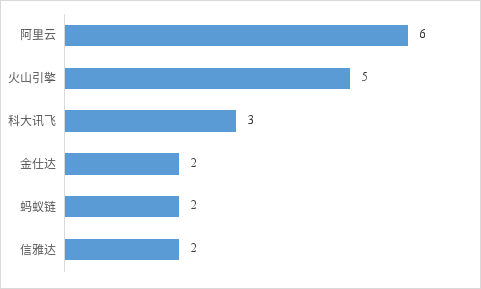
Note: Alibaba Cloud includes Alibaba Cloud Apsara and Tongyi Cloud Qi.
But this simple ranking doesn't tell the whole story. When ranked by disclosed contract value, the narrative changes entirely.
Sunyard secured over RMB 42 million with just two bids, including the largest single project—the "Enterprise-Level Intelligent Technology Application Platform Construction" for China Development Bank, worth RMB 40.96 million.
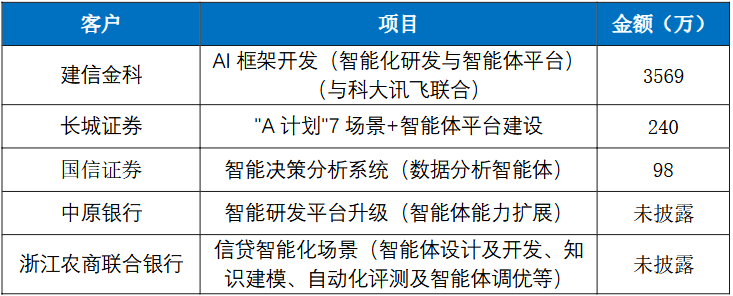
Although Alibaba Cloud had the highest frequency, its largest project—the "CCB Fintech AI Professional Domain Framework (Intelligent R&D and Agent Platform Construction)"—was a joint bid with iFLYTEK. The project adopted a "dual-shortlist, settlement based on actuals" model without predefined fixed shares.
This reveals an interesting feature of the financial agent market: frequency does not equal scale, with both high-frequency small projects and low-frequency large projects coexisting.
02 The Giants' Territories
Tech giants' ambitions in the financial agent market are no secret. However, their strategies differ, with each adopting a unique entry point.
Alibaba Cloud: The Full-Stack "General Contractor"
Data Source: Enterprise Early Warning, Collated by 01Fintech
Alibaba Cloud is the broadest supplier: it handles top-tier projects like "platform building for peers" (CCB Fintech), scenario implementations for mid-sized securities firms (Great Wall Securities, Guosen Securities), and single-source procurement for Central China Bank with "locked-in renewals."
Its approach resembles a "full-stack general contractor"—covering everything from underlying computing power and model platforms to upper-layer scenario applications.
Notably, Central China Bank's single-source procurement states: "Our intelligent R&D platform was built by Alibaba Cloud. This upgrade procurement expands core agent capabilities from the original 1.0 version"—highlighting a common logic: once the foundation is secured, subsequent upgrades nearly guarantee revenue.
Volcano Engine: The "Scenario Partner"
Data Source: Enterprise Early Warning, Collated by 01Fintech
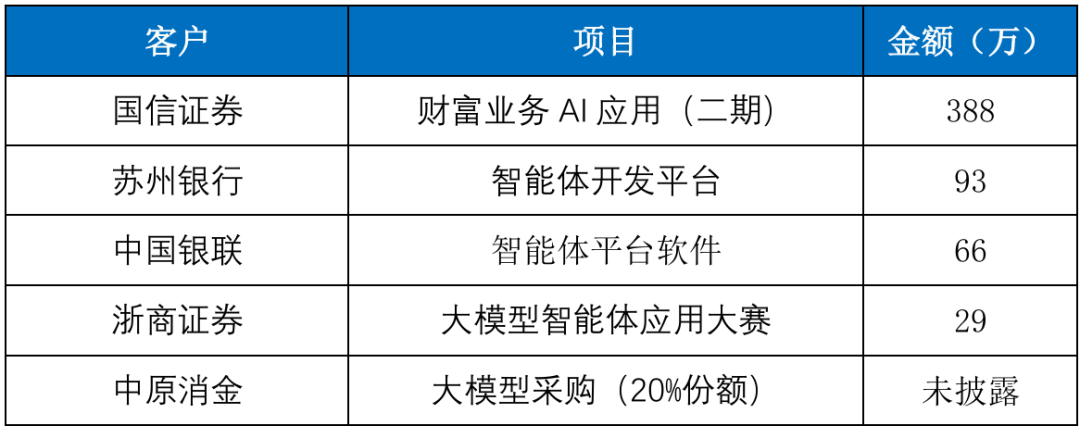
Volcano Engine adopts a high-frequency, multi-pronged approach. Its five wins span securities firms, city commercial banks, consumer finance, and payment clearing, but individual contract values are generally small (RMB 290,000–3.88 million). Its typical strategy uses agent development platforms as entry points (Bank of Suzhou, China UnionPay), binding clients' toolchains before penetration ing into scenario applications.
This strategy quickly builds client relationships and accumulates industry cases but risks low switching costs and difficulty in deep binding.
iFLYTEK: Betting on "Voice + Scenarios"
iFLYTEK appears in three projects—the large model software platform for Guangxi Rural Credit Union (RMB 3.32 million), framework development for CCB Fintech (joint bid with Alibaba Cloud), and loan approval agent for Bank of Suzhou.
iFLYTEK's strength lies clearly in voice interaction + OCR multimodal recognition. The Bank of Suzhou project explicitly requires "using multimodal large models for automatic material recognition"—a core competency for iFLYTEK.
Baidu & Tencent Cloud: Hidden in "Consortiums"
Public data shows Baidu and Tencent only appear in Central China Consumer Finance's large model "full-stack" procurement (Baidu 40%, Tencent 60%, Volcano 20%, Tongyi Cloud Qi 20%—note: percentages exceed 100%, suggesting multi-lot splitting).
This reflects a phenomenon: when clients procure "unified foundation" platforms, multiple large model vendors often bundle in, ensuring no single player is excluded—or dominates.
JD Technology: Single-Point Breakthrough
JD Technology appears only in CCB Consumer Finance's project but secures RMB 11.3025 million for comprehensive construction of customer operations, risk control, and corporate management agents.
This is a classic "one-hit wonder" case—not broad networking but securing a benchmark client with demonstration effect .
Ant Digital Tech: Retail Finance "Scenarios as Platforms"
Ant Blockchain, under Ant Digital Tech, won two projects focused on retail finance customer engagement: customer insights, marketing script assistance, and asset allocation support.
Ant's unique barrier here is its Alipay ecosystem's vast consumer behavior data and user profiling capabilities—unreplicable by pure software vendors.
Ant's strategy can be summarized as "scenarios as platforms": directly delivering a methodological + product + data closed loop for "retail customer engagement." For city and rural commercial banks, such "plug-and-play" solutions are far more attractive than empty platforms.
03 Traditional IT Service Providers: Another Kind of "Silent Wealth"
While tech giants "steal the spotlight," traditional financial IT service providers "secure orders." The most representative case is Sunyard.
Sunyard's CDB project is unique: it adopts a "total contract mode" combining products, development, and personnel deployment. Procurement includes training/inference platforms, knowledge base + agent platforms, text-to-PPT, meeting minutes, document checking, and requires custom development integration and on-site personnel.
Such composite "product + service" mega-projects are precisely the "heavy-delivery" projects large vendors avoid but traditional providers excel at.
Another notable player is Kingstar. This veteran in financial compliance won two projects—"Anti-Money Laundering System Transformation for Caixin Securities" and "Anti-Money Laundering Agent for Caitong Securities"—demonstrating the competitiveness of "business-savvy vertical vendors." In AML, a field with strong regulatory guidance and complex business rules, large model capabilities are necessary but business know-how is sufficient.
Veteran financial IT firms like Tianshan Soft (Tianjin Bank corporate intelligent marketing) and CEC Digital (State Power Investment Corporation Treasury Agent) also appear on the winner list. Their strategy avoids platform-level projects but firmly guards their deeply bound clients and scenarios.
04 Vertical Specialists: Deep Cultivation in Niche Fields
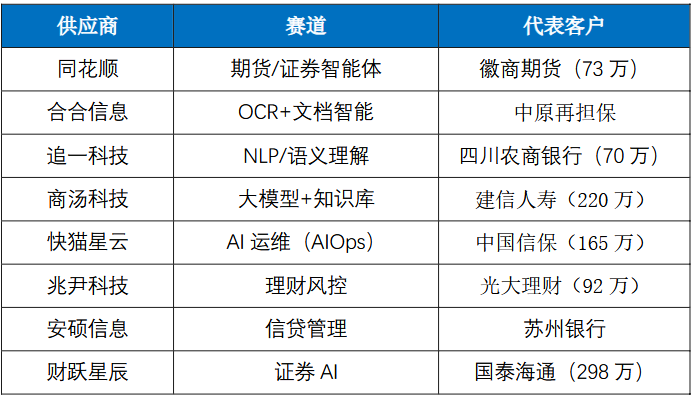
Beyond giants and traditional providers, a group of vertical specialists have carved out territories in specific tracks:
Data Source: Enterprise Early Warning, Collated by 01Fintech
These vendors share a common trait: strong product maturity and industry understanding in 1–2 niche scenarios, competing differentiation with giants. They avoid foundations and platforms, focusing only on their strongest segment.
For example, Caiyue Xingchen, a joint venture between Interface Finance Union (major shareholder) and Jieyue Xingchen, combines financial media + AI DNA, giving it natural content and data advantages in securities information empowerment and investment advisor AI scenarios.
05 Internal Group Synergy: An Unignorable Variable
Pudong Silver Leasing procured an agent operation platform + OCR agent for photovoltaic business via single-source procurement from Pudong Silver Financial Technology—a fintech subsidiary within the China Pudong Development Bank Group. The announcement explicitly states: "Core permissions are restricted to group internal staff," locking intelligentization infrastructure ownership within the group.
Similarly, CITIC Bank Wealth Management procured an intelligent service platform (RMB 2.9679 million) from CITIC Digital Technology Group—CITIC Group's internal fintech force.
-End-
-
![]()
Rokid's Ambition and Embarrassment: 300,000 Sales Can't Support Its Ecosystem Dream
-
Are Gaming Ventures No Longer in Vogue Among Tech Titans?
-
![]()
Kuaishou’s Keling AI, Valued at $18 Billion with a Five-Year IPO Pledge, Faces a Make-or-Break Challenge
-
![]()
Valued at $18 Billion with a Five-Year IPO Plan: Kuaishou’s Kling AI Takes a Bold Leap
-
![]()
NVIDIA Launches 'Computing Power Financing'
-
![]()
Following Up on the 'Safety Net' for Intelligent Driving: Is Huawei's Strategy Astute or Perilous?
-
![]()
ICML 2026 | One Model to Unify Humans, Objects, Sounds, and Actions: OmniShow Revolutionizes Multimodal Controllable Video Generation as a Systematic Engineering Feat!
-
![]()
Mid-Year Sales Analysis: Leapmotor Faces Challenges Alone, NIO Breaks Free from the 'NIO 30K' Stigma