Xiaopeng IRON to Reach 1,000-Unit Monthly Production by Year-End: Humanoid Robots Set to Revolutionize Car Sales Before Factory Work?
 07/17 2026
 341
341
This is the 90th original article from Thinking AI Society.
With a total of approximately 1,860 characters, the estimated reading time is 6 minutes.
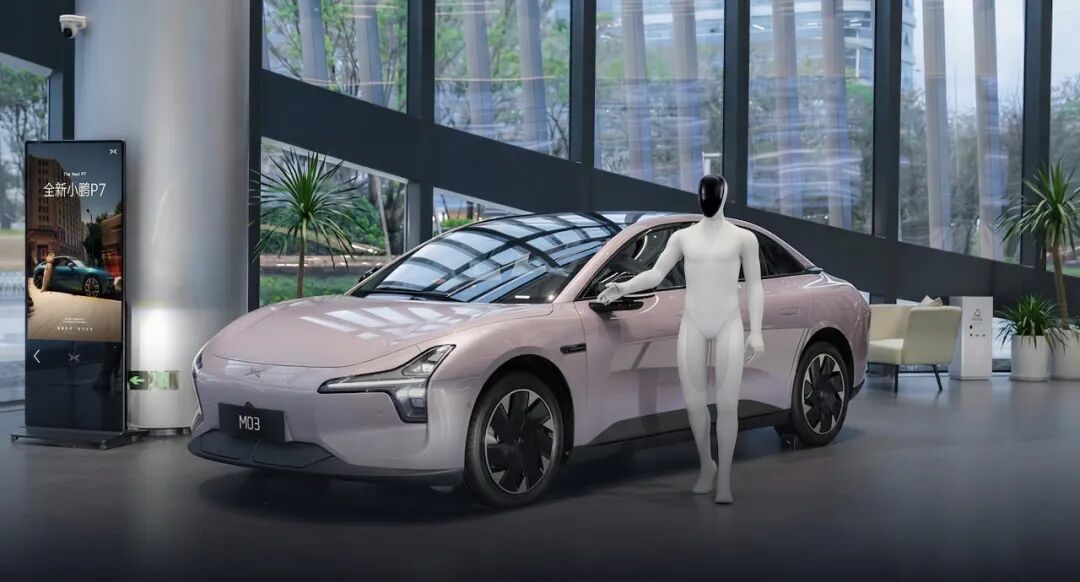
A few days ago, Xiaopeng Motors unveiled its plan to introduce the IRON humanoid robot to the global market by 2027, aiming for a monthly production volume of 1,000 units by the end of 2026. In the first quarter of 2027, the robot will initially serve as a store guide, with an international rollout scheduled for the second quarter.
Aren't humanoid robots typically designed for factory tasks, like tightening screws? Why is Xiaopeng taking a different approach?
Let's not jump to conclusions. First, let's examine some key figures.
What does a monthly production of 1,000 units really signify?
The verdict: By the end of 2026, this figure will represent a 'significantly meaningful production scale,' moving beyond mere prototype assembly.
What does that entail? Let me clarify with a comparison.
In 2025, the global shipment volume of humanoid robots is estimated at around 17,000 units, with Chinese companies contributing 84.7% of this total.
Among them, Unitree leads with over 5,500 units, followed by Agility Robotics with over 4,000 units—these two companies currently occupy the top tier in domestic mass production.
What about Tesla? Optimus was still in the pilot production phase last year, with shipments falling short of 1,000 units. Figure AI fared even worse, shipping only about 150 units throughout the year, primarily for testing at BMW factories.
So, what does Xiaopeng's goal of 1,000 units monthly by the end of the year imply? On an annualized basis, that's 12,000 units, a figure that would have ranked third globally last year. Of course, by year-end, Unitree and Agility Robotics will also be ramping up production, having already shipped over 10,000 units in the first half.
Objectively speaking, Xiaopeng's production target places it at the forefront of the second tier domestically—not as swift as Unitree and Agility Robotics, but already surpassing Tesla and numerous startups.
Crucially, Xiaopeng benefits from an 110,000-square-meter full-chain production base in Guangzhou's Tianhe District, which commenced construction in February and reached ground level by June. This pace aligns with He Xiaopeng's style—reminiscent of the rhythm preceding the mass production of the G3 model in the past.
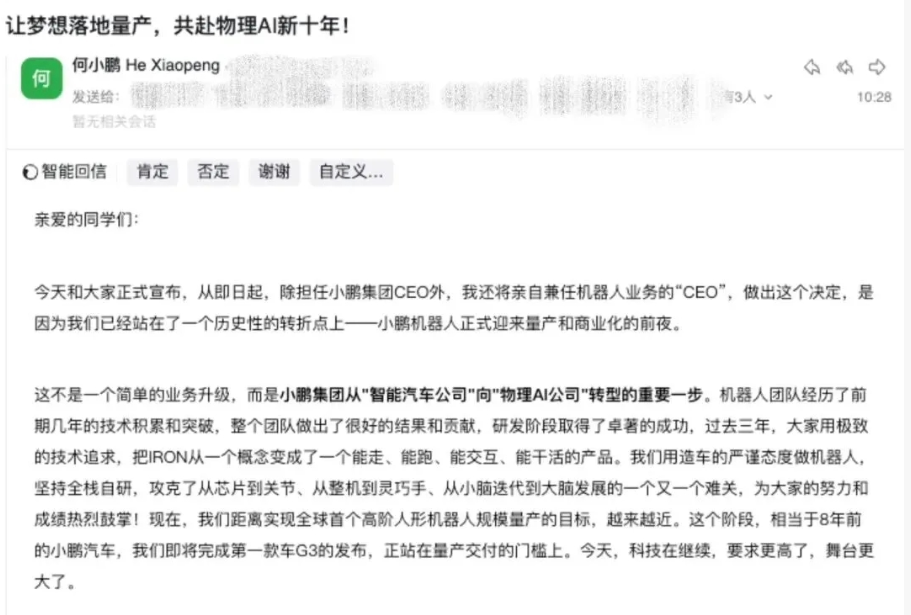
Interestingly, on June 10th, He Xiaopeng sent an internal letter, personally assuming the role of CEO for the robotics business, likening the current stage to the 'eve of mass production for the G3 eight years ago.' This statement carries significant weight, indicating a serious commitment rather than a mere experiment.
Why start with stores rather than factories?
This is the most intriguing aspect.
Tesla has Optimus working in factories, tightening screws. BYD's robots are undergoing testing in its workshops. Xiaomi's CyberOne is 'interning' in factories. So, why is Xiaopeng's strategy 'store guides first'?
Simply put, it boils down to cost-effectiveness—domestic factory labor costs are too low, rendering it uneconomical for robots to perform factory tasks.
He Xiaopeng himself explained at AI Day: 'Dexterous hands are costly, and tightening screws isn't cost-effective. The safety and generalization capabilities for home use are still inadequate. Store guides represent a realistic starting point.' Let me elaborate. Domestic factory workers earn between 4,000 and 8,000 yuan monthly. A humanoid robot costs at least 200,000 yuan upfront, with dexterous hands lasting only six to eight months. Including maintenance costs, the return on investment (ROI) period for replacing workers is lengthy, or may not be feasible at all.
However, stores present a different scenario. Sales guides in first-tier cities earn between 5,000 and 10,000 yuan monthly, plus social insurance, with high turnover and training costs.
More importantly, robot guides attract foot traffic. Positioned in a store, they become a marketing event—saving on advertising costs with the novelty of an 'AI guide in a suit.'"
Moreover, Xiaopeng has a unique advantage: 732 existing stores.
Unitree and Agility Robotics are also opening stores, but theirs are 'stores that sell robots,' requiring channel-building from scratch. Xiaopeng's are 'stores where robots sell cars,' with established demand and locations—robots simply enhance the experience.
Furthermore, the data value derived from store scenarios far exceeds that from factories. In factories, robots perform repetitive actions, providing limited data for generalization.
In stores, robots interact with real users daily, observing human behavior. This interaction data can be directly fed into VLA large models, enhancing not only robot capabilities but also autonomous driving perception and decision-making.
This strategy achieves three objectives simultaneously: technology validation, marketing, and data accumulation.

Automakers Entering the Humanoid Robot Race: Two Distinct Factions
You may not realize it, but 12 mainstream automakers in China have already ventured into the humanoid robot race.
Upon closer examination, they fall into two distinct factions.
One is the heavy-asset faction—Xiaopeng, BYD, Chery, Xiaomi, GAC, and Changan—all developing their own robots, establishing independent subsidiaries, and investing heavily in full-stack solutions. Essentially, they aim to be rule-makers, not just investors.
The other is the light-asset faction—companies like NIO and Li Auto, which invest in a few startups and assign a few R&D positions to test the waters, waiting to go all-in once the technology matures.
Neither approach is inherently right or wrong; they simply reflect different risk preferences. The heavy-asset faction bets on 'defining the product,' while the light-asset faction bets on 'it's too early to enter now; we can wait and see before going all-in.'"
Regardless of the faction, the underlying logic for automakers entering the humanoid robot race remains the same: the perception-decision-execution technology stack of autonomous driving highly overlaps with that of humanoid robots.
The vision, chips, and end-to-end large models for autonomous driving can be slightly adapted for robots, with a technology reuse rate of up to 70%.
This is why startups suddenly face increased pressure after automakers enter the field—automakers not only possess financial resources but also supply chains, manufacturing capabilities, scenarios, and data loops.
Of course, technology route choices will also diverge.
BYD opts for factories, Xiaopeng for stores, and Chery for overseas markets—each with its rationale. BYD has an internal demand of 20,000 units, so it naturally serves itself first. Xiaopeng believes factories offer poor ROI, so it starts with stores. Chery directly deploys robots in Malaysian 4S stores, where higher labor costs make the ROI feasible.
Speaking of Xiaopeng IRON, its biggest variable isn't technology—after all, with full-stack self-development and autonomous driving reuse, the technical foundation is solid. The biggest variable is whether the real-world experience in store scenarios proves effective.
Currently, most store robots are still at the 'greeting performance' stage—more static displays, fewer dynamic demonstrations, and even fewer actually performing real work.
If IRON ends up as just a 'decorative piece' in stores, this commercialization route won't be sustainable.
Battery life is also a major concern. Current humanoid robots typically last 2 to 4 hours, insufficient for an 8-hour store shift. Whether all-solid-state batteries can solve this remains to be seen in practice.
For humanoid robots, the keyword for 2026 has shifted from 'can we make it' to 'can we sell it.' We'll wait and see how the year-end production numbers unfold.

Article content is sourced from publicly available information and represents personal viewpoints only.
-
![]()
Casarte Holds the Fort, COLMO Catches Up, Samsung Exits: Who Will Have the Last Laugh?
-
![]()
Striving to Lead in New Energy: Anhui's Challenge to Overcome the 'Hefei vs. Wuhu' Rivalry
-
![]()
Four Anhui Pioneers: Two Decades Shaping China’s Auto Industry
-
![]()
Important to Observe: BYD Surges 20% Against Market Trend in July, Will It Reclaim the 1 Trillion Yuan Mark or Soar Even Higher?
-
![]()
Autonomous Driving Enters the Second Half: ByteDance Enters the Field, NVIDIA Restructures, and the First IPO Emerges
-
![]()
Service Takes Center Stage: A 2026 Mid-Year Analysis of BBA Reputation Index
-
![]()
The Paradox of Car Sales: Why Do Automakers Keep Launching New Models Amid Rising Losses?
-
![]()
"If We Can't Find a Breakthrough in Three Years, We're Finished": Japanese Cars Are Increasingly Emulating Chinese Models