Service Takes Center Stage: A 2026 Mid-Year Analysis of BBA Reputation Index
 07/17 2026
 412
412
The automotive market has witnessed further adjustments in the first half of 2026. With the growing penetration of new energy vehicles, overseas brands still relying on fuel vehicles have seen their market performance stagnate, putting considerable pressure on dealers. Amid this intense competition, luxury brands are also facing emerging derivative issues. According to reputation feedback data from Qichemen.com, alongside declining sales, BBA brands have encountered product issues, such as parts and assembly defects, as well as service-related problems, which have become the primary concerns highlighted in user feedback.
In this edition, we present a concise analysis based on the reputation index for the first half of 2026.
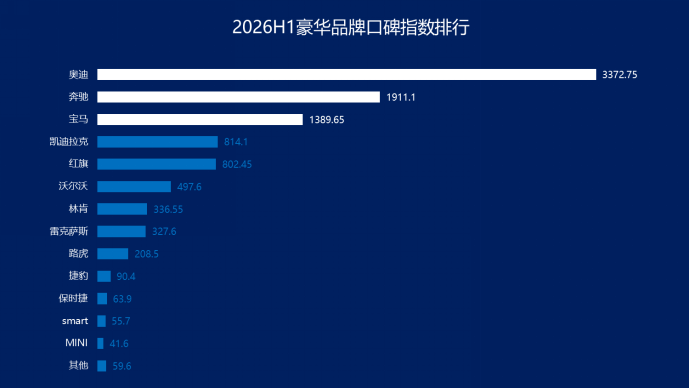
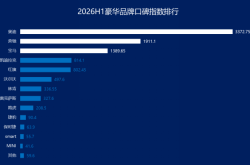
Unsurprisingly, Mercedes-Benz, BMW, and Audi once again topped the luxury brand reputation index in the first half of this year, significantly outperforming other luxury brands. Notably, Audi's reputation index was notably higher than those of Mercedes-Benz and BMW, accompanied by the highest rate of problem feedback.
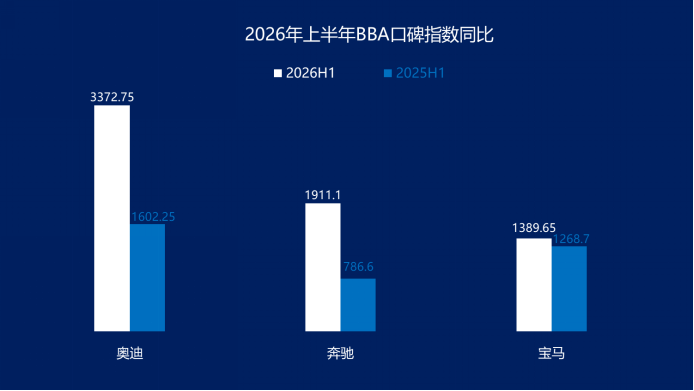
Data indicates that the reputation indices for Mercedes-Benz, BMW, and Audi in the first half of this year surpassed those of the same period last year. Audi's reputation index more than doubled year-on-year, exceeding the combined total of Mercedes-Benz and BMW. Mercedes-Benz's reputation index nearly doubled, surpassing BMW. Among the top three, only BMW's complaint index remained relatively unchanged from the previous year.
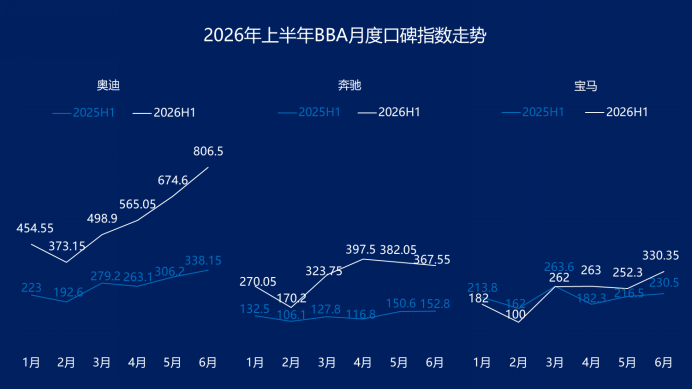
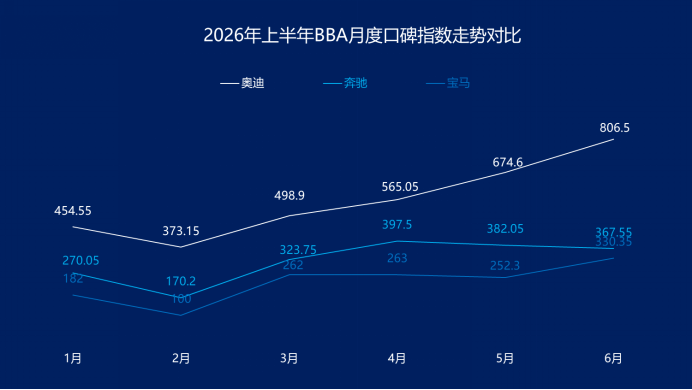
Analyzing the monthly trends of the three major luxury brands, Audi and Mercedes-Benz saw significantly higher monthly reputation indices in the first half of this year compared to the same period last year. Furthermore, over the past four months, the complaint indices for these two brands, particularly Audi, have continued to rise. BMW's reputation index has remained relatively stable, although it has shown an upward trend in the past three months.
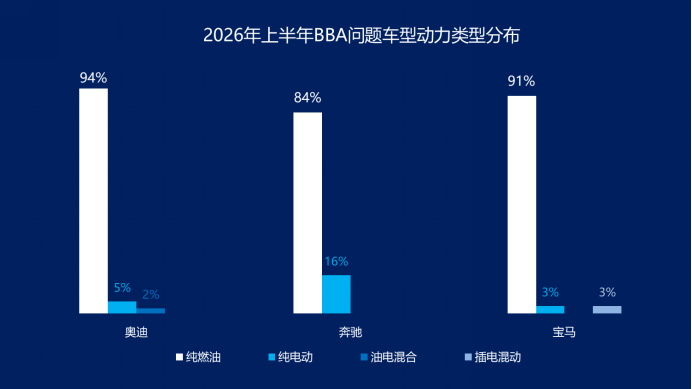
From the perspective of powertrain types in problematic models, fuel vehicles have emerged as the primary source of problem feedback. The proportion of problem feedback for fuel vehicles from Audi and BMW both exceeded 90%, while for Mercedes-Benz, it exceeded 80%. Interestingly, problem feedback for electric vehicles from Mercedes-Benz reached 16%, significantly higher than that from Audi and BMW. This indirectly reflects the market situation of electric vehicles among the top three brands.
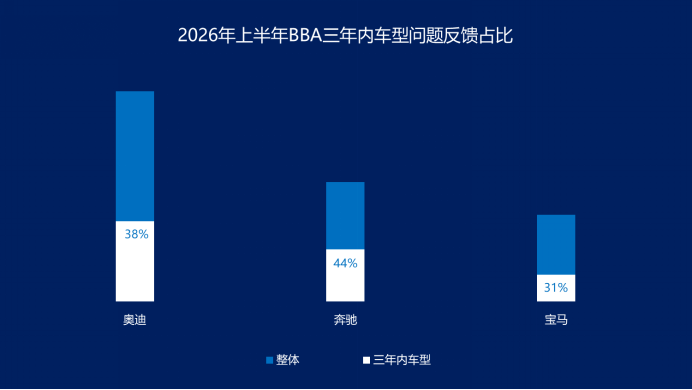
Regarding the model years of problematic vehicles, Mercedes-Benz had the highest proportion of problem feedback for models within three years, reaching 44%. Audi's proportion for models within three years was slightly lower than Mercedes-Benz, while BMW had the lowest rate, at only 31%.
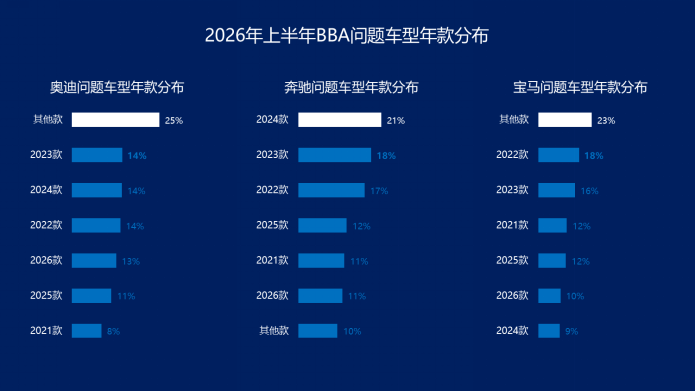
Specifically, problem feedback for models across all years from the three brands was relatively balanced. In comparison, the models with the most problem feedback for both Audi and BMW were those over six years old. The 2024 model year emerged as the largest source of problem feedback for Mercedes-Benz. It is noteworthy that while the 2025 model year has the highest proportion of problem feedback for many brands, it only accounts for slightly over 10% for the three major luxury brands, reflecting their market presence to a certain extent.
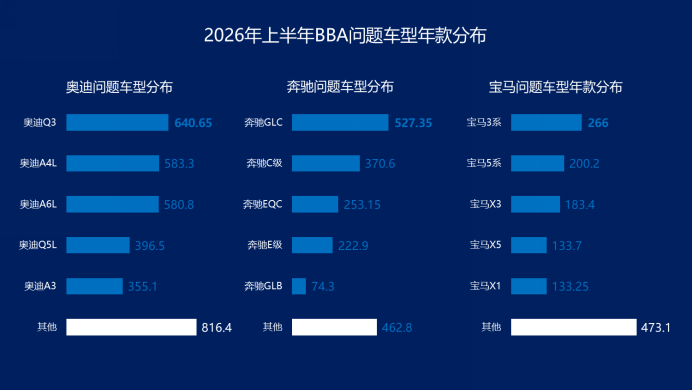
The distribution map of problematic models reveals that the top five models in the problem feedback rankings for the three brands are all popular models from each brand. The Audi A4L, A6L, Q5L, Mercedes-Benz C-Class, E-Class, and GLC-Class, and BMW 3 Series, 5 Series, and X3 all made the list. Notably, the Mercedes-Benz EQC, which does not have high sales, ranked third in Mercedes-Benz's list of problematic models, indicating concentrated feedback incidents regarding this vehicle.
Horizontally, Audi models generally boast a higher reputation index than Mercedes-Benz models in the same class. In turn, Mercedes-Benz models generally have a higher reputation index than BMW models. For instance, the reputation index of the Audi Q3 is significantly higher than that of the Mercedes-Benz GLB and BMW X1; the Audi A4L surpasses the Mercedes-Benz C-Class and BMW 3 Series; the Audi A6L has significantly more problem feedback than the Mercedes-Benz E-Class and BMW 5 Series. A notable exception is the Mercedes-Benz GLC, which has a significantly higher reputation index than the Audi Q5L and BMW X3, due to concentrated problem feedback in the first half of this year.
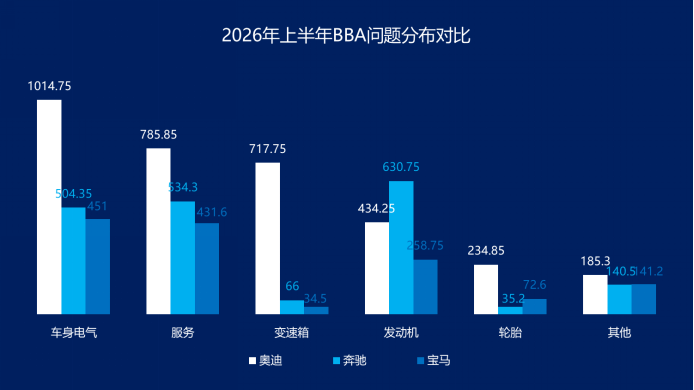
From the composition of complaint issues, the main problems of the three major luxury brands generally fall into three categories: vehicle electrical systems, service, and engines. Audi has significantly more problem feedback regarding vehicle electrical systems and service than Mercedes-Benz and BMW. In particular, Audi's transmission has also become a focal point of problem feedback. Due to concentrated problem feedback, Mercedes-Benz's engine reputation index is significantly higher than those of Audi and BMW. It is also worth mentioning that Audi's tire reputation index is relatively high, driven by recent tire cracking issues.
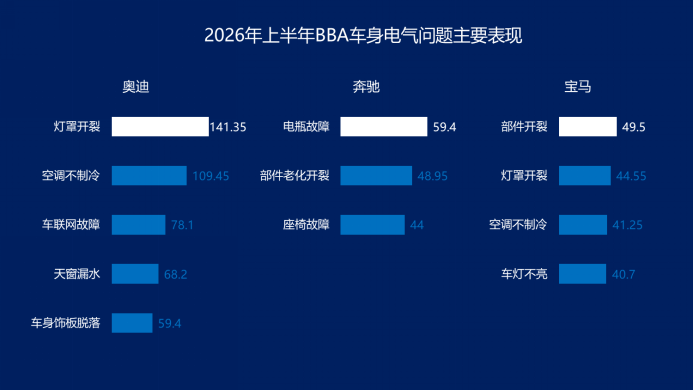
Regarding the most significant vehicle electrical system problems, Audi has a relatively high number of major issues with a high feedback rate. Feedback data shows that Audi owners have continued to complain about issues such as deformed lamp covers, malfunctioning air conditioning, cracked body panels, inability to connect to the internet via the infotainment system, and sunroof leaks. BMW also has a relatively high number of complaints about vehicle electrical systems, with issues such as malfunctioning air conditioning, cracked taillights, and battery failures having multiple cases, but the concentration of problems is lower than that of Audi. Mercedes-Benz has significantly fewer vehicle electrical system problems, with battery drainage being the main issue.
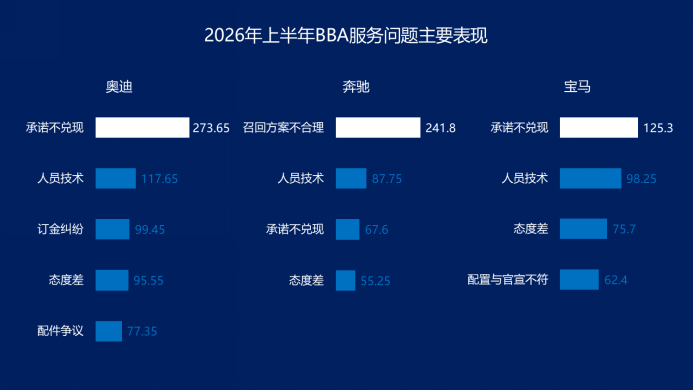
In terms of service, unfulfilled promises have become the most complained-about issue by Audi and BMW owners. Feedback indicates that a large number of owners have complained about the failure to fulfill subsequent vehicle maintenance, as well as various subsidies and complimentary benefits. Many owners have reported that maintenance has become an issue due to dealership closures. At the same time, personnel skills have become a common issue among the three major BBA luxury brands, with poor personnel attitudes, poor technical skills, and new problems arising from repairs being common complaints. This indicates that the current sluggish performance of luxury brands not only places significant pressure on dealership operations but also affects the subsequent vehicle usage experience of owners. Additionally, since the beginning of this year, the locking of battery capacity after the recall of the Mercedes-Benz EQC has been a focal point of complaints from owners, leading to a sudden increase in Mercedes-Benz's service complaint index.
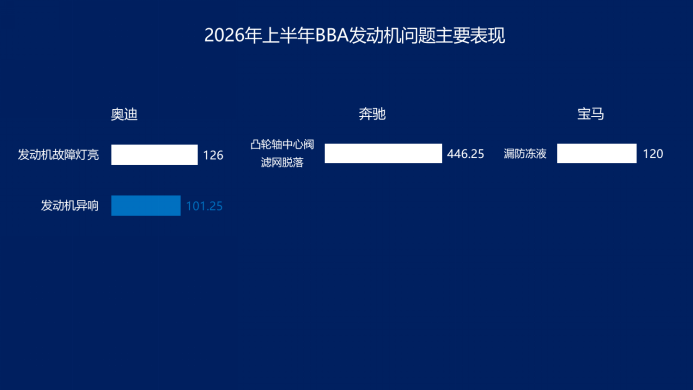
It is worth mentioning that engine problems have also become a more frequently reported issue for BBA since the first half of this year, especially for Mercedes-Benz. This is because, in April and May of this year, owners of the 2023 and 2024 Mercedes-Benz C-Class and GLC collectively reported potential issues with the detachment of the camshaft screw filter screen in their vehicle engines. It is reported that subsequent models have been improved. Therefore, many owners are requesting that Mercedes-Benz replace the parts to eliminate the potential hazard. BMW's engine problems mainly continue to manifest as coolant leaks, which have persisted for many years. For Audi, the engine fault light illuminating and engine noise have become two major complaints. Low oil levels, camshaft failures, and various types of noise are all manifestations of the issues.
Summary:
Overall, in the first half of this year, the reputation indices of BBA brands were all higher than those in the same period last year. Especially, Audi and Mercedes-Benz saw their reputation indices more than double year-on-year. At the same time, new changes have also emerged in the reputation indices of the three major luxury brands: the proportion of problem feedback for models within three years is lower than that in the same period last year, while the proportion of problem feedback for models over six years old has significantly increased. The decrease in problem feedback rates for new vehicles, especially the 2025 model year, also reflects, to a certain extent, the current market performance of BBA.
In comparison, the reputation index of Audi models remains higher than those of Mercedes-Benz and BMW models. Among them, problem feedback rates for vehicle electrical systems, service, and especially transmission issues, far exceed those of Mercedes-Benz and BMW.
It is worth mentioning that in the first half of this year, service issues for BBA have been particularly noteworthy. From user feedback, issues such as dealerships not refunding deposits and unfulfilled promises have become focal points of concern for many users.
(Images sourced from the internet, removed if infringing)
-
![]()
Casarte Holds the Fort, COLMO Catches Up, Samsung Exits: Who Will Have the Last Laugh?
-
![]()
Striving to Lead in New Energy: Anhui's Challenge to Overcome the 'Hefei vs. Wuhu' Rivalry
-
![]()
Four Anhui Pioneers: Two Decades Shaping China’s Auto Industry
-
![]()
Important to Observe: BYD Surges 20% Against Market Trend in July, Will It Reclaim the 1 Trillion Yuan Mark or Soar Even Higher?
-
![]()
Autonomous Driving Enters the Second Half: ByteDance Enters the Field, NVIDIA Restructures, and the First IPO Emerges
-
![]()
Service Takes Center Stage: A 2026 Mid-Year Analysis of BBA Reputation Index
-
![]()
The Paradox of Car Sales: Why Do Automakers Keep Launching New Models Amid Rising Losses?
-
![]()
"If We Can't Find a Breakthrough in Three Years, We're Finished": Japanese Cars Are Increasingly Emulating Chinese Models