Autonomous Driving Enters the Second Half: ByteDance Enters the Field, NVIDIA Restructures, and the First IPO Emerges
 07/17 2026
 486
486
Preface
TrueView
For nearly a decade, the narrative of technological breakthroughs has dominated, yet the true turning point for autonomous driving has little to do with code and parameters. Instead, it stems from triple shocks in capital, industry, and division of labor.
We’ve witnessed the industry move from labs to millions of new vehicles, but we must also confront the fundamental laws of the business world. Mass production is merely an entry ticket, not a guarantee of profitability. Declining hardware costs do not automatically translate into profits.
As the tide of euphoria recedes, the struggle for ecological niches and the test of cash flow become the true themes of the second half.
This article will focus on analyzing:
1. How are the three groups of players reshaping the industrial power landscape?
2. Why has a significant cost reduction pushed the industry further from overall profitability?
3. Where is the survival space and core competitive moat for independent Tier 1 suppliers?
4. What is the true path to commercialization for Robotaxi?
Content/Jin Huan
Editor/Yong E
Proofreader/Mang Fu
The series of “major events” in the autonomous driving industry are accelerating the arrival of a critical moment—not a technological singularity, but a violent fluctuations (fierce shake-up) in capital and industrial structure.
On July 8, Momenta went public on the Hong Kong Stock Exchange as the “first physical AI stock.” Before the cheers from the bell-ringing faded, two signals from different directions jolted the industry back to reality.
NVIDIA’s autonomous driving division underwent a major restructuring, with former XPeng intelligent driving lead Xinzhou Wu consolidating core authority and pushing software-hardware full-stack integration to the extreme. Meanwhile, ByteDance quietly assembled a world model team, using AI infrastructure to enter this once heavily fortified industry through an unnoticed side door.
Together, these three events paint a real picture of autonomous driving’s second half. When mass production is no longer a get-out-of-jail-free card and plummeting hardware costs fail to bring industry-wide profitability, a new round of reshuffling centered on ecological niches, cash flow, and industrial division boundaries has begun.
Part.1 The Supply Chain Truth: The Prosperity and Ledger of NOA
“Available nationwide”—this phrase, beloved by automakers and intelligent driving suppliers since 2024, has not only upgraded to “available globally” but is also becoming the industry’s biggest cognitive bubble.
150,000-yuan-class models now come standard with urban NOA, and “intelligent driving for all” is shouted loudly... Yet the industry’s power structure has never been more turbulent. Technical barriers are being reconstructed by AI paradigms, mass production delivery capabilities have replaced parameter metrics as the new competitive anchor, and both new and old players stand at a crossroads of reshuffling.
NVIDIA’s organizational adjustment is the clearest signal of a global shift toward mass production priority in the intelligent driving industry. Nearly three years after Xinzhou Wu took office, he has finally consolidated real power over autonomous driving operations. Veteran Sarah Tariq has stepped back from core roles, former Qualcomm autonomous driving engineering head Dheeraj Ahuja has joined, and the underlying system software team has been formally transferred to the autonomous driving division.
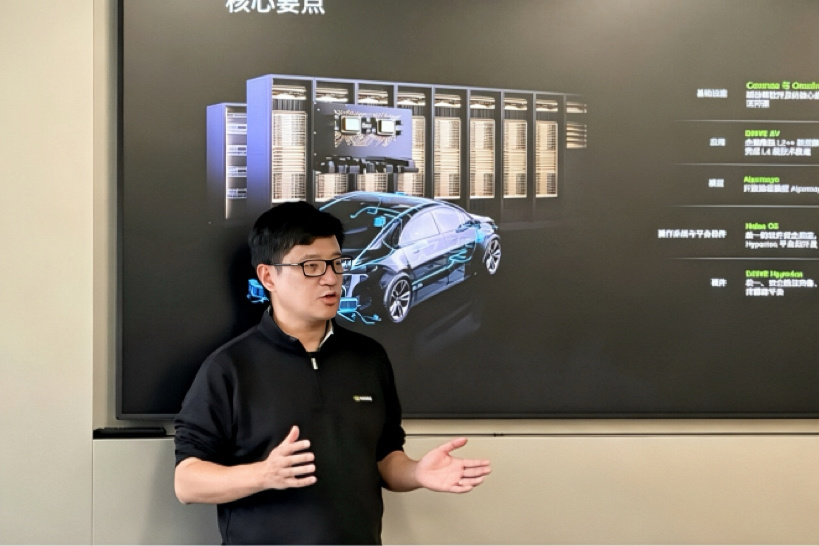
The figure is Xinzhou Wu
The intent behind this series of moves is clear: break up the original technology-oriented structure, bolster engineering and mass production delivery capabilities, and transform NVIDIA from a compute supplier into a full-stack intelligent driving solution provider.
Jensen Huang set a 2026 revenue target of $5 billion for the autonomous driving business, yet less than half has been achieved so far. To deliver on this promise, NVIDIA can no longer rely on showcasing compute power and models—it must secure more mass production design wins from automakers and ensure delivery.
The trend of Chinese intelligent driving players going global is also forcing NVIDIA to accelerate engineering iterations. After losing domestic market share to Horizon Robotics, Huawei, and other local players, overseas markets have become NVIDIA’s lifeline. Wu’s mass production experience and industry resources are the core assets in this defensive battle.
If NVIDIA’s pivot represents a giant’s self-revolution, ByteDance’s crossover is a dimensional strike from outside the industry. Led by Seed’s Zhou Chang’s world model team, ByteDance’s autonomous driving exploration never followed the traditional automaker or Tier 1 path. Instead, it targeted cost-effective areas like data labeling and simulation testing, leveraging Volcano Engine’s automotive industry line to deploy unmanned logistics scenarios.
The essence of this logic is betting on AI paradigms to rewrite intelligent driving thresholds. When world models become industry consensus and perception and planning increasingly rely on large models and compute, the core competitiveness of intelligent driving will no longer be a decade of accumulated engineering experience but data, compute, and general model capabilities.
ByteDance has ample compute reserves and a mature large model training system—what it lacks is traffic scene data and engineering delivery capabilities. With sufficient resources, ByteDance can accumulate the former through unmanned logistics scenarios and rapidly fill the latter by recruiting talent.
If world models can truly compress the infinite scenarios of open roads into high-fidelity virtual worlds, testing and validation costs could drop by an order of magnitude. While this remains a lab-stage concept today, its mere existence sends chills down the spines of traditional simulation suppliers.
More importantly, autonomous driving is not an isolated business for ByteDance but a training ground for embodied AI. Just as Tesla uses FSD data to feed Optimus, ByteDance needs real-world road data to iterate its world models for broader embodied AI applications.
Momenta’s IPO adds a critical capital dimension to this structural shift.

Momenta represents a dual-track approach of mass production solutions and Robotaxi. Its market debut is an industry milestone, signifying that the mass production intelligent driving sector has finally produced a scalable revenue target, with Tier 1 market stories now facing secondary market scrutiny.
Prospectus data shows Momenta’s revenue surged from 743 million yuan in 2023 to 2.413 billion yuan in 2025, with gross margins improving from 17.5% to 71.6%, intuitively validating the growth potential of the mass production intelligent driving business model.
As the first independent intelligent driving company to go public, Momenta will also gradually validate the long-term profitability potential of its dual-wheel-drive model under public market scrutiny.
Part.2 The Profitability Dilemma: The Real Ledger Behind the Mass Production Frenzy
The industry consensus is that Large scale cost reduction (scalability-driven cost reduction) will prevail—once volumes rise, hardware costs will dilute, and profitability will follow naturally.
Yet the reality is that more automakers are bundling intelligent driving as a free standard feature rather than a premium option. While leading intelligent driving companies have doubled revenue, losses have widened simultaneously. Mass production has not brought a profitability turning point but dragged the industry into a paradox: the more you sell, the more you lose.
Even though material costs for LiDAR and domain controllers have plummeted in recent years—pure vision highway NOA BOM costs have dropped below 4,000 yuan, a 40% reduction in two years; LiDAR-equipped urban NOA solutions using Horizon Journey 6M have seen hardware costs fall to 4,500–5,000 yuan, a 43% drop—the marginal cost of fitting urban NOA into a 150,000-yuan family car is just 3–4%.
But cost reductions have not translated into synchronized profitability due to two key bottlenecks. The first is the trap of high penetration but low utilization.
MIIT data shows that since 2026, 70% of new passenger vehicles have been equipped with combined driving assistance functions, with NOA penetration exceeding 30%. Yet penetration ≠ utilization. Yuanrong Qixing CEO Zhou Guang publicly noted that in 2025, urban NOA’s actual user retention was just 20–30%. When features aren’t must-haves, automakers struggle to charge sustained premiums for intelligent driving.
The second bottleneck is the rigid pressure of R&D amortization. In 2025, the automotive manufacturing industry’s overall profit margin was just 4.1%, sliding further to 3.2% in Q1 2026—razor-thin Vehicle profit (vehicle margins). Even with intelligent driving hardware costs down to the 5,000-yuan level, full-series standardization directly impacts vehicle gross margins. Thus, most brands still bundle high-end intelligent driving with specific trims or 10,000-yuan option packages.
For suppliers, algorithm R&D is a rigid investment. Leading firms typically invest over 1 billion yuan annually in R&D, with Momenta spending 1.87 billion yuan in 2025 (77.5% of revenue).
High R&D spending is necessary to maintain technical competitiveness, but it also means that a significant portion of scalability-driven cost reduction dividend must continuously flow back into technology iteration, making it hard to directly convert into net profits.
Beyond per-vehicle cost accounting, SAIC Motor’s famous quote from years ago—“not surrendering the soul to Huawei”—has evolved into a collective awakening across the industry.
Virtually all automakers selling over 300,000 units annually have launched or accelerated self-research of core intelligent driving algorithms. BYD’s intelligent driving team has expanded to 5,000 people, new forces continue to ramp up full-stack self-research, and even long-hesitant joint ventures have begun establishing independent R&D centers in China.
In July 2025, BMW Brilliance set up its first and only IT R&D center in China in Nanjing—its largest in Asia—focusing on core technologies like smart cockpits, intelligent driving assistance systems, and AI large model applications. In April 2026, Audi and SAIC Motor jointly established the “Audi Innovation Technology Center” in Shanghai to develop AI-powered smart cockpits and advanced driving assistance systems tailored for Chinese users.
Automakers’ demand for intelligent driving suppliers is rapidly downgrading from turnkey solutions to “underlying hardware + basic toolchains + pluggable modular software.”
Behind this shift lies automakers’ anxiety over data sovereignty, iteration efficiency, and cost control. Intelligent driving has replaced the tri-electric system as the core battleground for differentiation in the electric vehicle era’s second half. An automaker that doesn’t control driving decision algorithms cedes final authority over user experience.
More critically, intelligent driving capabilities heavily rely on data closures. If core algorithms remain with suppliers, automakers are perpetually held hostage.
The rise of white-box delivery and joint development models essentially represents automakers dismantling suppliers’ technical barriers. Suppliers provide chips and basic software, while automakers handle upper-layer algorithms and data training.
For suppliers like Horizon Robotics and Momenta, this means sustained pressure on profit margins.
Custom projects yield meager profits, while standardized products lack pricing power. More clients and higher volumes often translate to higher labor costs and lower gross margins—scaling up production degrades profit quality, a dilemma all Tier 1 suppliers face.
The subscription model’s rosy outlook also struggles against real-world payment habits. The industry once hailed subscriptions as the ultimate path to intelligent driving profitability: one-time hardware costs covered by vehicle prices, with software subscriptions as pure profit. Tesla’s FSD subscription model was widely emulated domestically.
But domestic market data is far less optimistic. Subscription revenue may contribute incremental growth but cannot yet support intelligent driving profitability.
Part.3 The Business Model Crucible: The Second Half’s Winning Factors Aren’t Technical
When mass production is no longer a rare capability and technical experiences rapidly converge, the competitive logic of autonomous driving has shifted. The first half was won by technological breakthroughs; the second half will be won by cost control, business positioning, and cash flow management.
Players across different tracks are diverging sharply.
The full-stack self-research automaker camp wins with closed loops but struggles with investment. Tesla, Xiaomi, XPeng, and Li Auto possess complete data closures and vehicle profit buffers. Intelligent driving can enhance brand premiums or explore value-added services like subscriptions.
The risk lies in industry price wars forcing intelligent driving into standard features, making R&D investment hard to recoup through single-product premiums.
For these players, intelligent driving isn’t a standalone profit unit but part of overall vehicle competitiveness. The accounting must consider brand and sales volume, not just individual features.
The solution provider camp wins with breadth but struggles with pricing. Horizon Robotics and Momenta serve multiple automakers, scaling rapidly without exposure to whole-vehicle market volatility.
But as automakers accelerate self-research, technical premiums will erode, likely relegating these players to chip and basic software roles—profitable but low-margin upstream positions.
Leading players with full-stack delivery capabilities can defend market share through engineering efficiency and cost advantages, while smaller suppliers may be eliminated in the next reshuffling, becoming cost-sensitive contract manufacturers.
The pure Robotaxi camp wins in the long term but struggles today. Pony.ai, WeRide, and others boast the highest technical barriers and the most imaginative long-term operational models but face the slowest commercialization.
In the domestic market, despite headway in fully driverless operations across multiple cities and declining per-vehicle hardware costs, overall profitability remains elusive.
An autonomous driving technical expert revealed that domestic Robotaxi per-vehicle daily revenue typically falls below 250 yuan, with annual revenue around 70,000–80,000 yuan. Annual per-vehicle labor costs average 40,000 yuan, and when hardware depreciation and maintenance are factored in, total annual costs reach ~140,000 yuan.
On balance, domestic Robotaxi operators lose ~50,000–60,000 yuan per vehicle annually. The industry’s so-called “per-vehicle unit economics turning positive” refers not to overall scalability profitability but to isolated profitability in high-performing vehicles.
Breakthrough hopes lie overseas. Robotaxi fares in some regions can reach 2.5–3x domestic levels, with only marginal cost increases. As cloud-based safety officer ratios improve, stable profitability could emerge first overseas.
Ultimately, autonomous driving will never have a unified profitability moment. It won’t suddenly become universally profitable after a single technological breakthrough. Profitability will emerge gradually across different links and players as industrial divisions Refactoring (restructure).
Like the smartphone industry, where some earned profits from brands, others from chips, and others from contract manufacturing, no one dominates the entire chain. Autonomous driving will follow suit: as technology demystifies and the industry matures, every player must find its ecological niche, abandon fantasies of total dominance, and accept stratification.
Momenta’s IPO is a milestone but not the finale. NVIDIA’s restructuring is defensive yet offensive. ByteDance’s crossover is a variable and an industry-wide opportunity.
The mass production frenzy will fade, and hardware cost reductions will plateau. The second half’s competition won’t be about whose algorithms look smoother in demo videos but who can unlock user value in low-retention markets, defend core barriers amid division reshuffling, achieve break-even first in overseas Robotaxi niches, and convert technical advantages into sustainable commercial edges before cash runs out.
For all players still at the table, the real battle begins at the moment when costs can no longer be reduced.
END
Wang Qingru
I have been keeping a close eye on major internet companies and leading enterprises in vertical industries, and welcome connections and communication.
-
![]()
Casarte Holds the Fort, COLMO Catches Up, Samsung Exits: Who Will Have the Last Laugh?
-
![]()
Striving to Lead in New Energy: Anhui's Challenge to Overcome the 'Hefei vs. Wuhu' Rivalry
-
![]()
Four Anhui Pioneers: Two Decades Shaping China’s Auto Industry
-
![]()
Important to Observe: BYD Surges 20% Against Market Trend in July, Will It Reclaim the 1 Trillion Yuan Mark or Soar Even Higher?
-
![]()
Autonomous Driving Enters the Second Half: ByteDance Enters the Field, NVIDIA Restructures, and the First IPO Emerges
-
![]()
Service Takes Center Stage: A 2026 Mid-Year Analysis of BBA Reputation Index
-
![]()
The Paradox of Car Sales: Why Do Automakers Keep Launching New Models Amid Rising Losses?
-
![]()
"If We Can't Find a Breakthrough in Three Years, We're Finished": Japanese Cars Are Increasingly Emulating Chinese Models