1100 Enterprises, Over 300 Worldwide Debuts! Six Key Highlights of the 2026 World Artificial Intelligence Conference
 07/17 2026
 570
570
This marks the 89th original article from the Thinking AI Society.
Approximately 2,130 words in total, with an estimated reading time of 6 minutes.
In the past, when the topic of artificial intelligence arose, the primary concerns revolved around: How extensive is the model? What is its benchmark score? Can it compose articles, create images, or produce videos?
However, by 2026, the focus of inquiry has shifted.
Now, the question on everyone's mind is: Beyond mere conversation, can AI genuinely accomplish tasks?
From July 17 to 20, the 2026 World Artificial Intelligence Conference will convene in Shanghai.
Let's delve into some statistics:
The exhibition area spans over 100,000 square meters, featuring participation from more than 1,100 enterprises, over 3,000 exhibits on display, over 300 worldwide product launches, and more than 140 forums with over 1,400 Chinese and international guests.
What does this signify?
This year, virtually all the hottest technologies, products, and companies in the global AI industry will converge in Shanghai.
So, what exactly should you be on the lookout for at this year's WAIC? Let's dissect it into six key points.
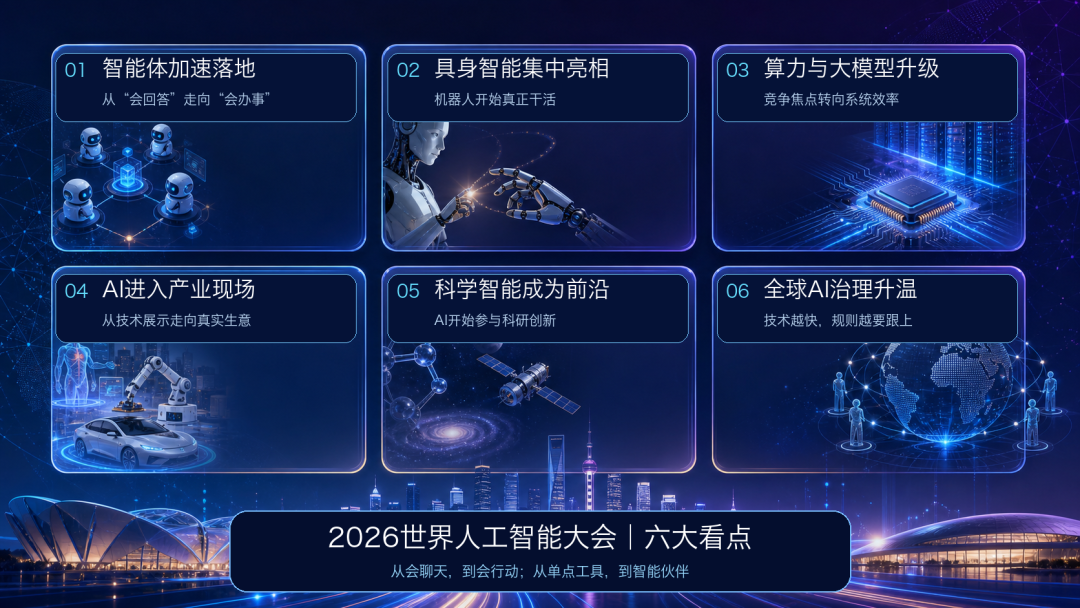
AI Agents Start Tackling Real-World Tasks
AI agents have become an unavoidable topic this year.
Traditional chatbots typically operate on a simple "you ask, it answers" basis. In contrast, AI agents must comprehend goals, dissect tasks, utilize tools, and continue acting based on results.
For instance, if tasked with creating a market report, an AI agent won't merely provide a template; it might also search for relevant information, organize data, generate charts, and deliver a comprehensive result.
This year's conference will delve into areas such as open-source AI agents, AI coding, and agent systems, with products like the Step Agent operating system and AI agent smartphones making their debut.
Additionally, the conference has established an OPC exhibition zone targeting "one-person companies" and super individuals, with 180 enterprises showcasing their achievements.
In essence, AI is lowering the barrier for individuals to accomplish tasks. Research, customer service, content creation, and development work that previously required a team may soon be completed by a single individual leading multiple AI agents.
However, impressive live demonstrations do not necessarily equate to real-world usability. Whether AI agents are stable, can integrate with enterprise systems, and offer sufficiently low costs are far more crucial factors to consider.
Robots Move Beyond Mere Demonstrations
While large models address issues in the digital realm, embodied AI aims to bring AI into the physical world.
At this year's WAIC, embodied AI will be one of the most active sectors.
Public information reveals that both the intelligent computing and embodied AI sectors have attracted over 200 enterprises, with multiple humanoid robots, AI dexterous hands, and related applications on display.
Previously, when observing robots, the primary focus was on their ability to run, jump, or move like humans.
Now, the industry is shifting its attention to a different set of questions: Can they operate continuously and stably? Can they comprehend complex environments? Can they genuinely enter scenarios such as factories, warehouses, inspections, and elderly care?
The true watershed for embodied AI is when robots transition from merely being able to move to being able to work effectively.
Computing Power Competition Transcends Chip Stacking
As large models become more powerful, the demand for computing power behind them also surges.
This year's conference will showcase products like large-scale supernodes, near-memory computing 3D chips, and multimodal large models. With over 200 exhibitors in the intelligent computing sector, the intensity of this competition is evident.
However, by 2026, the industry is no longer solely focused on comparing who possesses more chips or larger model parameters.
Once models are deployed in enterprises, inference speed, energy consumption, stability, and usage costs all directly impact their commercial value.
In the WAIC Academic agenda, topics such as GPU cluster scheduling, edge inference, and training fault recovery occupy prominent positions.
This indicates that large models have transitioned from a "capability race" in labs to an engineering phase. In the future, what truly creates differentiation may not just be the intelligence of the model, but the efficiency, stability, and cost-effectiveness of the entire AI system.
AI Begins to Penetrate Real Business Operations
The value of an AI conference is not solely measured by the number of models launched; it also hinges on the problems these technologies actually solve.
The conference features six major sections: forums and conferences, exhibitions, award competitions, application experiences, innovation incubation, and talent recruitment.
From public information, healthcare, automotive, industrial manufacturing, film and television creation, and urban governance will all be key application directions.
In healthcare, AI is entering auxiliary diagnosis and new drug development; in manufacturing, AI agents and robots are taking on quality inspection, scheduling, and inspections; in the automotive and entertainment industries, AI is being integrated into products and production processes.
AI consumer products are also noteworthy. From smartphones to companion robots, AI is evolving from a software feature into products that ordinary people can purchase and use continuously.
To determine whether these applications are truly practical or just stories, consider three factors: Is it a high-frequency need? Will users continue to use it? Is there a clear payment model?
AI Begins to Assist Scientists in Research
This year's conference introduces the high-level international academic conference WAIC Academic for the first time.
The conference is chaired by Turing Award winner Yao Qizhi, with "father of reinforcement learning" Richard S. Sutton serving as international co-chair.
Among these, AI for Science deserves special attention.
The official agenda already includes topics such as scientific multimodal agents, mathematical modeling and scientific computing, AI-driven quantum computing acceleration, and space-air-ground integrated intelligent computing.
In the past, AI primarily processed internet and enterprise data. Now, it's entering mathematics, physics, chemistry, materials science, and life sciences to assist in hypothesis generation, experimental design, and pattern discovery.
If this path proves successful, AI won't just help office workers improve efficiency; it could also transform scientific research itself.
The Faster Technology Advances, the More Important Rules Become
Another key role of WAIC is as a high-level global governance conference for artificial intelligence.
Why discuss governance?
Because when AI begins autonomously calling tools, processing data, and executing tasks, who is responsible when something goes wrong?
Is it the model provider, developer, deploying enterprise, or end user?
Additionally, data security, algorithmic bias, false content, intellectual property, and employment impacts are becoming increasingly difficult to ignore.
WAIC Academic has already set research themes like agent responsibility frameworks and large model watermark detection. The conference will also collaborate with multiple international organizations to discuss AI safety, development, and global cooperation.
Governance is not about stifling innovation; it's about building roads, guardrails, and traffic rules in advance.
This Year’s New Features
Beyond forums and exhibitions, this year's conference introduces five major ecosystems:
- WAIC Future Tech, connecting investment institutions, startups, and "one-person companies"; - WAIC CONNECT, facilitating alignment between AI technologies and real industrial needs; - WAIC UP!, sharing AI knowledge with the public; - WAIC YOUNG, focusing on youth innovation; - AI GRAVITY, serving international cooperation and enterprise globalization.
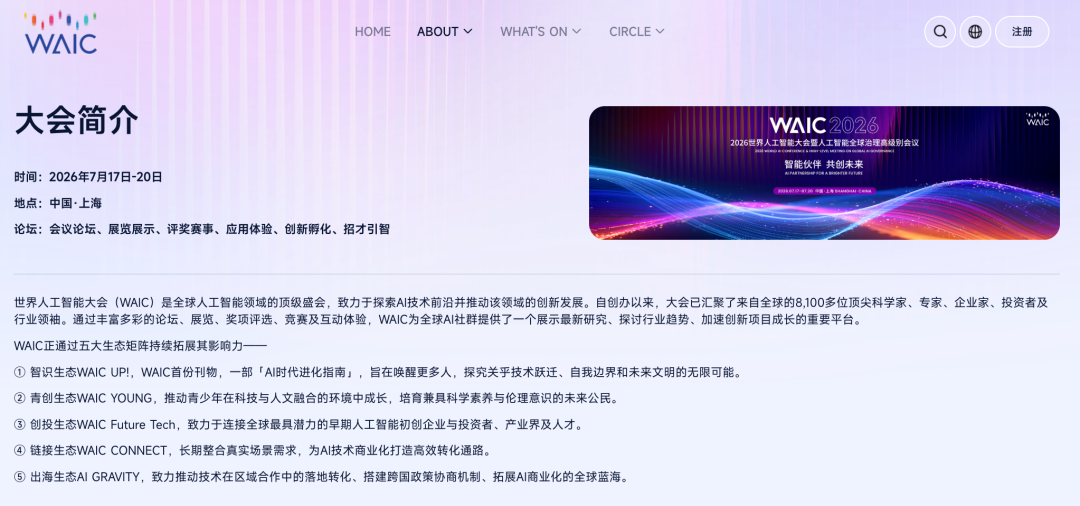
Source: WAIC Official Website
The organizers have also launched the "Hi WAIC" platform, built on a multi-agent architecture, allowing users to query events, register for tickets, and connect supply and demand.
This year, AI experiences aren't limited to the conference venue.
WAIC City Walk will collaborate with 16 districts in Shanghai, linking AI experience points in malls, parks, and neighborhoods to turn the entire city into a "wall-less AI exhibition hall."
Every AI conference brings new concepts, models, and products.
But this year, the real focus isn't on which robot performs best or which model has the most parameters.
The key is whether AI can stably complete tasks, enter real business operations, help enterprises reduce costs and improve efficiency, and form sustainable businesses.
From the information released at this year's WAIC, artificial intelligence is crossing an important threshold:
From chatting to acting; from standalone tools to intelligent partners.
That may be the most noteworthy signal from the 2026 World Artificial Intelligence Conference.

Article content is sourced from publicly available information and represents personal viewpoints only.
-
![]()
Casarte Holds the Fort, COLMO Catches Up, Samsung Exits: Who Will Have the Last Laugh?
-
![]()
Striving to Lead in New Energy: Anhui's Challenge to Overcome the 'Hefei vs. Wuhu' Rivalry
-
![]()
Four Anhui Pioneers: Two Decades Shaping China’s Auto Industry
-
![]()
Important to Observe: BYD Surges 20% Against Market Trend in July, Will It Reclaim the 1 Trillion Yuan Mark or Soar Even Higher?
-
![]()
Autonomous Driving Enters the Second Half: ByteDance Enters the Field, NVIDIA Restructures, and the First IPO Emerges
-
![]()
Service Takes Center Stage: A 2026 Mid-Year Analysis of BBA Reputation Index
-
![]()
The Paradox of Car Sales: Why Do Automakers Keep Launching New Models Amid Rising Losses?
-
![]()
"If We Can't Find a Breakthrough in Three Years, We're Finished": Japanese Cars Are Increasingly Emulating Chinese Models