A16Z's Latest Insight: 80% of Tokens Are Idle; Managing AI Is the Next Trillion-Dollar Opportunity
 07/17 2026
 458
458
Many people believe that artificial intelligence should replace human work.
The reality is exactly the opposite.
AI has not only failed to eliminate jobs but is creating them. Research by Ramp Economics Lab on 21,000 U.S. companies shows that two years after AI adoption, employee numbers at high-intensity AI users grew by 10.2%, while low-AI-spending companies saw little change.
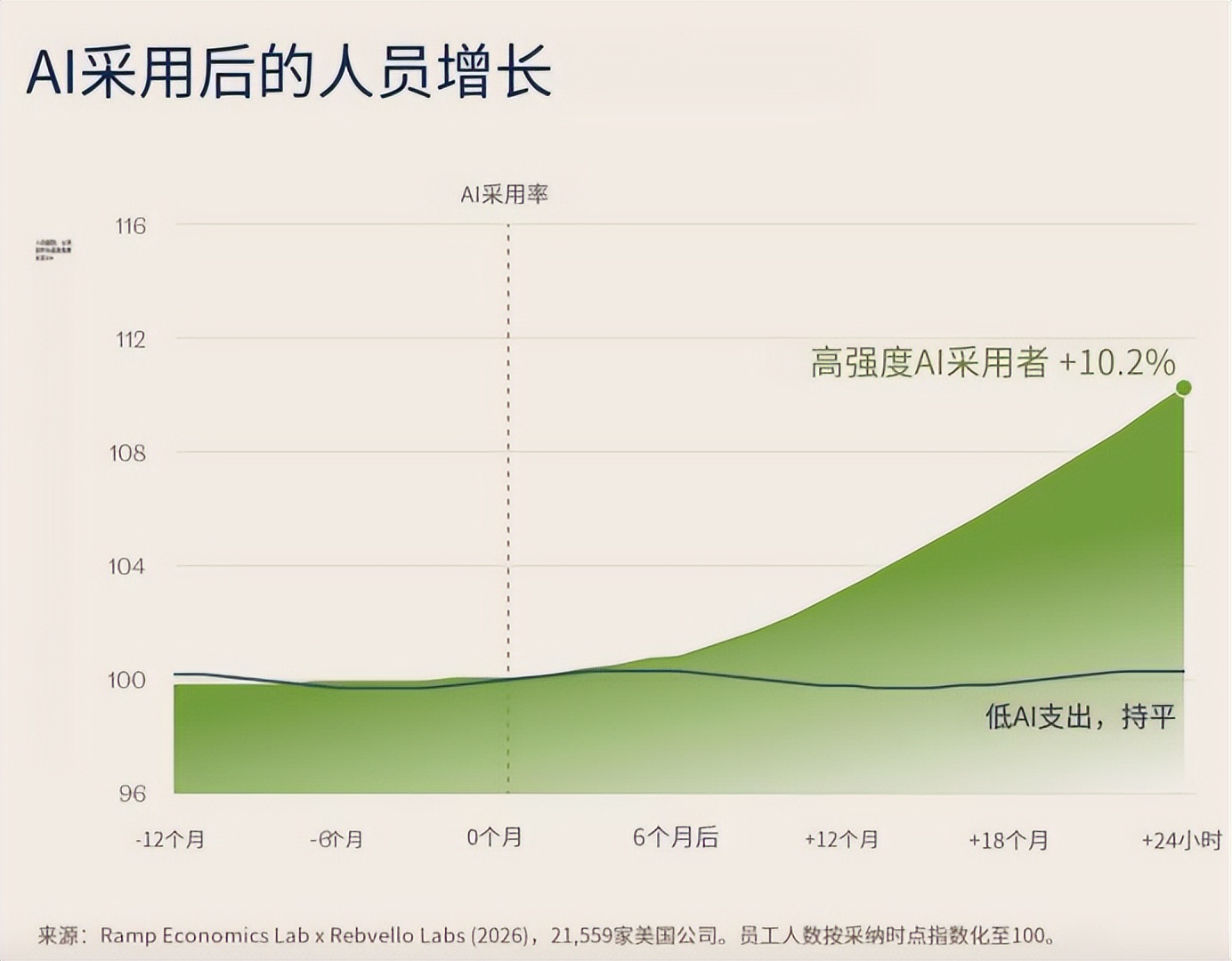
The reason is simple: humans are cheaper than AI.
Ramp data shows that among leading companies, AI spending per employee is expected to rise from about $20,000 in early 2025 to $225,000 by the end of 2026—far exceeding the average U.S. salary and software engineer pay.
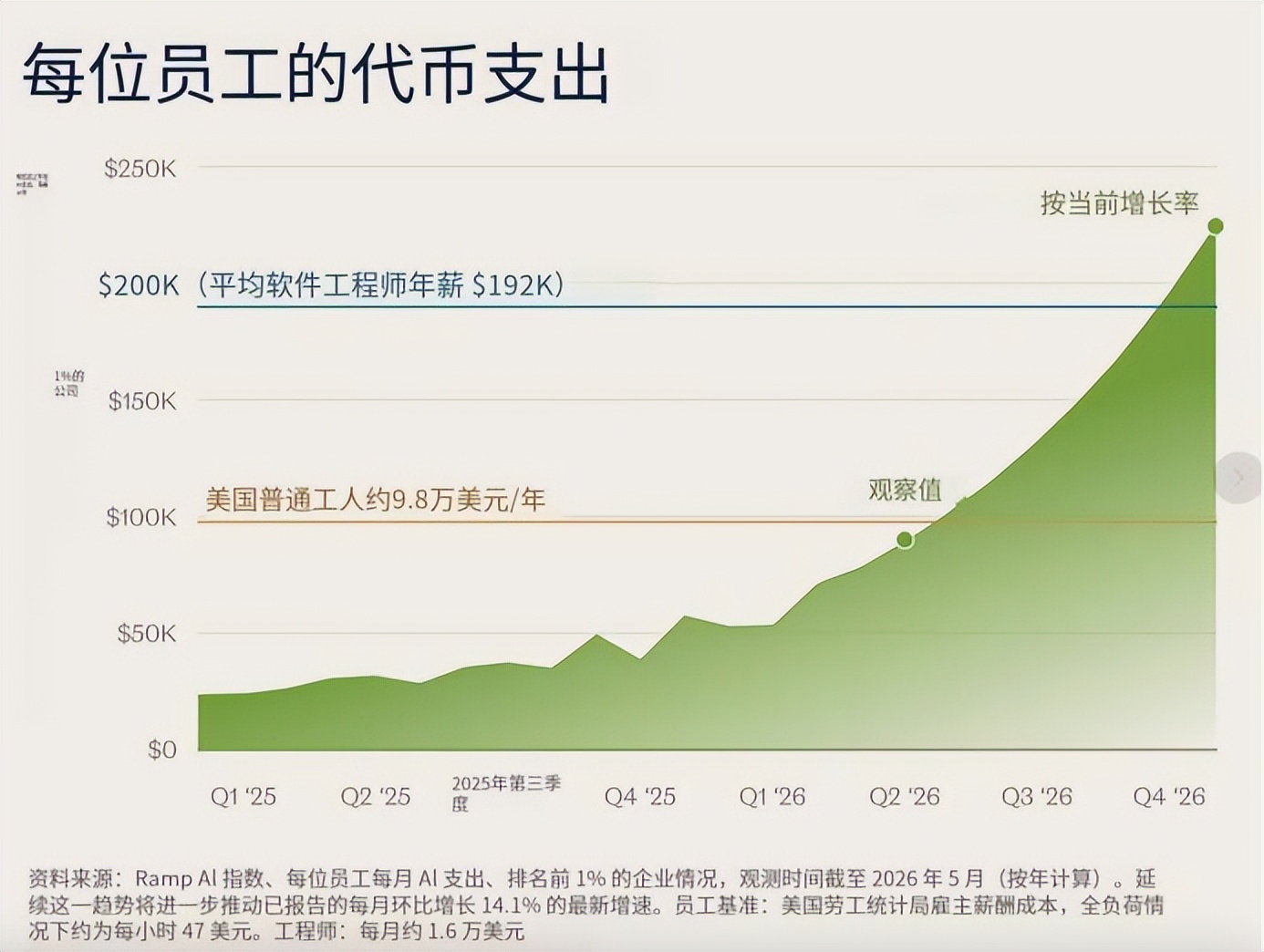
Why does this happen?
Recently, George Sivulka, CEO of a16z-backed Hebbia, wrote a dedicated article explaining this phenomenon with a surprising judgment: 80% of AI budgets are "idling."
His solution is straightforward: a 185-year-old craft—management.
This article is adapted from Hebbia CEO George Sivulka's July 15, 2026, piece, "You just hired a million bad employees." The compiled content follows:
/ 01 / Stacking Tokens Is the Digital-Era Equivalent of Stacking Bodies
When organizations face problems, their most common response isn’t to redefine the issue but to add resources.
In the past, this meant adding people; now, it means adding Tokens.
If the model’s response is inadequate or one inference isn’t enough, run it multiple times. On the surface, this increases intelligence density. Essentially, it’s no different from traditional companies’ "manpower tactics"—both use resource input to mask unclear task definitions.
Tokens themselves are never the issue. The problem is that most people don’t know which information is worth entrusting to AI.
Truly high-quality context clarifies processes and understands task objectives. This is, in fact, a management capability.
If tasks aren’t clearly defined, more Tokens won’t bring more intelligence—only more expensive chaos. As a result, many companies face an ironic phenomenon: AI budgets keep rising, but the number of problems solved doesn’t increase proportionally.
They’ve purchased more "digital employees" without adding corresponding management capabilities.
/ 02 / Agent Loops Are Like Holding AI Meetings
Many Agent systems feature a seemingly clever design: the model executes a task, checks the results, modifies them based on issues, and repeats until the goal is achieved.
When tasks are clearly defined and evaluation criteria are transparent, this mechanism works well. However, in real-world business, loops often become another form of ineffective meeting.
The model keeps trying because we never set clear objectives from the start. AI can only keep generating, reflecting, overturning, and regenerating, using more computational power to compensate for ambiguous goals.
How expensive is this? a16z provides a calculation: for the same codebase migration task, clear instructions cost $4; throwing it into a vague loop costs $310.
During Fable 5’s first-day testing in June 2026, the cost gap per unit task reached up to 17x. What does $310 mean? It’s close to the all-inclusive labor cost of an average U.S. employee for a full day.
And it delivers the same task as the $4 version.
Frankly, this is no different from a group of people holding back-to-back meetings about a vague topic. The first meeting reaches no conclusion, so a second is called; the second concludes that more people need to attend the third.
Humans consume work hours with meetings; Agents consume Tokens with loops. The underlying issue is identical: managers failed to define the problem.
/ 03 / Wasted Tokens Are the New Organizational Bloat
A common phenomenon in large companies: processes originally existed to solve problems but later become problems that need maintenance.
One approval node creates another; one department justifies needing more staff; one middle layer constantly generates complexity only it can coordinate. Eventually, the organization consumes vast resources just to sustain itself.
AI systems experience similar bloat.
One Agent breaks down tasks, another executes, another checks, and another evaluates the checks. Each additional layer makes the system seem more complete—but without strict benefit validation, they may just be generating work for each other.
Humans create more humans; Tokens create more Tokens.
This means the core metric for managing AI in the future will be how much verifiable business value each Token generates.
Future excellent AI managers will also excel at eliminating unproductive inferences, loops, and context. Token efficiency will become the new organizational efficiency.
/ 04 / Finding AI’s Efficiency Lever
AI’s truly irreplaceable advantage is scalability.
Replicating an excellent employee’s capabilities was nearly impossible in the past. You needed to hire, train, and authorize while accepting inevitable human differences. But a validated AI workflow can be copied ten thousand times instantly.
This is also where the judgment "humans are cheaper than software" is most easily misunderstood.
For a single task, an experienced human may be cheaper than an AI that keeps retrying. But at scale, once a company finds truly effective context, workflows, and evaluation systems, the marginal cost of high-quality Tokens will quickly fall below human labor.
The key lies in identifying AI scenarios with 100x leverage.
The previous generation of tech companies competed for "10x engineers"; the next generation will compete for business context and management systems that boost AI efficiency 100x.
/ 05 / No One Will Train Their Replacement for Free
Managing AI also faces an often-underestimated issue: a company’s most valuable knowledge usually resides in employees’ minds.
An experienced salesperson knows when to offer discounts; a customer service supervisor can tell from one sentence whether a client will complain; a supply chain manager knows which supplier promises fastest but delivers least reliably.
This knowledge rarely fits into standard processes yet determines a company’s true competitiveness.
AI transformation requires employees to organize these experiences into context that models can understand and use. This isn’t just a technical action—it directly impacts organizational power structures.
For centuries, possessing exclusive knowledge has been job security. Medieval guilds protected secret recipes; modern employees guard "experience." Now, companies ask employees to fully transfer their unique methods to AI while insisting AI is just an efficiency-boosting assistant.
Employees understand what this means.
No one will unconditionally train a potential replacement. Thus, corporate AI transformation inevitably enters the deep waters of organizational politics: who owns knowledge, how contributions are measured, how benefits are redistributed after efficiency gains, and why employees would cooperate.
Designing incentives for knowledge transfer will be critical to AI adoption.
/ 06 / Evaluation Is the New OKR
Why has AI advanced fastest in programming? One key reason is that code inherently carries evaluation criteria.
But much real-world work lacks such standards.
Thus, the most important task for AI adoption is building evaluation systems—Eval. AI adoption depends heavily on tracking work’s "evaluability."
Eval is AI’s OKR, but more concrete than traditional OKRs, breaking vague business judgments into machine-understandable rules. Models determine AI’s capability ceiling; Eval determines whether companies can reliably convert capabilities into results.
/ 07 / Transforming into AI Will Be the Next Trillion-Dollar Opportunity
In recent years, AI’s primary value has concentrated in foundational models, compute power, and application layers. Everyone’s selling shovels and discussing which services AI will reinvent.
But these discussions mask a bigger reality: there are already enough models and applications. What’s truly scarce is the ability to run them stably within core corporate processes.
A popular Silicon Valley view holds that traditional enterprises are too complex, political, and rigid to truly transform—future opportunities belong to new companies that rebuild businesses with AI from day one.
This is only half right.
AI-native companies are indeed lighter and more adaptable. But traditional firms still hold the most critical assets: real customers, distribution channels, industry licenses, historical data, and business experience not yet documented.
These assets won’t automatically lose value with a new model release. Instead, whoever converts them into AI-callable workflows will unlock enormous productivity.
Thus, the largest future AI companies may not be another foundational model firm or an "AI-native service provider" trying to replace all traditional businesses—but companies that help enterprises continuously transform with AI.
Essentially, they sell sustained management capabilities: streamlining processes, extracting knowledge, designing context, building Eval, controlling Token costs, defining human-AI boundaries, and continuously rewriting business as model capabilities evolve.
This is why Palantir deserves attention. On the surface, it sells software. In reality, it sells the ability to turn complex organizations into computable systems. Software is just the vehicle; transformation is the product.
The AI era will amplify such demands tenfold.
Because AI transformation isn’t a one-time project. Every time a company implements a scenario, ten new ones emerge; every model upgrade makes existing processes worth redesigning. The more AI is used, the more AI needs managing.
This is a classic Jevons paradox: as technology becomes more efficient, total demand for related resources and services may grow. In other words, managing AI will be the final act after the foundational model boom—and itself the next critical industry.
/ 08 / Conclusion
Every past technological revolution ultimately became a management problem.
In the 1830s, railroads expanded rapidly, with U.S. track mileage growing ~120x in a decade. Technology pushed transportation capacity to unprecedented heights, straining existing management approaches to the limit.
In 1841, two trains collided in Massachusetts due to scheduling errors. The accident revealed not that steam engines were inadequate but that systems had grown too complex for individual experience alone to sustain operations.
Railroad companies then began dividing regions, appointing managers, specifying roles in writing, and establishing clear reporting lines. Modern corporate management, now taken for granted, gradually took shape amid railroad expansion.
Railroads first created capacity, then created methods to manage it.
AI is repeating this process.
Foundational models have turned "intelligence supply" into a nearly instantly scalable resource. In the past, adding ten people required hiring, training, and integration. Now, adding ten thousand Agents requires adjusting a single scaling parameter.
But the easier supply becomes to expand, the costlier management failures become. In the AI era, management matters more than ever.
This is the birth of a new management science—and the next trillion-dollar opportunity.
By Aqi
-
![]()
A16Z's Latest Insight: 80% of Tokens Are Idle; Managing AI Is the Next Trillion-Dollar Opportunity
-
![]()
Average Pricing Rivals Apple and Samsung: realme’s Pause in China Fuels OPPO’s Strategic Advance
-
![]()
Casarte Holds the Fort, COLMO Catches Up, Samsung Exits: Who Will Have the Last Laugh?
-
![]()
Striving to Lead in New Energy: Anhui's Challenge to Overcome the 'Hefei vs. Wuhu' Rivalry
-
![]()
Four Anhui Pioneers: Two Decades Shaping China’s Auto Industry
-
![]()
Important to Observe: BYD Surges 20% Against Market Trend in July, Will It Reclaim the 1 Trillion Yuan Mark or Soar Even Higher?
-
![]()
Autonomous Driving Enters the Second Half: ByteDance Enters the Field, NVIDIA Restructures, and the First IPO Emerges
-
![]()
Service Takes Center Stage: A 2026 Mid-Year Analysis of BBA Reputation Index