Who Crossed the 'Kill Line' After DeepSeek's Price Adjustment?
 08/27 2026
 421
421
Not long ago, a scatter plot from Artificial Analysis spread throughout the industry. DeepSeek V4 Flash set a 'kill line' with a cost of $0.027 per task—nearly 70% of global models with inferior capabilities and higher prices fell below this line.
A month later, DeepSeek began redrawing the kill line.
Last week, prices were adjusted: the cost per task for DeepSeek V4 Flash during peak hours rose from $0.027 to $0.11, a fourfold increase with unchanged capabilities, shrinking the kill zone.
Subsequently, DeepSeek designated all-day weekends as 'off-peak.' The framework of doubling prices during peak hours and halving them during off-peak hours now includes an 'all-day weekend valley.'
One price increase, one decrease. DeepSeek is testing: How expensive of a model can developers accept?
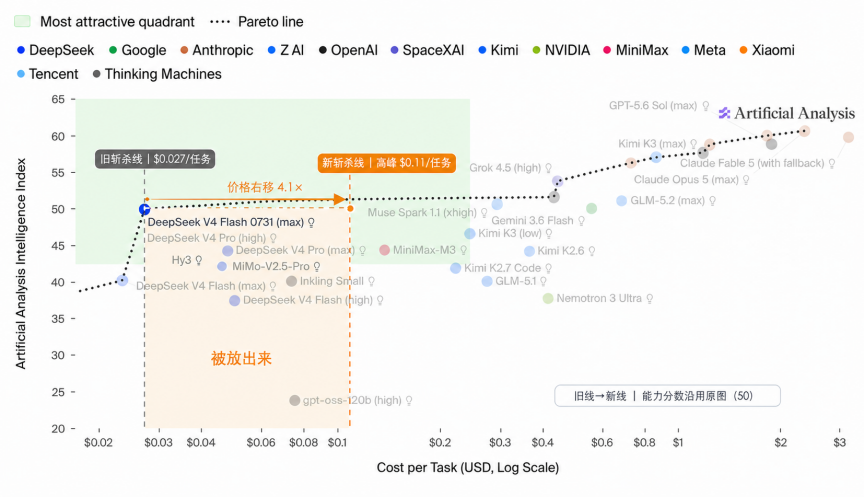
After shifting the line rightward, GPT-5.6 Luna, Tencent's Hy3, and Xiaomi's MiMo-V2.5-Pro were released.
According to Artificial Analysis's current metrics, these models didn't suddenly become stronger—they just gained breathing room.
Once released, some began to counterattack.
In the OpenRouter weekly rankings as of August 25, while DeepSeek V4 Flash still had 11.6T tokens in usage, Hy3's 7.16T, Luna's 4.16T, and others saw increases of 27%, 28%, and 29%, respectively. DeepSeek maintains a larger usage base, but faster growth occurred among competitors this week.

Low Prices Made It a Legend, Price Hikes Sustain It
When DeepSeek V4 Flash launched, it was like dropping a bomb in the AI circle.
With 284 billion total parameters and 13 billion activated, it surpassed its own flagship model in capability. Developers calculated: finding and fixing a bug in production cost 0.88 yuan total. Just for localization and repair, the cost was only 0.27 yuan. Cache hit rate reached 99.8%.
When Artificial Analysis's chart spread, the term 'kill line' exploded. Developers flocked like sharks sensing blood, with 8 trillion tokens processed in a single day, crushing the platform's daily average.
Then, the computational wall hit.
OpenCode reported that DeepSeek V4 Flash faced capacity shortages due to unprecedented traffic. The flood of cheaply attracted users crashed into DeepSeek itself.
The 'kill line' was originally a media gift. But continuing to accept it would backfire on DeepSeek. Cheap prices made DeepSeek a legend—now they're its curse.
Peak-valley pricing is the real signal: turning 'when to use' into a pricing variable. V4 Pro's cache hit input price rose from 0.025 yuan to 0.30 yuan during peak hours, a 1,100% increase. *Caijing* tests showed 100 million token costs rose from 17.5 yuan to 102.2 yuan during peak hours, a 5.8-fold increase.
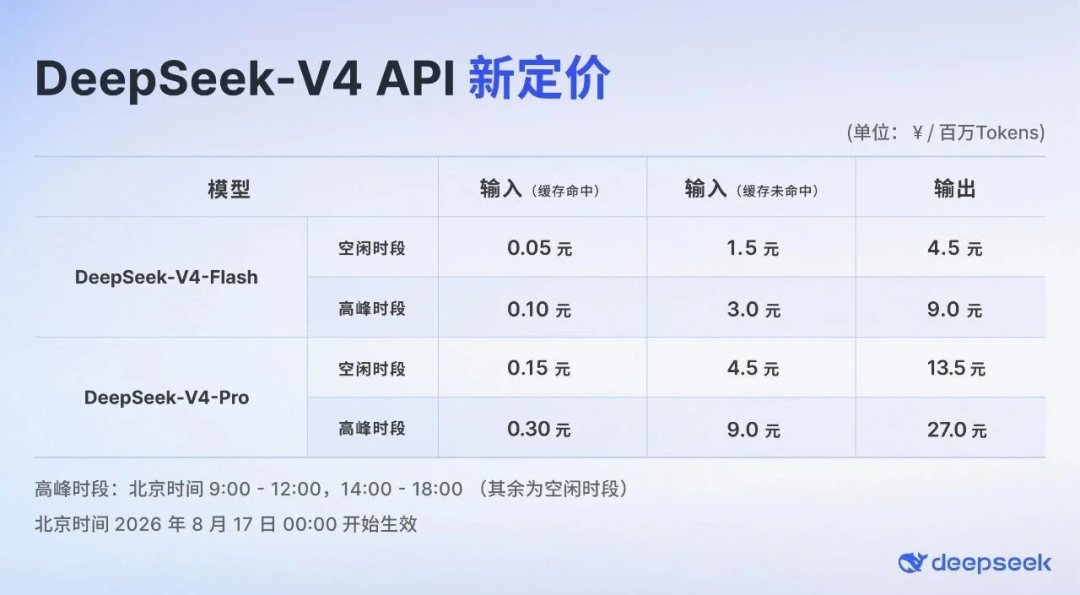
Off-peak prices are half of peak prices, leaving a backdoor for those unwilling to pay more—they can run tasks at midnight or on weekends. While cheaper than peak hours, this doesn't mean 'prices remain unchanged' compared to old rates.
DeepSeek completed 'user segmentation' through pricing, but two groups received entirely different bills.
For enterprise users, V4 Pro's cost for 100 million tokens during peak hours is 102.2 yuan—still 22% of OpenAI's and 36% of Zhipu's. 'Cost-effective' still applies.
For individual developers, the situation is more complex. Pay-as-you-go APIs and Token Plans aren't interchangeable: the former charges by actual tokens used, while the latter is affected by quotas, concurrency, and fair use policies. They help users budget but can't be simply converted into cost-per-billion-token comparisons.
The same API serves different needs: some buy 'time,' others buy 'cheapness.' This is both a choice for users and DeepSeek's answer to capital markets: it must prove it can convert traffic into higher-quality, sustainable revenue, not just rely on low prices.
This raises a question: Why does DeepSeek dare to raise prices? One underestimated variable is Kimi K3.
With 2.8 trillion parameters, it ranks first globally in coding and third in general AI agents, closely trailing Claude Fable 5 and GPT-5.6 Sol. Its API pricing is $3 per million input tokens and $15 per million output tokens—about 40-50% of GPT-5.6 Sol's but significantly higher than DeepSeek's.
According to Goldman Sachs, Kimi K3 marks China's AI transition from 'cost-efficiency competition' to 'pricing power competition.' In simpler terms: people used to think Chinese models could only compete on cheapness—now they realize they can sell at premium prices based on capability.
More interesting is the market reaction. Within 48 hours of Kimi K3's release, Moonshot AI suspended new consumer subscriptions due to surging requests and GPU strain. 'Wanting to charge' was hindered by 'insufficient capacity.' This proves demand for high-end models and computational pressure but doesn't directly show user acceptance of $0.84 per task API pricing.
Based on Artificial Analysis v4.1.1 (viewed August 26), Kimi K3 (max) scores ~60 with $0.84 per task; DeepSeek V4 Flash during peak hours scores ~52 with $0.11 per task. An 8-point capability gap comes with a ~7.6x cost difference per task.
Kimi only shows China's models can command higher price tiers—it doesn't complete DeepSeek's price elasticity test. DeepSeek must measure how many requests stay and how much traffic migrates after raising prices to $0.11.
Meanwhile, across the ocean, OpenAI slashed lightweight Luna's price by 80%, from $1 to $0.20; Google's Gemini 3.7 Flash cut prices by 50%.
For the first time, the kill relationship reversed: at 52 points, Luna costs ~$0.05 per task—less than half of DeepSeek's peak price. DeepSeek released others from its kill zone but entered Luna's firing range.

A Narrow Path
According to media reports citing insiders, DeepSeek launched a new funding round after its initial external financing, with a target valuation of ~$74 billion and annualized revenue of ~$400-500 million. These figures aren't officially disclosed by DeepSeek.
For comparison: Snowflake had a price-to-sales (P/S) ratio of ~57x at its 2020 IPO, surging to ~80x on debut. Top SaaS companies typically debut at 10-30x. However, Snowflake is a high-margin SaaS company, while DeepSeek is an API and R&D-intensive firm—they're not directly comparable. Even as a stress benchmark, 148x means DeepSeek must grow fast enough.
Whether this P/S holds depends on DeepSeek proving three things: sustained revenue growth, strong gross margins, and a paywall structure not propped up by subsidies. Traffic alone can't solve these—API billing can.
Thus, DeepSeek's pricing moves can be seen as aiming for one goal: converting traffic into predictable revenue and revenue into verifiable valuation metrics.
Previously, its 'low-cost narrative' of training V3 for $5.576 million shocked the industry. Now, it needs API revenue, enterprise contracts, and cash flow to tell a 'high-value narrative.' Pivoting from 'scary cheap' to 'justifiably expensive' is harder than training a model.
According to *The Information*, DeepSeek's inference API gross margins reportedly exceed 50%. Even if true, this is just API gross margin—not overall company profitability; training, R&D, depreciation, and bandwidth costs remain off the income statement.
But DeepSeek can't raise prices arbitrarily. Too little, and the 148x valuation story falls apart; too much, and developers silently redirect traffic—worse than a breakup is one without notice.
Peak-valley and weekend pricing can be seen as DeepSeek running two stress tests simultaneously: testing demand elasticity among developers after price hikes and testing whether usage retention, request migration, and revenue quality can support higher valuations for capital markets. Every price adjustment is an experiment—answers come from API logs, not surveys.
Boundaries are emerging. Among top public applications disclosed by OpenRouter this month, just five visible apps show Hy3 generating ~92.2 million requests, Luna ~52.8 million, DeepSeek V4 Pro ~36.1 million, and MiMo-V2.5-Pro ~9.88 million. They've integrated into workflows like Hermes Agent, Kilo Code, Claude Code, Codex, and Cline. But public data only proves 'someone is using'—not necessarily that requests migrated from DeepSeek.
DeepSeek has room to raise prices—but not infinitely.
China's large model market has split into two factions: one pursuing 'value-based pricing' for premium margins, the other relying on 'cost-based pricing' for scale. DeepSeek aims to straddle both—using Pro for value and Flash for scale. Whether this dual strategy works remains unknown.
More critically, the industry lacks standardized metrics. Cache hit rates are unclear, token units vary, and model adjustments lack transparency—'price comparison' requires extensive real-world testing.
The pricing power struggle is essentially a battle to define 'what's expensive' and 'what's cheap.'
DeepSeek walks a narrow path: to its left, developers vote with their feet; to its right, capital markets demand proof of revenue quality. Too little a hike, and the valuation story crumbles; too much, and released models capture the traffic.
From 'extreme low prices' to 'time-based pricing,' from rejecting funding to a rumored $74 billion valuation—every move DeepSeek made in the past year redefines its position in the market.
-
![]()
Too Pessimistic! MiniMax Isn't Doing That Badly
-
![]()
The 150,000-Yuan SUV Market: A Tempting yet Elusive Prize
-
![]()
The Endgame for New Car-Making Forces Is Set: Only a Three-Year Window Remains, Who Will Be Completely Eliminated?
-
![]()
Who Crossed the 'Kill Line' After DeepSeek's Price Adjustment?
-
![]()
Profits Plunge by 61% in the First Half of the Year! The Rise and Challenges of Great Wall Motors
-
![]()
BYD Han Unveiled for Pre-sale with Striking Design, Sparking Netizen Debate: Is It Merely an Enhanced Version of a Ride-Hailing Vehicle?
-
![]()
BAIC Taitan 700 vs. Xiangjie G9: A Clash of Kin, How Will Yu Chengdong Navigate This Challenge?", "Taitan 700, Xiangjie G9, BAIC, Huawei Intelligent Driving, Pricing Showdown", "BAIC has unveiled its
-
![]()
Volkswagen's Layoffs and Factory Closures: What Should Car Owners Make of It?